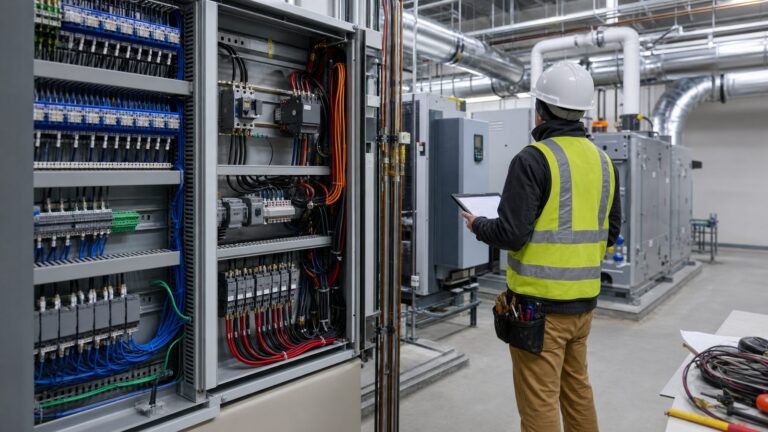
Data center construction is a specialized form of commercial construction, not a wholly separate building discipline. It uses familiar trades and building components, but its design and delivery are driven by the need to power IT equipment reliably, remove its heat, coordinate critical systems, and secure long-lead equipment. Those demands can reshape site selection, layout, procurement, commissioning, and cost. They do not mean every data center is more expensive or takes longer to build than every office, warehouse, retail, or institutional project.
What makes data center construction different?
Most commercial buildings are planned around the people, goods, services, or processes they are meant to accommodate. A data center is planned around IT equipment and the supporting infrastructure that keeps it powered and within an acceptable operating temperature range. The shell still matters, and construction still involves structural, civil, architectural, mechanical, electrical, and plumbing work. The difference is how closely the building, its utility connections, and its critical systems must work together.
As an Amazon Associate I earn from qualifying purchases.
In practice, the project team must coordinate expected IT loads with electrical distribution, backup arrangements, cooling capacity, physical layout, and the sequence in which equipment can be installed and tested. A decision about one system can affect other systems and the building plan. For example, cooling technology affects equipment arrangement and building layout as well as construction and operating costs. Redundant electrical or mechanical paths may improve resilience, but adding layers of redundancy without a clear reliability goal can increase complexity, construction effort, commissioning work, and operating burden.
The Tool Desk
Outbyte Driver Updater FREEScan for outdated or missing drivers - takes under a minuteDriver Scan →Outbyte PC Repair FREEClear out junk files and repair common Windows errorsFree Scan →The comparison is therefore best made by asking what the project must deliver—not by treating “commercial construction” as one uniform category. An office, distribution warehouse, hospital, retail building, and data center have different functions and owner requirements. The available industry figures do not provide a like-for-like benchmark proving that data centers are universally slower, costlier, or more power-intensive by a fixed multiple than all those other building types.
#1 Best Overall

- Valued Carpenter Pencil Set: You will get 2 pcs solid carpenter pencils with 26 piece 2.8 mm refills, 1 replaceable sharpener, 1 plastic storage box.The complete carpenter pencils combination allows you to finish your work faster and more easily
- Deep Hole Marker Pencil: The deep-hole construction pencils adopts 45mm elongated tip design, which is more convenient to mark in the small hole or in other tight areas that other carpenter markers cannot reach
- Carpenter Pencils with Sharpener: The sharpener is screwed into the top of the work pencil, which won't get lost either. Built-in pencil sharpener that keep the lead with pointed and smooth to Improves line of sight in fine work
- Stronger Solid Lead: This work pencil is matched with a 2.8 mm thick lead , which is much thicker and stronger during the drawing process of construction work, it will not break or damage easily
- Marks on Various Surfaces: 3 colors solid construction pencil can marks on various surfaces,such as metal, plastic, wood, paper etc. Ideals for woodworkers, contractors, craftsmen, builders, merchants and masons
How the project priorities compare
| Project dimension | Data center | Other commercial buildings |
|---|---|---|
| Primary purpose | House IT equipment and the systems that maintain power and operating temperature. | Varies by use, such as offices, retail, warehouses, or institutional facilities; each has different space, occupant, and process needs. |
| Site and power | Power availability and the time required to secure power are central development considerations. JLL ranks speed to power first in its data center site-selection criteria, followed by community support, latency, and proximity to customers. | Power is relevant to many projects, but the cited sources do not establish a universal ranking of site-selection factors across commercial building types. |
| Mechanical design | Cooling must match anticipated IT heat loads and the selected equipment strategy; those choices influence layout, cost, and operating assumptions. | Heating, ventilation, and air-conditioning design depends on each building’s use and occupancy. No quantified cross-sector comparison is established in the cited sources. |
| Reliability | Owners may require redundant paths and coordinated planning across systems to limit downtime. The appropriate approach depends on the project rather than a universal formula. | Reliability requirements vary by use and owner; the cited sources provide no matched benchmark against data centers. |
| Schedule and procurement | Utility access, specialized equipment, and long lead times can influence the sequence of work and completion date. | Procurement and schedule constraints also vary by project, but the cited sources do not give comparable averages for offices, warehouses, retail, or institutional projects. |
| Cost comparison | Per-megawatt estimates can be informative only when scope, geography, and exclusions are clear. | “Commercial construction” covers unlike buildings and cost bases. A data center per-MW figure cannot be directly compared with a commercial square-foot figure without explaining the different units and scope. |
| Construction methods | Repeatable designs, modular components, and off-site fabrication can support delivery at scale. | These methods are also used in other construction sectors; they are useful approaches, not unique features of data center projects. |
JLL’s ranking is specifically about data center site selection, not a claim about the priorities of every commercial developer. It points to a practical implication: a parcel that is available and otherwise attractive may still be unsuitable if power cannot be delivered on the project’s required schedule. JLL’s 2026 outlook describes speed to power as the top criterion, ahead of community support, latency, and proximity to customers (JLL Research, 2026 Global Data Center Outlook).
Why power, cooling, and redundancy shape the design
Power is a site issue as well as an electrical-design issue
A data center’s power strategy starts before the building is complete: the development team needs to understand the utility connection, expected availability, and timing of delivery. Inside the facility, electrical distribution and backup arrangements must align with the IT load and the owner’s reliability objectives. This coordination has consequences for building space, equipment placement, installation sequencing, and how systems are tested before operation.
That does not make a single redundancy arrangement appropriate for every facility. The design team needs a defined performance objective and a coordinated approach across critical systems. Redundancy added in one place can be undermined by a weak link elsewhere; piling on redundant components without considering how the whole system will be commissioned and operated can add cost and complexity without a commensurate practical benefit. McKinsey discusses this need to coordinate design and avoid unnecessary layers of complexity in its analysis of data center delivery (McKinsey & Company, “Scaling bigger, faster, cheaper data centers with smarter designs,” 2025).
Do these 3 things before closing this tab:
1Scan for outdated or missing drivers - takes under a minute2Repair Windows errors before they cause bigger problems3Fix the driver behind crashes, sound loss and screen glitchesCooling is selected to suit the load and layout
Cooling is not an interchangeable add-on: it must suit the expected equipment heat load, rack density, and workloads. McKinsey describes options including rear-door heat exchangers, direct-to-chip cooling, and liquid immersion. In its analysis, direct-to-chip cooling was the most popular of those approaches, while immersion was less ubiquitous. Those observations are not a specification for every project. The appropriate choice depends on the facility’s requirements and the design assumptions established by its owner and engineers.
Rank #2

- Ergonomically Designed: Work in tight areas with a compact design that gets into tough spots
- Compact and Lightweight: Both tools are designed to fit into difficult to reach spaces. The 1/4" impact driver has a length of 5.55 in. and weighs just 2.8 lbs, while the 1/2" drill/driver measures only 7.5 in. and weighs 3.6 lbs
- Both the DEWALT impact driver and electric drill driver feature integrated LED work lights with a convenient 20-second delay, ensuring enhanced visibility in dimly lit or challenging work areas
- One-Handed Loading - Keep one hand free with a 1/4 in. hex chuck that accepts 1 in. bit tips
- Power drill cordless with 1/2" single sleeve ratcheting chuck provides tight bit gripping strength, making bit changes faster and more secure
Cooling decisions affect the facility plan as well as the mechanical system. They can influence equipment arrangement, how systems connect, the space allocated to infrastructure, construction cost, and assumptions about operating cost. That is why a late change in cooling approach can have broader implications than swapping one piece of mechanical equipment for another. The project team should settle the design basis early enough to coordinate it with the building layout and procurement plan.
Commissioning is part of the delivery problem
Critical systems must be coordinated and verified as an operating whole, not merely installed as separate trade packages. Electrical, mechanical, controls, and backup arrangements need to work together under the conditions the project is intended to support. The design’s redundancy choices therefore affect not just construction quantities but also commissioning scope and the complexity of handover. An owner’s reliability objectives should inform these decisions from the outset, rather than being translated into a collection of isolated equipment choices late in design.
What data center construction costs mean—and what they do not
Cost figures for data centers are easy to misread because estimates can cover very different packages of work. Shell and core, all-in greenfield development, tenant technology fit-out, land, and active IT equipment are not interchangeable scopes. Geography and project assumptions matter as well. A per-megawatt figure is not directly comparable to a general commercial-building cost per square foot, and the numbers below do not establish a cost premium over every other kind of commercial building.
Free tools Windows power users keep installed
One-click scans. No signup required.
| Estimate | What it covers and how to read it | Source |
|---|---|---|
| $7.7 million per MW (2020); $10.7 million per MW (2025); 7% compound annual growth rate | JLL’s global average shell-and-core construction figures and reported growth rate. JLL forecasts an average of $11.3 million per MW in 2026. These are not all-in project prices. | JLL Research, 2026 outlook |
| 10% premium for liquid-cooled facilities | JLL’s comparison is for shell and core of a single-tenant, 50 MW air-cooled data center. Land and active IT equipment are excluded; do not treat the figure as a universal liquid-cooling premium. | JLL Research, 2026 outlook |
| Up to $25 million per MW | JLL says tenant technology fit-out for AI infrastructure can cost as much as this. It is separate from, and not included in, JLL’s shell-and-core figure above. | JLL Research, 2026 outlook |
| 21% average increase in construction cost per MW | Cushman & Wakefield reports this average increase since its prior edition in Q4 2024, covering U.S. and Canadian markets in its 2026 cost guide release. | Cushman & Wakefield, September 3, 2026 |
| $17.6 million per MW | Cushman & Wakefield’s average all-in greenfield development cost for modern U.S. and Canadian facilities, excluding chips and GPUs. This broader scope is not comparable as-is with JLL’s global shell-and-core benchmark. | Cushman & Wakefield, 2026 Data Center Development Cost Guide release |
| 5% average annual wage increase, 2021–2024 | Cushman & Wakefield attributes continuing cost pressure in part to shortages of skilled labor in mechanical, electrical, and plumbing trades. This is a wage trend, not a total project-cost increase. | Cushman & Wakefield, 2026 release |
The two headline estimates illustrate why scope must sit beside every number. JLL’s $10.7 million per MW figure is a global shell-and-core average for 2025; Cushman & Wakefield’s $17.6 million per MW figure is an all-in greenfield average for modern facilities in the United States and Canada. Their scopes and geographies differ, so subtracting one from the other or presenting them as competing bids would be misleading. Neither number is a project-specific estimate.
Rank #3

- 【Great Compatibility】This Katerk 1/4 inch hex shank bit holder is specifically designed for 1/4 inch hex shank drill bits. It's compatible with most 1/4 fast hex handles, hex sockets, various electric screwdrivers, and handheld screwdrivers. The bit holder makes it a valuable addition for any handyman.
- 【Secure and Safe】Built with a secure backup nut design, each drill bit holder securely locks onto your bits, ensuring they stay firmly in place. Additionally, our bit holder incorporates a high-quality steel ball rolling design that holds up to several kilograms of weight, ensuring your various drill bits don't fall off.
- 【Easy One-Handed Operation】The bit holder for impact driver allows you to change bits single-handedly, simplifying your workflow. Its multi-color design further allows for quick identification of the drill bit you need.
- 【Compact and Convenient】Thanks to its compact size, this 1/4 inch bit holder is easy to carry around. The bit holder allows for easy attachment to various tools, making this a convenient addition to your construction accessories. The Katerk bit holder is cast from high-quality alloy material, promising a long product lifespan. Despite its rugged strength, the bit holder remains lightweight, making it portable.
- 【Cool Christmas Gift For Men Stocking Stuffers】 This screwdriver bit holder, driver bit holder, impact bit holder, can be given as a gift to your loved one, especially for anyone involved in construction or electrical work. It's a must-have for stocking stuffers for men and women, tools gifts for dad, tech gadgets for men, gifts for dad, gifts for him, gifts for husband, gifts for boyfriend, cool gadgets for men, and cool gifts for dad.
For an owner or builder preparing a budget, the useful question is not simply “What does a megawatt cost?” It is “Which package, location, design, and exclusions does this estimate represent?” Before comparing proposals or benchmarks, identify whether the quoted scope includes land, shell and core, tenant fit-out, active IT equipment, and specialized cooling. Keep the basis consistent across options, and separately identify assumptions that can change with utility delivery, equipment selection, and project design.
How schedule and procurement influence delivery
Data center schedules are exposed to more than the sequence of on-site construction activities. Power availability and procurement of electrical and mechanical equipment can constrain when work starts, how trades are sequenced, and when commissioning can be completed. JLL’s 2026 outlook reports an average global build time of 18 months for a 50 MW data center, an average equipment lead time of 33 weeks, and that 57% of data center projects experienced a construction delay of at least three months in 2025. It also reports that developers preorder selected materials as much as 24 months ahead (JLL Research, 2026 Global Data Center Outlook).
Those figures describe data center projects in JLL’s reporting; they are not a matched comparison against other commercial construction. They do, however, show why delivery planning must account for procurement and utility coordination instead of assuming that construction can simply be compressed by adding more crews. A long-lead component can become a critical-path item if the design decision or purchase is deferred.
Recommended Free Tools
Practical planning steps for owners and construction teams
- Confirm the site’s power path early. Establish what power is available, what utility work or approvals are needed, and when service can be delivered. Site suitability depends on timing as well as land availability.
- Set the design basis before major procurement. Align anticipated IT load, cooling approach, redundancy goals, and facility layout so that equipment packages and infrastructure design are coordinated.
- Identify long-lead packages and decision dates. Build procurement milestones into the schedule, with clear owners for design approvals and purchasing decisions. JLL’s reported preordering horizon for selected materials underscores how far ahead some commitments may need to be considered.
- Plan installation and commissioning together. Sequence the work so that system integration and testing are accounted for—not left as an undefined final phase after individual trades finish.
- Use repeatable and off-site work where it fits. Modular components and prefabrication can shift some labor away from the site, support consistent quality, and improve installation efficiency, but they must fit the project’s design and logistics.
Scheduling tools can help teams coordinate a complex path, but software or a planning method is not a guaranteed schedule reduction. McKinsey says its cross-industry analysis found generative scheduling could improve delivery schedules by as much as 20% compared with a project team independently defining the construction path. That is an attributed analytical finding, not a promised result for an individual data center project (McKinsey & Company, 2025).
Rank #4

- Long Nib and Deep Hole Marker: Our mechanical carpenter pencil with 45mm nib is designed for easy marking of deep holes or narrow areas. These construction pencils are the great choice for woodworking tools, construction tools, carpenter tools, contractor tools, wood carpentry tools and architect tools
- Extra Refills in 2 Colors for Versatile Marking: The construction mechanical pencil comes with 12 extra 2.8mm refills, including 6 red and 6 black refills. The black refill is suitable for light surfaces, while the red wax is perfect for dark surfaces. Our carpenter mechanical pencil makes sure that you'll have an ample supply for extended use
- Built-in Sharpener: Our construction pencil comes with a built-in sharpener to ensure the mechanical pencil tip is always sharp and ready for use. Never buy an extra pencil sharpener again. A great tool for any woodworker pencil, contractor pencils. The refill can easily be extended or retracted with a simple click of the pencils mechanical, allowing you to work more efficiently and accurately
- Portable Clip Design: Our deep hole construction pencil features a portable clip design, easy to carry and attach to your pocket or tool box, so that you can keep the carpenter pencils mechanical close at hand, making it a convenient tool to have on the go. Great gifts choice for carpenters
- Stronger Pencil Lead: The black refills are made of lead, sturdy and smooth. The red refills are made of wax, clear and light. These marking pencils are much thicker and stronger than normal pencils during the marking process of construction work, suitable for various surfaces, such as glasses, metal, boards, floors, walls, furniture, etc. The written marks can be easily wiped with a wet paper towel when needed
Where modular construction and early coordination help
Prefabrication and modular construction can move selected work into controlled off-site settings, reduce the amount of skilled labor required on site, and make repeated installations more consistent. JLL identifies prefabricated modules as a way to accelerate installation and reduce costs through construction efficiencies. McKinsey likewise discusses modular components and shifting more work off site to ease skilled-labor pressure and improve quality. Neither source presents these methods as exclusive to data centers or as automatic savings on every project.
These methods are most useful when the project can standardize components, coordinate interfaces, and resolve design decisions early enough for off-site production to fit the schedule. They are less helpful if the design is still changing, transport and site logistics are unresolved, or modules arrive before the work needed to receive and connect them is ready. As with other delivery choices, the gains depend on fitting the method to the project rather than treating modularity as a universal shortcut.
What market context says—and what it does not
Data centers are included within the broader office sector in the market classification discussed by the American Institute of Architects. In its July 15, 2024 consensus construction forecast, AIA reported Commerce Department figures showing data centers above 3% of the overall nonresidential building market, with the share doubled since 2019. AIA also noted that data centers, manufacturing, and warehouses differ in design focus, materials composition, and contractor specialization. The forecast’s projections for commercial activity concerned 2024 and 2025, so they should be read as a 2024 forecast rather than as a current market outlook (American Institute of Architects, July 2024 Consensus Construction Forecast).
Crashes, No Sound, or Screen Glitches?
Random freezes, missing sound and display glitches usually trace back to one bad driver. Find and replace yours safely.Free scan · under a minutePC Slower Than It Used to Be?
A free scan shows the junk files, broken settings and background clutter dragging Windows down - then fixes them in one click.Free scan · Windows 10 & 11A separate Federal Reserve Board staff paper uses project-level data to estimate aggregate U.S. data center investment. Its mean forecast reaches $370 billion annualized in 2026 Q2. That is a model forecast, not realized spending; the paper says longer-horizon estimates depend on assumptions about the pace of future project plans and carry substantial upside and downside risks. The page was last updated July 16, 2026 (Federal Reserve Board, “Estimating Aggregate Data Center Investment with Project-level Data”).
Best Value

- Milwaukee Ink all Fine Point Marker, Black, 4 Per Pack
- 4 per pack Features Clog Resistant Marker Tip Writes through Dusty, Wet and Oily Surfaces Durable Marker Tip for Writing on Concrete, OSB and Rough Surfaces
- Clog resistant tip writes on dusty, wet and oily surfaces and is optimized for rough surfaces such as OSB, cinderblock and concrete
- Hard hat clip- attaches for easy access
- Quick dry time with reduced smearing and marking
The broader takeaway is that data centers have become a meaningful and specialized part of commercial construction, but market growth does not erase the need to evaluate each site and project on its own merits. A forecast of investment, a per-megawatt cost average, and an individual project budget answer different questions.
A decision framework for comparing a data center with another project
For an owner, developer, or contractor assessing whether the data center delivery model differs materially from another commercial job, compare the projects on a common basis:
- Function: Define the building’s purpose and the equipment, occupants, and processes it must support.
- Utility and site readiness: Identify required capacity, connection work, approvals, and the schedule for service—not just the site boundary and land cost.
- Mechanical and electrical design basis: Record the expected loads, cooling strategy, backup provisions, and system interfaces.
- Reliability objective: State the outcome the owner requires, then design redundancy and commissioning scope to support it without adding uncoordinated complexity.
- Procurement and schedule: Identify long-lead equipment, decision deadlines, procurement responsibilities, and critical-path dependencies.
- Cost scope: Use the same geography, date, units, and scope when comparing benchmarks or proposals. Separate shell and core from development, tenant fit-out, land, and IT equipment.
- Delivery method: Evaluate whether repeatable design, modular components, or off-site fabrication fit the project’s maturity, site constraints, and installation plan.
John McWilliams, Head of Data Center Insights at Cushman & Wakefield, said in the firm’s September 3, 2026 release: “The data center industry is entering a new phase where access to power, land, and skilled labor are increasingly determining where growth can occur” (Cushman & Wakefield). For project planning, that observation highlights why land, power, workforce, design, and procurement need to be considered together rather than as isolated line items.
Quick Recap
Product prices and availability are accurate as of the date/time indicated and are subject to change. Any price and availability information displayed on Amazon at the time of purchase will apply.