Recommended Free Tools
A deck railing update can change the whole feel of an outdoor space, but railing is not just trim. It is a guard system. On elevated decks, it has to resist load, control openings, hold up to weather, and still fit the architecture of the house.
For most residential decks in the U.S., guards are required when the walking surface is more than 30 inches above grade. The common IRC baseline is a minimum 36-inch guard height, openings small enough that a 4-inch sphere cannot pass through, and a guard system strong enough to handle a 200-pound concentrated load at the top rail. Local rules can be stricter, especially for stairs, multifamily buildings, coastal zones, wildfire areas, and historic districts.
As an Amazon Associate I earn from qualifying purchases.
Here is the practical way to use this guide: choose the look you like, then verify cost, maintenance, and code before ordering material. On our job sites, we inspect the rim joist, post connections, stair stringers, decking at post bases, and fasteners before replacing railings. A loose rail often points to a bigger problem than worn paint.
The Tool Desk
Outbyte PC Repair FREERepair Windows errors before they cause bigger problemsFix Now →Outbyte Driver Updater FREEScan for outdated or missing drivers - takes under a minuteDriver Scan →Quick Decision Guide
| Best need | Strong railing choice | Typical 2026 installed cost | Maintenance level |
|---|---|---|---|
| Preserving a view | Cable railing or glass panels | $75-$260 per linear foot for cable; $100-$600 for glass | Low to moderate |
| Best budget update | Wood rail with simple vertical balusters | $20-$50 per linear foot, more for premium species | Moderate to high |
| Lowest routine upkeep | Powder-coated aluminum or vinyl/PVC | $60-$150+ for aluminum; $20-$60 for vinyl/PVC | Low |
| Traditional homes | Painted wood, composite, Chippendale panels | $40-$120+ depending on detail | Moderate |
| Modern homes | Black aluminum, cable, glass, custom metal panels | $60-$600 depending on system | Low to moderate |
| Coastal climates | Marine-grade stainless, aluminum, PVC | $60-$260+ depending on material | Low, with rinsing |
| Privacy | Code-compliant guard plus partial screens or planters | $50-$200+ depending on screen material | Moderate |
What Deck Railing Costs in 2026
National installed deck railing prices run roughly $20 to $600 per linear foot. That wide range is real. A straight pressure-treated wood rail on a low deck is a different project than frameless glass around a second-story deck with three stair runs and structural reinforcement.
#1 Best Overall

- Material Of 4x4 Post Base: Made of Solid Steel, Black Powder Coated, Rustproof and Strong.
- Deck Post Base: Used to support porch railings, pergolas, gazebos, fences, deck brackets, post brackets and mailbox post brackets.
- Unique design: There is a partition at the bottom of the 4x4 post base, which is designed to be completely separated from the ground. Long term use will not cause the wood to rot due to rain. There is a small square box in the middle of base to make it more stable
- Screws & Anchors Supplied : A wrench. 24 x expansion anchors for concrete floors, 24 socket head wood screws for wood floors, 32 Phillips head self-tapping screws for 4x4 post fixation.All screws are inserted inside the base.
- After Sales---If you have any installation questions or other problems. Feel free to contact us.
Labor alone often lands around $10 to $50 per linear foot, with many projects averaging near $30 per linear foot. Hourly replacement labor can run about $50 to $150 per hour, depending on region and complexity. Demolition, disposal, stair sections, corner posts, fascia-mounted posts, permit fees, and guard-post blocking can all move the final number.
- Wood: about $20 to $50 per linear foot installed for common systems; cedar, redwood, mahogany, ipe, custom patterns, and staining raise the price.
- Vinyl or PVC: about $20 to $60 per linear foot, depending on profile, color, post sleeves, and stair kits.
- Composite: often starts around $15 to $30 per linear foot in basic material guides, but installed premium systems with drink rails and lighting commonly price higher.
- Aluminum: commonly $40 to $70 per linear foot for material, and about $60 to $150+ installed.
- Cable: usually $75 to $260 per linear foot installed, with many professional projects around $85 to $180.
- Glass: about $100 to $600 per linear foot installed, depending on panel type, engineering, wind exposure, and labor.
- Decorative steel or wrought iron: roughly $50 to $120 per linear foot, with custom fabrication and finishes adding cost.
18 Creative Deck Railing Ideas
1. Black Aluminum Balusters for a Clean, View-Friendly Update
Black aluminum railing works because it visually recedes. From inside the house, your eye tends to look past the dark verticals instead of stopping at them. It fits modern farmhouses, lake homes, brick colonials, and newer suburban decks without feeling trendy.
Aluminum is also one of the best low-maintenance choices. A powder-coated system will not rot, usually does not need repainting, and handles freeze-thaw cycles better than site-built painted wood. Expect many installed projects to fall around $60 to $150+ per linear foot.
Code watch-out: Keep baluster spacing under the 4-inch sphere rule, including at stair angles and rail transitions.
2. Cable Railing for Open Views
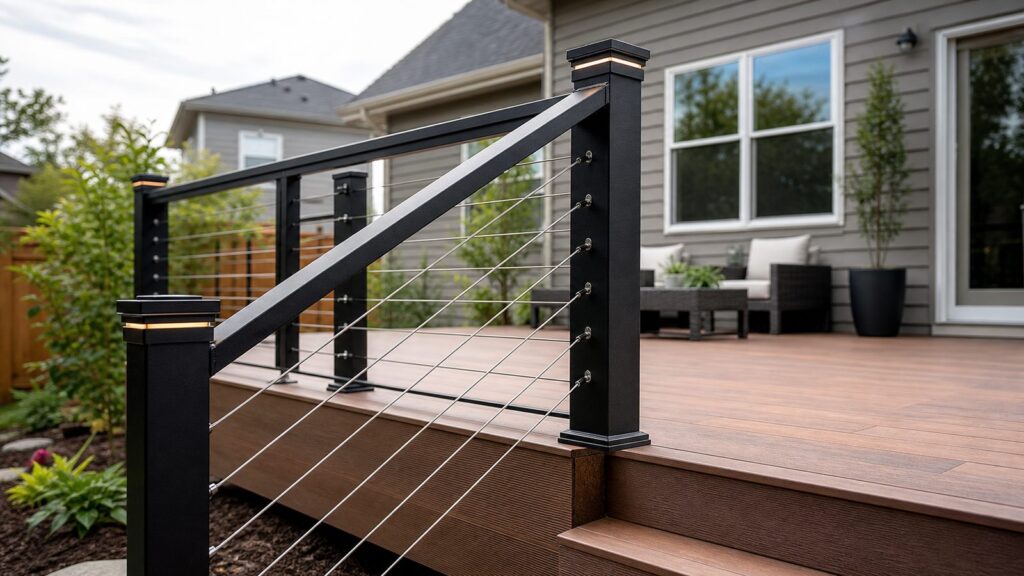
Cable railing is a strong choice for wooded lots, water views, and second-story decks where the railing should disappear as much as possible. The key is stiffness. Cable systems need rigid end posts, proper corner hardware, short enough runs, and planned re-tensioning after initial stretch.
Installed cable railing commonly runs $75 to $260 per linear foot, with many pro installs around $85 to $180. Stainless fittings, stairs, corners, and marine-grade components increase cost.
Code watch-out: Cable deflection matters. The spacing may look compliant when installed but fail if the cables spread enough for a 4-inch sphere to pass through.
Crashes, No Sound, or Screen Glitches?
Random freezes, missing sound and display glitches usually trace back to one bad driver. Find and replace yours safely.Free scan · under a minuteWindows Errors? Fix Them Before They Spread
Repair common Windows errors and clear accumulated junk for a smoother, more stable PC - no reinstall needed.Free scan · no reinstall3. Composite Rails With a Wide Drink Cap
If you entertain outside, a continuous flat cap is one of the most useful upgrades. A drink rail gives guests a place for cups and small plates without cluttering the deck with extra tables. Composite systems can match the decking or contrast with it, and many manufacturers offer compatible post sleeves, lighting, and stair components.
Composite costs vary widely. Basic pricing can look affordable on paper, but premium capped systems with matching accessories often move into midrange aluminum territory.
Code watch-out: The cap still has to meet guard height and load requirements. Use manufacturer-approved brackets and posts, not improvised trim boards.
4. Glass Panel Railing for Scenic Lots
Glass railing is the premium view-preserving option. It works especially well around pools, city rooftops, mountain homes, and waterfront decks where wind control is also valuable. Framed glass is usually more forgiving and often less expensive. Frameless glass has a cleaner look but may require heavier panels, stronger anchoring, and more engineering.
Budget carefully. Glass can run $100 to $600 per linear foot installed. Panel thickness, tempered or laminated glass requirements, top rail rules, site access, and wind exposure all affect price.
Code watch-out: Local inspectors may require a top rail or specific glass type, especially on elevated decks and wind-exposed sites.
5. Mixed Wood and Metal Railing
A wood frame with metal balusters is a reliable way to update an older deck without making it look out of place. The wood top and bottom rails tie into the deck structure, while black metal balusters sharpen the sightlines and reduce maintenance compared with all-wood pickets.
This is often a good middle-ground project when the existing deck framing is sound but the rail infill looks dated. Seal cut ends, slope or detail horizontal surfaces to shed water, and use corrosion-resistant fasteners.
Code watch-out: Do not reuse old posts unless they are structurally sound and properly connected to framing.
6. Horizontal Slat Railing
Horizontal slats create a modern, linear look that pairs well with contemporary homes and simple deck furniture. Cedar, thermally modified wood, composite boards, and powder-coated metal can all work.
The design needs careful spacing. Wood moves as it dries and swells, and long horizontal members can invite climbing by children. In some jurisdictions, that climbability concern may draw extra scrutiny even if the openings are technically sized correctly.
Code watch-out: Confirm local approval before building. Openings must remain under the 4-inch rule after movement, shrinkage, and deflection.
Free tools Windows power users keep installed
One-click scans. No signup required.
7. Chippendale or Geometric Wood Panels
Chippendale panels and geometric wood grids add character to traditional homes, porches, and garden decks. They look custom without requiring exotic materials, and they can be painted to match trim.
The labor is the cost driver. More cuts mean more time, more end grain to seal, and more places for water to sit. Use exterior-rated material, stainless or hot-dip galvanized fasteners as appropriate, and keep the pattern crisp rather than overcomplicated.
Code watch-out: Decorative openings must still reject a 4-inch sphere throughout the panel.
8. Hog-Wire or Welded Mesh Infill
Mesh railing gives a deck a relaxed, practical look that works well for cabins, modern rustic homes, and garden spaces. It preserves more view than solid wood and costs less than many cable or glass systems.
Do these 3 things before closing this tab:
1Scan for outdated or missing drivers - takes under a minute2Repair Windows errors before they cause bigger problems3Fix the driver behind crashes, sound loss and screen glitchesRank #2

- 🔧【Applications: Wood Post Cable Railing】Steel DN Mate black swage lag screw system is made from T316 marine-grade stainless steel, providing a reliable solution to create or upgrade a sleek, modern and minimalist look while preserving your view. Suitable for straight, angled and corner sections, it is ideal for wire railing kit for decks, porches, stair railings, balcony railings and fences, creating stylish indoor and outdoor wood post cable railing systems that enhance your living space.
- 🔧【Reinforced Left & Right Thread Design for Superior Stability】Built with reinforced right and left hand threads, this black cable railing hardware rotates both ends in the same direction during tension adjustment, helping reduce cable twisting and prevent damage during installation. Designed for 1/8" deck cable railing kit, it is compatible with 2"x2", 4"x4" and 6"x6" wood posts and provides Up to 590kg pull-out strength for a secure and long-lasting stability.
- 🔧【T316 Stainless Steel with Premium PVD Black Finish】This black cable railing screw is made from marine-grade T316 stainless steel with an advanced PVD black finish, providing excellent resistance against rust, corrosion,salt air, and harsh weather conditions. Unlike traditional black oxidized finishes that may chip or wear over time, the durable PVD coating forms a strong bonded surface layer with enhanced scratch resistance and color stability. This wire railing hardware is perfect for indoor, outdoor and coastal railing applications.
- 🔧【Easier Installation with Reinforced Wrenches】The included 2 upgraded reinforced wrenches make cable tension adjustment faster and easier by turning the threaded ends into wood posts. Compared with standard tools, these wrenches provide a secure grip and better control while resisting bending and deformation during installation. Works with DC03 hydraulic crimper for professional swaging steel cable into these swage terminals, creating secure connections for 1/8" deck railing systems.
- 🔧【Complete Cable Railing Solution】Package Includes: 50 x Left - lag screws+ 50 x right - lag screws, 2 x wrenches, 2 x drill bits and 1x user guide. Steel DN Mate provides a complete deck cable railing kits and hardware, including BW22 Stainless Steel Cable, DC03 Hydraulic Crimper, DB58 Level Protectors and DG12 Drill Guide etc, scroll down to find them. Enjoy one stop-shop,free design consultation, a 10-year warranty and lifetime support for a confident DIY installation experience.
Use welded panels that are stiff enough for guard use, set into a proper rail frame. Raw steel will rust. Galvanized or powder-coated mesh lasts longer and looks cleaner.
Code watch-out: Mesh opening size must comply, and the panel has to be secured so it cannot bow out under load.
9. Privacy-Screen Rail Sections
Full privacy walls can make a deck feel boxed in. A better approach is often targeted privacy: one or two screened sections near a dining table, hot tub, or neighboring window, combined with standard open railing elsewhere.
Good materials include vertical wood slats, aluminum screen panels, composite boards, or framed lattice. Keep privacy elements proportional so they do not overload the deck visually or structurally.
Code watch-out: Tall screens may trigger zoning, setback, wind-load, or fence-height rules. They also must not create unsafe climbable conditions.
10. Built-In Planter Railing
Planter railings soften a deck and help define outdoor rooms. They work best as add-ons to a code-compliant guard, not as the guard itself. Use rot-resistant liners, drainage paths, and manageable soil volumes. Wet soil is heavy.
For a small herb rail, keep boxes narrow and removable. For larger planters, treat them like dead load and check framing capacity.
Code watch-out: Do not reduce required guard height or create a climbable step near the rail.
What’s actually slowing this PC down?
Pick the symptom - the matching free tool is one click away.
11. Integrated LED Post-Cap or Under-Rail Lighting
Lighting makes stairs safer and extends deck use after sunset. Post-cap lights are simple and visible. Under-rail LED strips give a cleaner wash of light across the deck surface. Low-voltage systems are more dependable than bargain solar lights, especially in shaded yards.
Plan wiring before railing installation. Retrofitting lights after posts and sleeves are set can mean visible wires or extra labor.
Code watch-out: Electrical work must use exterior-rated components, protected wiring, and GFCI-protected circuits where required.
12. Curved or Radiused Railing
Curved railing can make a deck feel more built-in and less boxy, especially around a round dining area, pool edge, or curved stair landing. Aluminum, composite, and custom metal systems are usually better suited than standard wood for clean curves.
Quick wins for a faster PC:
Fix the driver behind crashes, sound loss and screen glitchesFind Drivers →Repair Windows errors before they cause bigger problemsFix Now →This is not a budget shortcut. Curves add layout time, special ordering, templates, and more complicated post spacing.
Code watch-out: Post spacing, top rail continuity, and infill openings must remain compliant along the curve.
13. Contrasting Top Rail
A contrasting top rail is a simple design move with a strong payoff. Try a dark top rail over white posts, a composite cap over aluminum balusters, or a stained wood cap over painted framing.
This works well when the deck boards, trim, and house siding already have multiple tones. It also helps hide hand marks on high-use rails.
Code watch-out: A decorative cap cannot be loosely fastened. It is part of the guard people lean on.
14. Stainless Steel or Powder-Coated Metal Rails
Metal railings are a good fit for homeowners who want long service life and minimal repainting. Powder-coated aluminum is lighter and corrosion-resistant. Steel can be stronger and more decorative but needs proper galvanizing or coating.
In coastal salt air, specify marine-grade stainless hardware or a coating system designed for that exposure. Even good metal needs rinsing in salt-heavy environments.
Code watch-out: Confirm the full system rating, not just the strength of individual parts.
What’s actually slowing this PC down?
Pick the symptom - the matching free tool is one click away.
15. Coastal-Ready Vinyl or PVC Railing
Vinyl and PVC railings are popular near water because they resist rot and do not need staining. They fit beach houses, simple porches, and rental properties where low maintenance matters.
Expect about $20 to $60 per linear foot in many pricing guides, with color, profile, stair sections, and post sleeves affecting the total. White is common, but darker colors may have heat and expansion considerations.
Code watch-out: Use structural posts or approved post supports inside sleeves. A sleeve alone is not a guard post.
Rank #3

- Left and Right Feature: Package comes with 10 left and 10 right cable railing lag screws for 10 cable runs, 1 drill bit, and 1 reinforced bent wrench. This cable railing hardware is designed to rotate wire rope in the same direction to avoid twisting or damaging the wire rope. Professional hydraulic crimper Muzata CR09 is recommended
- Clean Look and Durability: Muzata cable railing system with 1/8" swage lag screw has a cleaner look and better view. This cable railing kit is made of T316 stainless steel with excellent resistance to rust, ideal for indoor, outdoor, even coastal applications. For angled stairs, drill guide MUZATA CT24 is recommended to drill holes
- Easy Installation: Simply use the included reinforced wrench to simultaneously screw the left and right threaded ends into the wooden post to adjust the cable tension. Installation video & guide is provided. Note: Post spacing should not exceed 4 ft and cable spacing should not exceed 4 inch. To ensure safety and structural integrity, splitting the cable runs is recommended when the distance between end posts is over 15 ft or there are corners or angle transitions
- Advice for constructing a system: To help you build a cost-effective cable railing system more efficiently, we recommend the following product combinations from Muzata, including 1/8" swage lag screw CK17, hydraulic crimper and cable cutter CK12, drill guide CT24, level protector sleeve CR13, angled protector sleeve CR70,1/8" wire rope WR02
- Why Muzata: We make home renovation simple, seamless, and budget-friendly with premium products and expert installation guidance. Planning a custom project or need layout advice? Our team is always here to help you complete your project with confidence
16. Low-Profile Bench-Edge Concepts
Built-in benches can make a deck more usable, but they are not a universal railing substitute. On low decks where guards are not required, a bench edge can define the perimeter nicely. On higher decks, the bench usually needs to sit inside a compliant guard rather than replace it.
Keep seat heights, backs, and circulation clear. A bench too close to a guard can create a climbing hazard.
Code watch-out: If the deck is more than 30 inches above grade, do not assume a bench satisfies guard requirements.
17. Stair Rail Upgrades
Stairs deserve their own design attention. Many deck injuries happen on stairs, and stair rails often age faster because they get pulled, twisted, and hit from different angles. Upgrading stair rails can include graspable handrails, stronger newel posts, lighting, and matching balusters.
Stair sections cost more than straight rail because of angles, cuts, transitions, and handrail requirements. Budget extra labor here.
Free tools Windows power users keep installed
One-click scans. No signup required.
Code watch-out: Guards and handrails are not always the same thing. Stairs may need a continuous graspable handrail in addition to guard infill.
18. Custom Laser-Cut Metal Panels
Laser-cut panels can give a deck a distinctive architectural identity. Patterns can be botanical, geometric, regional, or privacy-oriented. They work especially well as accent sections rather than around the entire deck.
Use exterior-grade metal, proper coating, and panel frames that allow drainage. Custom steel, aluminum, powder coating, and engineering can push costs well beyond standard railing.
Code watch-out: Decorative cutouts must meet opening limits, and dense panels may increase wind load on posts and framing.
The Tool Desk
Outbyte PC Repair FREERepair Windows errors before they cause bigger problemsFix Now →Outbyte Driver Updater FREEFix the driver behind crashes, sound loss and screen glitchesFind Drivers →Code, Safety, and Permit Notes Before You Order Railing
Most railing mistakes happen before installation starts. A homeowner finds a photo, orders parts, and only later discovers the system does not fit the deck framing, stair geometry, or local code.
Use these baseline checks before committing:
- Height: Many residential deck guards need to be at least 36 inches high. Commercial and multifamily settings commonly require 42 inches.
- Openings: Most guard openings must be small enough that a 4-inch sphere cannot pass through.
- Load: Guardrails are commonly designed around a 200-pound concentrated load at the top rail.
- Posts: The 2021 IRC added clearer expectations for transferring guard loads into wood deck framing through a continuous load path. Blocking, connectors, and proper fasteners matter.
- Permits: Many local building departments require permits for new decks, major repairs, structural changes, and sometimes guard replacement. Rules vary by city and county.
If the existing rail is loose, do not just replace the visible railing. Check for rot at post bases, failed rim joists, corroded bolts, undersized fasteners, water trapped behind fascia, and weak stair connections. A new railing attached to bad framing is still a bad railing.
When to DIY and When to Hire a Pro
A handy homeowner can sometimes replace simple railing sections on a low, structurally sound deck using a manufacturer’s complete kit. Good DIY candidates are straight runs, no stairs, no rot, clear instructions, and railing that matches the existing post layout.
Hire a deck contractor or structural pro when the deck is high, aging, attached to a second story, has stairs, uses cable or glass, needs post reinforcement, has visible rot, or requires permit drawings. Also hire out if you are changing from surface-mounted posts to fascia-mounted posts, adding privacy screens in a windy area, or installing custom metal panels.
Outdated Drivers Are Slowing You Down
One free scan finds every outdated or missing driver and matches the right update for your exact hardware.Free scan · exact hardware matchWindows Errors? Fix Them Before They Spread
Repair common Windows errors and clear accumulated junk for a smoother, more stable PC - no reinstall needed.Free scan · no reinstallFor most professional railing replacements, plan on one to three working days after materials are on site. Complex glass, cable, custom metal, or structural repair work can take longer, especially if inspections are required.
How to Choose the Right Railing for Your Home
Start with the site, not the catalog. If the deck faces a view, use black aluminum, cable, or glass. If neighbors are close, use targeted privacy sections. If the deck is a rental or coastal property, prioritize aluminum, PVC, or stainless hardware over painted wood. If the home is traditional, a well-built wood, composite, or Chippendale-style rail may look better than a sleek commercial-style system.
Then compare lifecycle cost. Wood is cheaper upfront but needs staining or sealing every few years in many climates. Aluminum, vinyl, composite, cable, and glass cost more at installation but reduce repainting and rot risk. In freeze-thaw regions, allow for movement and use corrosion-resistant fasteners. In salt air, rinse metal systems periodically and avoid bargain hardware. In wildfire-prone areas, check local material restrictions before choosing wood or plastic components.
The best deck railing is the one that fits the house, passes inspection, holds up in the local climate, and feels good to use every day. Good design matters, but the hidden work behind the rail is what keeps it solid.
Frequently Asked Questions
What is the cheapest deck railing option in 2026?
Basic wood railing is usually the cheapest installed option, often around $20 to $50 per linear foot. Vinyl or PVC can also be budget-friendly at roughly $20 to $60 per linear foot, depending on the system.
How much does it cost to replace deck railing per linear foot?
Most U.S. deck railing replacements fall somewhere between $20 and $600 per linear foot installed. Simple wood or vinyl is on the low end, aluminum and cable are midrange to premium, and glass is usually the highest-variance option.
How high does residential deck railing need to be?
The common IRC baseline for residential deck guards is 36 inches minimum when guards are required, often when the walking surface is more than 30 inches above grade. Local amendments can be stricter.
Are horizontal deck railings allowed by code?
They may be allowed in some areas, but you need to confirm locally. Horizontal slats still have to meet opening limits, usually the 4-inch sphere rule, and some inspectors may scrutinize climbability.
Is cable railing safe for decks?
Cable railing can be safe and code compliant when it is installed as a complete engineered system with rigid posts, proper fittings, correct spacing, and maintained tension. Loose cables or weak posts are the usual problem.
Do I need a permit to replace deck railing?
Often, yes, especially if the deck is elevated, stairs are involved, structural posts are being changed, or local rules classify guard replacement as structural work. Check your city or county building department before ordering materials.
Quick Recap
Product prices and availability are accurate as of the date/time indicated and are subject to change. Any price and availability information displayed on Amazon at the time of purchase will apply.

