For new construction, both copper and aluminum conductors can be safe and code-compliant. Copper is usually the simpler choice for small branch circuits and crowded terminations. Aluminum can reduce conductor cost, shipping weight, and pulling effort on large feeders and service entrances, but it requires larger conductors and equipment specifically listed for aluminum or the exact AL/CU combination. The deciding factor is the complete, locally approved electrical design—not the metal alone.
What the choice means in a new house
Copper and aluminum are both used in modern electrical construction. Their different conductivity and physical properties affect conductor size, raceway fill, pulling effort, connector selection, labor, and inspection. A reliable comparison therefore looks at the entire feeder or branch-circuit assembly rather than a spool of wire.
As an Amazon Associate I earn from qualifying purchases.
The local authority having jurisdiction (AHJ) enforces the electrical code adopted for the project. A design that is acceptable under one NEC edition or local amendment may require changes in another jurisdiction. Have the electrical engineer or licensed electrician confirm the design with the AHJ before materials are ordered.
Decision at a glance
| Question | Copper | Aluminum |
|---|---|---|
| Conductor size for a given ampacity | Often smaller because copper has higher conductivity | Usually larger because aluminum has lower conductivity |
| Material cost | Usually higher per foot | Often lower per foot, especially in large sizes |
| Weight and pulling | Heavier; can require more handling effort | Lower density reduces shipping and pulling effort |
| Terminations | Commonly compatible with standard copper-rated equipment | Every lug, splice, breaker, receptacle, and device must be listed for aluminum or the specified AL/CU combination |
| Typical new-construction fit | Small branch circuits and dense panels | Large feeders and service entrances where the complete design supports it |
Cost: compare the installed circuit, not just the wire
Aluminum’s main economic advantage appears in large conductors. A 2026 WireRef comparison applying NEC 2023 termination limits reports that 3/0 AWG aluminum costs roughly 40–60% less per foot and weighs about one-third as much as comparable copper. In that example, the same gauge is reported at 200 A usable ampacity for copper and 155 A for aluminum. These are example values for one conductor size, not a universal installed-price rule; ampacity depends on the applicable code conditions and termination temperature rating.
#1 Best Overall

- Exact Gauge And Length You Can Plan Around: This copper wire spool holds 100ft / 30.48 m of 24 AWG copper wire measuring 0.02inch/ 0.5mm in diameter. Remember the higher the gauge number, the thinner the wire — if this thickness is not the one your project needs, the size menu above covers 16 gauges from heavy 4 AWG to fine 34 AWG so you can pick by load instead of guessing
- Made For Wire Wrapping And Jewelry Making: A practical length of copper wire for jewelry making, this gauge threads through most beads and bends into tight coils by hand Use it for wire wrapping, jump rings, ear wires, beaded bracelets, pendant frames and chain links. Fine enough to loop repeatedly without fighting the wire, so it suits both first projects and detailed copper jewelry wire designs
- 99.9% Pure Bare Copper, No Coating To Strip: Made of 99.9% pure copper wire with no insulation, so you can cut and shape it straight off the spool with regular pliers instead of stripping a jacket first. As uncoated bare copper wire it conducts well and gradually darkens into a natural patina with air exposure — a normal property of raw copper rather than a defect, and a tone many makers keep on finished pieces
- One Spool For Craft, Garden And Hobby Projects: Beyond copper jewelry making supplies, this soft copper wire works for electroculture garden antennas, plant and bonsai shaping, floral arranging, model and sculpture armatures, holiday DIY decor, weaving and low-voltage hobby circuit connections. Pair it with a thicker or thinner gauge from the same size menu when a project needs both a frame wire and a detail wire
- Easy To Bend, Store And Handle: The wire bends readily and holds the shape you set, and it ships on its own spool so the wire stays untangled on a bench and travels easily in a craft bag. Spool style may vary, wire length is the same either way. Safety note: this is uninsulated bare wire and cut ends can be sharp — wear gloves or handle cut pieces carefully
Why a lower wire price can produce a smaller project saving
Aluminum normally needs a larger cross-sectional area to carry the same current. The larger conductor can require a different raceway size, more bending space, greater pulling radius, or additional labor. Lugs and splices may cost more, and the electrician must prepare and torque each aluminum termination exactly as the equipment manufacturer specifies. If the available cable type is uncommon in the required size, procurement can also erase a material-price advantage.
Copper’s higher conductivity can allow a smaller conductor and simpler terminations. That may reduce conduit size and installation time on short runs, even when the copper itself costs more. Conversely, the lower density of aluminum can make a long, large feeder easier to transport and pull. The only meaningful comparison is the complete assembly, including conductors, conduit or cable, fittings, terminations, labor, inspection corrections, and any future service work.
A practical estimating worksheet
- Define the load and circuit length. Record calculated load, continuous-load treatment, voltage, phase, ambient conditions, and the number of current-carrying conductors.
- Size each material under the adopted code. Apply ampacity tables, adjustment and correction factors, and the temperature limitation imposed by the terminations.
- Price all raceway and cable components. Include conduit diameter, fittings, supports, pulling lubricant or equipment, and delivery.
- Price compatible connection hardware. Use the actual breaker lugs, panel lugs, splice connectors, disconnects, and devices that are listed for the conductor material.
- Add labor and quality-control time. Allow for stripping, preparation, manufacturer-specified compound when required, calibrated torque, labeling, and inspection access.
- Compare future serviceability. Consider whether replacement devices and qualified labor will be readily available for the selected conductor and cable type.
Safety: what the aluminum fire history does—and does not—mean
The well-known safety concern came from older residential aluminum branch-circuit installations and deteriorating connections, not from a blanket prohibition on aluminum conductors. The U.S. Consumer Product Safety Commission (CPSC) reported in 1974 that it had received reports of home fires attributed to aluminum conductors, often involving overheated terminals at receptacles or switches. CPSC estimated that about two million homes and mobile homes had been constructed with aluminum wiring since 1965.
Aluminum connections can be vulnerable when a device is not listed for aluminum, the conductor is damaged or improperly stripped, the screw is not torqued correctly, or the connection loosens and heats over time. Thermal expansion, oxidation, and mechanical stress make correct connector selection and workmanship especially important. Those risks are managed in new construction by using listed equipment, following the manufacturer’s preparation instructions, and verifying torque; they are not a reason to reject every modern aluminum feeder.
Existing aluminum branch wiring is a different problem
CPSC’s technical guidance says ordinary twist-on pigtail connectors are not an acceptable permanent repair for the older aluminum branch-circuit problem. It describes COPALUM crimp connectors as a permanent repair method when trained professionals install them at every aluminum connection. That remediation advice applies to existing wiring and should not be confused with selecting conductors for a new building.
Rank #2

- [HIGH-QUALITY 99.9% PURE COPPER WIRE] Crafted from 99.9% pure copper, this wire showcases a brand-new artistic charm. It is pliable enough for shaping, yet sturdy enough to maintain its form. You can easily cut and bend the pure copper wire without it breaking, making it suitable for securely fastening various objects. Unleash your creativity to craft your own unique style with ease
- [VIBRANT AND SHINY COLOR] The copper wire features a transparent polyurethane coating, which gives it a sparkling luster that won't fade or rust. With its powerful anti-oxidation capability, the copper wire remains timeless and unaffected by the passage of time, leaving no trace of rust or corrosion. The copper wire for jewelry making exudes an eternal sense of beauty, always appearing fresh and appealing
- [16 GAUGE/102 FT] The solid copper wire measures approximately 102 feet / 31 meters in length, with a diameter of 16 gauge (1.3mm). Whether you're engaged in intricate jewelry crafting or practical everyday scenarios, this specification is undoubtedly an excellent choice. The copper wire for jewelry making is packaged on a spool to prevent wear, with a compact size that facilitates easy use and portability, suitable for both indoor and outdoor activities
- [JEWELRY CRAFT WIRE] The copper's attractive and glossy appearance, combined with its corrosion resistance, allows this craft wire to work seamlessly with diverse beads, pendants, and jewelry components. It is ideal for creating earrings, bracelets, rings, necklaces, wire-wrapped pendants, and other jewelry-related projects. Additionally, the copper wire for jewelry making suits various crafting uses like metal weaving, embellishing, handwork, beading, floral arrangements, and beyond
- [ELECTROCULTURE GARDENING] Made from pure copper, this wire make it suitable for demonstrating its wonders in DIY electroculture, garden plants, vegetable growth, and science education. Wrap the copper wire around stakes positioned beside tomatoes, legumes, bell peppers, cucumbers, or potted plants to assist their development
CPSC also cautions: “CONSUMERS WHO HAVE NOT HAD THOROUGH ELECTRICAL TRAINING SHOULD NOT ATTEMPT TO INSPECT THEIR HOME WIRING SYSTEM OR MAKE ANY ELECTRICAL REPAIRS OR ADJUSTMENTS BEFORE SEEKING EXPERT ADVICE.” A homeowner should not open energized equipment or attempt an aluminum repair without a qualified electrician.
Connection rules for new work
- Use breakers, lugs, disconnects, receptacles, switches, splices, and other devices listed for aluminum conductors or for the exact copper-aluminum combination.
- Do not place copper and aluminum under one terminal unless that terminal is marked or otherwise listed for that combination.
- Follow the equipment manufacturer’s instructions for stripping length, conductor preparation, brushing or cleaning, antioxidant compound, and torque. Antioxidant is not a substitute for a listed connection and should be used only as directed.
- Keep aluminum conductors from being nicked or sharply bent, and leave the working space and bend radius required by the equipment and code.
- Have a licensed electrician and the AHJ verify the design and installation before walls are closed.
NEC and local-code requirements
NFPA describes NFPA 70, the National Electrical Code (NEC), as having “served as the benchmark for electrical safety in residential, commercial, and industrial occupancies for more than 125 years.” NFPA lists a 2026 edition with updates involving grounding, bonding, load calculations, and emerging technologies. The 2023 NEC product description covers wiring, overcurrent protection, grounding, GFCI, AFCI, and related installation requirements.
Recommended Free Tools
The edition that controls your project is the one adopted by your state, city, county, or other AHJ, together with local amendments and administrative rules. A jurisdiction may continue using an earlier edition after NFPA publishes a newer one, or it may adopt selected amendments. Washington and New Jersey, for example, publish their own adoption rules. Confirm the applicable edition and amendments on the project’s permit documents or directly with the AHJ.
Code checks that affect an aluminum design
- Ampacity: Select a conductor that carries the calculated load after applying the required adjustment and correction factors. Check the temperature limitation at the equipment terminations rather than assuming the conductor’s insulation rating is the only limit.
- Overcurrent protection: Match the breaker or fuse to the permitted conductor ampacity and any applicable code rule for the equipment.
- Raceway fill and pulling: A larger aluminum conductor may change raceway fill, conduit size, bend count, pulling tension, and box or gutter dimensions.
- Voltage drop: Evaluate voltage drop where the design requires it or where the run length and load make it a practical concern. A larger aluminum conductor may be needed even when its ampacity is adequate.
- Grounding and bonding: Size equipment grounding conductors, bonding jumpers, and service connections under the adopted NEC and use terminals listed for the conductor material.
- GFCI and AFCI: Provide the protection required for the occupancy, circuit type, and adopted edition. Verify that the selected devices accept the conductor material and wire size.
- Product listing: Confirm the listing for every aluminum or AL/CU termination, not just the main breaker. A listed cable does not make an incompatible device acceptable.
A codebook is a reference, not a substitute for the locally adopted code, approved plans, or professional design. The inspector can require changes based on local amendments and the equipment listing.
Where each material usually fits
Small branch circuits
Copper is commonly the simplest choice for receptacle, lighting, and control branch circuits. These circuits have many device terminations, limited box space, and frequent future alterations. Copper-rated devices are widely available, and the smaller conductor can make routing and termination easier. Aluminum is not automatically prohibited, but the designer must source devices and connectors listed for it and provide the required workmanship at every connection.
Rank #3

- Low Voltage Wire : 16/2 gauge black and red speaker wire is ideal for low voltage applications such as 12V/24V DC circuit connections, home or car speakers, home appliances, single color LED light strip, lamps, automotive, boat etc
- Benefits of CCA Wire : CCA 12 volt wire combines the high conductivity of copper with the lightweight property of aluminum, offering a lighter and more flexible option; It is more cost-effective than copper wire, helping you save costs while delivering the similar functionality and reliability as copper wire
- Premium PVC Insulation : The PVC jacket of the 16 AWG 2-conductor wire is durable yet flexible, making it suitable for wiring in tight spaces; It boasts excellent anti-aging, moisture-resistant, and corrosion-resistant properties, along with heat and cold resistance, operating within a temperature range of -35°C to 105°C
- Wide Selection : In addition to 16 gauge, we also offer ultra-flexible 2 conductor parallel cables for 10 gauge,12 gauge,14 gauge,18 gauge,20 gauge Wire; You can purchase them with confidence
- Packet Includes : The extension led wire comes in 100ft/spool (100ft red and 100ft black) We're committed to top-notch customer service for your pleasant shopping experience. For questions or assistance, contact us directly. Your satisfaction is our priority.
Large feeders
Aluminum is often economically attractive for feeders serving panels, detached buildings, electric equipment, or long distribution runs. Its lower weight can reduce pulling effort, and its lower per-foot conductor cost can be significant at large sizes. The design must account for the larger conductor, raceway dimensions, pulling requirements, and AL/CU-rated lugs or splices.
The Tool Desk
Outbyte Driver Updater FREEScan for outdated or missing drivers - takes under a minuteDriver Scan →Outbyte PC Repair FREEClear out junk files and repair common Windows errorsFree Scan →Service entrances
Service conductors are a common application for large aluminum conductors when the utility, service equipment, and AHJ accept the design. Confirm the utility’s conductor and termination requirements before ordering material. Service equipment may have separate terminals for line, load, neutral, and grounding conductors, and each terminal’s listing matters.
Mixed-material buildings
A house may use copper branch circuits and aluminum feeders without a safety problem when each part is designed and terminated correctly. The transition between materials must occur in a connector listed for that purpose; do not improvise a copper-to-aluminum splice inside a box. Labeling the conductor material and documenting the connector model helps future electricians avoid an incompatible replacement.
Can copper and aluminum be mixed?
They can be part of the same electrical system, but they cannot be treated as interchangeable at a terminal. The following table summarizes the practical boundary.
| Situation | Acceptable approach | Do not do this |
|---|---|---|
| Separate conductors on separate terminals | Use each conductor with equipment listed for that material and the conductor size. | Assume a copper-only terminal accepts aluminum because the wire fits. |
| Two conductors under one terminal | Use the terminal only if its marking and listing permit the exact materials, sizes, and number of conductors. | Put copper and aluminum together under an unmarked screw or lug. |
| Copper-to-aluminum transition | Use a listed connector or splice identified for the combination and installation environment. | Twist conductors together, use an ordinary wire nut, or rely on tape or compound alone. |
| Replacement device | Match the new device’s conductor-material listing and follow its torque and preparation instructions. | Replace an aluminum-rated device with a copper-only device. |
Installation workflow for a code-ready design
- Confirm jurisdiction and edition. Ask the permit office or AHJ which NEC edition and amendments govern the project, and check utility service requirements.
- Calculate the load. Document service, feeder, and branch-circuit loads, including continuous loads and any required demand factors.
- Select conductor material by circuit. Use copper where compact terminations and frequent device connections provide a practical advantage; evaluate aluminum for large feeders and service conductors where the total installed cost supports it.
- Size conductors and raceways. Check ampacity, termination temperature, voltage drop, raceway fill, bend radius, pulling tension, grounding, and bonding.
- Build a compatibility schedule. List each breaker, panel lug, disconnect, splice, receptacle, switch, and equipment terminal with its permitted conductor material, size range, and torque value.
- Install according to the listing. Strip to the specified length, prepare the conductor as directed, apply compound only when required, insert it fully, and torque with the specified tool and value.
- Inspect before concealment. Photograph or record terminations, labels, torque verification, and conductor identification before walls or ceilings are closed.
- Resolve inspection comments. If the inspector requires a different conductor, connector, raceway, or protection device, revise the design as a set; changing only the wire can create an ampacity or listing mismatch.
Common failure modes and fixes
“The wire is cheaper, so the project must be cheaper.”
Cause: The estimate uses per-foot conductor prices but omits larger raceways, fittings, compatible lugs, labor, and inspection time.
Quick wins for a faster PC:
Clear out junk files and repair common Windows errorsFree Scan →Fix the driver behind crashes, sound loss and screen glitchesFind Drivers →Repair Windows errors before they cause bigger problemsFix Now →Rank #4

- Corrosion Resistance: This Copper 18 Gauge Galvanized Hobby Wire cable offers exceptional corrosion resistance, ensuring durability for craft and DIY projects
- Versatile Gauges: Available in a range of gauges from 16 to 32, our copper wire cable accommodates various needs; perfect as stainless steel wire rope for projects requiring robust metal cable
- High Load Capacity: Supporting up to 14 lbs, this cable rope is reliable for multiple tasks; the cable wire rope design ensures strength and flexibility, making it suitable for wire cable rope applications and projects
- Extended Length: Each roll contains 25 feet of wire, providing ample material for extensive work; use it as wire string for cable & wire rope crafting and diy activities
- Durable Construction: Crafted with high-quality materials, this wire withstands up to 14 pounds of weight
Fix: Re-price the complete assembly and include delivery, pulling, termination, and correction work.
“The conductor fits the lug, so it is approved.”
Cause: Physical fit is mistaken for a product listing.
Fix: Read the terminal marking and installation instructions. Replace the terminal or conductor with a listed combination before energizing.
“Antioxidant makes any aluminum connection safe.”
Cause: Compound is treated as a universal repair instead of one step in a listed installation.
Fix: Use the connector and preparation procedure specified by the manufacturer; verify torque with a calibrated tool.
Best Value
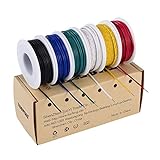
- 6-COLOR, 180 FT KIT: Includes red, black, white, blue, green, and yellow wire, 30 ft per color, for organized circuit identification and fewer wiring mistakes
- SOLID TINNED COPPER CONDUCTOR: Single-core conductor holds clean bends, inserts into breadboards without loose strands, and accepts solder for PCB and electronics work
- 22 AWG DIMENSIONS: Approximately 0.64 mm conductor diameter and 1.55 mm overall diameter help provide a practical fit for breadboards, perfboards, and terminals
- PVC INSULATION RATING: Rated 300 V and up to 80C for fixed electronics wiring. The jacket strips cleanly when used with a properly sized wire stripper
- VERSATILE APPLICATION: Use for breadboards, microcontroller projects, PCB soldering, guitar electronics, STEM builds, and other fixed internal wiring
“The NEC allows it everywhere.”
Cause: A national model code is treated as the law without checking adoption and amendments.
Fix: Confirm the locally adopted edition, amendments, permit conditions, and utility requirements with the AHJ.
“A modern feeder has the same risk as old aluminum branch wiring.”
Cause: Historical fires involving deteriorated residential device connections are generalized to all aluminum conductors.
Do these 3 things before closing this tab:
1Fix the driver behind crashes, sound loss and screen glitches2Repair Windows errors before they cause bigger problems3Scan for outdated or missing drivers - takes under a minuteFix: Distinguish existing branch-circuit remediation from new construction. For new work, use listed equipment, correct preparation, and documented torque at every connection.
A decision checklist for owners and builders
- What NEC edition and local amendments apply to this permit?
- Is the proposed conductor size based on the actual termination temperature limitation and adjusted ampacity?
- Will the larger aluminum conductor fit the planned raceway, box, panel, and bending space?
- Are every breaker, lug, disconnect, splice, and device listed for aluminum or the exact AL/CU combination?
- Does the estimate include conductor, raceway, fittings, connectors, labor, torque verification, inspection, and likely future service?
- Are conductor materials and transition points labeled for the next electrician?
- Has a licensed electrician reviewed the plans, and has the AHJ accepted the design before installation?
When the answers are documented, the choice becomes a project-specific engineering and cost decision. Copper generally buys compact conductors and straightforward terminations; aluminum can deliver meaningful savings and easier handling on large circuits. Neither advantage outweighs an incorrect ampacity calculation, an unlisted connection, or work that does not satisfy the locally adopted code.
Quick Recap
Product prices and availability are accurate as of the date/time indicated and are subject to change. Any price and availability information displayed on Amazon at the time of purchase will apply.

