Do these 3 things before closing this tab:
1Repair Windows errors before they cause bigger problems2Fix the driver behind crashes, sound loss and screen glitches3Clear out junk files and repair common Windows errorsYes, you can make a simple cooling-paint experiment by mixing calcium-carbonate powder into commercial outdoor white paint. No, current evidence does not establish a reliable homemade recipe that produces radiative cooling or temperatures below ambient. In a 2026 outdoor comparison, 45% and 65% calcium carbonate by mass produced panels that stayed close to the white-paint control. The useful DIY project is therefore a controlled comparison on your own substrate—not a guaranteed upgrade for a wall or roof.
What “cooling paint” has to do
A radiative-cooling coating must do two jobs at once: reflect a large share of incoming sunlight across the solar spectrum and emit heat efficiently as infrared radiation, particularly through the atmosphere’s transparency window. A coating can look bright white while failing to perform both jobs. Visible whiteness alone does not establish high solar reflectance or strong infrared emissivity.
As an Amazon Associate I earn from qualifying purchases.
For a fiber-cement wall, an ordinary exterior white coating may reduce solar heating compared with a dark finish, but that is not the same as a tested radiative-cooling system. Surface temperature, indoor temperature, cooling power, solar reflectance and infrared emissivity are different measurements.
The simplest mixture you can reproduce
The directly relevant 2026 study by Advik Gujrati in the National High School Journal of Science compared commercial outdoor white paint with formulations containing calcium carbonate (CaCO3) at 45% and 65% of total mixture mass. It also tested application methods for the 65% formulation and included uncoated aluminium panels.
#1 Best Overall
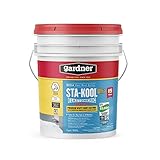
- ELASTOMERIC ROOF SEALANT: Seal and protect your roof from intense heat and harsh UV rays with Gardner-Gibson Sta-Kool 15-Year Turbo-Dri Elastomeric Roof Coating. It's engineered to be "rain safe" in 30 minutes for protection against unexpected rain.
- COOL-CORE TECHNOLOGY: This heat reflective paint features "cool-core" technology – specialized pigments that repel heat gain to keep interiors cooler and help save on cooling costs.
- PREMIUM “SINGLE DAY” WHITE ROOF COATING: Engineered to be “Rain Safe” in 30 minutes and recoated in just three hours, STA-KOOL Turbo-Dri Technology greatly improves efficiency allowing for faster completion times and unprecedented protection against unexpected rain.
- EASY TO APPLY: Simply use a roller to spread Sta-Kool into a uniform coat on your surface. Follow all directions on label. Packaged in a 5-gallon container.
- SERVING PROS SINCE 1945: Established in 1945, Gardner-Gibson has been setting the industry standard with a variety of roof, road and waterproofing products for more than 75 years.
Materials
- Commercial outdoor white paint, used as the base paint and control.
- Calcium-carbonate powder.
- Matching test panels, such as identical pieces of aluminium or fiber cement.
- A scale capable of recording the powder and paint masses.
- A consistent mixing and application setup.
- An infrared thermometer for comparing surface temperatures.
Do not infer a better ratio from the study. Its evidence covers the tested 45% and 65% mass fractions, not every possible loading or paint brand.
Repeat the comparison, not just the recipe
- Prepare at least three otherwise identical panels: one uncoated, one coated with the commercial white paint, and one coated with your chosen tested CaCO3 mixture.
- Weigh the base paint and powder separately, then record the exact masses and the mass fraction used.
- Mix using the same method each time and record how long you mix. Keep the 65% trial’s application method separate if you are comparing methods.
- Apply comparable wet coverage and let every panel dry for the same length of time.
- Mount the panels side by side with the same orientation and exposure so they receive similar sunlight, wind and humidity.
- Measure each panel at the same locations and times through the day. Record ambient conditions and the complete temperature time series.
An infrared-thermometer reading is a surface-temperature comparison. It does not measure the coating’s solar reflectance, infrared emissivity or total radiative-cooling power.
Rank #2

- UV RESISTANCE - Our Cool Foot Deck Coating has excellent solar reflectivity and UV stability; reduces heat transfer by up to 35% compared to regular paint
- PROTECTIVE FINISH FOR - Wood, concrete, decks, walls, fences and more for a seamless membrane!
- EASY TO APPLY - Use a brush, roller, or paint sprayer for a seamless and fully adhered membrane. Designed as a stand-alone coating but can also be used with Liquid Rubber Geo-textile Fabric to bridge seams and flashing
- ENVIRONMENTALLY FRIENDLY - Liquid Rubber Deck Coating is water based, non-flammable, and non-toxic, containing no solvents or VOC's. Safe for humans and pets alike, can be used indoors and outdoors with no special breathing apparatus
- COVERAGE - Apply a minimum final thickness of 1 gallon/50 square feet (4.6 sq m). This should require 3-4 heavy coats. Heavy traffic areas require 1 gallon/30 square feet (2.8 sq m)
What the 2026 outdoor test found
During the strongest heating, uncoated aluminium peaked approximately 10–12 °C hotter than the regular white-paint panel. The calcium-carbonate panels were typically within ±1 °C of that white-paint control. The study found no consistent separation between the 45% and 65% mixtures or among the tested application methods.
Those numbers came from a small comparison: one panel per condition per week over a two-week outdoor test. The work did not independently characterize reflectance, emissivity or coating microstructure. It does not prove that every CaCO3 formulation is ineffective; it does show that simply adding a common powder to already good commercial white paint is not a demonstrated shortcut to a large cooling effect.
Rank #3
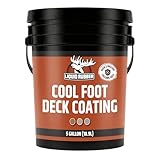
- UV RESISTANCE - Our Cool Foot Deck Coating has excellent solar reflectivity and UV stability; reduces heat transfer by up to 35% compared to regular paint
- PROTECTIVE FINISH FOR - Wood, concrete, decks, walls, fences and more for a seamless membrane!
- EASY TO APPLY - Use a brush, roller, or paint sprayer for a seamless and fully adhered membrane. Designed as a stand-alone coating but can also be used with Liquid Rubber Geo-textile Fabric to bridge seams and flashing
- ENVIRONMENTALLY FRIENDLY - Liquid Rubber Deck Coating is water based, non-flammable, and non-toxic, containing no solvents or VOC's. Safe for humans and pets alike, can be used indoors and outdoors with no special breathing apparatus
- COVERAGE - Apply a minimum final thickness of 1 gallon/50 square feet (4.6 sq m). This should require 3-4 heavy coats. Heavy traffic areas require 1 gallon/30 square feet (2.8 sq m)
Why a white household coating is not automatically radiative-cooling paint
Performance depends on the complete formulation and process, including:
- particle size and particle-size distribution;
- the filler’s optical properties;
- binder chemistry and pigment volume;
- powder loading and dispersion;
- film thickness, surface texture and porosity;
- application method and drying conditions; and
- weathering and durability after installation.
Engineered studies specify those variables rather than assuming that any bright coating will work. A 2025 Journal of Materials Chemistry C paper describes a water-based inorganic coating that adjusts the ratio of alumina particles to sodium methylsilicate adhesive, mixes the components with water for 30 minutes, sprays the coating and dries it at indoor temperature, followed by a hydrophobic surface treatment. Those results belong to that specified formulation and process, not to household white paint.
Rank #4
- UV RESISTANCE - Our Cool Foot Deck Coating has excellent solar reflectivity and UV stability; reduces heat transfer by up to 35% compared to regular paint
- PROTECTIVE FINISH FOR - Wood, concrete, decks, walls, fences and more for a seamless membrane!
- EASY TO APPLY - Use a brush, roller, or paint sprayer for a seamless and fully adhered membrane. Designed as a stand-alone coating but can also be used with Liquid Rubber Geo-textile Fabric to bridge seams and flashing
- ENVIRONMENTALLY FRIENDLY - Liquid Rubber Deck Coating is water based, non-flammable, and non-toxic, containing no solvents or VOC's. Safe for humans and pets alike, can be used indoors and outdoors with no special breathing apparatus
- COVERAGE - Apply a minimum final thickness of 1 gallon/50 square feet (4.6 sq m). This should require 3-4 heavy coats. Heavy traffic areas require 1 gallon/30 square feet (2.8 sq m)
Another 2025 study reports a TPU/BaSO4/SiO2 coating. It disperses barium sulfate and hydrophobic silica in dimethylformamide, adds thermoplastic polyurethane and sprays the mixture. Dimethylformamide handling and that engineered composition are not casual DIY instructions, and their reported optical or temperature results must not be transferred to a calcium-carbonate paint mixture.
The Tool Desk
Outbyte PC Repair FREERepair Windows errors before they cause bigger problemsFix Now →Outbyte Driver Updater FREEScan for outdated or missing drivers - takes under a minuteDriver Scan →How to test a homemade coating fairly
Minimum practical test
- Use the same substrate, panel dimensions, orientation and mounting for every condition.
- Match coating coverage, drying time and number of coats.
- Keep treated and control panels side by side.
- Log powder mass, paint mass, mixing method, application method and weather.
- Take repeated measurements rather than relying on one afternoon reading.
For a fiber-cement demonstration, seal or prepare every panel identically and avoid comparing a rough, weathered board with a smooth new one. The comparison is only meaningful when the substrate and exposure are matched.
Best Value

- MAXIMUM REFLECTIVITY WHEN APPLIED ON TOP OF WET PAINT: Designed to be broadcast onto freshly applied traffic paint, striping paint, or epoxy coatings for superior nighttime visibility. Unlike products mixed into paint, these reflective glass beads remain exposed to headlights to create maximum retroreflectivity and brighter markings after dark
- PROFESSIONAL TYPE 1 DOT HIGHWAY GRADE: Contractor-grade reflective glass beads manufactured to Type 1 highway bead specifications commonly used for pavement markings, parking lots, curbs, crosswalks, private roads, warehouses, industrial facilities, schools, churches, and commercial properties
- COMPATIBLE WITH LINE STRIPING EQUIPMENT: Suitable for use with professional line striping machines, bead dispensers, pavement marking equipment, walk-behind stripers, and manual broadcast applications. Designed for parking lot striping contractors, sealcoating professionals, property managers, and maintenance crews
- MADE IN USA QUALITY: Proudly manufactured in the USA using high-quality glass for consistent bead size, excellent reflectivity, and dependable performance. Trusted by striping contractors, HOAs, facility managers, municipalities, and commercial property owners
- PARKING LOTS, CURBS AND DRIVEWAYS APPLICATION: Improve visibility of parking stalls, fire lanes, directional arrows, handicap spaces, loading zones, curbs, driveways, warehouse safety markings, and pavement striping. Helps increase visibility in low-light, rainy, and nighttime conditions
What a stronger evaluation adds
The 2025 Nature Protocols workflow for radiative-cooling materials treats optical and outdoor measurements separately. It describes solar measurements from 0.3–2.5 µm and infrared measurements from 2.5–20 µm, alongside outdoor testing that accounts for insulation, radiation shielding, humidity, sunlight, wind and ambient temperature. Typical durations in that procedure are seven days outdoors and one day indoors.
Without those measurements, a cooler surface reading can reflect differences in airflow, thermal mass, shade or emissivity rather than superior solar reflection. A rigorous test also distinguishes a daytime surface temperature from the temperature inside a building.
Independent reader supportYour contribution helps us test, update, and keep practical guides available for everyone.How the DIY option compares with specialist coatings
| Approach | What is established | What is not established |
|---|---|---|
| Commercial white paint | Provides a practical control and may reduce solar absorption compared with a dark surface. | White appearance alone does not establish full-spectrum reflectance or high infrared emission. |
| 45% or 65% CaCO3 in outdoor white paint | Tested in the 2026 small outdoor comparison; panels generally stayed within ±1 °C of the white-paint control. | No consistent large cooling improvement; no proof of sub-ambient performance. |
| Engineered alumina/sodium-methylsilicate coating | A specified water-based formulation and spray process were reported in 2025 research. | Its results do not validate a household paint recipe. |
| Engineered TPU/BaSO4/SiO2 coating | A specified solvent-based formulation and spray process were reported in 2025 research. | Its results cannot be assumed for CaCO3 or ordinary exterior paint. |
| SRI Self-Cooling Paint | SRI says the product is available by contacting the company and is intended for sky-facing outdoor surfaces. | Independent confirmation and broad consumer retail availability are not established here. |
What commercial claims mean
SRI says its Self-Cooling Paint combines high solar reflectance with high infrared emittance and reports, from internal tests, cooling of up to 5–8 °C below ambient air, 10–15 °C below an uncoated surface and daytime summer cooling power on the order of 100 W/m². These are vendor-reported internal-test figures, not results from the calcium-carbonate experiment. SRI also states: “Others may see results that vary from our internal tests — as with any coating, cooling performance varies based on the application and surrounding conditions, including weather.”
Recommended Free Tools
The company lists possible uses including electronics enclosures, aerospace and drones, power generation, textiles, architecture, tents, storage tanks and automotive applications. Contact the manufacturer for availability and application requirements rather than assuming a standard retail paint can will provide the same performance.
Decision guide for a construction project
- Need a low-cost visual experiment? Use the CaCO3 mixture as a documented panel comparison, with a commercial white-paint control.
- Need a cooler exterior finish? Start with a properly specified exterior coating and evaluate the actual substrate, color, exposure and weathering conditions.
- Need verified radiative cooling? Require optical data, matched outdoor testing and application instructions for the exact product and substrate.
- Need lower indoor temperatures? Do not rely on a surface-temperature claim alone; assess roof or wall assembly, insulation, ventilation, shading and heat flow.
The Bottom Line
You can make a test coating by adding calcium carbonate to outdoor white paint at the 45% or 65% mass fractions studied in 2026. The available outdoor evidence found no consistent advantage over the white-paint control, so treat it as an experiment—not a proven recipe for below-ambient cooling.
Quick Recap
Product prices and availability are accurate as of the date/time indicated and are subject to change. Any price and availability information displayed on Amazon at the time of purchase will apply.

