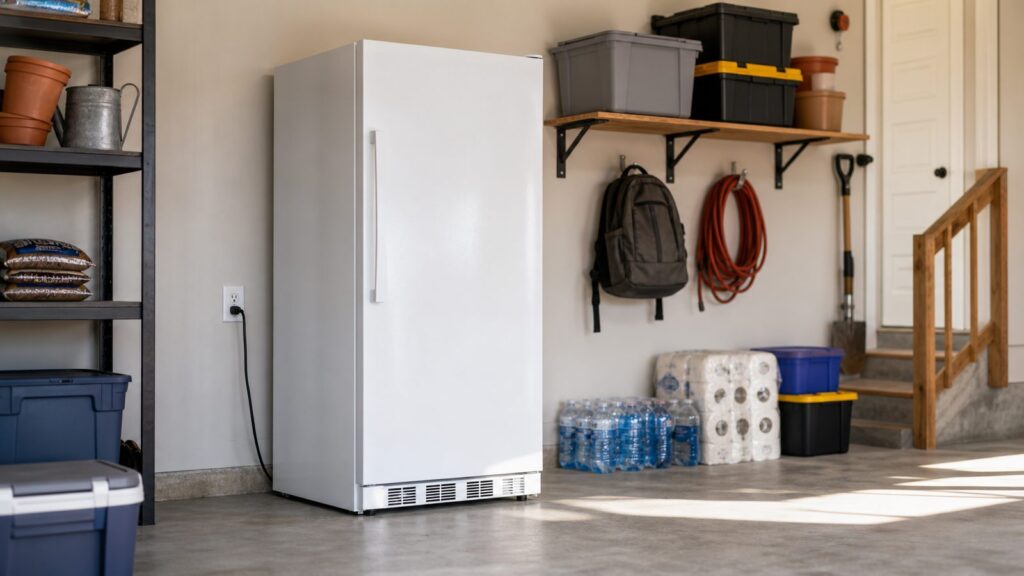
A convertible refrigerator freezer is one of the most practical secondary appliances a homeowner can buy, but only if it matches the space, the circuit, and the way the household actually stores food. The short answer: for most homes, the best choice is a 13 to 18 cu. ft. ENERGY STAR, frost-free, garage-ready upright convertible unit. That size range gives enough overflow capacity for bulk groceries, holidays, beverages, meal prep, and freezer stock without taking over the garage or requiring a major remodel.
The key word is convertible. Most convertible units switch the entire cabinet between refrigerator mode and freezer mode. They are not the same thing as a dual-zone appliance with one refrigerator compartment and one freezer compartment operating at the same time. If you want half refrigerator and half freezer every day, buy a true dual-zone appliance. If your needs change by season, a whole-cabinet convertible unit is usually the better value.
As an Amazon Associate I earn from qualifying purchases.
On our job sites, we see these units used in garages, basements, walk-in pantries, mudrooms, utility rooms, pool houses, ADU kitchenettes, workshops, butler’s pantries, and home bar areas. The appliance itself is only part of the decision. The mistakes that cost money usually happen around outlet placement, GFCI access, floor slope, door swing, ventilation clearance, delivery path, and whether the garage temperature is within the manufacturer’s operating range.
What Makes a Convertible Refrigerator Freezer Worth Buying?
A good convertible refrigerator freezer gives you one cabinet that can operate as either a refrigerator or a freezer. In freezer mode, it handles meat, frozen meals, garden produce, fish, ice, and bulk warehouse purchases. In refrigerator mode, it becomes overflow space for drinks, party trays, holiday prep, produce, dairy, or catering pans.
#1 Best Overall

- Large Capacity Upright Freezer: With spacious 7.0 cubic feet interior, stand-up deep freezer measures 21.3" W x 22.8" D x 56.0" H and provides ample space to store bulk meats, frozen goods, breast milk reserves or emergency provisions. Ideal for managing holiday feasts, extended grocery storage, and long-term garage storage
- Convertible Temperature Control: The standing upright freezer can switch effortlessly between freezer (-7.60°F-6.80°F) and refrigerator modes (37.94°F-46.94°F), letting you lock in the perfect temp in seconds. Ideal for seasonal needs or various environments like kitchen, garage, basement, or workshop
- Crisper Drawer & Removable Shelves: This deep freezer includes 5 glass shelves and drawer. 5 removable shelves let you customize storage for pizza boxes, frozen meals, or tall bottles; The garage freezer with drawer keeps fruits and vegetables crisp and separated, ideal for organizing a compact refrigerator or freezer space
- Space-Saving Design: Adjustable leveling feet stabilize on uneven floors, while the recessed handle provides extra in tight spaces, ensuring durability and less cleaning works. With reversible door and flush back design, this refrigerator freezer fits into dorm, apartment, kitchen, or home office
- User-Friendly Features & Quiet Operation: Upright freezer also includes an ice tray and removable defrost tool. This compact fridge with freezer costs just $36/year (0.89kWh/24hrs) to operate, making it both energy-efficient, Ideal for tight spaces like your office, studio or open living space
The best models for residential use usually have five things in common:
- Garage-ready rating: The model is designed for wider ambient temperature swings, often around 0°F to 110°F on several mainstream garage-ready freezer lines.
- Frost-free defrost: Higher upfront cost, but less maintenance and less chance the homeowner ignores ice buildup for a year.
- ENERGY STAR certification: Common in this category and worth prioritizing for a second appliance that may run all year.
- Usable interior layout: Adjustable shelves, door bins, clear drawers, and enough vertical spacing for real groceries, not just boxed photos in a showroom.
- Alerts and controls: Temperature alarm, door-ajar alarm, power-outage indication, interior light, lock, reversible door, leveling feet, and digital temperature controls.
For most homeowners, an upright cabinet is easier to live with than a chest freezer because the shelves keep food visible. Chest freezers can be efficient and inexpensive, but they are harder to organize, harder to defrost, and more awkward in a finished garage or mudroom. If the goal is flexible food storage rather than only long-term frozen storage, an upright convertible model usually fits better.
Best Sizes for Real Homes
Convertible refrigerator freezers are often advertised by cubic feet, but the right size depends on how you shop, where the unit will sit, and how much clearance you have around it. A 21 cu. ft. cabinet can sound like a better value than a 14 cu. ft. cabinet until it blocks a garage walkway, hits a car door, or cannot swing open in a mudroom.
| Capacity | Best Use | Typical 2026 Price | Builder’s Take |
|---|---|---|---|
| 4-7 cu. ft. | Small apartments, beverage overflow, compact garages | About $405-$700 for many 7 cu. ft. convertible uprights | Good where space is tight, but limited for families or bulk grocery runs. |
| 13-14 cu. ft. | Average household overflow, pantry backup, small garage | About $480-$750 | The best value range for many homes. Enough capacity without a large footprint. |
| 16-18 cu. ft. | Families, meal prep, warehouse shopping, holiday storage | About $750-$1,100 | Our default recommendation when the space and budget allow it. |
| 20-21 cu. ft. | Large households, hunting, fishing, events, catering prep | About $750-$1,300 for many large flex or garage-ready models | Useful, but confirm delivery path, floor space, and door swing before ordering. |
As a rule of thumb, choose 13-14 cu. ft. for normal overflow storage, 16-18 cu. ft. for families that shop in bulk, and 20+ cu. ft. only when you have a clear storage pattern that justifies it. Bigger is not automatically better. Larger cabinets cost more, use more electricity, need more clear floor space, and are harder to relocate later.
Garage-Ready Is Not Marketing Fluff
If the appliance is going in a garage, garage-ready rating should be treated as a hard requirement. Many standard refrigerators are designed for conditioned indoor space. In a winter garage, a standard refrigerator may not cycle properly because the surrounding air is already cold. In a hot summer garage, it may run harder, use more power, and struggle to maintain safe food temperatures.
Several mainstream garage-ready upright freezers are rated for ambient temperatures from roughly 0°F to 110°F. That range is the kind of specification to look for. Do not rely on vague wording like “great for garage storage” unless the product sheet confirms operating temperature limits.
Placement matters too. Keep the unit out of direct sun and away from water heaters, furnaces, dryers, boilers, and other heat-producing equipment when possible. A freezer sitting next to a dryer in a 100°F garage will work harder than the same freezer in a shaded basement utility room. That means more runtime, more heat rejection, and higher operating cost.
Quick wins for a faster PC:
Clear out junk files and repair common Windows errorsFree Scan →Scan for outdated or missing drivers - takes under a minuteDriver Scan →Repair Windows errors before they cause bigger problemsFix Now →Garage Floor Slope and Leveling
Most garages are sloped toward the overhead door or a floor drain. That slope is good construction, but it can make appliance placement tricky. Upright freezers need to sit stable and close to level so the door seals properly and the cabinet does not rock when loaded. Before delivery, check the slab with a 2-foot or 4-foot level. If the slope is significant, choose a location where the leveling feet can compensate without leaving the appliance unstable.
Do not shim with scraps of wood in a damp garage. If minor correction is needed, use proper appliance-rated leveling feet, manufacturer-approved adjustments, or a stable, moisture-resistant platform designed for the load. A full 17 cu. ft. freezer can hold hundreds of pounds of food, so the support matters.
2026 Cost Guide: Appliance, Delivery, Electrical, and Extras
For 2026 budgeting, most practical convertible upright refrigerator freezers fall between about $480 and $1,150 before delivery, installation, haul-away, or utility work. Broader upright freezer listings can run from about $400 to $3,000 depending on size, finish, brand, features, and specialty design.
Here is a realistic planning budget:
| Item | Typical 2026 Cost | Notes |
|---|---|---|
| 13-14 cu. ft. convertible upright | About $480-$750 | Common sweet spot for garage or pantry overflow. |
| 16-18 cu. ft. upright | About $750-$1,100 | Large enough for many families and bulk buyers. |
| 20-21 cu. ft. flex or garage-ready unit | About $750-$1,300 | Confirm dimensions and clearances before buying. |
| Basic appliance installation labor | About $131-$270, average around $187 | Can increase with stairs, tight turns, door removal, or built-in conditions. |
| New electrical outlet | About $220 and up | More if a dedicated circuit, conduit, GFCI breaker, panel work, or drywall repair is needed. |
| Water line, if needed | About $75-$135 for simple installs | Only relevant for units with an ice maker or water dispenser. |
| Wireless temperature sensor | Often $25-$80 | Cheap insurance for a secondary freezer full of food. |
Delivery and haul-away costs vary widely. Stairs, long carries, narrow doors, tight turns, old-appliance removal, local disposal fees, and a return trip after electrical corrections can all raise the final bill. If the appliance is going into a basement, measure the stair width, landing depth, ceiling height, and turn radius before you order.
Do these 3 things before closing this tab:
1Repair Windows errors before they cause bigger problems2Scan for outdated or missing drivers - takes under a minute3Clear out junk files and repair common Windows errorsElectrical Planning: Outlet, Circuit, GFCI, and Cord Reach
Most residential convertible upright refrigerator freezers use a grounded 115/120V receptacle on a 15A circuit. One current Frigidaire specification answer lists 120V, 15A, roughly 150-300 running watts, and warns against extension cords. That is typical for this appliance class, but always follow the selected model’s installation manual.
We prefer a dedicated or lightly loaded circuit for secondary cold storage, especially in garages and utility rooms. The problem is not only running wattage. Compressors have startup loads, and garages often collect other equipment on the same circuit: battery chargers, shop vacs, freezers, treadmills, holiday lights, and power tools. A nuisance trip can spoil a freezer full of food before anyone notices.
GFCI Requirements and Practical Access
Garage receptacles commonly require GFCI protection under modern electrical codes. The exact code application depends on location, edition adopted locally, appliance location, and circuit design, so this is where a licensed electrician or local inspector matters. From a homeowner’s standpoint, the practical goal is simple: the appliance should be protected as required, and the reset point should be accessible.
Do not bury the only GFCI reset behind a full freezer that weighs several hundred pounds when loaded. A better layout is a receptacle located high enough and slightly to the side so it remains reachable, does not interfere with back clearance, and does not force a sharp cord bend. If a GFCI breaker is used instead, make sure the panel is accessible and labeled.
Free tools Windows power users keep installed
One-click scans. No signup required.
Avoid extension cords. They are commonly prohibited by manufacturers, create trip hazards, and can cause voltage drop or overheating when used poorly. If the cord will not reach, install the receptacle in the right place.
Ventilation, Clearances, and Built-In Mistakes
Convertible refrigerator freezers reject heat into the room. If you trap that heat in a tight closet or flush-built cabinet, the unit can run hotter, louder, and less efficiently. It may also shorten compressor life. Always follow the manufacturer’s clearance requirements for the exact model.
For planning purposes, many freestanding appliances need breathing room at the sides, top, and rear. Even when a model appears nearly flush in photos, the service manual may require space for airflow, door opening, and cord clearance. In remodels, decide early whether the appliance is freestanding, recessed, or built into a pantry or mudroom wall. That decision affects framing depth, outlet position, baseboard returns, trim, door casing, and service access.
We avoid tight appliance closets unless they are intentionally designed with ventilation and access. A good appliance niche should allow the unit to slide out without removing trim, should not pinch the cord, and should leave enough door swing to remove shelves and bins. If the appliance has a reversible door, decide the hinge side before the electrician places the outlet and before the trim carpenter finishes the opening.
Recommended Free Tools
Features That Matter and Features That Do Not
Some features are worth paying for because they reduce real homeowner problems. Others look good on the showroom tag but do not change daily use very much.
Worth Prioritizing
- True garage-ready rating: Especially for unconditioned garages and workshops.
- Frost-free defrost: Reduces maintenance and keeps storage usable.
- Temperature alarm: Helps catch a failed door seal, power loss, or compressor issue.
- Door-ajar alarm: Valuable for households with children, guests, or busy garage traffic.
- Power-outage assurance: Useful where outages happen or the unit is not checked daily.
- Lock: Helpful for garages, shared spaces, workshops, rentals, and pool houses.
- Interior LED lighting: More useful than it sounds in a garage or basement.
- Adjustable shelves and clear bins: Better organization means less food waste.
- Reversible door: Important in narrow mudrooms, pantries, and utility rooms.
Nice, but Situation-Dependent
- Stainless finish: Worth it in a finished pantry or bar area, less important in a garage.
- Casters: Helpful for cleaning and service, but the unit still needs to sit stable when loaded.
- Ice maker or water dispenser: Adds convenience but requires a water line and more installation planning.
- Extra-large capacity: Useful only if the household will keep it organized and full enough to justify the space.
We strongly recommend adding a wireless temperature sensor with phone alerts for any secondary freezer. It is a small cost compared with losing a full cabinet of meat, seafood, frozen meals, or garden produce. Place the sensor inside the cabinet and test alerts before loading expensive food.
Best Use Cases by Location
Garage
The garage is the most common location, but it needs the most planning. Prioritize a garage-ready model rated for wide temperature swings, an accessible GFCI-protected receptacle, clearance from vehicles, and a door swing that does not block a walking path. Keep the unit away from direct sun and heat-producing equipment where possible.
Basement or Utility Room
A conditioned basement is easier on the appliance than a garage. Check stair access, floor moisture, and whether the circuit already carries a sump pump, dehumidifier, treadmill, or workshop tools. If the basement has a history of water intrusion, raise the appliance only on a proper platform and do not place it where shallow flooding is likely.
The Tool Desk
Outbyte PC Repair FREEClear out junk files and repair common Windows errorsFree Scan →Outbyte Driver Updater FREEFix the driver behind crashes, sound loss and screen glitchesFind Drivers →Rank #2

- Freezer Size:The Bangson 7 cu. ft. Upright Freezer provides ample storage space for fruits/vegetables/seafood/ice cream so you can always enjoy fresh food. You can remove the crisper depending on the food placement. Dimensions: 21.5 inches L, 23.3 inches D, and 56.0 inches H.
- Convertible Freezer/Refrigerator:This Bangson Upright Freezer can easily be changed from an upright freezer to a no-freezer refrigerator and then back to an upright freezer. Temperature range: Freezer: -7.6(℉)-6.8(℉), Refrigerator: 38(℉)-47(℉).
- Flexible Food Storage:Our Bangson Convertible Deep Freezer/Refrigerator has two pulleys for easy freezer movement. The freezer is also equipped with three freshness drawer boxes that provide separate storage areas for fruits and vegetables, making cleaning more hygienic.
- Enhanced Details:BANGSON's compact refrigerator comes with a reversible door to suit your preferences. Leveling feet on the bottom allow for stable placement on uneven floors. The built-in handle not only makes it easy to open the freezer door, but it also makes the freezer cleaner and more aesthetically pleasing.
- User-Friendly Design:The removable door seal makes cleaning a breeze. It also includes an ice tray and a defrost tool. For any inquiries, please don't hesitate to contact us as we are committed to providing excellent customer service.
Walk-In Pantry or Mudroom
This can be an excellent location during a remodel. The appliance is close to the kitchen, easier to access than a garage unit, and useful for holidays and bulk groceries. Plan the door swing, trim clearance, outlet location, and ventilation before cabinets or shelving are finalized.
ADU, Pool House, or Guest Suite
A full-cabinet convertible unit can work well for flexible hosting, but consider the use pattern. If guests need refrigerator and freezer storage at the same time, a true dual-zone refrigerator/freezer, undercounter drawers, or a compact refrigerator with a separate freezer compartment may be a better fit than a convertible cabinet that operates in only one mode at a time.
Independent reader supportYour contribution helps us test, update, and keep practical guides available for everyone.Pre-Delivery Checklist
Before the truck arrives, verify the site. Delivery crews may refuse installation if the space is not ready, the appliance cannot fit through the path, the outlet is missing or unsafe, or the old unit cannot be removed without extra work.
- Measure the appliance path: Include driveway, porch, hallway, garage entry, basement stairs, landings, door widths, ceiling height, and tight turns.
- Check the final opening: Confirm width, height, depth, rear clearance, side clearance, top clearance, and room for the door to open fully.
- Verify outlet location: Use a grounded 115/120V receptacle that the cord can reach without an extension cord.
- Confirm GFCI access: Make sure the reset point is reachable after the unit is installed.
- Check the floor: The surface should be stable, dry, and level enough for the appliance feet to adjust properly.
- Plan the door swing: Confirm hinge side, handle clearance, nearby shelving, cars, walls, and trim.
- Clear the work area: Remove stored items, rugs, boxes, shelving conflicts, and anything blocking the delivery path.
- Know the haul-away rules: Ask whether the old appliance must be empty, defrosted, disconnected, and accessible.
After transport, leave the appliance upright per the manufacturer’s instructions before startup, especially if it was tilted during delivery. Then commission it empty for several hours, verify the temperature with an independent thermometer, and load food gradually. That simple sequence catches many problems before the cabinet is full.
When to DIY vs. When to Hire a Pro
Setting a freestanding convertible refrigerator freezer can be a reasonable DIY job if the site is already correct. That means the outlet exists, the circuit is appropriate, the floor is stable, the path is clear, and the appliance is not being built into cabinetry.
DIY is usually appropriate when you are rolling a unit into a garage or basement, plugging it into an existing code-compliant receptacle, leveling the feet, reversing the door according to the manual, and monitoring startup temperature. Two adults should handle positioning for most upright units. Do not drag the appliance across finished flooring without protection.
Hire a pro when any of these conditions apply:
- A new outlet, dedicated circuit, GFCI breaker, conduit, or panel work is needed.
- The appliance is being recessed into a pantry, mudroom wall, cabinet run, or finished niche.
- Door trim, baseboards, shelving, or cabinetry must be modified.
- The delivery path includes tight stairs or removal of doors and railings.
- The unit has an ice maker or water dispenser requiring a new water line.
- The garage slab needs a proper platform or other correction for stability and moisture.
Electrical permits may be required for new circuits, new receptacles, panel work, or garage wiring changes. Plumbing permits may apply for new water lines in some jurisdictions. Local rules vary, but the principle is consistent: appliance placement is simple; modifying building systems should be done to code.
Our Practical Buying Recommendations
If a homeowner asked us what to buy without brand loyalty, we would narrow the field this way.
Best all-around category: A 13-18 cu. ft. ENERGY STAR, frost-free, garage-ready upright convertible refrigerator freezer. This is the practical middle ground for most homes. It has enough volume to matter, the upright layout is easy to organize, and the garage-ready rating gives more placement flexibility.
Best budget category: A 7 cu. ft. convertible upright around $405-$700. This works for beverages, small frozen overflow, apartment living, or one-person households. It is not the right answer for large families or bulk warehouse shoppers.
Best family category: A 16-18 cu. ft. frost-free upright, typically around $750-$1,100. This is the range we like for households that routinely stock meat, frozen meals, kids’ food, party supplies, or garden produce.
Best large-storage category: A 20-21 cu. ft. convertible or garage-ready model around $750-$1,300. This makes sense for large households, hunting and fishing storage, event prep, or serious batch cooking. Measure carefully because these units can dominate a garage wall or pantry opening.
Outdated Drivers Are Slowing You Down
One free scan finds every outdated or missing driver and matches the right update for your exact hardware.Free scan · exact hardware matchPC Slower Than It Used to Be?
A free scan shows the junk files, broken settings and background clutter dragging Windows down - then fixes them in one click.Free scan · Windows 10 & 11Best remodel choice: The model that publishes clear dimensions, clearance requirements, hinge options, electrical requirements, and service access needs before framing starts. In a remodel, the best appliance is not always the biggest or cheapest one. It is the one that the room can support cleanly for the next 10 years.
Final Builder’s Advice
A convertible refrigerator freezer is a good investment when it solves a real storage problem and is installed in a space designed to support it. The appliance price is only one line item. Plan for delivery, electrical access, ventilation, floor conditions, door swing, and monitoring.
For most homeowners, stay in the 13-18 cu. ft. range, choose a true garage-ready model if it will live outside conditioned space, and buy frost-free unless you have a clear reason to manage manual defrost. Add a wireless temperature sensor, keep the receptacle accessible, and verify operating temperature before loading the unit.
That is the difference between a flexible storage appliance that quietly helps the household every week and a bulky box in the garage that creates maintenance, nuisance trips, and spoiled food.
What’s actually slowing this PC down?
Pick the symptom - the matching free tool is one click away.
Frequently Asked Questions
Are convertible refrigerator freezers the same as dual-zone refrigerator freezers?
Usually no. Most convertible units switch the entire cabinet between refrigerator mode and freezer mode. A dual-zone appliance has independently controlled compartments that can refrigerate and freeze at the same time.
What size convertible refrigerator freezer is best for most homes?
For most households, 13 to 18 cu. ft. is the best range. A 13-14 cu. ft. unit works for normal overflow storage, while 16-18 cu. ft. is better for families, meal prep, and bulk shopping.
Can I put a convertible freezer in the garage?
Yes, if the model is explicitly garage-ready and rated for the garage’s temperature range. Look for published ambient operating limits, often around 0°F to 110°F on many garage-ready models.
Do I need a dedicated circuit for a garage freezer?
Many units run on a grounded 115/120V, 15A receptacle, but a dedicated or lightly loaded circuit is preferred. Garages often have tools and chargers on the same circuit, and a nuisance trip can spoil food.
How much does installation cost?
Basic appliance installation labor commonly runs about $131-$270 in 2026, with an average around $187. A new outlet may add about $220 or more, and water lines only matter if the appliance has an ice maker or dispenser.
Is frost-free worth it?
For most homeowners, yes. Frost-free models cost more than manual-defrost units, but they reduce maintenance, ice buildup, and the chance that defrosting gets ignored until the appliance performs poorly.
Quick Recap
Product prices and availability are accurate as of the date/time indicated and are subject to change. Any price and availability information displayed on Amazon at the time of purchase will apply.

