For most construction sites, general security cameras are the better starting point. They record people, equipment, materials, vehicles and the surrounding scene, so a manager can investigate what happened. A license plate recognition (LPR, or ANPR) system is the better fit when the specific question is which vehicle entered or left through a controlled access point. Neither technology has been proven, on its own, to prevent construction-site theft.
The practical choice is therefore purpose-led: use broad-coverage CCTV for site-wide evidence, LPR for vehicle identity at a gate, or both when the site genuinely needs both kinds of evidence and can support the extra equipment, data controls and response work.
As an Amazon Associate I earn from qualifying purchases.
The decision in one minute
- Choose general CCTV/security cameras when you need a visual record of activity across a worksite: people near plant, material movements, damaged fencing, unsafe access or an incident that occurs away from a gate.
- Choose LPR when vehicle identity is the primary question, such as recording registration plates at an entrance or exit.
- Choose both only when scene context and vehicle identity are both material risks, and you can provide suitable placement, lighting, power, connectivity, storage, access controls and someone to review or act on alerts.
The Information Commissioner’s Office (ICO) uses a construction example in which “a construction company uses traditional CCTV alongside security guards within the perimeters of a building site” to protect workers and nearby members of the public. The example also calls for prominent notices explaining the cameras’ purpose and a contact for questions. See the ICO principles guidance.
What each system can actually show
General security cameras: scene evidence
A conventional fixed or pan-tilt camera is designed to show a defined area rather than identify one data field. Correctly positioned cameras can show a person approaching a tool store, a forklift moving materials, a cut section of fence, an argument, a trip hazard or the sequence before and after damage. That context is often what an investigation needs.
#1 Best Overall

- 4G LTE outdoor security camera with included SIM card, ideal for construction sites, and storage areas where Wi-Fi is not available.
- Wireless surveillance powered by a frameless solar panel and high-capacity battery, delivering up to 6 months of autonomy with no external power.
- Detects motion up to 100 ft and sends instant photo alerts or 15-second video clips on demand, giving real-time visibility of your tools, equipment, and site.
- Integrated deterrent light signals the camera’s presence and repels intruders, protecting valuable materials, trailers, and storage containers.
- Rugged antenna, IP65 weather resistance, and durable solar design ensure continuous operation in rain, snow, dust, and harsh jobsite conditions.
Its usefulness depends on the image being usable: the camera must cover the relevant area, retain enough detail, cope with the available light and record for long enough to be reviewed. A camera pointed at a wide yard may establish that activity occurred but fail to identify a face or a tool label. A narrow view may give better detail while leaving other routes unobserved.
LPR: vehicle-identity evidence
An LPR system uses a camera, optical-character-recognition software and a database of previously read plates. The National Institute of Justice (NIJ)-sponsored overview lists lighting, vehicle speed, accuracy, location, communications and costs as core deployment considerations. Read the NIJ overview published in June 2012.
LPR is normally aimed at a defined vehicle path. It can produce a plate reading associated with a time and location, but it is not a substitute for a broad scene recording. A plate image may not show who was driving, what was loaded, whether a person entered on foot or what happened elsewhere on the site. Those questions require other cameras, access records or witness evidence.
Side-by-side comparison
| Decision factor | General CCTV/security camera | LPR/ANPR system |
|---|---|---|
| Primary evidence | Whole-scene video: people, equipment, materials, vehicles and incidents | Vehicle registration plate linked to a time and capture point |
| Best location | Perimeter, storage areas, plant yards, welfare areas and routes where incidents may occur | A controlled entrance or exit where vehicles pass a predictable capture point |
| What it can miss | Details outside the field of view, poor facial or object detail caused by distance, angle or light | People on foot, activity away from the gate, vehicle occupants and surrounding context |
| Performance dependencies | Coverage, framing, image detail, lighting and continuous usable recording | Lighting, vehicle speed, camera angle, plate readability, software accuracy, communications and location |
| Data captured | Video images, potentially including workers, visitors and members of the public | Plate reads and associated images or records, potentially linked to time and location |
| Operational question | What happened, where, and who or what was involved? | Which vehicle passed this point, and when? |
| Deployment burden | Multiple viewpoints may be needed to cover a large or changing site | Specialist capture and processing at each relevant vehicle route, plus database and communications arrangements |
Can a plate reader prevent construction-site theft?
It can support identification and investigation when a theft involves a vehicle that passes the monitored gate, but the available evidence does not establish that LPR prevents construction theft. NIJ’s CrimeSolutions profile summarizes a 2011 place-based evaluation and a 2012 patrol evaluation of LPR used as a crime deterrent. In the settings and short follow-up periods described, the evaluations found no statistically significant difference for the reported general-crime or auto-related outcomes. They were police deployments, not construction sites, so they cannot be treated as a construction-site effect estimate. The profile is available at NIJ CrimeSolutions.
Deterrence also requires an operating response. A plate read that nobody reviews, cannot be connected to a gate event, or is stored without a lawful process may add little practical protection. The same is true of CCTV: recording a theft is not the same as stopping it. Guards, lighting, access control, inventory checks, secure storage and a clear escalation process remain separate parts of a site-security plan; the sources do not establish their relative effect sizes.
Rank #2

- Dual View on One Screen: With 6X hybrid zoom enabled by the wide-angle and telephoto lenses, this 4G security camera brings you a full view and a closeup of key details on one screen. You can see them both at one glance.
- Covers Every Corner & Detail by PTZ Auto-Zoom Tracking: Control the camera to pan 355° and tilt 90° to see 360°. It can also track and zoom in on the moving object automatically, clearly showing you how the event unfolds.
- Get Alerted to What Matters in Real Time: The camera can distinguish people, vehicles, and pets from other objects and provide relevant alerts. You'll get notified by email, app push, or siren immediately.
- Crisp 4K Video Day & Night: With 4K 8MP high resolution, the dual lens sharply captures fine details. In the night, it provides infrared black-and-white night vision and spotlight color night vision.
- Forever Solar Power: The combination of the solar power panel and 4G connection on this cellular camera saves you from the troubles of finding sockets or networks outdoors. Ideal for country houses, construction sites, etc.
Which technology fits your site?
Use CCTV first for dispersed theft risks
General cameras are more directly aligned with theft of tools, plant, fuel or materials when those items are spread across a yard or building. They can document approach routes, handling and departure, including incidents that never pass a vehicle gate. Prioritise views of high-value storage, temporary fencing, blind corners, loading areas and routes connecting the site to public roads. Keep enough overlap to follow movement between important areas, but avoid collecting irrelevant neighbouring or worker areas where a less intrusive view would work.
Add LPR for a single, controlled vehicle route
LPR becomes more useful when nearly every vehicle uses one or a small number of predictable gates and vehicle identity is a defined investigative need. It may provide a time-stamped plate record to correlate with CCTV, delivery paperwork or an access-control event. It is a poor substitute where vehicles can leave through informal tracks, where the camera cannot obtain a reliable angle, or where the main concern is activity inside the perimeter rather than the vehicle itself.
Use both when the evidence chain needs both links
A combined design can pair an LPR capture at the gate with overview and detail cameras covering the approach, barrier and nearby yard. The LPR supplies a plate record; the scene cameras can show occupants, loads, barriers and interactions. This is a practical design inference from the systems’ different functions, not a measured claim that a combined system reduces theft by a particular percentage. It also creates more footage, more personal-data handling and more equipment to maintain.
Placement and performance: where systems succeed or fail
Plan CCTV around the incident you need to reconstruct
- Map likely approaches, storage points, plant routes, temporary structures and public interfaces rather than placing cameras solely where power is easiest.
- Define the detail required at each view. A wide establishing view and a closer detail view serve different purposes; one camera rarely does both well across a large yard.
- Check day, night, glare, rain, dust and temporary obstructions. Construction layouts change, so schedule a review whenever fencing, scaffolding, hoarding or access routes move.
- Confirm that recording is continuous or event-triggered as intended, that timestamps are reliable, and that footage can be exported in a form investigators can use.
Design LPR around the capture point
- Select a gate where vehicles slow or stop and where the camera can view plates at a workable angle.
- Test the system in the actual light conditions, including darkness, headlights, rain and glare. NIJ identifies lighting, speed and accuracy as material considerations.
- Provide dependable communications so a plate image and its associated record reach the intended system or operator. A connection failure can create a gap precisely when a vehicle passes.
- Decide how reads are associated with a location and time, and how operators will correct or investigate an apparent misread.
- Use a separate overview camera when you need to see the driver, load, barrier or surrounding activity; an LPR image alone is not that context.
Account for construction conditions
Temporary power, long cable runs, network dead zones, cranes and changing hoardings can affect either system. Include weather protection, secure mounting and a maintenance route in the design. The total burden includes installation, power, connectivity, storage and the staff time needed to review footage or respond to an alert. The NIJ LPR overview specifically flags communications and costs alongside performance factors; it does not provide a universal cost figure for construction sites.
Rank #3
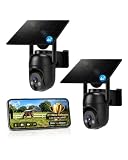
- 【4G LTE Network & No WiFi Needed】Cellular security camera include a pre-installed SIM card with 7-day unlimited trial data; auto-connects to the strongest U.S. network (Verizon/T-Mobile/AT&T). After the 7-day trial ends, subscribe to unlimited data for $19.90/month or $169.90/year via the UBox app to maintain remote access. Note: Each device requires a separate data plan subscription and cannot be shared. 100% wireless & no wifi needed—ideal for ranches, construction sites, vacation homes, or home security. (SIM card is non-replaceable)
- 【High-capacity Battery & Non-stop Solar Powered】 No wifi security camera that works without WiFi comes with a rechargeable battery and a 6W solar panel; the high-capacity battery and solar panel together provide continuous power for 365 days of uninterrupted operation, so you don't need to worry about it running out of power. Plus, with an IP65 weatherproof rating, this solar outdoor camera withstands rain, dust, heat, and cold, delivering reliable performance in harsh outdoor environments year-round. (Do not support WiFi)
- 【2K Color Night Vision & 360° Wide View】 This jobsite camera offers a 360° wide view and 4X digital zoom. You can remotely pan 355° and tilt 100° via the UBox App, which increases the flexibility of the 360 camera to get the broadest view without blind spots. By adopting color 2K HD night vision mode, the non wifi security camera could capture colorful footage up to 65ft. Even in the dark, the full-color night vision lets you always keep an eye on your assets. (Do not support auto-tracking)
- 【Smart Motion Detection & Real-Time Alerts】 Solar security cameras wireless outdoor features an advanced PIR motion sensor that detects movement and immediately sends an alarm notification to your mobile phone when humans or animals are detected. Built-in microphone and speaker let you listen and speak through the app to deter intruders. If you turn on white light alarm & siren alarm, solar camera will also emit dazzling lights and sirens, and you can customize detection zones and sensitivity to reduce unnecessary notifications.
- 【Flexible Dual Storage Options & Multi-Sharing】 Enjoy 30-day free trial cloud storage with easy playback anytime via the app— subscription is required after the 30-day trial ends. For added flexibility and data security, the 4g camera also supports local storage with a TF card up to 128GB (not included). Easily share cellular camera access with family members through the app, allowing remote property monitoring anytime, anywhere, even when abroad. (TF Card not included)
Turn recordings into a usable incident process
Before installation, write the question the system must answer and the action that follows an answer. For CCTV, define who checks footage after an incident, how quickly footage is preserved, and who supplies it to investigators or insurers. For LPR, define who may access plate records, what event justifies a search, and how a read is correlated with other evidence.
- Alert ownership: name a person or team for live alerts and after-the-fact review; do not assume an unattended feed is monitored.
- Evidence preservation: document how relevant clips or plate records are exported, time-stamped and protected from alteration.
- Access control: limit viewing and searching to authorised roles, log access where the system supports it, and remove access when a role changes.
- Maintenance: test cameras, storage, clocks, communications and night performance on a schedule, and record faults and repairs.
- Review: measure whether the system answers the original security question and adjust views, retention or process when it does not.
Privacy, workers and legal duties
UK guidance: purpose, notice and proportionality
The ICO treats surveillance processing as potentially involving personal data and advises lawful, fair and transparent use. Its guidance recommends defining the purpose, considering less intrusive alternatives, placing signage before people enter the camera’s field of view, and targeting video or audio monitoring at risk areas where privacy expectations are low. See the ICO video-surveillance guidance and its data-protection-principles example.
For a construction site, notices should explain that surveillance is in use, state the security or safety purpose in plain language and provide a contact for questions. Consider workers, subcontractors, visitors, delivery drivers and people near the perimeter when setting camera angles and privacy zones. Audio recording is especially intrusive and should not be enabled by default without a documented, lawful reason.
Worker monitoring is jurisdiction-specific
The Swiss Federal Data Protection and Information Commissioner says night-time video surveillance to prevent theft or vandalism may in principle be justified when workers are absent, while daytime monitoring of workers is problematic and must be assessed for proportionality. That is Swiss guidance, not a universal rule. Read the Swiss workplace-surveillance guidance.
Rank #4

- NO WIFI NEEDED — WORKS ANYWHERE WITH CELL SIGNAL — Connects over LTE cellular, not your home network, so it works at a remote gate, barn, or cabin with zero WiFi setup or dropped connections.
- 360° PAN, TILT & ZOOM FROM YOUR PHONE — Remotely rotate the camera to check any angle of your property on demand, instead of installing multiple fixed cameras to cover the same ground.
- SOLAR + RECHARGEABLE BATTERY — RUNS OFF-GRID — Solar charging keeps the built-in battery topped off, so the DEFEND 360 runs continuously anywhere, with no wall outlet required.
- 4K PHOTOS, 1080P VIDEO, INSTANT MOTION ALERTS — Get real-time notifications and imagery the moment motion is detected, sent straight to your phone.
- WEATHER-RESISTANT, BUILT TO STAY OUTSIDE — Handles rain, heat, cold, and years of exposure without missing a trigger.
Other jurisdictions have different employment, privacy, labour-consultation and data-retention requirements. Obtain local advice before deployment, particularly if LPR records can be linked to named workers, contractors or visitors.
Governance principles for UK public-authority contexts
The UK surveillance-camera guide lists principles including a defined purpose, privacy, transparency, data minimisation, access safeguards, secure storage, regular review and effectiveness. The guide concerns relevant authorities and public-space surveillance in England and Wales; a private construction company’s duties vary by location and circumstances. Use the GOV.UK guide updated 25 August 2026 as a governance reference, not as a statement that every private site is subject to the code.
Free tools Windows power users keep installed
One-click scans. No signup required.
A practical implementation checklist
- Write the security objective. Choose a primary question such as “What happened in the materials yard?” or “Which vehicle used the east gate at a specific time?” If you have two materially different questions, document both instead of forcing one technology to do both jobs.
- Map people, vehicles and property. Mark public interfaces, worker areas, storage, plant, gates, temporary routes and likely blind spots. Record where a camera would capture neighbouring property or a place where people reasonably expect privacy.
- Select the minimum effective coverage. Use CCTV for scene coverage and LPR for a defined vehicle capture point. Add views only when they answer a documented risk or close an evidence gap.
- Specify technical conditions. For CCTV, define required detail, lighting and recording coverage. For LPR, specify plate angle, vehicle speed, lighting, communications and accuracy testing at the actual gate.
- Design the evidence workflow. Set alert ownership, review times, export procedures, clock synchronisation, storage protection and escalation contacts before cameras go live.
- Set data rules. Document purpose, retention, authorised access, deletion, subject requests where applicable, signage and worker or contractor communications. Keep LPR and CCTV searches limited to legitimate security needs.
- Commission and test. Test day and night views, rain and glare, plate reads, recording continuity, network outages, storage recovery and export playback. Correct failures before relying on the system.
- Review after the site changes. Construction sites evolve. Re-check coverage when hoarding, scaffolding, access routes, lighting or storage locations change, and periodically assess whether the system still delivers useful evidence without excessive collection.
Common mistakes to avoid
- Treating an LPR read as a complete incident record: pair it with scene video when occupants, loads or actions matter.
- Installing wide CCTV views without testing detail: a recorded image that cannot show the relevant person, object or action may not answer the investigation.
- Ignoring informal exits: an LPR gate cannot identify vehicles that bypass it; cover alternative routes or address them through physical access controls.
- Assuming recording equals response: assign review and escalation responsibilities, including out-of-hours arrangements.
- Collecting more worker or public footage than necessary: narrow views, use privacy zones where appropriate, provide notice and restrict access.
- Claiming a theft-prevention result without evidence: report what your system records and how incidents are handled; do not present an untested deterrence effect as a guaranteed outcome.
For a site-wide security question, start with well-positioned, usable CCTV and an operating process. Add LPR when vehicle identity at a controlled gate is a separate, valuable requirement. The right design is the one that produces the evidence your team can lawfully collect, reliably review and act on.
Quick Recap
Product prices and availability are accurate as of the date/time indicated and are subject to change. Any price and availability information displayed on Amazon at the time of purchase will apply.

