Quick wins for a faster PC:
Fix the driver behind crashes, sound loss and screen glitchesFind Drivers →Repair Windows errors before they cause bigger problemsFix Now →Scan for outdated or missing drivers - takes under a minuteDriver Scan →Sometimes—but a covered porch is not automatically safe for a patio heater. Use one there only when the exact heater’s owner’s or installation manual permits your porch configuration, every required clearance and ventilation condition is met, and local fire or building requirements allow it. A fuel-burning heater and an electric outdoor heater follow different rules, and even two propane or two electric models may have different approved clearances.
If you cannot verify the model, enclosure allowance, clearances, and installation requirements, do not operate the heater under that porch. Choose a location that the manufacturer clearly approves or ask a qualified installer and your local authority to assess it.
As an Amazon Associate I earn from qualifying purchases.
Why a roof alone does not answer the question
“Covered porch” can mean an open patio with a roof, a screened room, a porch with one enclosed wall, or a nearly enclosed extension of the house. Those spaces do not provide the same airflow or heat dissipation. A heater’s approval depends on the number and type of walls, the permanently open perimeter, the ceiling and roof construction, and the materials near the appliance—not simply on whether rain can reach it.
Patio heaters also are not one appliance category. Propane and natural-gas units produce combustion gases and require fresh air, while electric units avoid fuel combustion but still produce concentrated heat and require model-specific mounting, electrical, and clearance conditions.
#1 Best Overall

- SOOTHING WARMTH: Outdoor gas heater for cozy warmth when sitting outside; ideal for cafes, restaurants, and home patios
- EASY TO USE AND MOVE: One-touch ignition button for quick start ups; wheels for maneuvering into place
- POWERFUL HEAT: 46,000 BTUs for heating up to a 9 foot radius; adjustable temperature knob for controlling the output
- SAFETY FEATURES: Tilt safety auto-shut off valve; water box for weighing down the base and wheel kit; chain included to secure the tank
- DURABLE EXTERIOR & REQUIRES: Powder-coated finish in Slate Gray for lasting strength; 20 pound liquid propane gas tank to operate (not included)
| Heater type | Main porch concern | What must be confirmed |
|---|---|---|
| Propane or natural gas | Combustion air, exhaust, carbon monoxide, and heat near combustible materials | Approved shelter configuration, permanent openings, fuel installation, ventilation language, and overhead and side clearances in the exact manual |
| Electric outdoor heater | Hot surfaces, radiant heat, mounting loads, weather exposure, and electrical installation | That the exact model is approved for outdoor or covered-porch use, its mounting method, electrical rating, environmental limits, and clearances |
Do not treat a clearance printed for one model as a general patio-heater standard. The manufacturer’s instructions for the unit you own control the installation decision.
A practical go/no-go process
- Identify the exact heater. Photograph the rating label showing the make, model, fuel type, and electrical or gas information. Download the current owner’s and installation manuals for that model. If the label or manual is missing, stop until the model can be identified.
- Describe the porch accurately. Record whether it has a roof, ceiling, soffit, screens, windows, railings, or solid walls; how many sides are open; and whether openings are permanent or can be closed. A screened porch should not be assumed to meet an “open-air” requirement merely because the screens are mesh.
- Measure the installation envelope. Measure from the heater’s hottest or highest specified point to the roof, beams, rafters, walls, screens, curtains, furniture, plants, umbrellas, and other combustible or heat-sensitive items. Include both vertical and horizontal measurements and account for the required bracket, pole, or ceiling mount—not just the heater body.
- Match the measurements to the manual. Look for separate overhead, side, rear, floor, and mounting clearances. Check whether a heat shield, reflector position, or particular mounting angle is required to obtain the stated distance.
- Check air and exhaust requirements. For a fuel-burning unit, read the sections covering ventilation, combustion air, prohibited locations, and partial enclosures. An open door, a household fan, or a window cracked open is not a substitute for a configuration the manufacturer approves.
- Check the installation system. For gas, verify the permitted fuel, regulator, hose or hard-pipe arrangement, and any installer qualification stated by the manufacturer. For electric, verify the outdoor rating, supply voltage and current, cord or fixed-wiring instructions, mounting hardware, and weather exposure limits. Do not assume that “electric” means clearance-free.
- Check local requirements. Contact the fire or building authority for the property’s jurisdiction, especially for a permanently mounted gas heater, commercial property, condominium, or porch attached to a dwelling. Local rules can add conditions beyond the product manual.
- Make a conservative decision. If one required condition cannot be demonstrated, do not use that heater in that location. Relocate it to an approved open area, select a product whose manual expressly covers the porch, or obtain a site-specific assessment from a qualified installer.
What manufacturer instructions show
The following examples illustrate why a single “safe clearance” number cannot answer every covered-porch question. They apply only to the named product, configuration, and source document.
| Example | What the source says | How to use the information |
|---|---|---|
| Gas patio-heater owner’s manual | The manual states: “This appliance shall be used only in a well-ventilated space and shall not be used in a building, garage or any other enclosed area.” It describes an overhead cover with no more than two side walls, or three side walls only when at least 30% of the horizontal perimeter remains permanently open. Its stated combustible clearance is 1.2 m (48 in) from the top and sides. | These are model-specific shelter and clearance conditions. Read the current manual for your unit before relying on them. The 30% figure is not a universal code threshold. |
| Patio Comfort NPC05 manual | The AEI Corporation manual describes temporary comfort heating in outdoor areas “with plenty of fresh air” and says the heater is not designed, approved, or intended for indoor or enclosed-area use. It lists 27 inches from combustible vertical or horizontal walls and 20 inches above the reflector. | The document is dated 2009. Treat those dimensions as applicable only after confirming that your model and manual revision match. |
| SunStar GLASS and GLASS Marine Grade | The manufacturer describes these radiant heaters for outdoor or partially covered spaces and says above-unit clearance can be as low as 10 inches when an optional heat shield is fitted. The GLASS product information claims 12-foot-by-12-foot coverage in minimal wind conditions. | The 10-inch clearance, accessory requirement, and coverage claim belong to those product lines and stated conditions. They do not establish a clearance for another infrared, propane, or electric heater. |
| Westinghouse WES31-1540BLK | The product page markets this as an outdoor ceiling-mounted electric heater and names covered porches, patio covers, gazebos, and pergolas as suitable locations. | That application statement is a starting point, not a complete installation approval. Use the exact owner’s or installation manual to verify dimensions, mounting, electrical requirements, and enclosure limits. |
Fuel-burning heaters: ventilation and carbon monoxide
Why enclosure status matters
Propane and natural-gas heaters consume oxygen and release combustion products. In an enclosed or poorly ventilated porch, carbon monoxide can accumulate while fresh air becomes limited. The gas-heater manual quoted above expressly prohibits use in a building, garage, or other enclosed area and allows only specified partial-enclosure arrangements.
Count the actual open perimeter and consider what can block it: screens, glass panels, roll-down shades, curtains, storm windows, neighboring walls, and seasonal furniture. A porch that is technically open on paper may behave like an enclosed space when those elements are installed or closed.
Do not improvise ventilation
Do not rely on a box fan, an open household door, or a partially raised window to make a prohibited installation acceptable. Those changes may not provide the airflow pattern or exhaust path required by the appliance. If the manual does not clearly approve the porch’s arrangement, move the heater or obtain a professional evaluation.
Combustion air and exhaust around noncombustible construction
Sunpak’s installation guidance says local codes apply and that adequate space is needed for combustion air and exhaust even when surrounding material is noncombustible. Its guidance also says, “Heaters should never be located in a ceiling recess or soffit.” It warns that additional clearance may be needed near glass, painted surfaces, vinyl siding, and other heat-sensitive materials. Read the guidance at Sunpak’s installation page alongside the heater’s own manual; one does not replace the other.
Electric heaters: a possible covered-porch option, not an automatic approval
An electric outdoor ceiling heater may be easier to place on a covered porch because it does not burn propane or natural gas at the heater. It still has a hot emitter, radiates heat toward the ceiling and walls, and can be damaged by moisture or installed incorrectly. The product must be specifically rated for the intended outdoor exposure and mounting position.
Do these 3 things before closing this tab:
1Repair Windows errors before they cause bigger problems2Fix the driver behind crashes, sound loss and screen glitches3Clear out junk files and repair common Windows errorsRank #2

- Pyramid Flame Warmth: Powerful propane patio heater heats your outdoor space fast, while the mesmerizing quartz glass tube flame column turns any evening into an event - real warmth you can actually see. It delivers reliable heat coverage for up to 15 feet diameter, concentrating heat at the top and dispersing it efficiently.
- Propane Powered with Easy Ignition: Runs on a standard 20 lb propane tank (not included) with reliable pulse ignition - no matches, no electricity. Side-access door makes tank changes quick and clean.
- Triple Safety Protection: Tip-over auto shut-off valve, flame-failure protection and overheat guard. The stable weighted base keeps the tower secure on your patio, deck or porch.
- Assemble in About 1 Hour: Pre-fitted parts and clear illustrated instructions - most customers are warming up within an hour. Smooth-rolling wheels enable easy movement between patio and poolside.
- All-Season Outdoor Living: Extend your season from spring cookouts to fall dinners by the dining set, poolside, gazebo or garden. Custom-fit, fade-resistant cover included to protect your outdoor heater between parties.
For a ceiling-mounted electric model, confirm:
- The exact model is approved for outdoor use and for a roofed or covered location.
- The ceiling structure and supplied bracket can support the installation as instructed.
- The supply voltage, current, wiring or cord arrangement, and controls match the manual.
- The stated overhead, side, and front clearances are available after mounting.
- Water exposure, condensation, wind, and cleaning conditions remain within the product’s limits.
The WES31-1540BLK product page is an example of a manufacturer naming covered porches, patio covers, gazebos, and pergolas as intended locations. Before installation, obtain the current instructions for that exact model and follow every mounting and electrical step. A retailer’s location description cannot override a manual’s warning or a local requirement.
How much overhead clearance does a covered porch heater need?
There is no universal number. Measure from the heater’s specified reference point—often the top of a reflector, emitter, or housing—to the nearest ceiling, beam, soffit, or other overhead material. Then apply the exact manual’s requirement for that installation configuration.
The examples demonstrate the range: the gas-heater manual cited above specifies 1.2 m (48 inches) from the top and sides; the 2009 Patio Comfort NPC05 manual lists 20 inches above the reflector and 27 inches from combustible walls; and SunStar states that some GLASS models can be installed as low as 10 inches above only with an optional heat shield. These figures are not interchangeable. A lower number may depend on a shield, a particular reflector, a fixed mounting angle, or a specific product design.
Measure side clearance as carefully as overhead clearance. Radiant heat can affect painted surfaces, vinyl siding, glass, screens, curtains, furniture, plants, and stored materials even when a wall is not combustible. Keep movable items outside the manual’s required zone and account for anything that may be brought onto the porch later.
What’s actually slowing this PC down?
Pick the symptom - the matching free tool is one click away.
Porch-by-porch decision guide
Open-sided roof with no screens
This is the simplest configuration to evaluate, but it is not automatically approved. Confirm the heater’s ventilation language, clearances, mounting, and local rules. Roof height, beams, ceiling finishes, and nearby furnishings still control the decision.
Screened porch
Do not assume screens provide the same airflow as an open side. The heater manual must address screened or partially enclosed use, or a qualified professional must determine whether the actual opening area and arrangement comply. Screens, shades, and curtains can also be heat-sensitive materials that require additional separation.
Porch with two or three solid walls
Some gas manuals permit limited partial enclosures, but only under precise conditions. The cited gas manual allows an overhead cover with no more than two side walls, and its three-side-wall option requires at least 30% of the horizontal perimeter to remain permanently open. That condition belongs to that manual; do not apply it to another model.
Rank #3
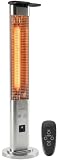
- INSTANT WARMTH: Relax on cool days with our patio heaters for outdoor use, delivering sun-like, odorless heat in seconds—no gas or propane needed. Two heat levels and a remote control ensure immediate, convenient comfort.
- WEATHER-RESISTANT: With an IP65 rating, this patio heater's aluminum alloy frame ensures durability and corrosion resistance, ideal for outdoor spaces.
- ENERGY EFFICIENCY - Our ETL-certified 900-watt infrared outdoor space heater features high-efficiency carbon fiber heating elements. With an 88% efficiency rating, this heater helps reduce your energy costs.
- 15 SQ. FT. HEATING RANGE: The 37.4" outdoor patio heater effectively warms areas up to 15 sq. ft, making it ideal for gazebos, patios, outdoor cafes, and various indoor or outdoor living spaces.
- SAFETY FEATURES: This outdoor heater includes a 360-degree tip-over switch, overheat protection, and a mesh guard to prevent contact with the heating element, ensuring safety for children and pets.
Porch with a soffit, recess, or low ceiling
A recess can trap heat and interfere with exhaust. Sunpak’s guidance specifically says heaters should never be located in a ceiling recess or soffit. Even if the ceiling is concrete or another noncombustible material, the appliance may still need combustion-air and exhaust space and additional separation from heat-sensitive finishes.
Recommended Free Tools
Porch attached to a home or enclosed by windows
Treat operable windows and doors as part of the enclosure analysis, not as guaranteed ventilation. If closing them changes the porch from open to enclosed, the heater may no longer be permitted. A fuel-burning unit should not be used where the manual prohibits enclosed operation.
Local codes and professional review
Manufacturer instructions are only one part of compliance. Fire, fuel-gas, electrical, building, condominium, and landlord rules may impose additional requirements for clearances, mounting, fuel storage, wiring, or permits. Sunpak directs installers to follow applicable local codes.
The Town of Centre Wellington Patio Heaters Safety Checklist is an example of local-government guidance for restaurant owners and operators. It can help identify questions to ask, but it is not a nationwide rule and does not decide whether a residential porch in another jurisdiction is compliant.
Ask the local authority or a qualified installer for a site-specific answer when the manual and porch conditions do not line up clearly, when gas piping or fixed wiring is involved, or when the heater will be used at a business or shared property.
PC Slower Than It Used to Be?
A free scan shows the junk files, broken settings and background clutter dragging Windows down - then fixes them in one click.Free scan · Windows 10 & 11Outdated Drivers Are Slowing You Down
One free scan finds every outdated or missing driver and matches the right update for your exact hardware.Free scan · exact hardware matchCommon mistakes and what to do instead
| Mistake | Why it fails | Safer response |
|---|---|---|
| Using the clearance from a different heater | Heat shields, reflectors, output, and mounting angles differ by model. | Use only the current manual for the exact model and configuration. |
| Assuming a roof means “outdoors” | Walls, screens, windows, and shades can limit airflow and trap heat. | Document the number of permanently open sides and compare it with the manual. |
| Installing a gas heater in a soffit or recess | The recess can restrict combustion air and exhaust and concentrate heat. | Follow the manufacturer’s prohibited-location instructions; relocate or obtain professional review. |
| Adding a fan or opening a door to justify a prohibited setup | Improvised airflow does not establish the approved ventilation pattern. | Use only a configuration the manufacturer expressly permits. |
| Measuring only to the ceiling | Walls, screens, glass, furniture, plants, and fabrics may also need separation. | Measure every nearby combustible or heat-sensitive surface and object. |
| Closing screens or curtains after installation | The enclosure and airflow may change while the heater is operating. | Keep the approved opening arrangement in place whenever the heater runs. |
Final pre-use checklist
- The model and current manual are identified.
- The manual expressly covers the porch’s roof, walls, screens, and open-perimeter arrangement.
- Overhead, side, and other required clearances have been measured from the correct reference points.
- Furniture, plants, curtains, umbrellas, glass, vinyl, paint, and stored items are outside the required zones.
- A fuel-burning heater has the required fresh-air and exhaust conditions; an electric heater has the required outdoor rating and electrical installation.
- Any required heat shield, reflector position, bracket, or mounting arrangement is installed exactly as specified.
- Local fire, building, fuel-gas, electrical, condominium, or landlord requirements have been checked.
- No condition depends on an improvised fan, open door, or temporary workaround.
If any box cannot be checked, do not use the patio heater under that covered porch. The correct answer is model- and site-specific, and the safest installation is the one that can be demonstrated from the current instructions and applicable local requirements.
Quick Recap
Product prices and availability are accurate as of the date/time indicated and are subject to change. Any price and availability information displayed on Amazon at the time of purchase will apply.

