Yes, but only on a small and carefully engineered scale. A thermoelectric cooler, or Peltier module, can cool a small insulated box and may freeze a small load. It is much harder to build a dependable freezer that maintains 0°F (-18°C) or below throughout its usable space. For long-term food storage, a compressor freezer remains the practical choice.
The central design rule is simple: a Peltier module does not create cold. It moves heat from its cold face to its hot face, while also adding its electrical input to the hot-side heat load. If the hot side cannot reject that combined heat, the cold side will stop cooling effectively.
As an Amazon Associate I earn from qualifying purchases.
Can a Peltier cooler really make a freezer?
It depends on what you mean by “freezer.” These projects fall into several different categories:
Free tools Windows power users keep installed
One-click scans. No signup required.
- Cooler: Keeps contents below room temperature.
- Refrigerator: Maintains roughly 35–40°F (2–4°C).
- Soft-freezer: May freeze water or thin items but cannot reliably hold a full load at freezer temperature.
- Freezer: Maintains 0°F (-18°C) or below throughout the storage volume.
- Cold plate: Cools a small metal surface, sample, or container without necessarily cooling an entire enclosure.
A well-insulated experimental box can approach freezing, particularly when it starts empty and the ambient temperature is moderate. Reaching and maintaining -18°C under realistic load is a substantially more demanding target. The FDA recommends maintaining a food freezer at 0°F (-18°C) or below and checking it with an appliance thermometer. See the FDA’s food-storage guidance.
#1 Best Overall

- Please identify the "diymore" store.
- Model: TEC1-12706.
- Size: 40mm x 40mm x 3.6mm.
- Refrigeration power: Qcmax 50-60W.
- Operation Temperature: -30°C-70°C(-86℉-158℉)
Do not call a project a freezer because its cold plate briefly reaches a low temperature. The air, walls, and contents must all remain at the target temperature under load.
How thermoelectric cooling works
A TEC module uses direct current to create a temperature difference between two ceramic faces. One face becomes cold and the other becomes hot. Reversing the polarity reverses the hot and cold sides, so the same module can theoretically heat or cool.
The module must be clamped evenly between two flat thermal surfaces:
Do these 3 things before closing this tab:
1Repair Windows errors before they cause bigger problems2Fix the driver behind crashes, sound loss and screen glitches3Clear out junk files and repair common Windows errors- Hot-side heat sink or liquid heat exchanger.
- Thin layer of thermal compound.
- Thermoelectric module.
- Thin layer of thermal compound.
- Cold plate or cold-side heat exchanger.
Heat moves through the module while the module consumes electricity. The relationship is:
Qhot = Qcold + Pelectrical
For example, a module drawing approximately 12 V at 6 A consumes about 72 W. If it removes 20 W from the box, the hot side may need to reject about 92 W, plus fan, wiring, and power-electronics losses.
A representative TEC1-12706 specification lists approximately 6 A maximum current, 15.4 V maximum voltage under specified conditions, 53 W maximum cooling capacity at zero temperature difference, and a 67°C maximum temperature difference at zero cooling load. These are different test conditions. They do not mean the module can provide 53 W of cooling while maintaining a 67°C temperature difference.
Why most DIY Peltier freezers disappoint
The hot side is usually undersized
The hot-side heat exchanger is not an accessory. It is the part that determines whether the system can continue operating. Use a large finned heat sink, forced-air cooling, or a liquid loop sized for the total heat load. Include thermal compound, flat mating surfaces, even clamping pressure, and an airflow path that prevents hot exhaust from returning to the intake.
Recommended Free Tools
Install a hot-side temperature sensor and an independent shutdown. A fan failure, blocked intake, or loose heat sink can make the hot side rise rapidly. Manufacturer guidance warns that operating a TEC without adequate heat removal can damage the module and create a burn hazard; a small included hobby heat sink is not automatically suitable for continuous full-power operation.
Cooling capacity falls as temperature difference rises
Maximum cooling capacity is generally specified at little or no temperature difference. As the cold side gets colder relative to the hot side, the amount of heat the module can pump falls. A hot heat sink makes the situation worse.
That is why reaching approximately 0°C at a small cold plate is much easier than maintaining -18°C throughout an insulated box. The Microchip Peltier reference design treats temperature sensing, current monitoring, fan-failure detection, and over-temperature shutdown as design requirements. Its target was approximately 0°C, not a household freezer.
Rank #2

- Adopt premium Aluminum+TEC1-12706 semiconductor chilling plate, could long-term use. Complete sealed structure, isolating the moisture in the air. Power Supply: DC 12V.Max Power:120W.
- Small Size Design, save space,can be use anywhere,easy to install. DIY Peltier Kit include TEC1-12706 semiconductor cooler and other accessories
- Easy to use, completely assembled,you have no need to use your hands,save time. Positive red and negative black
- High cooling efficiency, equipped with cool fan for better heat dissipation,easily cooling down within a few minutes. no noise, no vibration, no refrigerant required.
- Great Peltier Cooler DIY kit for electronic enthusiasts in semiconductor cooling applications,suitable for computer heatsink ,small splace cooling. Also used for pet bed cooling,plate cooling,test bench,cardboard box, Pantry,wine cellar,ect
Warm contents create a large temporary load
Maintaining an already-cold box is one task. Pulling warm food or drinks down to freezing temperature is another. Warm contents, repeated lid openings, humid air, and newly formed frost can overwhelm a system that appears to work with an empty enclosure.
Condensation and frost reduce performance
Any surface below the dew point will collect condensation. Below freezing, that moisture becomes frost. Frost insulates the cold plate, blocks airflow, adds thermal mass, and can expose electronics to moisture. Use a gasketed lid, seal the cold-side penetration, protect wiring, and plan for drainage and defrosting.
Choose a realistic target
For a first build, target a small experimental cold box or cold plate rather than a household freezer. Keep the internal volume small, use thick rigid closed-cell foam, and cool a modest payload that is already near the desired temperature.
A useful progression is:
- Cool a metal plate and verify hot-side control.
- Cool a very small insulated box with no contents.
- Test with a measured water or thermal-mass load.
- Test at the highest expected ambient temperature.
- Only then consider whether the system can maintain a freezer temperature under load.
Parts you will need
- Small insulated enclosure made from thick rigid closed-cell foam.
- Removable, moisture-resistant inner liner.
- One or more TEC modules with a genuine datasheet.
- Flat aluminum cold plate.
- Large hot-side heat sink or liquid heat exchanger.
- Fans with adequate airflow and, ideally, tachometer feedback.
- Thermal compound and controlled mounting hardware.
- Regulated DC power supply with current margin.
- Fuse, suitable wire, enclosed terminals, and strain relief.
- Cold-side temperature sensor.
- Hot-side heat-sink sensor.
- Controller with hysteresis and independent over-temperature cutoff.
- Appliance thermometer or other verified temperature instrument.
- Gasket, sealant, cable grommets, and insulation for the wall penetration.
Size the cooling system
Module count should not be chosen from enclosure volume alone. Estimate the total heat load:
Qtotal = Qwall + Qair leakage + Qcontents + Qthermal bridges + Qmiscellaneous
Wall heat leak
Heat entering through the walls depends on surface area, insulation thickness and conductivity, ambient temperature, target temperature, gaps, compression, and thermal bridges. A small box with thick, continuous foam is generally more practical than a large box with thin insulation.
Minimize metal screws, brackets, hinges, wiring paths, and other conductive connections between the interior and exterior. Seal every seam. A poorly insulated TEC penetration can conduct heat directly back into the cold compartment.
Air leakage
A loose lid introduces warm, moist air. That adds sensible heat, causes condensation, and creates frost. Use a compressible gasket and a lid that closes evenly. Keep cable pass-throughs small and sealed.
Contents
Separate the energy required to freeze the contents from the energy required to maintain them. Test with a measured water load or thermal mass before using food. A box that reaches a low temperature empty may fail as soon as warm contents are added.
Outdated Drivers Are Slowing You Down
One free scan finds every outdated or missing driver and matches the right update for your exact hardware.Free scan · exact hardware matchPC Slower Than It Used to Be?
A free scan shows the junk files, broken settings and background clutter dragging Windows down - then fixes them in one click.Free scan · Windows 10 & 11Build the insulated enclosure
Use a small rigid foam box with accurately cut panels and sealed joints. Add a removable inner liner so moisture and frost can be cleaned out. Fit a gasket around the lid rather than relying on a loose cover.
Rank #3

- 【Easy to install】An excellent DIY kit for electronic enthusiasts in semiconductor refrigeration applications,Completely assembled,you have no need to use your hands,save time. Positive red and negative black,easy to install.
- 【High quality and Durable】The complete sealing structure isolates the moisture in the air,Using high-quality aluminum + TEC1-12706 semiconductor cooling plate, durable.
- 【High cooling efficiency】 This semi-conductor cooler includes a large radiator, 2 cooling fans, 2 large fans and 2 cold-end modules.easily cooling down within a few minutes. no noise, no vibration, no refrigerant required.Power Supply: DC 12V.Max Power:144W.
- 【Mini size design】Easy to install,Save space, can be installed anywhere,compact size (200 * 120 * 95mm / 7.87 x 4.72 x 3.74 inches) DIY Peltier Kit include TEC1-12706 semiconductor cooler and other accessories.
- 【 Best assistant for small space cooling】Suitable for computer heatsink ,small splace cooling. Also used for pet bed cooling,plate cooling,test bench,cardboard box, Pantry,wine cellar,ect
Mount the cold plate through one wall and insulate around the penetration. Avoid a large uninsulated metal panel that connects the cold interior to the warm exterior. Keep the hot-side heat exchanger entirely outside the insulated volume, with clear intake and exhaust airflow.
Do not place exposed electronics inside the cold compartment. Condensation can cause corrosion or short circuits even when the box appears dry during initial testing.
Mount the TEC correctly
Clean both mating surfaces and check that they are flat and parallel. Apply a very thin, continuous layer of thermal compound. Clamp the assembly evenly, tightening gradually in a cross pattern. Excessive or uneven pressure can crack the ceramic plates.
The Tool Desk
Outbyte Driver Updater FREEFix the driver behind crashes, sound loss and screen glitchesFind Drivers →Outbyte PC Repair FREERepair Windows errors before they cause bigger problemsFix Now →Confirm polarity before prolonged operation. On first power-up, verify that the intended cold side cools and the hot side warms. Do not reverse polarity while the module is hot. One supplier recommends allowing more than 15 minutes for thermal equalization before changing heating and cooling direction.
Power and wiring
A single TEC1-12706 may draw several amps. A regulated supply rated around 12 V and at least 6 A can be a starting point for one module, but it is not a universal recommendation. The exact requirement depends on operating current, controller behavior, fans, wiring losses, and desired margin.
Use:
- A fuse close to the DC supply.
- Wire and connectors rated for continuous current.
- An enclosed, ventilated power section.
- Strain relief on all cables.
- Voltage measurement at the module while operating.
- A supply with enough capacity that its voltage does not collapse under load.
Do not connect a TEC to an unverified adapter simply because its label says “12 V.” Multiple modules multiply both the power requirement and the hot-side rejection requirement. Add modules only after the heat exchanger, wiring, supply, and controls are sized for the combined load.
A current-controlled driver or suitable PWM controller is preferable to crude high-load switching. Driver heat, PWM frequency, current ripple, and module operating current all matter. A hobby W1209-style thermostat can provide basic temperature control, but it is not a complete safety system: it may not detect a stalled fan, overheated heat sink, disconnected sensor, or stuck relay.
Quick wins for a faster PC:
Scan for outdated or missing drivers - takes under a minuteDriver Scan →Repair Windows errors before they cause bigger problemsFix Now →Temperature-control and safety logic
Use separate measurements for the cold compartment and hot-side heat sink. The internal sensor should represent the air or contents, not be attached directly to the cold plate.
A robust control sequence should:
- Read the internal temperature.
- Read the hot-side temperature.
- Verify fan operation through tachometer feedback or fan-current monitoring.
- Enable the TEC only when all safety conditions pass.
- Shut down the TEC if the hot side exceeds its limit.
- Keep the hot-side fan running during cooldown after TEC shutdown.
- Alarm if the internal temperature rises beyond the permitted threshold.
- Record minimum, maximum, and duration of temperature excursions.
Add hysteresis to prevent rapid cycling. Consider an independent maximum-runtime cutoff, watchdog, low-voltage protection, and door-open detection for unattended operation.
Independent reader supportYour contribution helps us test, update, and keep practical guides available for everyone.Commissioning procedure
1. Test without contents
Check polarity, fan direction, current draw, supply voltage, sensor readings, and hot-side temperature. Stop immediately if the heat sink temperature rises uncontrollably. Confirm that the hot exhaust is not recirculating into the intake.
Rank #4
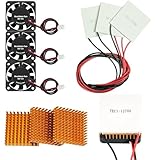
- Peltier cooler:Compatible with for Making Portable Coolers Hot and Cold Water Dispensers 3D Printers CPU Coolers
- Size:40*40*10mm
- Operating current:IMAX=4.3-4.6A(at rated 12V)
- Rated voltage:12V (VMAX:15V starting current 5.8A)
- Commodities include:3Pcs Peltier Cooler Cooling;3Pcs Aluminum Heat Sinks;3Pcs 12V Cooling Fan;16 Pcs Fan mounting screws
2. Test with a measured thermal load
Use water or another known thermal mass. Record ambient temperature, internal temperature, hot-side temperature, supply voltage, TEC current, fan status, time to reach each temperature, and recovery time after opening the lid.
What’s actually slowing this PC down?
Pick the symptom - the matching free tool is one click away.
3. Test worst-case conditions
Repeat the test at the highest expected ambient temperature with the intended load. Include lid openings, a power interruption, sensor disconnection, a slowed or blocked fan, and frost accumulation. An empty-box test is not enough to establish freezer performance.
Troubleshooting
| Symptom | Likely causes | What to check |
|---|---|---|
| Cold side barely cools | Wrong polarity, inadequate power, poor thermal contact, or hot-side overheating | Measure voltage and current at the module; check mounting and heat-sink temperature. |
| Hot side overheats | Small heat sink, weak fan, blocked airflow, or poor contact | Shut down the TEC, keep the fan running, then inspect the thermal stack and airflow. |
| Temperature stops dropping | Cooling capacity has fallen at the temperature difference, or heat leak is too high | Improve insulation and heat rejection before adding modules. |
| Frost forms quickly | Humid air leakage or an exposed cold surface | Improve the gasket, dry the box, protect the penetration, and establish a defrost routine. |
| Controller cycles rapidly | Insufficient hysteresis or sensor mounted on the cold plate | Move the sensor into representative air or contents and widen the control band. |
| Power supply shuts down | Over-current protection, voltage collapse, undersized wiring, or a short | Measure loaded voltage, inspect connectors, and verify the supply rating. |
| Module cracks or fails | Uneven clamping, excessive pressure, thermal shock, or overheating | Check flatness and use gradual, even clamping. |
| Box cools empty but not loaded | Warm-content load exceeds available cooling capacity | Reduce payload, pre-cool contents, improve insulation, or choose a compressor system. |
Is a homemade TEC box safe for food?
Not automatically. Food should not be treated as safely frozen because a cold plate feels cold or because an empty box briefly reaches a low reading.
Use a verified thermometer at representative points and demonstrate stable operation at or below 0°F (-18°C) under the full intended load. Also test recovery after lid openings and power interruptions. Freezing slows bacterial growth but does not kill most bacteria, and food safety cannot be judged reliably by appearance or odor after a temperature excursion.
Until the enclosure has demonstrated stable, monitored performance, use it for non-food experiments rather than long-term food storage.
Thermoelectric versus compressor refrigeration
| Criterion | Thermoelectric system | Compressor system |
|---|---|---|
| Mechanical design | Modules, heat exchangers, fans, power electronics, and controls | Compressor, refrigerant circuit, condenser, evaporator, and controls |
| Moving parts | The TEC has none, but practical systems use fans or pumps | Compressor and usually fans |
| Noise | Can be quiet with properly sized fans | Compressor cycling and fan noise |
| Efficiency at freezer temperatures | Generally poor for large, continuous temperature differences | Usually much better for sustained freezer loads |
| Small cold plate | Excellent fit | Often excessive |
| Household freezer | Poor fit in most DIY applications | Appropriate technology |
| Portability | Convenient at low DC voltage | 12-V compressor units are available but more complex |
The absence of a compressor does not mean low energy use. The TEC, fans, controller, and power supply consume energy, and nearly all of it ultimately becomes heat on the hot side.
Better alternatives
- Compressor chest freezer: Best for dependable long-term frozen food storage and larger volumes.
- 12-V compressor refrigerator/freezer: Better for vehicles, boats, RVs, and battery systems when true freezer temperatures are required.
- Commercial thermoelectric cooler: Convenient for portable, refrigerator-like cooling, although many are designed only to cool below ambient.
- DIY Peltier cold plate: The best narrow project for learning temperature control, current monitoring, and thermal design.
A TEC module with a small included heat sink is a poor fit for a household-size freezer, rapid freezing of warm food, unattended operation without independent protection, or battery-powered service where efficiency matters.
Final verdict
Build a thermoelectric freezer project if your goal is experimentation, portability, silent operation, reversible heating and cooling, or a small specialized cold load. Start with a cold plate or very small, heavily insulated box.
Do not assume that a cheap TEC1-12706 can replace a household freezer. Its headline cooling and temperature-difference figures are maximum values measured under different conditions, and the hot side must reject both pumped heat and electrical input. For reliable -18°C food storage, buy or build around a compressor-based refrigeration system instead.
Quick Recap
Product prices and availability are accurate as of the date/time indicated and are subject to change. Any price and availability information displayed on Amazon at the time of purchase will apply.

