PC Slower Than It Used to Be?
A free scan shows the junk files, broken settings and background clutter dragging Windows down - then fixes them in one click.Free scan · Windows 10 & 11Outdated Drivers Are Slowing You Down
One free scan finds every outdated or missing driver and matches the right update for your exact hardware.Free scan · exact hardware matchUsually, no: trees do not literally explode in extreme cold. But a tree can split suddenly along its trunk or a major limb, producing a sharp report that sounds like a gunshot. The arboricultural term for this is a frost crack, also called frost cracking, winter cracking, or, in some Extension publications, southwest injury.
The real danger is not wooden shrapnel or a blast wave. It is the structural weakness created by a split trunk or limb, especially when the damaged tree stands over a house, driveway, road, vehicle, playground, or utility line.
As an Amazon Associate I earn from qualifying purchases.
What people call an “exploding tree” is usually a frost crack
A frost crack is a longitudinal split in a tree’s bark and underlying wood. It may run vertically along the trunk, begin near the root flare, or occur in a large branch. USDA forestry guidance describes many cracks beginning just above ground level—often on the south side—and extending several feet upward. A crack may close during warmer weather and reopen during later winters.
Do these 3 things before closing this tab:
1Repair Windows errors before they cause bigger problems2Scan for outdated or missing drivers - takes under a minute3Clear out junk files and repair common Windows errorsWhen the split occurs abruptly, the sound can be startlingly loud. University Extension sources compare it to a discharged shotgun or rifle. That loud report is why videos and social-media posts sometimes describe the event as a tree “explosion.” The more accurate description is: the tree cracked loudly; it did not normally detonate or blow apart. [CIT001] [CIT002] [CIT003] [CIT004]
#1 Best Overall

- Sharp Mn Steel Blade for Fast & Clean Cuts: This pole saw uses a sharp three-sided edge with a double-sided barb design to grip branches securely and cut smoothly from multiple angles. The Mn steel blade is durable, rust-resistant, and lightweight, delivering fast, clean cuts. This is a manual pole saw with detachable pole sections for adjustable reach, not pruner, not a telescoping pole; it is neither electric nor battery-powered.
- Sturdy Steel Pole Reinforced for Secure Use: This tree branch cutter combines stainless steel poles and Mn steel blade, built for long-term use. The powder-coated finish prevents rust, and the anti-slip grip ensures stable control. An extra screw secures the saw head firmly to the pole, preventing loosening. Strong enough to prune higher branches without climbing ladders, it helps reduce risks and makes outdoor trimming safer and more reliable.
- Adjustable Length & Quick Assembly: This tree trimmer has three options: 8.5ft (6 sections), 11ft (8 sections), and 14.5ft (11 sections). Each stainless steel pole is rust-resistant with a matte finish for durability. The modular design lets you connect or remove sections quickly to adjust the length. Simple to assemble in a few steps, it adapts easily to close hand pruning or trimming tall trees, saving time and effort in your yard work.
- Safe High Reach Pruning Without Ladders: This lightweight manual cutting saw extends up to 14.5ft, letting you prune tall branches from the ground without ladders. It reduces fall risks and increases safety, while the anti-slip grip lowers fatigue. Easy for women and seniors to handle, it makes tall tree pruning, patio care, and yard maintenance more efficient. A reliable tool that combines safety and comfort for long-term outdoor use.
- Versatile Pruning Saw for Garden & Forestry: This extendable pruning saw works both handheld and extended for shrubs, hedges, and tall branches. Use it short for close trimming or fully extended for oaks, palms, pines, and firs. Perfect for yards, gardens, patios, and forestry tasks, it suits both home gardening and professional landscaping. With one tool for high and low pruning, it saves space while providing durable, versatile performance.
Why extreme cold can split a tree
Frost cracking is best understood as a stress problem involving temperature differences, contraction, moisture, and weak points in the wood. No single mechanism explains every crack, and the exact process varies with species, weather, tree condition, and the location of earlier injuries.
Rapid heating and cooling
On a bright winter day, sunlight can warm the south or southwest side of a trunk while the shaded side remains much colder. The outer bark, cambium, and wood do not all change temperature or contract at the same rate.
When the sun disappears, a cloud blocks the sunlight, or the air temperature drops rapidly after sunset, the previously warmed side can cool quickly. The resulting difference in temperature and contraction creates tension. If that tension exceeds the strength of the bark and wood, the trunk or limb may split vertically. This is why the south and southwest sides are frequently involved: they receive the strongest low winter sun in many locations. [CIT002] [CIT003] [CIT004]
Freezing water and moisture changes may add stress
Extension materials also describe the role of water in tree tissues. Freezing water can create pressure, while the loss of water and associated contraction can enlarge an existing weakness. It would be misleading, however, to say that the sap in every tree simply freezes solid and causes an explosion. Tree physiology is more complicated, and the risk depends on species, acclimation, moisture status, and the severity and speed of the weather change. [CIT001] [CIT005]
Most cracks exploit an earlier defect
Extreme cold may trigger or extend a frost crack, but the split often follows a weakness that existed beforehand. Possible starting points include:
- an old branch stub or poorly healed pruning cut;
- a basal sprout stub near the trunk base;
- a canker or area of disease;
- mower, string-trimmer, vehicle, or other mechanical damage;
- insect injury or decay;
- included bark or a weak branch union; and
- damage from an earlier frost crack.
Iowa State’s discussion of frost cracks is useful because it contrasts the traditional explanation—a warmer inner core constrained by a rapidly contracting outer layer—with research emphasizing a notch effect. In that explanation, an earlier fault concentrates stress in the same way a notch concentrates stress in a piece of material. The severe cold supplies the trigger, but the tree’s pre-existing defect helps determine where the crack forms. [CIT001]
What a frost crack looks and sounds like
A typical frost crack is a straight or somewhat irregular vertical seam in the trunk or a major limb. It may:
The Tool Desk
Outbyte Driver Updater FREEScan for outdated or missing drivers - takes under a minuteDriver Scan →Outbyte PC Repair FREERepair Windows errors before they cause bigger problemsFix Now →Rank #2

- High Cutting Power for 6–7 Inch Branches with SK-5 Steel Blade——SK-5 steel blade with aggressive 7 TPI staggered teeth delivers strong cutting performance for green wood, branches, and general yard work, allowing efficient cutting of branches up to 6–7 inch diameter, making it highly effective for camping, survival, bushcraft, and landscaping tasks where fast and controlled wood cutting is required.
- Optimized Sharpness and Sawing Performance for Wood Cutting Tasks——Aggressive staggered tooth geometry combined with SK-5 steel construction provides effective cutting performance for green wood, branches, firewood, and outdoor materials, helping reduce cutting resistance and supporting efficient sawing in outdoor use scenarios.
- Lightweight Folding Design for Backpacking, Camping, and Survival Kits——Lightweight and compact folding structure makes this saw easy to carry in backpacks and survival bags, providing strong portability for camping, hiking, bushcraft, and emergency outdoor use, while maintaining full cutting capability without adding unnecessary weight.
- Reinforced Blade Structure for Improved Stability and Long-Term Use——Reinforced blade design improves structural stability during heavy cutting tasks, helping maintain consistent performance during repeated use in wood cutting applications, addressing common outdoor tool concerns such as blade tip stress during intensive branch cutting.
- Ergonomic Rubber-Coated Handle for Secure Grip and Outdoor Control——Ergonomic rubber-coated polymer handle provides a firm and stable grip in wet, cold, or dry conditions, improving safety and control during extended outdoor use, reducing hand fatigue and ensuring reliable handling in camping, survival, and landscaping environments.
- open suddenly with a sharp, gunshot-like sound;
- begin near the lower trunk or root flare and extend upward;
- appear on the south or southwest side;
- close partially when temperatures rise;
- reopen during another cold spell; or
- develop raised ridges, bulges, or “frost ribs” along the edges after repeated injury.
The visible opening may become less obvious in spring, but that does not prove the wood has returned to its original strength. New tissue can grow over the wound while the internal split remains. Repeated opening and closing can also create pathways for decay fungi and insects. [CIT001] [CIT004]
Which trees are most vulnerable?
Thin-barked trees are generally more susceptible because their tissues can experience more abrupt temperature changes. Purdue Extension identifies maples, redbuds, apples, and crabapples among trees that can be prone to frost cracking. University of Delaware materials also identify maple and cherry as susceptible groups.
Oaks, maples, and lindens are frequently mentioned in cold-climate discussions, but no species is automatically safe or destined to crack. Susceptibility depends on the particular species and variety, local adaptation, age, bark thickness, site, tree vigor, weather pattern, and prior injury. A healthy, well-adapted tree may tolerate conditions that damage a stressed tree of the same general type. [CIT002] [CIT003] [CIT006]
Risk may also increase when a tree has been affected by:
Recommended Free Tools
- drought stress;
- herbicide injury;
- insect damage or disease;
- poor pruning;
- root or trunk damage; or
- another structural defect.
A previous frost crack matters too. A tree may remain alive and functional for many years after one, but the repaired area is often weaker than undamaged wood and may reopen at the same location. [CIT001] [CIT002] [CIT004]
Is there a temperature at which trees “explode”?
There is no universal trigger temperature. Frost-crack risk is determined by a combination of extreme cold, the speed of the temperature drop, winter sunlight, freeze-thaw cycling, species, bark thickness, tree condition, and existing defects.
Some media accounts cite temperatures around -20°F to -40°F for frost cracks in particular healthy, mature trees with relatively thick insulating bark. That range should not be treated as a rule. A vulnerable tree can split under a different set of conditions, and a tree exposed to those temperatures may not crack at all. Extension guidance does not support a single thermometer reading that predicts the event for every tree or region. [CIT002]
Rank #3

- Razortooth saw technology removes more material in each pass
- 3 sided razor teeth efficiently cut limbs up to 7 in.
- High-carbon steel blade made of japanese sk5 steel
- Chrome-plated blade reduces friction and improves tree trimming efficiency
- Ergonomic comfort handle with pistol grip
Could a loud winter bang be something else?
Yes. A dramatic sound in cold weather does not by itself identify a frost crack. Other possibilities include:
- A limb breaking under snow or ice: accumulated weight can overload branches, particularly when combined with wind.
- Wind-related structural failure: a weak branch union, decayed section, or partially split limb may fail during a gust.
- Lightning damage: lightning can rupture wood through a separate heat-and-vapor mechanism.
- An existing split opening: a crack that formed earlier may suddenly separate farther as temperatures change.
These events can look similar in a short video or photograph, but they have different causes and may require different responses. Heavy snow, ice, wind, and lightning should not be conflated with ordinary cold-triggered frost cracking. [CIT008] [CIT010]
Are frost cracks dangerous?
The crack itself is not normally an explosion hazard to someone standing nearby. However, a split trunk, major limb, or branch union can have reduced structural strength. The damaged part may fail immediately or later under wind, snow, ice, or its own weight.
Risk is especially important when the tree has a target beneath it or nearby, such as:
- a home or other occupied building;
- a road, sidewalk, or driveway;
- a parked vehicle;
- a playground or sitting area; or
- an overhead utility line.
The size and depth of the crack, its position, decay, included bark, codominant stems, lean, dead branches, and target occupancy all affect the decision to retain, prune, stabilize, or remove a tree. A photograph cannot reliably establish that a major crack is safe.
Quick wins for a faster PC:
Clear out junk files and repair common Windows errorsFree Scan →Fix the driver behind crashes, sound loss and screen glitchesFind Drivers →Repair Windows errors before they cause bigger problemsFix Now →Keep away from split stems, hanging limbs, leaning trees, and trees near energized power lines. Do not climb the tree, shake ice from its branches, brace it improvisedly, or use a chainsaw on a potentially damaged structure unless you are qualified. ISA and University Extension guidance recommend professional help when work requires a ladder or chainsaw, when a limb is unsupported or hanging, when utility lines are involved, or when the owner cannot judge whether the tree is safe. [CIT007] [CIT008] [CIT009] [CIT010]
Can a tree recover from a frost crack?
Many trees can compartmentalize the injury and grow new tissue over the outside of the crack. Some remain alive for years or decades. “Heal,” however, needs qualification: the tree can seal, close over, or compartmentalize the visible wound, but it may not restore the original internal strength.
Rank #4

- Safe And Efficient - The Karveden telescoping extension pole saws can reach up to 20FT. You can easily trim tall, difficult to reach branches. You can quickly adjust the length of the pole as needed without climbing a ladder. Pruning trees and shrubs will be easier and safer than ever before. It is designed for pruning high branches, but can also be used as a handheld saw to prune low branches, shrubs and logs.
- Steel Pole Saw Blade - Karveden 19" 3X sharpened tooth are made of high quality carbon steel for high cutting power, lightweight, durable and rust-resistant. The non-stick blade coating extends its life and ensures smooth and efficient cutting and trimming, saving you energy and time. You can use this hand saw for a variety of cutting jobs, such as trees, bamboo, PVC pipes and more.
- Double Security Design - There will be two blue foam cotton designs on the telescopic pole, making the grip more comfortable and very anti-skid. In order to make the connection between the pruning saw and the pole closer and less prone to falling, we have included a screw that can better connect the saw and pole, making it very safe and reliable.
- Multipurpose Extension Pole - The Karveden telescopic extension pole can adjust the smart 4-stage extension pole to any custom length from 5 to 20 foot with the flip-tab lock. The telescopic rod uses standard 3/4 "universal threads, which can complete all difficult to reach tasks. It can be adapted to various accessories, such as paint rollers, feather duster, light bulb changer!
- Great Service From Customer Support: Karveden is committed to providing quality products and good service to customers. We provide up to 1 year warranty service. Besides, we are constantly optimizing and improving the details of our products. Your suggestions may help us improve our products.
USDA guidance notes that cracks may grow over yet remain weaker than surrounding tissues. They can also provide entry points for decay fungi and insects. Iowa State similarly reports that trees with frost cracks are often capable of living with the injury, even when the crack recurs. Survival and structural safety are separate questions. [CIT001] [CIT004]
A crack in a small ornamental tree is not automatically a death sentence. It is also not proof that the tree is safe merely because the opening narrows in spring. A qualified assessment should examine the full tree, including the crack’s depth and length, decay, branch attachments, lean, deadwood, and the consequences of failure at that particular site. [CIT007] [CIT008]
What’s actually slowing this PC down?
Pick the symptom - the matching free tool is one click away.
What homeowners should do after finding a crack
1. Make the area safe
Keep people, pets, and vehicles away from the tree and from any limb that is hanging, partially detached, or resting under tension. Increase the exclusion area if the tree is leaning or the crack is widening.
2. Look from the ground only
Without climbing or pulling on anything, note whether the split affects the trunk, a major limb, or a branch union. Look for additional hazards such as dead branches, a pronounced lean, lifted roots, fresh breaks, or branches caught in other trees.
3. Document the changes
Photograph the crack from the ground and record its approximate location. Note whether it is on the south or southwest side, whether it opens during cold weather, whether it has reopened at an old seam, and whether nearby limbs are dead or broken. This information can help an arborist understand the pattern, but it is not a substitute for an inspection.
4. Arrange a qualified assessment
Contact an ISA Certified Arborist or another appropriately qualified tree-risk professional when the crack affects the trunk, a major limb, or a branch union—particularly if the tree is over a target. A professional can evaluate whether monitoring, pruning, cabling or other mitigation, or removal is appropriate. Referral availability and qualifications vary by location, so verify the provider’s credentials and insurance before work begins. [CIT007] [CIT008]
5. Treat power-line situations as specialized hazards
Never cut a tree or limb that is touching or could fall onto an energized power line. Keep clear and contact the utility or a qualified professional who is authorized to work around that hazard.
Best Value
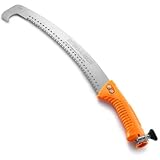
- NO BRANCH UNTRIMMED - This manual hand saw is expertly designed for those hard-to-reach pruning tasks. Pair this hand-held pruning saw with any standard US Acme threaded extension pole to optimize reach and keep your garden in impeccable shape.
- CUTTING EDGE DESIGN - Elevate your tree trimming experience with our specially designed hand saw. Designed for both hand-held use and pole attachment, it ensures safety and efficiency, delivering precise cuts even in challenging conditions.
- HAND HELD SAFETY. POLE REACH. - Achieving the perfect trim without a ladder has never been easier. With the option to attach the Pruning Manual Hand Saw to a compatible extension pole, you can safely prune those high tree limbs, keeping your feet firmly on the ground.
- OPTIMIZED FOR DURABILITY - Made with premium materials, our pruning saw is built to last. Whether you're tackling thin branches or more robust limbs, you can trust in the reliability and performance of our saw.
- EXTENDED 3-YEAR WARRANTY. EXTEND-A-REACH, FOR GOOD - we put our heart and soul into our pruning tools. So much so that we offer you an extended 3-year warranty for your prunning tree saw. As a family-run business who has faced hardship, we give back to our community by donating a portion of our profits to helping clean cancer patients' homes. Add to cart and take part in our mission to clean 100,000 cancer patients' homes.
What can help prevent future frost injury?
Prevention is mainly about reducing avoidable stress and protecting vulnerable young trees—not guaranteeing that an established tree will never crack.
- Maintain adequate water during drought, following local watering guidance.
- Avoid mower and string-trimmer injuries around the trunk.
- Use proper pruning practices and avoid leaving large stubs or making unnecessary cuts.
- Control pests and diseases before they create structural weaknesses.
- Place mulch in a broad, moderate layer, but keep it away from direct contact with the trunk.
- For young, thin-barked trees, follow local Extension recommendations for a correctly selected, reflective seasonal guard where appropriate.
A white tree guard may reduce solar heating and temperature swings on the lower trunk of some young, thin-barked trees. It is a preventive accessory, not a repair for an existing crack. Follow local guidance on installation and timing, and remove the guard in spring or when recommended; leaving protection on indefinitely can create other problems. [CIT002] [CIT003] [CIT005]
Seasonal tree wrap is not a universal cure. Recommendations differ by tree, climate, and purpose, and University of Delaware specifically advises against painting or covering an existing frost crack. Do not use wrap, paint, tar, or sealant as a DIY attempt to close a damaged trunk. The tree should form callus tissue naturally, while the structural condition is evaluated separately. [CIT003]
What not to do
- Do not paint, tar, or seal the crack. Covering the wound does not restore internal strength and may conflict with Extension recommendations.
- Do not assume a closed crack is gone. The internal split may remain and reopen in the next cold season.
- Do not climb into a damaged canopy. A limb under tension can move or fail unexpectedly.
- Do not shake snow or ice from branches. Winter-damaged branches may break while you are beneath them.
- Do not improvise a brace or cable. Incorrect hardware or placement can add risk rather than restore safety.
- Do not start chainsaw work simply because the damage looks small from the ground. Split wood can release stored energy unpredictably, and ladder- or chainsaw-dependent work is better left to qualified professionals.
The practical answer
Trees can split loudly in extreme cold, sometimes with a report that sounds like a gunshot. The normal phenomenon is a frost crack, not a true explosion. Rapid temperature changes and freezing-related stresses can trigger the failure, but an old wound, pruning defect, canker, decay pocket, or other weak point often determines where the crack occurs.
If the damage is limited to a minor twig in an isolated location, it may not represent an immediate hazard. A split trunk, major limb, branch union, hanging limb, or tree over a target is different: keep clear and arrange a qualified tree-risk assessment. The fact that the crack closes in warm weather does not establish that the tree is structurally sound.
Frequently Asked Questions
Can a tree really explode when it freezes?
A tree does not normally detonate in extreme cold. A trunk or major limb can split suddenly and make a gunshot-like sound, usually because of frost cracking. The event is a loud structural crack, not a blast that scatters the whole tree.
Do frost cracks happen only below a certain temperature?
No. There is no universal trigger temperature. Risk depends on the rate of temperature change, winter sunlight, freeze-thaw conditions, species, bark thickness, tree health, and earlier defects.
Free tools Windows power users keep installed
One-click scans. No signup required.
Should I seal or paint a frost crack?
No. Do not paint, tar, or seal the wound as a DIY repair. Extension guidance recommends allowing the tree to form callus tissue naturally. A crack in a trunk or major limb should be assessed for structural risk.
Will a tree survive a frost crack?
Many trees survive and grow new tissue over the visible wound, sometimes for decades. However, the internal split may remain weaker than surrounding wood, reopen in winter, or allow decay and insects to enter. Survival does not automatically mean safety.
When should I call an arborist?
Arrange a qualified assessment for a crack in the trunk, a major limb, or a branch union, especially when the tree stands over people, buildings, vehicles, roads, or utility lines. Keep away from hanging limbs and do not perform ladder or chainsaw work on a damaged tree.
The Bottom Line
Bottom line: Extreme cold can make a vulnerable tree split with an explosive-sounding crack, but the usual event is frost cracking—not a true explosion. Because the split can weaken a trunk or major limb even after it closes over, keep people away and have significant damage evaluated by a qualified arborist.
Quick Recap
Product prices and availability are accurate as of the date/time indicated and are subject to change. Any price and availability information displayed on Amazon at the time of purchase will apply.

