Yes—sometimes. A 4-ohm speaker can be used with an 8-ohm-rated receiver only when the exact receiver model’s manual permits a 4-ohm load and the complete wiring configuration remains within its limits.
Yes—sometimes. A 4-ohm speaker can be used with a receiver labeled for 8-ohm speakers only when the exact receiver model’s manual permits a 4-ohm load and your complete wiring configuration stays within its limits. The 8-ohm label alone is not enough to answer the question.
As an Amazon Associate I earn from qualifying purchases.
Before connecting the speakers, verify four things: the receiver’s minimum speaker impedance, the speaker’s minimum impedance, the receiver’s required impedance setting, and whether you will use one or two speaker pairs. If any of those details are unknown, avoid high-volume testing until you find the receiver’s official manual.
Quick wins for a faster PC:
Scan for outdated or missing drivers - takes under a minuteDriver Scan →Clear out junk files and repair common Windows errorsFree Scan →Why a 4-ohm speaker is harder for a receiver to drive
Speaker impedance is not the same as simple DC resistance. A loudspeaker’s impedance changes with frequency, so a speaker labeled “4 ohms” may present a higher or lower load at different points in its operating range. Its phase behavior and minimum impedance also affect how demanding it is for an amplifier.
#1 Best Overall

- Size: Full frequency cavity, 31 mm long, 28 mm wide, 15 mm thick.
- Shape: Rectangle; Diaphragm material: non-paper; Magnetic circuit form: internal magnetic.
- Mini speaker 4ohm 3w sound cavity adopts high-end built-in magnetic speakers, stable performance, tight sealing, convenient and reliable, clear sound, providing a long timefor you!
- Frequency Characteristics: Rated power: 3 (W); Rated impedance: 4 ohms (Ω); Frequency response: 500-20K (kHz).
- 4pcs 2" 4Ohm 3W Full Range Audio Speaker Stereo Loudspeaker for Arduino
In general, a lower impedance requires the receiver to deliver more current for a given output voltage. That increases stress on the receiver’s output stage, power supply, and cooling system. A nominal 4-ohm speaker can therefore be a substantially more difficult load than a nominal 8-ohm speaker—particularly at high volume, with bass-heavy material, or when the speaker’s impedance dips well below 4 ohms.
The nominal impedance printed on the speaker is only a starting point. When comparing a speaker with a receiver, look for the speaker’s published minimum impedance, not just its nominal rating.
Check the exact receiver model before connecting anything
Do not rely on a product family name, a retailer’s generic description, or the fact that another receiver in the same series accepts 4-ohm speakers. Manufacturers set different limits for different models.
Free tools Windows power users keep installed
One-click scans. No signup required.
In the receiver’s manual or technical specifications, search for wording such as:
- “4 ohms minimum”
- “4–16 ohms”
- “6 ohms or higher”
- A model-specific impedance selector or speaker-impedance menu
- Separate limits for one speaker pair versus A and B pairs used simultaneously
If the specifications say the receiver is designed only for 8-ohm-or-higher speakers and do not provide an approved 4-ohm operating mode, treat that as a no. Choose speakers within the stated range or use an amplifier designed for the load.
Examples from receiver manuals
Manufacturer documentation illustrates why the receiver model matters:
Rank #2

- INDOOR & OUTDOOR VERSATILITY - Experience studio-quality sound anywhere—by the pool, on the patio, in the garage, or on a bookshelf. These speakers are designed for flexible mounting and placement, delivering expansive acoustic dispersion in any open space.
- WEATHER & UV RESISTANT - Built to withstand the elements, these all-weather speakers feature a UV-resistant resin coating and a durable ABS enclosure. This protective design preserves sound integrity through every season by resisting sun and moisture.
- POWERFUL 3-WAY HIGH-FIDELITY SOUND - Digitally optimized for deep, rich bass, the synchronized 3-way component system and 4-inch woofer create a full range of sound. Enjoy accurate audio performance with clear highs and profound low-end response.
- BLUETOOTH EXPANSION READY - For the ultimate wireless setup, pair these speakers with a Bluetooth amplifier (recommend the DBTMA100, sold separately). This combination provides a seamless, high-performance indoor/outdoor audio experience.
- EXTENDED 2-YEAR WARRANTY COVERAGE – Enjoy with peace of mind knowing your speakers are backed by a standard 1-year warranty. Gain an additional year of protection by registering your product, ensuring reliable, long-term support.
| Receiver | What its documentation demonstrates |
|---|---|
| Denon AVR-S670H | Denon instructs users to select the 4-ohm setting when any connected speaker is 4 ohms. The 8-ohm setting is intended for systems in which all connected speakers are 8 ohms or higher. |
| Sony STR-ZA5000ES | Sony describes the 8-ohm setting for systems where all speakers are nominally 8 ohms or higher, and the 4-ohm setting for other speaker types. |
| Yamaha RX-A4A | Yamaha specifies at least 4 ohms for the front speakers and directs users with 4-ohm front speakers to select a 6-ohm-minimum setting. This shows why a setting label cannot be interpreted without that model’s manual. |
| Yamaha R-S700/R-S500 | Yamaha permits 4-ohm-or-higher speakers with one output set in the low-impedance position, but requires 8-ohm-or-higher speakers when both A and B outputs are used at the same time. |
| Denon PMA-800NE | Denon permits 4–16 ohms for one speaker set, but specifies 8–16 ohms when speaker systems A and B are both used. |
| Marantz SR6011 | Marantz specifies 4–16-ohm speakers and directs users to select the 4-ohm setting when any connected speaker is 4 ohms. |
These are examples, not interchangeable recommendations. A setting or specification from one model cannot be safely applied to another.
The practical compatibility checklist
- Identify the exact receiver. Record the full model number, including suffixes or regional variations.
- Find the official manual. Check the manufacturer’s support site, the printed manual, or the PDF supplied with the receiver.
- Find the minimum speaker impedance. Look for the speaker-connection specifications and any special restrictions.
- Check the speaker’s minimum impedance. A speaker labeled 4 ohms may dip below that value. If the manufacturer publishes an impedance curve or minimum figure, use it.
- Check the number of speaker pairs. Confirm whether the receiver allows your speakers with only A, only B, or A and B active together.
- Set the receiver exactly as instructed. Some models use a physical selector; others use an on-screen menu. Some require the receiver to be switched off before changing the setting.
- Test conservatively. Begin at moderate volume with good ventilation around the receiver. Do not start by running demanding music at maximum output.
Why the impedance setting matters—and what it cannot do
An impedance selector is a model-specific operating control, not a universal upgrade that turns an 8-ohm receiver into a high-current 4-ohm amplifier. Depending on the design, the setting may change protection thresholds, power-supply behavior, or other operating limits.
Use the setting exactly as the manual directs. Do not assume that choosing “4 ohms” makes every nominal 4-ohm speaker safe, especially if the speaker has a very low impedance minimum or difficult phase characteristics. Conversely, do not assume that an “8-ohm” label automatically forbids 4-ohm speakers when the manufacturer explicitly provides a compliant 4-ohm mode.
The A/B speaker-output trap
Using two pairs of speakers at once can create a lower effective load because the receiver may connect the pairs in parallel. That is why a receiver may permit one 4-ohm pair but require 8-ohm-or-higher speakers when both A and B outputs are active.
For example, a receiver manual may allow a single 4-ohm pair on the low-impedance setting but specify 8–16 ohms when A and B are used together. Follow the stricter limit for the actual configuration, not the more permissive limit listed for one pair.
An impedance-protected speaker selector can help in some multiple-room or multiple-pair installations by managing the load presented to the receiver. It does not override the receiver’s minimum-impedance rating, and it does not automatically make an unsuitable speaker combination safe. The selector’s own instructions and the receiver’s specifications must both be followed.
Rank #3
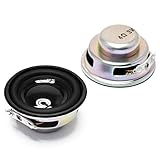
- 2pcs 4Ohm 3W 40mm Diameter Full Range Audio Speaker Stereo Woofer Loudspeaker
- Two mounted mini audio speakers, audio speaker stereo woofer, ideal for radio, interphone, multimedia speakers, can be used for Bluetooth Speakers, radio replacement, also suitable for DIY hobby soldering.
- resonance frequency : 320Hz±20%, Insulation Resistance : 10MΩ, characteristic sensitivity of loudspeaker : 83±3dB
- nominal impedance : 4Ω±15%, input-power rating : 2W
- rated frequency range : 0-20KHz, distortion factor : maximum 5%
What can happen if the load is too demanding?
If a receiver is asked to deliver high current into a load below its design limit, possible symptoms include:
- Excessive heat from the receiver’s chassis
- Audible distortion or clipping at moderate volume
- Unexpected shutdown
- Repeated entry into a protection mode
- Reduced output or sound cutting out during bass-heavy passages
- In the worst case, damage to the output stage or power supply
The risk increases with high playback levels, low-sensitivity speakers, demanding program material, poor ventilation, and speakers whose impedance falls substantially below their nominal rating.
A protection shutdown does not necessarily mean the speakers are defective. It may mean that the receiver is protecting its output circuitry or power supply. The opposite is also true: if the receiver does not shut down, that does not prove the combination is operating within specification.
The Tool Desk
Outbyte Driver Updater FREEScan for outdated or missing drivers - takes under a minuteDriver Scan →Outbyte PC Repair FREEClear out junk files and repair common Windows errorsFree Scan →If the receiver becomes hot or shuts down
- Stop playback and allow the receiver to cool.
- Turn the receiver off before changing speaker wiring.
- Check for stray wire strands touching another terminal or the receiver chassis. A short circuit can cause protection mode independently of impedance.
- Confirm the speaker impedance and the receiver setting.
- Disconnect the second speaker pair if A and B outputs are both in use, then check whether the manual permits the remaining pair.
- Improve ventilation and keep the receiver away from enclosed cabinets or heat-producing equipment.
- Do not continue increasing the volume to see whether the problem resolves. If shutdowns continue, use a receiver or separate amplifier rated for the speakers.
What to buy if your receiver is not 4-ohm compatible
If the receiver is rated only for 8-ohm-or-higher speakers, the safest options are:
- Choose speakers whose nominal and minimum impedance meet the receiver’s published limit.
- Replace the receiver with a model whose manual explicitly permits the intended 4-ohm load.
- Use a separate amplifier designed to drive the speakers, provided the receiver and amplifier can be connected correctly.
- For multiple speaker pairs, use an appropriately rated impedance-protected selector only after confirming that the complete arrangement remains within specification.
If you are shopping for 4-ohm speakers, treat the receiver’s manual as the deciding document. Do not assume that every speaker sold as “4 ohm” has the same minimum impedance behavior or that every receiver with an impedance switch can safely drive every 4-ohm design.
Independent reader supportYour contribution helps us test, update, and keep practical guides available for everyone.When a 4-ohm speaker is a reasonable match
The pairing is generally reasonable when all of the following are true:
Rank #4
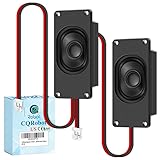
- Rated power 2.0W RMS, maximum output 3.0W, sealed enclosure delivers loud, clear and stable sound with low distortion, perfect for compact audio and voice output projects
- 4 ohm impedance plus/minus 15%, standard matching value, easily driven by amplifier boards, Arduino audio modules and Raspberry Pi sound HATs
- Compact size 70mm x 31mm x 16mm (3.1 x 1.2 x 0.63 inch) L x W x T, slim rectangular sealed body saves mounting space, fits tight enclosures and DIY cases
- Front-firing design for better directional sound, 4 corner mounting holes for firm and easy screw fixing, pre-wired 2.54mm Dupont lead wires for quick plug-and-play connection without soldering
- Widely compatible with Arduino, Raspberry Pi, robots, advertising machines, game machines, integrated machines and DIY electronic projects; 1 pair included for stereo use
- The exact receiver manual explicitly supports a 4-ohm speaker load or gives a compliant range that includes the speaker.
- The speaker’s minimum impedance and other published characteristics do not exceed the receiver’s stated operating limits.
- The required impedance setting has been selected.
- The number of connected speaker pairs matches the manual’s restrictions.
- The receiver has adequate ventilation and is not routinely driven into audible clipping or protection shutdown.
When not to take the risk
Do not connect the speakers for high-volume use when the receiver manual is unavailable, the receiver specifies 8 ohms minimum with no approved 4-ohm mode, the speaker’s impedance falls well below its nominal rating, or both A and B outputs would violate the receiver’s impedance limits.
Do these 3 things before closing this tab:
1Repair Windows errors before they cause bigger problems2Scan for outdated or missing drivers - takes under a minute3Clear out junk files and repair common Windows errors“4-ohm speakers are always unsafe with 8-ohm receivers” is too broad, just as “the impedance switch makes any 4-ohm speaker safe” is too broad. The accurate answer depends on the exact receiver, the speaker’s real impedance behavior, and the wiring configuration.
Frequently Asked Questions
Are 4-ohm speakers always unsafe with an 8-ohm receiver?
Not necessarily. Some receivers labeled for 8-ohm speakers explicitly permit 4-ohm speakers when a particular setting is selected. Others require 8-ohm-or-higher speakers. Check the exact model’s manual rather than relying on the 8-ohm label alone.
Does an impedance switch make any receiver safe for 4-ohm speakers?
The selector is a model-specific operating control. It may change protection thresholds or other operating limits, but it does not make every receiver capable of driving every difficult 4-ohm speaker. Follow the receiver manual exactly.
Can I use two pairs of 4-ohm speakers on the receiver’s A and B outputs?
Often, yes. Some receivers permit one 4-ohm speaker pair but require 8-ohm-or-higher speakers when A and B pairs are used simultaneously, because the pairs may present a lower effective load.
Outdated Drivers Are Slowing You Down
One free scan finds every outdated or missing driver and matches the right update for your exact hardware.Free scan · exact hardware matchPC Slower Than It Used to Be?
A free scan shows the junk files, broken settings and background clutter dragging Windows down - then fixes them in one click.Free scan · Windows 10 & 11What should I do if the receiver overheats or shuts down?
Stop playback, let the receiver cool, check for shorted speaker wires, verify the impedance setting and speaker configuration, and consult the manual. Repeated protection shutdowns mean the combination should not be used at that volume or configuration.
The Bottom Line
Bottom line: A 4-ohm speaker may work with an 8-ohm-labeled receiver, but only when the exact receiver manual permits it. Check the receiver’s minimum impedance, the speaker’s minimum impedance, the required impedance setting, and whether one or two speaker pairs are connected. If the receiver is rated only for 8-ohm-or-higher loads, choose compatible speakers or use an amplifier designed for the 4-ohm load.
Quick Recap
Product prices and availability are accurate as of the date/time indicated and are subject to change. Any price and availability information displayed on Amazon at the time of purchase will apply.

