Do these 3 things before closing this tab:
1Clear out junk files and repair common Windows errors2Fix the driver behind crashes, sound loss and screen glitches3Repair Windows errors before they cause bigger problemsShort answer: a battery backup sump pump can keep pumping when a storm or utility failure stops the primary pump, but it cannot guarantee a dry basement. Protection depends on the backup pump’s capacity at your home’s actual lift, the rate water enters the pit, battery condition, installation, and an open discharge path. It also protects only against water the sump system can collect; it does not stop sewer backup, surface water entering through walls or windows, or every other source of flooding.
This guide explains how the equipment works, what to compare with a generator, how to size and install it, and how to test it so an outage does not become a preventable flood.
As an Amazon Associate I earn from qualifying purchases.
What a battery backup sump pump actually does
A sump system collects groundwater that reaches a pit at a low point below or beside the basement. A float switch senses a rising water level and starts the primary pump. The pump pushes water through a discharge pipe to a suitable location away from the foundation. A check valve helps stop discharged water from flowing back into the pit.
Free tools Windows power users keep installed
One-click scans. No signup required.
The primary pump normally runs on utility electricity. When that power is interrupted, the pump stops even if the pit is filling rapidly. A battery backup system adds a separate, usually smaller pump with its own float switch. A charger keeps the battery ready while mains power is available. If water rises to the backup trigger level during an outage, the secondary pump runs from the battery and sends water through a discharge arrangement designed for the installation.
#1 Best Overall

- Outstanding Performance: This sump pump battery backup system delivers 2500W pure sine wave output, supporting dual-pump operation (1 HP main + 1/3 HP backup). Includes a USB port and AC outlet, ideal for emergency use and a home prone to heavy rainfall
- Quick Plug-In Setup: Say goodbye to risky wiring. This sump pump battery backup inverter features a standard 3-prong plug for quick and secure installation. It reduces errors and electrical hazards. Just plug in, and you're ready
- Battery-Friendly Charging: Equipped with 3-stage charging (Bulk, Absorption, Float), this basement protection sump pump inverter automatically optimizes battery performance and service life. Compatible with 12V Lead-acid, AGM, Gel, and LiFePO4 batteries
- Real-Time Display: Stay informed with an LCD screen and LED indicators. This pure sine wave power inverter allows you to monitor voltage, battery level, and working status easily. Control with confidence
- Security Comes First: Designed with security in mind, this back up system for emergency includes built-in protection against overcurrent, overvoltage, short circuit, reverse polarity, and high temp. A circuit breaker adds another layer of safeguards
Most kits include these parts, although the exact configuration varies:
- secondary sump pump;
- battery and a battery box or enclosure;
- battery charger connected to utility power;
- backup float or water-level sensor;
- discharge piping, fittings and a check valve as required; and
- an alarm or monitoring feature on models that provide one.
The backup can also help when the primary pump has a mechanical or electrical failure, not just when the utility fails. Government of Canada guidance identifies both situations as reasons to provide alternate pumping capability, and manufacturer guidance describes backup operation during an outage or primary-pump failure.
Why it cannot promise a dry basement
A backup pump is one layer of flood protection. It can fail to keep up when any of the following occurs:
Windows Errors? Fix Them Before They Spread
Repair common Windows errors and clear accumulated junk for a smoother, more stable PC - no reinstall needed.Free scan · no reinstallOutdated Drivers Are Slowing You Down
One free scan finds every outdated or missing driver and matches the right update for your exact hardware.Free scan · exact hardware match- water enters the pit faster than the pump can remove it;
- the pump does not have enough capacity at the home’s vertical lift and pipe friction;
- the battery is discharged, aging, incorrectly sized or not being charged;
- the backup float is stuck or set too high;
- the discharge pipe, check valve or outlet is blocked, frozen or disconnected;
- the pit is too small for the selected pump’s operating requirements; or
- water is entering somewhere the sump cannot collect, such as a sewer, window well, wall crack or surface-flow path.
No source reviewed establishes a universal runtime, battery capacity or percentage reduction in flood losses. Runtime changes with battery chemistry and condition, pump model, water inflow, vertical lift, pipe layout and how often the pump cycles. Treat any general promise of a fixed number of “hours of protection” as unreliable unless it is tied to a specific current model and documented test conditions.
Rank #2

- System comes preassembled and preplumbed so that installation is simple and quick
- Reliable design with durable ½ HP energy efficient copper-wound Permanent Split Capacitor (PSC) motor for long life and savings on your electric bills
- Includes a WiFi-capable battery backup system that provides 24-hour-a-day monitoring of pump, power and battery conditions; backup controller will sound an alarm, illuminate a warning light and describe what to do for easy maintenance
- Allows for connection to a Basement Watchdog CONNECT Module (BW-WiFi2—a SEPARATE PURCHASE), giving you real-time alerts via text, email, push notification or through the Basement Watchdog free app
- Provides days of intermittent pumping power on a single battery charge and is compatible with both maintenance-free AGM and wet-cell batteries. Connect two batteries in parallel for double the runtime.
The Hydromatic Battery Backup System manual states: “The battery back-up sump system is not a substitute for your primary sump pump.” Its intended role is temporary backup while an outage or another problem prevents the primary pump from operating.
Battery backup versus a generator
A generator can provide alternate power to an existing primary pump, while a battery system normally adds a separate pump. Neither approach is automatically best for every property. The right choice depends on inflow, lift, available space, electrical service, fuel or battery maintenance, and how much of the home you need to keep operating.
| Factor | Battery-powered secondary pump | Generator-supplied power |
|---|---|---|
| What operates during an outage | A separate pump runs from a charged battery. | The existing pump (and potentially other circuits) runs from generator power. |
| Independence from failed equipment | Provides a second pump, so a mechanical failure of the primary pump can be covered. | May not help if the primary pump itself has failed; it restores power rather than adding a pump. |
| Installation work | Requires compatible plumbing, a battery enclosure, charger, float and electrical connection. | Requires a correctly designed generator installation, transfer equipment and safe operation under the manufacturer’s instructions. |
| Capacity question | Check the backup pump’s flow at your actual lift and the battery’s ability to support the expected cycling. | Check that the generator can start and continuously supply the pump and any other connected loads. |
| Maintenance | Test the pump, float, charger, alarm and battery condition. | Maintain the generator, fuel or energy source, transfer equipment and the pump. |
| Failure warning | Some selected systems provide low-battery or pump alarms and app monitoring; verify what your model actually includes. | Use the generator’s own status and fuel or fault indicators, plus a separate water alarm where appropriate. |
Do not connect a backup pump to the same electrical source that is already unavailable. A second pump sharing the failed circuit does not solve an outage. Likewise, a generator must be installed and operated according to its manufacturer’s safety requirements; generator safety and local electrical rules vary by jurisdiction.
Recommended Free Tools
How to choose a backup system for your house
1. Measure the real pumping conditions
Identify the vertical distance from the pump to the discharge outlet, then account for pipe length, bends and check-valve resistance. Ask for the pump’s performance curve or published flow at that lift, rather than relying on a free-flow or “maximum” number measured with no head. Record how quickly the pit fills during heavy rain, rapid snow or ice melt, and past outages. A qualified installer can make a more reliable assessment than a generic runtime chart.
Rank #3

- 【CONTINUOUS POWER】The Cantonape 2000 Watt Sump Pump Backup Battery System is a professional backup system in case of a power outage, featuring pure sine wave output, 2000 watts of powerful power output, LED display and 3 AC outputs, which produces a seamless, grid-like power output that is resistant to interference, can drive any type of load (resistive and inductive loads), has the highest conversion efficiency, and the lowest losses, and is therefore safer for all types of loads.
- 【CHARGING MODE】The 2000W sump pump backup battery system has a built-in 20A battery charger, which supports fast charging. In the event of a power outage, this sump pump battery backup system can quickly auto-switch to battery inverter power, ensuring continuous sump pump operation.
- 【LED DISPLAY】The Cantonape sump pump battery backup system is equipped with LED display, you can instantly monitor vital information such as battery voltage and AC voltage. Enjoy confident and informed decision-making every step of the way!
- 【SAFETY IN USE】The Cantonape sump pump battery backup system has a built-in cooling system and overload protector, as well as multiple protection functions such as overheat protection, short circuit protection, low voltage protection, overcharge protection, etc., which not only improves the safety of use, but also extends the service life of the device.
- 【MULTIPLE APPLICATIONS】Our sump pump battery backup system also works as a power inverter for many applications requiring backup power. You can use it to operate various electric devices, including lights, mobile phones, monitors, and other equipment. This inverter doesn't come with battery, a 12V GEL, AGM/SLA, Flooded/Wet battery is required for backup power operation.
2. Confirm physical compatibility
Check the minimum sump-pit dimensions, discharge-pipe size, available mounting space and the proposed float’s operating range. A product page for the discontinued Pentair/Flotec FPDC20 illustrates the kinds of specifications buyers should examine: maximum lift, flow at a stated lift, minimum sump dimensions, discharge size and compatible battery types. Those figures apply only to that model and should not be treated as current or category-wide performance.
3. Match the battery exactly
Use only the chemistry, voltage and capacity approved by the backup manufacturer. Some systems are designed for a 12-volt deep-cycle battery; others have different requirements. A generic automotive starting battery may not be suitable for repeated deep discharge. Confirm charging requirements, enclosure ventilation, terminal protection and replacement recommendations before buying the battery.
4. Decide how you will know it has failed
Prefer a system with a local audible alarm or clearly specified low-battery and pump-fault indicators if you cannot inspect the pit regularly. Some manufacturer systems advertise app monitoring, but those are manufacturer claims and depend on communications, power and subscription or network conditions. A separate battery-operated water alarm is also recommended by the US National Flood Insurance Program as part of basement flood preparation.
Quick wins for a faster PC:
Repair Windows errors before they cause bigger problemsFix Now →Fix the driver behind crashes, sound loss and screen glitchesFind Drivers →5. Check availability and documentation
Before ordering, verify that the model is currently sold, that replacement batteries and parts are available, and that the warranty and installation instructions cover your configuration. A discontinued model can still show useful specification categories, but it is not a current purchase recommendation.
Rank #4

- Maintenance free - no need to add battery fluid or distilled water
- Up to 40-hour protection (based on a 10% duty cycle) on the Basement Watchdog Big Dog (BWD12-120C+)
- Up to 48-hour protection (based on a 10% duty cycle) on the Basement Watchdog Special + (BWSP+) and Basement Watchdog Big Combination sump pump system (BW4000, CITS-50)
- Up to 80-hour protection (based on a 10% duty cycle) on the Basement Watchdog Emergency (BWE) and Basement Watchdog Combination sump pump system (DFK961, CITE-33)
- Runs various Basement Watchdog sump pump systems intermittently for days
Installation: the decisions that affect performance
Consult local authorities about permits and inspection requirements. Government of Canada guidance strongly recommends professional advice and installation, and a licensed electrician may be needed for a dedicated circuit or other electrical work. Canadian recommendations are not automatically building-code requirements elsewhere; homeowners in the United States or other countries should check their own jurisdiction.
- Inspect the pit and drainage. Confirm that foundation drainage actually reaches the pit, the pit is structurally sound and both floats can move without catching on piping or cables.
- Plan independent pumping. Position the backup pump so it can operate if the primary pump is jammed or has failed. Follow the selected manufacturer’s instructions for discharge routing and check-valve placement.
- Route water away from the foundation. Keep the outlet unobstructed and direct water far enough away that it cannot return along the footing or pool beside the house. Protect exposed piping from freezing where local conditions require it.
- Provide reliable charging power. The charger needs a suitable, protected utility connection so the battery is maintained during normal operation. Do not assume a receptacle remains energized during an outage unless the electrical design provides that capability.
- Commission and document the system. Test the primary and backup pumps, note the normal float levels, record the battery installation date and keep manuals, model numbers and service contacts near the equipment.
Testing and maintenance schedule
Government of Canada guidance recommends a full primary-pump test once a year: confirm the pump has power, pour water into the pit and verify that it starts and discharges correctly. Check the discharge outlet at the same time for blockage, ice, crushed pipe or water returning toward the foundation.
Check backup-pump performance two to five times a year, using the method appropriate to the installation and the manufacturer’s instructions. One possible method described in the guidance is unplugging the backup from its primary power source, but the correct test depends on the model and wiring. Do not disconnect equipment in a way that creates an electrical hazard.
- Inspect the battery case for swelling, leakage, corrosion or damaged terminals.
- Confirm the charger indicates normal charging and that alarm tests work.
- Pour enough water into the pit to activate the backup float, then watch the discharge.
- Listen for unusual vibration, grinding or rapid cycling.
- Test after major rainfall, rapid snow or ice melt and any outage.
- Replace the battery according to the manufacturer’s schedule and condition, not simply when an outage occurs.
The Government of Canada says sump pumps should generally be replaced every 10 years, while emphasizing that owners should follow the manufacturer’s recommendation. That is general agency guidance, not a guaranteed service life for every pump or installation.
Best Value
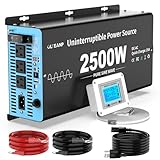
- 【Designed for Basement Flood Protection & Emergency Preparedness】: Protect your home from flooding during hurricanes, heavy rainstorms, and unexpected power outages. This sump pump battery backup system automatically switches from grid power to battery power, ensuring uninterrupted water removal and continuous basement protection. Ideal for homeowners in flood-prone areas and finished basement properties.
- 【Acts as a Reliable Emergency Backup Power Source (Battery Not Included)】: Serves as a dedicated emergency backup solution for primary or secondary sump pump systems. When utility power fails, it instantly transfers to 12V deep cycle battery power (battery required, not included) and automatically recharges when power is restored. Compatible with LiFePO4, AGM, GEL, and Flooded deep-cycle batteries.
- 【Built-in 25A Smart Charger with Multi-Stage Battery Protection】:Features a high-speed 25A charger with selectable charging modes to optimize battery lifespan. Includes overcharge, low voltage, overload, short circuit, and overheat protection. Designed for long-term reliability during storm season and emergency situations.
- 【2500W Pure Sine Wave Output – Safely Powers Sump Pumps & Essential Devices】: Delivers stable pure sine wave power capable of running sump pumps smoothly and efficiently without damaging sensitive equipment. With 3 AC outlets, USB port, and Type-C port, it can also support essential household devices during outages.
- 【LCD Remote Monitoring & Easy Installation】: Includes a remote controller with LCD display to monitor battery voltage, load status, and operating mode in real time. Supports wall mounting or flat placement with simple AC and DC connections — no complicated rewiring required. Trusted by homeowners, property managers, and contractors seeking dependable flood prevention solutions.
Common failure scenarios and fixes
The backup never starts
Check whether the battery is connected, charged and the correct voltage; then inspect the float for obstruction and confirm the pit water actually reaches its trigger level. If the charger or alarm shows a fault, stop relying on the system and have it serviced.
The pump runs but water comes back
Look for a missing or failed check valve, a blocked outlet, a disconnected joint or discharge water draining next to the foundation. Correct the discharge route before the next storm.
The pump runs continuously
Continuous operation can indicate unusually high inflow, insufficient capacity at the installed lift, a stuck float or a discharge restriction. Do not infer runtime from the sound of the pump; measure inflow and have the installation assessed.
The battery is flat after a short outage
Battery age, incomplete charging, unsuitable chemistry, high water inflow and frequent cycling can all shorten operating time. Check charger operation and battery compatibility, then compare the pump’s required duty with the site’s actual conditions. No universal runtime can be applied without those facts.
What a complete basement flood plan includes
Pair the sump system with a battery-operated water alarm and a way to receive alerts when the property is unoccupied. Keep valuables, finishes and electrical equipment off the floor in areas known to flood. Inspect window wells, grading, downspouts and foundation drainage so the sump is not asked to solve preventable surface-water problems. If sewer backup or groundwater remains a risk, ask a qualified contractor about measures designed for that specific source; a battery pump alone does not address it.
For flood-prone lower levels, Massachusetts emergency-preparedness guidance recommends backup-powered sump pumping. Illinois floodproofing guidance likewise identifies alternate power as a way to keep sump systems operating. These are preparedness recommendations, not a universal substitute for local plumbing, electrical or building requirements.
Bottom line for homeowners and property managers
Install a battery backup when loss of the primary sump pump would create unacceptable damage, but treat it as temporary, secondary protection. Select it from the pump’s flow at your actual lift, verified battery compatibility and the pit’s dimensions—not from a broad runtime claim. Keep the discharge open, test the primary pump annually and the backup two to five times a year as appropriate to the installation, and replace aging equipment according to the manufacturer and local guidance. A professional assessment is the safest way to determine whether a battery pump, generator, or both can handle the water your property actually receives.
The Tool Desk
Outbyte PC Repair FREEClear out junk files and repair common Windows errorsFree Scan →Outbyte Driver Updater FREEScan for outdated or missing drivers - takes under a minuteDriver Scan →Quick Recap
Product prices and availability are accurate as of the date/time indicated and are subject to change. Any price and availability information displayed on Amazon at the time of purchase will apply.

