Recommended Free Tools
To build this open source DIY wind turbine for $30, make the scrap-material rotor—not a complete household energy system. The six-vane Lenz2-style vertical-axis design uses reclaimed aluminum printing plates, bicycle wheels, rivets, and basic tools; electricity still requires a separate generator, controls, wiring, load, and safe support structure.
The project is best understood as a hands-on construction and reuse exercise. The current official tutorial reports a $15–$30 rotor build for two people, while an earlier version reports a different bill of materials and roughly six hours rather than four. Follow one version’s plans consistently.
As an Amazon Associate I earn from qualifying purchases.
Key takeaways
- The $15–$30 estimate covers a scrap-built Lenz2-style rotor, not a complete household wind-power system.
- The current six-vane tutorial calls for 11 aluminum lithographic plates, two approximately 26-inch bicycle wheels, 280 4 mm pop rivets, and 30 M4 fastener sets.
- A hand pop riveter is a required tool because the vane assemblies are joined with hundreds of pop rivets.
- OpenSourceLowTech reports at least 130 watts at 30 km/h and 1 kilowatt at 60 km/h for a specified rotor and 90%-efficient alternator, but says a full power curve has not yet been calculated.
- The rotor produces mechanical rotation; battery charging or household electricity additionally requires a generator, rectification, regulation, wiring, safety controls, and an appropriate load.
- Wind quality, tower height, turbulence, structural design, permitting, and electrical integration matter more than the headline price.
What is this $30 DIY wind turbine?
This project is a six-vane, vertical-axis Lenz2 wind-turbine rotor developed by Daniel Connell and published by OpenSourceLowTech.org. The Lenz2 design combines lift and drag, and the official tutorial describes its mechanical efficiency as 35–40%. The design is open source and license-free for any purpose, according to OpenSourceLowTech.org’s project homepage.
The $30 figure describes a low-cost rotor made largely from reclaimed materials, especially aluminum lithographic offset-printing plates and bicycle-wheel parts. The rotor is not a complete wind-energy installation, and it does not include a generator, tower, foundation, wiring, battery system, inverter, or permits.
#1 Best Overall

- 【4 Interchangeable Rivet Heads】Our professional riveter tool comes with 4 tool-free interchangeable rivet heads:3/32"(2.4mm), 1/8" (3.2mm), 5/32"(4mm), and 3/16"(4.8mm).Other types of rivet heads placed on the handle, which creates more convenient to use and save more space.And each size is equipped with 50 pcs rivets, which meets all your needs while riveting
- 【Easy to Use】Sleeve knurled unibody design and guide mouth knurling design can be removed tool-free for easy change or maintenance. When working, no other tools are needed, you can easily change the size you want, simple operation and easy to carry. For thinner nails, we can choose to operate with one hand. If operated with two hands, the rivet will be carried out faster and more accurately. But for thicker nails, we need to use more strength
- 【Durable & Solid】High quality aluminum alloy body, reinforced carbon steel heat treatment handle increase the rivet gun body strength and service lifeThe ergonomic double-curved handle design makes working more labor-saving, and the PVC handle sleeve provides protection for your hands from harm, and maximum fit and comfort
- 【Wide Application】Our WETOLS professional rivet gun kit can handle all three type of rivets: aluminum, steel, and stainless steel rivets to adapt to various riveting operations, such as construction, maintenance or hand-made, etc. 4.8mm Rivet head is not recommended for use with steel and stainless steel rivets
- 【What's Included】This WETOLS rivet gun kit includes: Rivet Gun*1, Aluminum Rivets*200( 50 pcs each size) , Twist Drill*4, User Manual*1, Sturdy Blow Molded Case*1, Worry-Free-24-Months-Warranty. Do not hesitate to contact us if you encounter any questions when using WETOLS single hand riveter, we are happy to assist you
“This is a Vertical Axis Wind Turbine which uses wind energy to drive things like an alternator/generator for producing electricity, or air and water pumps for cooling, irrigation and similar.” — Daniel Connell, OpenSourceLowTech tutorial.
The current OpenSourceLowTech tutorial was updated September 5, 2022. An earlier Instructables version documents the same general project but uses different quantities and reports a different build time. Follow one version’s drawings and bill of materials consistently instead of mixing the two.
What does the $30 cost include?
The $15–$30 estimate is realistic only when the builder can reclaim or borrow much of the material and already has basic tools. The official six-vane list includes the following items:
| Category | Current six-vane tutorial | Important qualification |
|---|---|---|
| Templates | Two sheets of A4 or US Letter paper; computer and printer | Print at 100% and verify the 10 cm reference dimension. |
| Vane material | 11 aluminum lithographic offset-printing plates | Reclaimed plates preserve the low-cost and reuse premise. |
| Rotor support | Two approximately 26-inch bicycle wheels and 12 spokes | Suitable wheels must be structurally sound and compatible with the mounting design. |
| Rivets | 280 4 mm pop rivets, approximately 6–8 mm long | A hand pop riveter is required for assembly. |
| Bolts and nuts | 30 M4 countersunk bolts or machine screws and 30 M4 nyloc nuts | Small and large washers are also listed. |
| Angle aluminum | Approximately 1 metre of 20 mm × 20 mm angle aluminum | Used for the internal structural parts. |
| Hand tools | Power drill, 4 mm and 5 mm metal bits, craft knife or box cutter, tape measure, marker, sticky tape, four clothes pegs, and pop riveter | Borrowing tools can keep the materials spend low, but tool purchases are not meaningfully included in the $15–$30 estimate. |
A practical first purchase is a hand pop riveter. The official tutorial explicitly lists one, and the build uses hundreds of rivets. The riveter is a construction tool rather than part of a complete “$30 wind turbine kit”; no complete retail kit is described by the project.
For reclaimed materials, contact a local offset printer, newspaper printer, packaging printer, reuse centre, or salvage source about clean, flat aluminum lithographic plates. Bicycle co-ops, repair shops, reuse centres, and salvage yards may be better sources for wheels and spokes than buying new components. Inspect every salvaged part before it becomes part of a rotating structure.
How do the three-vane and six-vane versions differ?
The three-vane and six-vane versions are related designs, but their material lists and reported build times are not interchangeable.
Rank #2

- 🔨【With 200 Pcs Rivets】Meiwaltee rivet gun kit comes with 200 pcs aluminum rivets, 4 interchangeable Nosepieces and a Wrench, 3/32 inches(2.4mm), 1/8 inches(3.2mm), 5/32inches(4.0mm), and 3/16 inches(4.8mm), each size comes with 50 pcs rivets.
- 🔨【More Sturdy And Durable】Meiwaltee pop rivet gun is made of heat-treated 0.08inch(2MM) thickened carbon steel. note: be sure to match right interchangeable heads and rivets size to work to prevent from the jam.
- 🔨【Ergonomic, Non-slip Handles】Our grip handles are comfortable and can provide proper leverage to apply pressure to squeeze the rivet. If your single hand is small and have limited strength, you can use two hands to rivet.
- 🔨【DIY, Wide Application】Meiwaltee pop rivet tool kit is suitable for small DIY projects or fixes. You can rivet plastic, metal sheets, wood and all kinds of things around the house. Whether you're a novice or seasoned riveter, this rivet gun will accomplish your needs.
- 🔨【Note】Not recommended for use with 3/16 in.(5mm) Dia all-steel rivets, stainless steel rivets are not for use with manually operated rivet tools. Generally speaking, our rivet gun can work smoothly.Please use the correct rivet to match the correct rivet head during work. If you insert a large rivet into a small rivet joint and it gets stuck accidentally, please snap off the head of the rivet first and attach a 4.8mm rivet head so that the spike bar stuck inside will automatically fall out.
| Decision point | Three-vane version | Six-vane version |
|---|---|---|
| Vane count | 3 | 6 |
| Aluminum plates in earlier documentation | 12 | The current tutorial lists 11 for the six-vane build. |
| Pop rivets in earlier documentation | 126 | The current tutorial lists 280, 4 mm diameter and approximately 6–8 mm long. |
| M4 bolts and nuts in earlier documentation | 18 sets | The current tutorial lists 30 sets. |
| Bicycle-wheel specification | One approximately 27-inch wheel is specified in the earlier version, with an outside rim diameter of about 64 cm. | Two approximately 26-inch wheels are listed in the current tutorial. |
| Spokes in earlier documentation | Six | The current tutorial lists 12. |
| Reported build time | Earlier documentation: about six hours for two people. | Current tutorial: about four hours for two people. |
The earlier figures come from the earlier Instructables documentation; the current six-vane quantities and four-hour estimate come from the official tutorial. The difference is best treated as a version difference, not as a reason to average the lists.
What’s actually slowing this PC down?
Pick the symptom - the matching free tool is one click away.
How do you build the rotor?
Use the current tutorial’s printable A4 or US Letter templates and 3D-model files as the controlling drawings. The following is a construction overview; the template and original instructions supply the shapes, hole locations, and dimensions that should not be guessed from a text summary.
- Print the template at full scale. Set the printer to 100% or “actual size,” not “fit to page.” Measure the printed 10 cm reference dimension before transferring the template to metal.
- Make the former patterns. Assemble the paper template and mark the fold, cut, and hole locations on the aluminum plates.
- Score the aluminum safely. Use a straight edge and craft knife to score the plates repeatedly rather than trying to cut through sheet aluminum in one pass. Flex the scored sections until they separate, then remove and dress sharp edges.
- Drill aligned holes. Group matching formers and drill through the aligned marks with the specified 4 mm and 5 mm metal bits. Clamp or hold the material securely so the drill does not catch the sheet.
- Bend the formers. Fold the prepared former sections to 90 degrees as shown in the tutorial. Accurate, repeatable bends help keep the finished rotor symmetrical.
- Cut and shape the vane sheets. Transfer the sheet outlines, cut the aluminum, and fold the edges required by the template. Recheck every edge for burrs and sharp points.
- Reinforce the folded edges. Insert bicycle spokes into the folded edges where the design specifies them. The spokes provide reinforcement for the thin aluminum sections.
- Rivet each vane. Rivet the internal struts and aluminum sheet sections together. Keep the former positions consistent and confirm that every rivet is fully set without deforming the sheet.
- Attach the vanes to the bicycle-wheel rims. Drill the rims at the specified locations and use the M4 bolts, nyloc nuts, and washers to fasten the vanes between the two wheels.
- Check balance and symmetry. Rotate the assembly by hand before connecting any generator. Look for wobble, loose fasteners, uneven vane spacing, rim damage, and anything that can contact the frame.
- Build the support and transmission. Mount the rotor on a rigid, appropriately engineered frame. Connect the shaft or a belt drive to a mechanical load or generator only after the rotating assembly is secure.
OpenSourceLowTech’s cutting warning is worth repeating: “Any time you’re cutting, always make sure your other hand is never in front of the knife.” Scored aluminum can be unexpectedly sharp, and the project also involves drilling, riveting, stored mechanical energy, and a large rotating assembly.
Can a DIY wind turbine really make 1,000 watts?
The project page reports at least 130 watts at 30 km/h wind and 1 kilowatt at 60 km/h for a specified six-vane rotor paired with a 90%-efficient alternator. Those are developer-reported performance claims or projections for stated conditions, not a universal output rating for every homemade rotor.
| Claim or evidence | What it means | How to use it responsibly |
|---|---|---|
| 35–40% mechanical efficiency — Daniel Connell/OpenSourceLowTech, tutorial updated 2022 | A stated design-efficiency figure for the Lenz2 concept. | Do not treat it as measured electrical efficiency for a complete system. |
| At least 130 W at 30 km/h — Daniel Connell/OpenSourceLowTech, tutorial updated 2022 | A stated output under the specified rotor and alternator assumptions. | Actual output depends on wind, generator matching, losses, and rotor construction. |
| 1 kW at 60 km/h — Daniel Connell/OpenSourceLowTech, tutorial updated 2022 | A higher-wind projection under the same stated assumptions. | It is not a promise that a $30 rotor will continuously supply 1 kW. |
| 80 km/h sustained-wind survival for three vanes; 105 km/h for six vanes — Daniel Connell/OpenSourceLowTech, tutorial updated 2022 | Reported survival-test conditions. | Do not interpret the figures as a site-wide safety certification or a substitute for shutdown and structural design. |
| Full power curves have not yet been calculated for this particular build. | The project lacks a complete output-versus-wind-speed characterization in the cited tutorial. | Use the wattage figures as conditional claims, not as a bankable energy forecast. |
The official page states: “Full power curves have yet to be calculated for this particular build.” That qualification is decisive. A wind turbine’s instantaneous wattage is not the same as its annual energy production, and a brief high-wind output does not establish how much energy the turbine will deliver over a year.
Do these 3 things before closing this tab:
1Scan for outdated or missing drivers - takes under a minute2Clear out junk files and repair common Windows errors3Fix the driver behind crashes, sound loss and screen glitchesTreehugger reports related figures of at least 135 watts at 30 km/h and 1.05 kW at 60 km/h with an efficient alternator, while also discussing 158 watts at 50 km/h and 649 watts at 80 km/h with a 50%-efficient car alternator. The different alternator assumptions make those figures non-interchangeable; they should not be combined into one specification. No independent, current laboratory test report for this exact scrap-material build was located in the researched record.
Rank #3

- High Quality: Libraton heavy-duty rivet gun set includes an aluminum rivet gun, a mini wrench, 25 each of 4 sizes of rivets, and 1 each of 4 sizes of HSS drills. The set provides full-process support for riveting work.
- Sturdy Material: The professional riveter has a lightweight aluminum body, with 35Cr-Mo steel claw piece and heat-treated alloy steel structural parts, providing a longer service life (increased to more than 160% of conventional riveting guns).
- Working Efficiency: The design of the ergonomic handle provides a larger lever ratio, saving 25% of the grip strength. The TPR soft rubber can provide a comfortable grip.
- Smart Design: The riveting tool kit includes a mini wrench to change the heads. And there are test holes in the wrench that can help you identify the size of the rivets. Please choose the rivets of the same size as the head, as wrong size compatibility may lead to the stuck. A carrying case is included for easy storage.
- Wide Application: The pop rivet gun has four replaceable heads in sizes 3/32"(2.4mm), 1/8"(3.2mm), 5/32(4mm), and 3/16"(4.8mm) for fixing metals and heavy fabrics. The rivet gun set can be widely used in riveting of construction, automobiles, ships, airplanes, machines, electrical appliances, furniture, etc.
What generator can you use with the rotor?
The rotor itself produces mechanical rotation. To produce electricity, the project needs a separately selected generator or alternator whose voltage, revolutions per minute, current, gearing, shaft arrangement, and mounting match the rotor and intended load.
The official tutorial identifies several possibilities:
- Permanent-magnet hoverboard or balance-board wheel: a sealed three-phase AC motor that can be operated as a generator, potentially through a belt arrangement.
- Electric-bicycle hub wheel: another permanent-magnet motor option, subject to its electrical and mechanical specifications.
- Motorbike, scooter, or tuk-tuk alternator: a possible source of electrical generation, but one that may require different speed, gearing, excitation, or control arrangements.
A hoverboard hub motor or wheel generator is an advanced optional component, not a plug-and-play upgrade. Identify the generator’s phase wiring, expected voltage at the rotor’s operating speed, current capability, bearing and shaft requirements, and mounting method before buying or connecting it.
Quick wins for a faster PC:
Repair Windows errors before they cause bigger problemsFix Now →Fix the driver behind crashes, sound loss and screen glitchesFind Drivers →Clear out junk files and repair common Windows errorsFree Scan →Can a homemade wind turbine charge a battery?
A homemade wind turbine can charge a battery only when the generator and electrical controls are correctly matched; connecting an improvised generator directly to a battery is not a safe or reliable charging design.
Depending on the generator and battery system, the electrical chain may require a three-phase rectifier, voltage regulation, charge controller, over-voltage protection, a dump load or other energy-management method, fusing, disconnects, correctly sized wiring, batteries, and an inverter for AC loads. The exact equipment depends on generator output and the intended battery chemistry and voltage.
The U.S. Department of Energy Small Wind Guidebook treats a small wind system as more than the rotor: the turbine, tower, wiring, and balance-of-system components can include controllers, inverters, and batteries. The same principle applies here. Design the electrical system around measured generator output, not around the rotor’s headline wattage.
Rank #4

- 4 Interchangeable Rivet Heads: Arrow rivet gun kit, comes with 4 size manual interchangeable rivet heads- 3/32"(2.4mm), 1/8" (3.2mm), 5/32"(4mm), and 3/16"(4.8mm), which will meet your most need when riveting
- Easy Identification & Install Heads: All of the 4 nose pieces have color coded and stamped size marking that will help you identify them easily. Thumb screw rivet nosepieces are easier to remove and install, you don’t need to use pliers to change them. Save time and effort for you
- 100 Pieces Rivets Included: Riveter gun kit is equipped with 100 pieces 4 different sizes rivets-3/32", 1/8", 5/32", 3/16 ", each 25 pieces, which will work well for general purpose rivet jobs, such as gutters, furniture and canvas works
- Comfortable & Convenient: Designed with ergonomic PVC handle providing comfortable grip and help save energy. Steel body with easy-squeeze handles, can be easily operated with one hand. Convenient handle lock helps store easier
- Wide application: Metal work, gutter, automotive and other common projects. Whether you're a novice or seasoned riveter, this gun will accomplish your needs
Where should you install a small vertical-axis turbine?
A useful site needs consistent, sufficiently strong, and relatively low-turbulence wind; a nominal rotor output cannot compensate for a poor site.
According to DOE Wind Energy Maps and Data guidance, wind conditions can vary significantly over only a few miles because of terrain and local flow effects. Wind maps are useful starting points, but they are modeled estimates. Buildings, trees, vegetation, terrain, and atmospheric conditions can make the wind at a proposed tower substantially different from the map value.
Measure wind at the proposed site when practical, or obtain a qualified site assessment before spending money on a permanent installation. DOE’s general guidance says the bottom of a rotor should be at least 30 feet above obstacles within 300 feet of the tower. The applicable requirement can differ by jurisdiction and project design.
A roof is usually a poor location for a serious small turbine. Rooftop turbulence can reduce production and shorten turbine life, as discussed in DOE WINDExchange safety guidance. A vertical-axis rotor is not automatically immune to turbulence, vibration, fatigue, or structural loads.
Independent reader supportYour contribution helps us test, update, and keep practical guides available for everyone.What does a complete installation cost?
A complete installation costs substantially more than $30 because the rotor is only one part of the system. DOE reported that the capacity-weighted average cost of small-wind projects installed in 2021 was $5,120 per kilowatt, based on 16 projects in three states totaling 396 kW. That government figure is context for installed small-wind projects, not a price for this open-source rotor and not a direct comparison with a scrap build.
| Cost or requirement | Included in the $15–$30 rotor estimate? | Why it matters |
|---|---|---|
| Reclaimed aluminum, rivets, fasteners, and salvaged wheel parts | Potentially, if sourced cheaply or free | These materials create the low-cost premise. |
| Existing or borrowed drill, bits, knife, riveter, and measuring tools | No, unless already available | Buying tools can exceed the material estimate. |
| Generator or alternator | No | Converts rotor rotation into electricity and determines electrical matching. |
| Rectifier, controller, wiring, protection, batteries, and inverter | No | These components make electricity usable and protect equipment. |
| Frame, shaft or belt drive, tower, foundation, guy wires, and anchors | No | They carry rotating and wind loads and determine installation safety. |
| Weatherproofing, maintenance, permitting, inspection, and installation work | No | Permanent outdoor systems need site-specific compliance and upkeep. |
For a construction experiment, the project can be an inexpensive way to learn about sheet-metal fabrication, reuse, rotor balance, and generator matching. For dependable household power, compare the experimental rotor with certified small-wind turbine equipment, a qualified site assessment, and professional installation. DOE recommends third-party certification for small-wind models under 100 kW when dependable operation is the goal; relevant certification bodies include the Small Wind Certification Council and UL.
Best Value
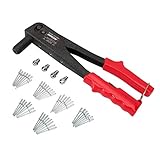
- Designed to work with 3/32 in. to 5/32 in. Dia rivets for general purpose rivet jobs
- Extended nose makes work easier in hard-to-reach places making it a great tool for general purpose rivet tasks, such as gutters, furniture and canvas works
- Manual riveter provides portable fastening:includes 4 interchangeable heads so that you have everything you need to start riveting
- Not recommended for use with 3/16 in.(5mm) Dia all-steel rivets; stainless steel rivets are not for use with manually operated rivet tools
- Wide application: Metal work, Gutter, Automotive and other common projects Whether you're a novice or seasoned riveter, this gun will accomplish your needs
What safety and permitting checks are required?
Before building or operating the rotor, address sharp-metal, tool, rotating-equipment, structural, electrical, battery, and tower-failure hazards. The original tutorial is an assembly guide, not a substitute for structural or electrical engineering.
- Wear suitable eye protection during drilling, riveting, and cutting, and protect hands from scored aluminum and burrs.
- Keep the non-cutting hand away from the knife path; clamp work where possible instead of holding sheet metal in front of the blade.
- Deburr every cut edge and inspect rivets, bolts, washers, spokes, wheel rims, and joints before rotation.
- Test balance and clearance at low speed before connecting a generator or load.
- Design a way to stop, furl, disconnect, or otherwise control the rotor and generator during overspeed, storms, and maintenance.
- Do not stand near the rotor plane or under a tower while an unproven assembly is operating.
- Use appropriately rated electrical protection, disconnects, grounding, and battery safety equipment.
Check local zoning, building permits, setbacks, property-line rules, electrical code, utility interconnection requirements, noise rules, and environmental or wildlife requirements before erecting a permanent tower. Taller structures may also involve aviation requirements. The FAA obstruction and NOTAM guidance includes wind turbines among obstructions relevant to aviation notices and obstruction-light status reporting; that does not mean every small rotor automatically requires lighting or a NOTAM.
Is this $30 wind turbine worth building?
Build it if the goal is a hands-on, open-source engineering and reuse project and you can obtain the scrap materials safely. Do not choose it as a guaranteed $30 route to household electricity or as a substitute for a certified turbine and engineered tower.
Free tools Windows power users keep installed
One-click scans. No signup required.
| Your goal | Best decision |
|---|---|
| Learn sheet-metal fabrication and rotor mechanics | Build the rotor carefully from one documented version. |
| Experiment with direct mechanical work | Consider the tutorial’s air- or water-pump applications and engineer the frame and drive system for the load. |
| Charge a small battery | First match a generator, rectifier, controller, battery, wiring, and dump-load strategy; do not connect the rotor directly to a battery. |
| Power household circuits reliably | Start with a wind assessment, permits, structural and electrical design, certified equipment, and professional installation. |
| Minimize environmental cost | Source lithographic plates, wheels, and spokes through local printers, bicycle co-ops, repair shops, reuse centres, or salvage yards. |
Frequently Asked Questions
What does the $30 DIY wind turbine price include?
The $15–$30 estimate covers the scrap-focused rotor materials, especially reclaimed aluminum plates, bicycle-wheel parts, rivets, and fasteners. It excludes tools you must buy, the generator, tower, frame, foundation, wiring, charge controller, batteries, inverter, permits, and installation.
Can this DIY wind turbine really produce 1,000 watts?
The project page reports at least 130 watts at 30 km/h and 1 kilowatt at 60 km/h for a specified six-vane rotor with a 90%-efficient alternator. Those are developer-reported conditional claims, not a universal rating; the tutorial also says a full power curve has not been calculated for this build.
What motor can be used as a wind-turbine generator?
A permanent-magnet hoverboard or balance-board wheel, an electric-bicycle hub wheel, or a motorbike, scooter, or tuk-tuk alternator may serve as a generator. Generator voltage, RPM, current, gearing, and mounting must match the rotor, so none of these options is automatically plug-and-play.
Can a homemade wind turbine charge a battery?
A homemade wind turbine can charge a battery only through a correctly designed electrical system. Depending on the generator, the system may need a rectifier, voltage regulation, charge controller, over-voltage protection, dump load, fuses, disconnects, batteries, and possibly an inverter.
Is the Lenz2 DIY wind turbine worth building?
The rotor can be worth building as an open-source fabrication and reuse exercise when scrap materials and tools are available. It is not a sensible $30 substitute for a certified turbine, engineered tower, site assessment, and compliant installation intended to provide dependable household power.
The Bottom Line
The open-source DIY wind turbine can be a credible $15–$30 scrap-material rotor project, but not a $30 complete power system. Build one for fabrication and renewable-energy experimentation; treat the reported 130-watt and 1-kilowatt outputs as conditional developer claims, and engineer the generator, tower, controls, site, and permits separately.
Quick Recap
Product prices and availability are accurate as of the date/time indicated and are subject to change. Any price and availability information displayed on Amazon at the time of purchase will apply.




