Quick wins for a faster PC:
Clear out junk files and repair common Windows errorsFree Scan →Fix the driver behind crashes, sound loss and screen glitchesFind Drivers →To grow large, mild Candy onions, first confirm that your location suits this yellow hybrid’s intermediate- (mid-) day requirement. Candy bulbs when daylight is roughly 12–13 hours, so match the seed packet and your local extension guidance to your latitude and planting season. Then plant early in full sun, build fertile well-drained soil, maintain steady moisture while leaves grow, control weeds shallowly, and harvest when the tops fall. Candy is a short-term-storage onion, so plan to use it relatively soon after curing.
Know which Candy onion you are growing
“Candy” in this guide means the named yellow Candy hybrid, not every onion with Candy in its name and not similarly named red cultivars. Penn State Extension lists Candy as a yellow Sweet Spanish, intermediate-day onion at 95 days to maturity in its production table. That figure is a regional guide, not a guaranteed number of days from your transplanting or seeding date. Bayer Seminis describes its Candy hybrid as mid-day, yellow, mild-tasting and suitable for short-term storage; it can be direct-seeded or transplanted. Bayer also reports high resistance to pink root, a cultivar-company claim rather than an independent home-garden trial result.

As an Amazon Associate I earn from qualifying purchases.
Day length, not a universal calendar date, initiates bulbing. University of Delaware Cooperative Extension describes approximate classes as short-day near 10 hours, intermediate-day near 12–13 hours and long-day near 14 hours of daylight. Cultivar naming and regional adaptation can differ, so verify the packet and local recommendations before buying or planting.
Choose the site and soil
Give plants unobstructed sun
Select a bed with full sun and good air movement. Shade reduces the leaf growth that supplies the bulb before bulbing begins.
#1 Best Overall
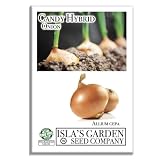
- 🧅 Candy Onion - These sweet flavored onions tend to be medium to large in size and have sweet flavor. They are often consumed raw, grilled or lightly cooked with other foods, or added as a decoration to salads.
- 🌱 Plant the seedlings 6" apart in rows 12" apart. For direct sowing, sow three seeds per inch 1/2" deep in light, rich soil and full sun. Seeds are great for Planting in Garden or for storing in a seed safe for an emergency.
- ☀️ Annual. 85 days. 12-18" height. 4-6" spacing.
- 🌎 USDA Zones: 3,4,5,6,7,8,9,10,11,12
- 📷 Please take photos of your plants and upload them in a review! - Isla's Garden 👩🌾
Build fertile, well-drained ground
Onions prefer fertile soil with abundant organic matter and reliable drainage. University of Minnesota Extension gives a general target of pH 6.0–7.0. Test the bed before adding lime or fertilizer, and follow your local soil-test recommendations rather than applying nutrients by guesswork.
Set the planting calendar around bulbing
Plant early enough for Candy to establish substantial foliage before daylight triggers bulb formation. The correct date depends on your latitude, spring temperatures and whether you are sowing seed or setting transplants; a date that works in one region can produce small bulbs in another.
Rank #2

- VARIETY: Candy Hybrid onion seeds produce large, sweet, golden-colored bulbs with excellent flavor ideal for fresh eating, cooking, and storage
- SEED COUNT: Package contains 100 premium quality onion seeds for planting in your home garden or raised beds
- GROWING SEASON: Intermediate-day variety that requires 12-14 hours of daylight to form bulbs, making it suitable for growing in transitional climate zones
- CULTIVATION: Plant seeds indoors 8-10 weeks before last frost or direct sow outdoors when soil temperature reaches 50°F for best germination results
- HARVEST: Produces hugely popular sweet onions with mild flavor that mature in approximately 110-120 days from transplanting
- Check your seed packet for the recommended planting window and whether it is written for direct seeding or transplants.
- Compare that guidance with your local extension service’s onion calendar for intermediate-day types.
- Prepare the bed so seedlings or transplants can go in as soon as local conditions allow, while protecting young plants from severe cold.
Oregon State University horticulture professor Jim Myers explains the general onion principle: “This is why early planting is critical if you want large onions, as well as plenty of water and fertilizer.” The statement is general onion advice, not a Candy-specific yield guarantee.
Seed or transplant: match the method to your season
Direct seeding
Bayer lists Candy as suitable for direct seeding. Sow into prepared soil at the packet depth and thin seedlings so neighboring plants do not compete. Direct seeding needs a long enough local season for leaves to develop before bulbing.
Transplanting
Penn State describes intermediate-day onions as normally spring-transplanted, and Arkansas Extension lists Candy among transplant options. Set healthy plants at the local recommended depth without burying the neck. For larger bulbs, general home-garden guidance from Illinois and Arkansas Extension supports approximately 4–5 inches between plants; adjust if your packet or regional guide specifies another spacing.
Water consistently while bulbs form
Onions have shallow roots. Keep soil evenly moist during active leaf growth and through the start of bulbing, avoiding repeated drought-and-flood cycles. Oregon State warns that drought can trigger early bulbing and small bulbs. Drip irrigation or a low-flow soaker keeps foliage drier than overhead watering, but whichever system you use should wet the root zone consistently.
Rank #4
- Onion Seeds - Candy Hybrid - 250 mg Packet - Allium cepa
- Non-GMO - Hybrid - High Germination Rate
- Seeds For: Vegetable Gardening
- Days to Full Maturity: 85 -- Annual -- USDA Hardiness Zone: Annual Crop, Not Intended To Overwinter
- Mountain Valley Seed Company Brand - Premium Quality Seeds
When the tops begin to dry and fall, stop routine watering so the neck can mature. Do not continue irrigating simply to chase a calendar-based size target.
Recommended Free Tools
Control weeds without injuring shallow roots
Weeds compete directly for the moisture and nutrients Candy needs. Cultivate only shallowly or hand-weed close to plants; deep hoeing can cut onion roots. Illinois Extension cautions against hilling dry-bulb onions because soil piled around the neck can contribute to storage neck rot. Keep mulch off the neck and use a thin, loose layer between rows if it does not hold the bed excessively wet.
Best Value

- 8 ONION VARIETIES WITH DISTINCT ADVANTAGES AND UNIQUE FEATURES. A diverse range of unusual flavors, shapes, and colors, from sweet to pungent. Perhaps it’s time to welcome something new to your garden. Diversity is the key to an interesting and abundant harvest. Why not discover new aspects of a familiar vegetable when nature offers such rich choices? Amazing variations of this valuable everyday product will delight your taste buds. Many dishes are unimaginable without these vegetables.
- BARLETTA is a high-quality, extra early, vigorous salad-type variety. It’s grown both for its green stalks and bulbs. Long, hollow, dark-green stalks are rich in carotene, essential oils, and phytoncides. Bulbs are flat-round, pearl-white, with thin necks. Its semi-spicy, juicy, sweet, mild taste and tender texture provide gentle piquancy suitable for a wide range of dishes. An excellent flavor base for sauces, marinades, and pickling.
- RED BURGUNDY is a popular culinary variety. This early, hardy, attractive variety consistently produces high yields of large, firm bulbs under diverse conditions. It grows quickly, is drought-resistant, and produces until early frost. Noted for its oval shape and thick purple-red skin, it's valued for quality, long storage, and distinctive spicy flavor—rich, gently spicy, sweet-pungent without bitterness.
- Crisp with red rings inside, bright and appetizing in fresh vegetables, stews, pizzas, burgers, sauces, marinades, and garnishes, especially good grilled with meat. Also suitable for green stalk production, RED BURGUNDY yields juicy, robust greens. The nutritional value of red onions lies in their complex composition, including numerous natural antioxidants, a broad spectrum of minerals, vitamins, essential oils, and beneficial amino acids.
- ECLIPSE L303 is an heirloom, open-pollinated variety known for excellent adaptability. Bulbs are thick, medium-sized, and flat-round with white skins. Dense, uniform, and crunchy texture. Both bulb and bunching onions have a mild, fresh flavor ideal for salads, sandwiches, burgers, soups, stews, and main dishes. Rich in beneficial compounds and high in vitamin C.
Fertilize from soil information, not a fixed recipe
Start with a soil test and your extension service’s onion recommendations. Fertility supports leaf growth before bulbing, but excessive or late nitrogen can delay maturity and leave soft necks. Apply any sidedressings early enough to support foliage, then taper inputs as plants approach maturity.
Monitor pests and diseases
Delaware Extension identifies onion maggot, leafminers, thrips, downy mildew, leaf blight and onion rust among onion problems. Candy-specific susceptibility and treatment thresholds are not established here. Inspect leaves and the plant base regularly for feeding scars, distorted growth, wilting or spreading lesions.
- Remove badly affected plants when local guidance recommends sanitation.
- Improve spacing and irrigation timing so foliage dries promptly.
- Use your state or provincial extension diagnostic service to identify the problem before applying a pesticide or other treatment.
Harvest by plant signals, not the 95-day figure alone
Use top fall as the primary maturity cue. Oregon State University recommends harvesting about one week after approximately half the tops have fallen, provided weather and soil conditions allow. Stop watering as tops dry and fall, then lift bulbs carefully rather than pulling hard on a weak neck.
The Tool Desk
Outbyte PC Repair FREERepair Windows errors before they cause bigger problemsFix Now →Outbyte Driver Updater FREEFix the driver behind crashes, sound loss and screen glitchesFind Drivers →Cure and use Candy promptly
Cure freshly harvested onions in a dry, airy, weather-protected place according to local extension directions until the outer skins are dry and the necks are tight. Handle bulbs gently and remove soil without bruising them. Bayer classifies Candy as short-term storage, so it is better suited to fresh use over the near term than to the long storage expected from a dedicated storage cultivar. Check stored onions often and use any that soften or show decay first.
Quick Recap
A practical decision checklist
- Latitude: Does local daylight and the recommended calendar suit an intermediate-/mid-day onion?
- Planting method: Will direct seed or transplants provide enough time for leaf growth before bulbing?
- Bed: Is the site sunny, fertile, well drained and near pH 6.0–7.0?
- Spacing: Can you maintain roughly 4–5 inches for large bulbs, unless your local guide says otherwise?
- Water: Can you keep shallow roots consistently moist until bulbing starts?
- Weeds: Can you cultivate shallowly without hilling soil around dry-bulb plants?
- Use plan: Do you have a near-term fresh-use plan for a short-term-storage onion?
Sources and further reading
- Penn State Extension: Onion Production
- Bayer Seminis: CANDY Onion
- University of Delaware Cooperative Extension: Onions
- Oregon State University Extension: Plant onions early for bigger summer bulbs
- Oregon State University Extension: No need for tears if you plant onions soon
- University of Illinois Extension: Onion
- University of Minnesota Extension: Growing onions in home gardens
- University of Arkansas Extension: Onions (Home Gardening Series)
Product prices and availability are accurate as of the date/time indicated and are subject to change. Any price and availability information displayed on Amazon at the time of purchase will apply.

