Free tools Windows power users keep installed
One-click scans. No signup required.
Some links on this page are affiliate links: if you buy through them we may earn a commission, at no extra cost to you.
A good slimline toaster should do two things well: toast evenly and stay out of the way. For most small kitchens, the best choice is not the fanciest smart toaster or the cheapest two-slot model on the shelf. It is a compact, stable, easy-to-clean toaster that fits your bread habits, your counter depth, and your outlet layout without needing an extension cord.
For 2026, most practical slimline and compact long-slot toasters cost about $25 to $80. Budget models often land around $25 to $40, while better-finished long-slot or smart models can run $100 to $250 or more. That is not where most homeowners get into trouble. The costly part is discovering after a backsplash, cabinet, or countertop job that the toaster has no safe place to plug in. A typical new outlet installation runs about $138 to $320, with an average around $229. GFCI outlet installation commonly runs $130 to $300, and permits may add $50 to $100 or more depending on the city and scope.
As an Amazon Associate I earn from qualifying purchases.
Do these 3 things before closing this tab:
1Scan for outdated or missing drivers - takes under a minute2Clear out junk files and repair common Windows errors3Fix the driver behind crashes, sound loss and screen glitchesOn our kitchen jobs, we treat the toaster like part of the layout, not an afterthought. It creates heat, crumbs, cord clutter, and morning traffic. If the kitchen is small, those details matter. The right toaster can free up a narrow counter run. The right power plan can keep the homeowner from dragging appliances across the counter or plugging high-wattage equipment into a power strip.
What Makes a Toaster Slimline?
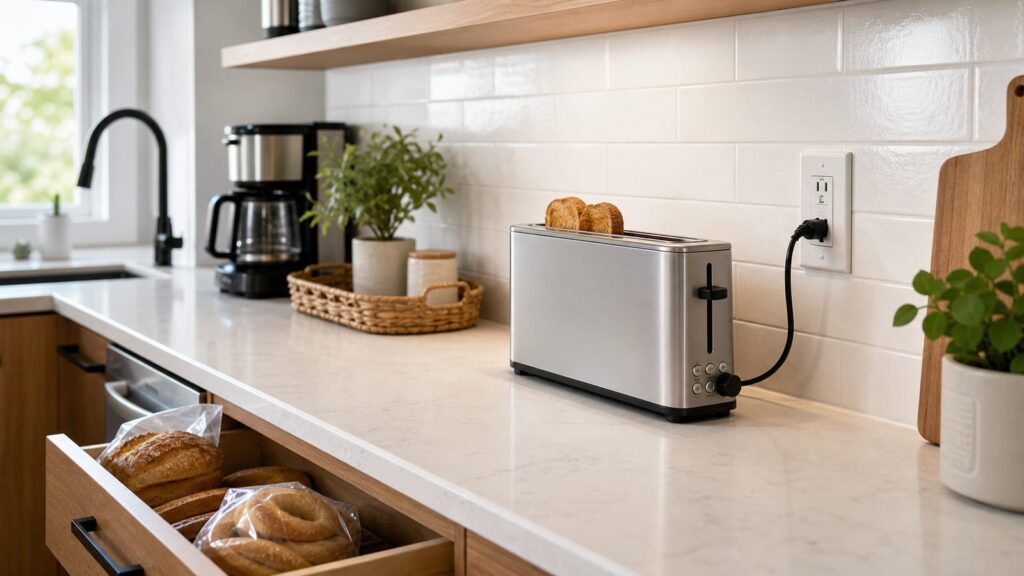
A slimline toaster is usually narrower than a standard two-slice toaster, longer front-to-back, or both. Many ultra-slim two-slice models are roughly 3.5 to 4 inches wide, 6.8 to 7 inches tall, and about 14.8 to 15 inches long. That shape works well on shallow or crowded counters because the toaster can sit tight along the backsplash and leave more usable counter width for prep.
Popular on Amazon

- SLIM DESIGN, BIG IMPACT: With a sleek 3.58" profile, the bella 2-Slice Slim Toaster fits comfortably on any countertop without taking up much space. Part of our Fits-anywhere kitchenware collection, it’s the perfect blend of style and practicality
- One Long Slot for Versatile Toasting: The extra-wide, 10-inch long slot accommodates two slices of bread side by side or thick artisan breads like bagels, baguettes, and Texas-style toasts. No more squeezing or cutting—just perfect toast, every time
- TOASTED PERFECTION: Six shade settings with a convenient cancel function allow you to customize your bread to your exact preference, from lightly golden to dark and crispy. Achieve your ideal toast with just a simple turn of the dial
- EASY CLEANUP & CLUTTER-FREE COUNTERTOP: The removable crumb tray slides out for quick cleaning, ensuring your toaster stays tidy and operates efficiently. Plus, the cord wrap feature keeps your countertop neat and free from tangled cords
- EFFORTLESS ACCESS: Retrieving smaller slices like English muffins is a breeze with the high-lift lever, giving you easy access without burning your fingers. It’s thoughtful details like these that make this appliance a must-have for every kitchen
Long-slot toasters are a related category. Instead of two separate side-by-side slots, they use one long slot or two long slots. A compact long-slot model may hold two standard sandwich slices end to end or one long artisan slice. This is often the better choice for households that buy sourdough, rye, bakery loaves, or wider bread. A very thin toaster with narrow slots may look perfect on the counter and still be a daily annoyance if it cannot handle the bread you actually eat.
The practical measurements to check are width, depth, height, slot length, slot width, cord exit location, and crumb tray direction. A toaster that is only 4 inches wide may still need 15 inches of counter length. A toaster that fits under the cabinet may still be too close to finished wood or painted panels when it is running. A crumb tray that pulls out the rear can be a poor fit if the toaster lives against a backsplash.
The Best Slimline Toaster Types for Real Kitchens
There is no single best toaster for every kitchen. The right one depends on how much counter space you have, what kind of bread you toast, and whether the toaster stays out all day or gets stored between uses.
Ultra-Slim Two-Slice Toaster
This is the space-saving option for apartments, small condos, galley kitchens, and tight coffee stations. Look for a body around 4 inches wide and about 15 inches long. The advantage is obvious: it leaves more open counter in front and beside the appliance. The tradeoff is that slot width may be limited, and some models are less stable if they are too light.
Choose this style if you toast standard sandwich bread, frozen waffles, toaster pastries, or thin slices most of the time. Avoid it if bagels, thick sourdough, or hand-cut bakery bread are part of your normal breakfast routine.
Single Long-Slot Toaster
A single long-slot toaster is often the smartest small-kitchen compromise. It is still narrow, but the slot is long enough for wider bread. Many homeowners like this style because it can sit parallel to the backsplash and look less bulky than a traditional toaster.
Recommended Free Tools
For a remodel, this is the style we most often tape out on the counter when planning a breakfast zone. It gives the designer more flexibility because the appliance can sit along a wall, beside a coffee maker, or on a pantry counter without dominating the surface.
Two Long-Slot Toaster
A two long-slot toaster gives you more capacity, but it usually uses more counter depth and more wattage. Many larger long-slot or four-slice models draw roughly 1,400 to 1,800 watts. That can be fine in a modern kitchen with proper 20-amp small-appliance circuits, but it can be a breaker-tripping problem in older kitchens where the toaster, coffee maker, microwave, and kettle all compete on one circuit.
Choose this style for families, frequent bagel use, or households that toast several pieces at once. In a very small kitchen, make sure the extra capacity is worth the permanent counter footprint.
Smart or Premium Slim Toaster
Premium toasters can cost $100 to $250 or more. Some offer touchscreens, countdown displays, lift-and-look features, or preset programs. Those features are not useless, but they should come after the basics: even browning, slot width, removable crumb tray, high-lift lever, cord wrap, stable feet, and a shell that does not feel flimsy.
On job sites, the appliance that survives daily use is usually the one that is simple to wipe down, simple to unplug, and simple to move when the counter is cleaned. Novel controls do not make up for a toaster that traps crumbs or forces the plug into an awkward bend.
Slimline Toaster Comparison Table
Use this table as a practical starting point. Exact dimensions vary by brand, but these ranges are realistic for shopping and kitchen planning.
| Toaster Type | Typical Footprint | Best For | Typical 2026 Price | Watch-Outs |
|---|---|---|---|---|
| Ultra-slim two-slice | About 3.5-4 in. wide, 14.8-15 in. long, 6.8-7 in. tall | Apartments, narrow counters, standard bread | $25-$80 | May have narrow slots; check bagel fit and stability |
| Single long-slot | Narrow body with one long slot | Artisan bread, small kitchens, clean counter runs | $35-$100 | Usually slower for multiple servings |
| Two long-slot | Wider or deeper body with two long slots | Families, bagels, several slices at once | $60-$150+ | Often 1,400-1,800W; circuit load matters |
| Premium smart slim toaster | Varies; often larger than expected | Owners who value presets and display controls | $100-$250+ | Higher cost does not guarantee better layout fit |
What to Look For Before You Buy
Do not buy a slim toaster from the product photo alone. A toaster is a small appliance, but the wrong details show up every morning.
Slot Width and Bread Fit
Slot width matters more than the outside width of the toaster. If your household eats bagels, Texas toast, thick sourdough, or hand-cut bread, look for extra-wide slots. A slim toaster that only handles thin sandwich bread may save 2 inches of counter space and create years of irritation.
A long slot is useful if you buy bakery loaves. It lets one irregular slice fit without cutting it in half. For standard bread, two separate slots may be faster and easier, but long-slot designs usually look cleaner on a tight counter.
Even Browning and Useful Controls
Good browning control should be predictable. You want a shade dial or buttons that make repeatable sense: light, medium, dark, plus cancel, defrost, and bagel if you use them. High-lift levers are worth having because they keep fingers away from hot slots when removing small slices.
We do not recommend paying extra only for app features. A toaster is a high-heat countertop appliance. The useful controls are the ones you can operate quickly while standing in front of it.
Also popular on Amazon

- Slim Design, Big Impact: With a sleek 3.58" profile, the bella 2-Slice Slim Toaster fits comfortably on any countertop without taking up much space. Part of our Fits-anywhere kitchenware collection, it’s the perfect blend of style and practicality
- One Long Slot for Versatile Toasting: The extra-wide, 10-inch long slot accommodates two slices of bread side by side or thick artisan breads like bagels, baguettes, and Texas-style toasts. No more squeezing or cutting—just perfect toast, every time
- Toasted Perfection: Six shade settings with a convenient cancel function allow you to customize your bread to your exact preference, from lightly golden to dark and crispy. Achieve your ideal toast with just a simple turn of the dial
- Easy Cleanup & Clutter-Free Countertop: The removable crumb tray slides out for quick cleaning, ensuring your smart toaster stays tidy and operates efficiently. Plus, the cord wrap feature keeps your countertop neat and free from tangled cords
- Effortless Access: Retrieving smaller slices like English muffins is a breeze with the high-lift lever, giving you easy access without burning your fingers. It’s thoughtful details like these that make this appliance a must-have for every kitchen
Crumb Tray Access
A removable crumb tray is non-negotiable. Check which direction it pulls. If the toaster will sit in an appliance garage, pantry counter, or tight corner, the tray should pull out toward the user. Rear-access trays usually mean the appliance gets dragged forward, which scratches counters and strains cords.
Cord Management
Look at the cord length and exit direction. Some toasters exit from the rear center; others exit from one side. In a compact kitchen, that detail determines whether the toaster can sit flat against the backsplash or must be pulled forward several inches.
Leave room for the plug itself. A standard plug can force the toaster forward if the outlet is directly behind the appliance. A recessed outlet, angled plug, or slightly offset outlet location can make the counter feel cleaner, but those choices should be made before backsplash tile is installed.
Where a Slim Toaster Should Go in the Kitchen
The best toaster location is usually near bread storage, plates, coffee, trash or compost, and a protected countertop outlet. That keeps crumbs, wrappers, and breakfast traffic in one zone. In larger kitchens, this may be a dedicated breakfast station. In smaller kitchens, it may be a 24- to 36-inch counter run that works harder than it looks.
Galley Kitchen
In a galley kitchen, put the toaster on the side that does not interrupt the sink-to-range prep path. A slim long-slot toaster against the backsplash can preserve the front half of the counter for cutting, spreading, and plating. Avoid placing it directly under low upper cabinets if steam and heat will hit the cabinet bottom every morning.
What’s actually slowing this PC down?
Pick the symptom - the matching free tool is one click away.
Apartment or Condo Kitchen
For apartments and condos, counter depth and outlet count are usually the constraints. A 4-inch-wide slim toaster can work well beside a coffee maker, but only if both appliances can be plugged in safely. Do not use a power strip on the counter to make the layout work. If you own the unit and are remodeling, it is usually cleaner to add or relocate outlets while the backsplash is open.
Kitchen Island
An island can be convenient, but it needs careful thinking. Recent code cycles changed island and peninsula receptacle rules in many jurisdictions. Some islands may not require a receptacle in every case, but if one is omitted, provisions for future installation may be required. Side-mounted outlets below the countertop can create cord-pull hazards, especially near stools, children, and traffic paths.
We generally prefer toaster placement on a perimeter counter unless the island was specifically designed as a breakfast or prep zone with safe power access. A toaster cord hanging over an island edge is a bad trade for convenience.
Appliance Garage
An appliance garage can hide a toaster, but it must be planned as a working space, not just a pretty cabinet door. You need heat clearance, ventilation, a safe cord path, and crumb tray access. The interior material should tolerate heat and cleaning. The door should stay fully open while the toaster is running.
The Tool Desk
Outbyte PC Repair FREEClear out junk files and repair common Windows errorsFree Scan →Outbyte Driver Updater FREEFix the driver behind crashes, sound loss and screen glitchesFind Drivers →Before final cabinet approval, tape out the toaster footprint plus the plug and cord path. Also confirm the lever side, button visibility, and whether the crumb tray can come out without removing the toaster. For aging-in-place or universal design, the toaster should be reachable without lifting it from an upper cabinet, and the controls should be visible from the user’s normal stance.
Pantry Counter
A pantry counter is one of the best places for a slim toaster if the kitchen has the space. It keeps crumbs away from the main prep zone and can sit near bread, spreads, plates, and a trash pullout. The key is power. Pantry and dining-type receptacles are commonly part of the required small-appliance circuit planning, so bring the electrician into the design before cabinets are ordered.
Electrical Planning: The Part Most Toaster Reviews Skip
A toaster is usually a 120-volt plug-in appliance and does not need its own dedicated branch circuit. That does not mean any outlet is fine. Kitchens are high-demand rooms. A typical two-slice toaster may draw about 750 to 1,000 watts. A larger four-slice or long-slot toaster may draw roughly 1,400 to 1,800 watts. Add a coffee maker, microwave, electric kettle, blender, or air fryer, and an older kitchen can run out of capacity quickly.
Modern kitchen planning commonly includes at least two 20-amp small-appliance branch circuits serving kitchen, dining, pantry, and similar receptacle areas. Countertop and work-surface receptacles are generally required where a wall counter is 12 inches or wider, with spacing so that no point along the wall line is more than 24 inches from a receptacle, subject to sink and range exceptions. Local adoption varies, so the final answer belongs to your local code and inspector.
Quick wins for a faster PC:
Fix the driver behind crashes, sound loss and screen glitchesFind Drivers →Repair Windows errors before they cause bigger problemsFix Now →Scan for outdated or missing drivers - takes under a minuteDriver Scan →GFCI protection is required for kitchen countertop and wet-area receptacle planning. AFCI protection also applies to many 120V, 15A and 20A kitchen circuits under recent code editions. Depending on the panel, layout, and jurisdiction, your electrician may use GFCI receptacles, GFCI breakers, dual-function AFCI/GFCI breakers, or another approved strategy.
The remodel lesson is simple: the toaster itself is inexpensive, but finished surfaces are not. If you install a tile backsplash and then realize the outlet is 8 inches too far from the breakfast zone, moving it becomes messier and more expensive. Electrical changes are cheaper and cleaner before tile, stone, cabinets, and trim are finished.
2026 Cost Guide: Toaster vs Outlet Planning
Here is the realistic budget range we would discuss with a homeowner during a kitchen update.
| Item | Typical 2026 Cost | Notes |
|---|---|---|
| Budget slimline toaster | $25-$40 | Good for standard bread and basic use; check slot width and crumb tray |
| Mainstream compact or long-slot toaster | $40-$80 | Best value range for most small kitchens |
| Premium long-slot or smart toaster | $100-$250+ | Worth considering only if it also fits the layout and bread type |
| Typical outlet installation | $138-$320 | Average around $229; can vary from about $80 to $596 depending on access and wiring |
| GFCI outlet installation | $130-$300 | Average around $210; material-only GFCI outlets often cost $15-$50 |
| Electrical permit | $50-$100 typical; sometimes $50-$400 | Depends on locality and project scope |
Cost drivers include electrician labor rates, whether the wall is already open, distance to the panel, need for a new breaker or circuit, panel capacity, backsplash material, island routing, and whether several outlets are bundled into one visit. If we are already opening walls for cabinets or backsplash, we want the toaster, coffee maker, microwave, and small-appliance plan decided before rough electrical.
Also popular on Amazon

- Slim Design, Big Impact: With a sleek 3.58" profile, the bella 2-Slice Slim Toaster fits comfortably on any countertop without taking up much space. Part of our Fits-anywhere kitchenware collection, it’s the perfect blend of style and practicality
- One Long Slot for Versatile Toasting: The extra-wide, 10-inch long slot accommodates two slices of bread side by side or thick artisan breads like bagels, baguettes, and Texas-style toasts. No more squeezing or cutting—just perfect toast, every time
- Toasted Perfection: Six shade settings with a convenient cancel function allow you to customize your bread to your exact preference, from lightly golden to dark and crispy. Achieve your ideal toast with just a simple turn of the dial
- Easy Cleanup & Clutter-Free Countertop: The removable crumb tray slides out for quick cleaning, ensuring your smart toaster stays tidy and operates efficiently. Plus, the cord wrap feature keeps your countertop neat and free from tangled cords
- Effortless Access: Retrieving smaller slices like English muffins is a breeze with the high-lift lever, giving you easy access without burning your fingers. It’s thoughtful details like these that make this appliance a must-have for every kitchen
When to DIY vs When to Hire a Pro
Buying the toaster is a homeowner decision. Measuring the counter, checking the slot size, confirming crumb tray access, and testing the cord path are all reasonable DIY steps. You can also use painter’s tape to mark a 4-by-15-inch footprint on the counter and live with it for a few days before ordering the appliance.
Hire a licensed electrician when you need a new outlet, a relocated outlet, GFCI or AFCI upgrades, island or peninsula power, a new small-appliance circuit, or any work inside the panel. Also bring in a pro if breakers trip when the toaster and coffee maker run together. That symptom often means the layout is asking too much from an older circuit.
For cabinet work, hire a remodeler or cabinet professional if you are building an appliance garage, adding a pantry counter, modifying side panels, or routing ventilation and cord access through cabinetry. A toaster garage that traps heat or hides a hard-to-reach plug is not a good built-in detail.
Permits depend on local rules. Many jurisdictions require permits for new wiring, new circuits, panel work, and some outlet changes. A simple like-for-like receptacle replacement may be treated differently than adding a new counter outlet. Ask before work starts, not after the wall is closed.
PC Slower Than It Used to Be?
A free scan shows the junk files, broken settings and background clutter dragging Windows down - then fixes them in one click.Free scan · Windows 10 & 11Outdated Drivers Are Slowing You Down
One free scan finds every outdated or missing driver and matches the right update for your exact hardware.Free scan · exact hardware matchCommon Mistakes to Avoid
The first mistake is buying the thinnest toaster without checking the bread. A narrow body does not guarantee useful slots. If you eat bagels or thick sourdough, extra-wide slots matter.
The second mistake is planning the toaster under low upper cabinets or tight against a side panel. Toasters release heat upward. Repeated heat and steam can discolor paint, affect finishes, and make the cabinet bottom harder to keep clean. Leave breathing room around the appliance and follow the manufacturer’s clearance instructions.
The third mistake is relying on extension cords or countertop power strips. A toaster is a high-wattage appliance. If the outlet is not where it needs to be, fix the outlet plan rather than stretching cords across a wet, busy counter.
The fourth mistake is forgetting how the toaster is used by real people. Check whether the lever is on the left or right, whether the buttons face the user, whether the cord exits toward the outlet, and whether the crumb tray can be removed without dragging the toaster across stone or laminate.
The fifth mistake is ignoring the morning load. A toaster plus a coffee maker, kettle, microwave, or air fryer can overload a weak kitchen circuit. If a remodel is already underway, use multiple 20-amp small-appliance circuits strategically so breakfast appliances are not all fighting for the same capacity.
Our Practical Buying Recommendation
For most small kitchens, we would start with a mainstream compact long-slot toaster in the $40 to $80 range. Look for one long slot or two long slots, extra-wide slot capability if you buy bagels, a removable front crumb tray, high-lift lever, cord wrap, stable feet, and a simple shade control. If the kitchen is extremely tight and you mostly eat standard bread, an ultra-slim two-slice model around 4 inches wide can be a good fit.
Do not pay $150 for a toaster until you have confirmed the counter location, outlet distance, plug clearance, cabinet clearance, and circuit behavior. The better investment may be a $60 toaster and a properly placed GFCI-protected outlet, especially during a kitchen refresh.
Before finalizing a remodel, we tape out the toaster footprint, mark the cord path, and place it in the same zone as bread storage, coffee, plates, and trash. That five-minute exercise often catches problems before they become tile cuts, cabinet fillers, or an electrician’s return visit. A slimline toaster is a small purchase, but when it is planned correctly, the whole kitchen works cleaner every morning.
Do these 3 things before closing this tab:
1Repair Windows errors before they cause bigger problems2Fix the driver behind crashes, sound loss and screen glitches3Clear out junk files and repair common Windows errorsFrequently Asked Questions
What is the best slimline toaster for a small kitchen in 2026?
For most small kitchens, the best choice is a compact long-slot toaster in the $40 to $80 range with extra-wide slot capability, a removable crumb tray, high-lift lever, cord wrap, and simple browning controls. Ultra-slim two-slice models around 4 inches wide work well if you mostly toast standard sandwich bread.
How much counter space does a slim toaster really save?
Many ultra-slim models are roughly 3.5 to 4 inches wide and about 15 inches long, compared with bulkier standard two-slice or four-slice models. The real savings is usable counter width, but you still need room for the cord, plug, heat clearance, and crumb tray access.
Can I put a toaster inside an appliance garage?
Yes, but only if the cabinet is planned for heat clearance, ventilation, cord routing, and cleaning access. The appliance garage door should stay fully open while the toaster runs, and the crumb tray should be removable without dragging the toaster out every time.
Does a toaster need a dedicated circuit?
Usually no. A toaster is normally a 120V plug-in appliance, but kitchens need adequate small-appliance circuits. Many two-slice toasters draw about 750 to 1,000 watts, while larger long-slot or four-slice models can draw 1,400 to 1,800 watts, so older circuits can trip when several breakfast appliances run together.
Are kitchen countertop outlets required to be GFCI protected?
Kitchen countertop and wet-area receptacles generally require GFCI protection, and many recent code editions also require AFCI protection for 120V, 15A and 20A kitchen circuits. Local adoption varies, so a licensed electrician should confirm the correct protection method for your jurisdiction.
What should I plan before adding outlets during a kitchen remodel?
Tape out the toaster footprint, mark the cord path, confirm plug clearance, decide where the coffee maker and other high-draw appliances will sit, and review the small-appliance circuit plan before backsplash or cabinet finishes go in. Outlet changes are usually cleaner and less expensive before finished surfaces are installed.
Quick Recap
Product prices and availability are accurate as of the date/time indicated and are subject to change. Any price and availability information displayed on Amazon at the time of purchase will apply.

