Some links on this page are affiliate links: if you buy through them we may earn a commission, at no extra cost to you.
Silicone lids are one of the simplest sustainable kitchen upgrades a homeowner can make, but only if they fit the containers you already use and fit the way your kitchen actually works. A good set can reduce plastic wrap use, make leftovers easier to see, and keep bowls, cans, mugs, cut fruit, and meal-prep containers covered without hunting for matching hard lids.
For most households in 2026, the best silicone lids are not the fanciest ones. They are food-grade, reusable, dishwasher-safe covers with enough stretch to seal around your most-used container rims. Basic 6- or 7-piece stretch-lid sets usually run about $7 to $15. Better mid-range sets with thicker silicone, pull tabs, more sizes, and clearer food-grade labeling usually land around $13 to $25. Produce-specific lids and half-fruit savers often cost about $13 for a 4-pack, while glass food-storage systems with silicone or gasketed lids can range from about $9 to $55 depending on size and brand.
As an Amazon Associate I earn from qualifying purchases.
Recommended Free Tools
From a construction standpoint, silicone lids are not a building product and they do not replace proper cabinetry, ventilation, appliances, or commercial kitchen storage systems. But we do pay attention to them when planning modern kitchens because storage habits affect drawer layouts, dishwasher placement, pantry zones, counter workflow, and waste reduction. A remodel that includes beautiful cabinets but no practical place for reusable lids, containers, compost, and drying space is not finished well.
What Silicone Lids Are Best For
Silicone lids work best as flexible covers for containers that do not already have dependable lids. They are especially useful for mixing bowls, prep bowls, open cans, mugs, small jars, cut produce, and odd serving dishes. They can also help during meal prep when food moves between the counter, refrigerator, microwave, and dishwasher over the course of a day.
Popular on Amazon

- Effortless Seal: Our adaptable Silicone Lids fit various containers, simplifying food storage and eliminating the search for matching lids.
- Health & Eco-Friendly Sizes: 7 Units with sizes ranging from 9.4" to 2.6", our BPA-free, food-grade silicone lids fit various containers, promoting safety and reducing plastic waste for environmental health. It comes with a Cotton Bag for Storage!
- Lasting & Economical: Replace plastic wraps with our durable silicone lids for a reusable, cost-saving solution to kitchen waste.
- Space-Efficient Freshness: Our stackable silicone lids keep food fresh, save cabinet space, and help you organize your kitchen with ease. Handwash or dishwasher-safe silicone wraps for food.
- Cheerful & Practical: Add a splash of color and joy to your kitchen with our cheerful silicone stretch lids for a fun, organized food storage solution.
The best use cases are ordinary ones. Covering a bowl of chopped onions before dinner. Sealing half a lemon. Covering a can of beans for tomorrow. Stacking glass containers with visible leftovers in the refrigerator. These are the moments where reusable lids can replace a sheet of plastic wrap or foil without adding friction.
Where silicone lids perform poorly is just as important. They are not magic. They do not seal well on wet, oily, chipped, warped, or irregular rims. They may slip off lightweight plastic bowls. Some stretch lids are hard for kids or older adults to remove if the edge is thin and slick. And unless the manufacturer specifically rates the product for the use, do not assume a silicone lid is safe in an oven, under a broiler, or on a hot pan.
What To Look For In A Good Silicone Lid
Good silicone lids share a few practical traits: correct sizing, food-contact labeling, enough thickness to hold shape, an easy-grip tab, and cleaning instructions that match your household habits. The right set should feel boring in the best way. It should get used several times a week because it is easy to grab, stretch, wash, and put away.
Food-Grade Silicone Claims
Look for lids marketed as food-grade silicone and, ideally, made with materials described as FDA-compliant for repeated food contact. FDA 21 CFR 177.2600 covers rubber articles intended for repeated food-contact use, including repeated-use materials used for holding food. That does not mean every product with the word “silicone” is automatically equal. It means the manufacturer should be clear about food-contact suitability, temperature limits, and cleaning instructions.
Be cautious with vague claims such as “non-toxic” if they are not backed by more specific food-contact language. In our work, we use the same mindset we use for construction materials: the label should tell you what the product is meant to do, what conditions it can handle, and what limits apply.
Size Range And Shape
Many 6-pack silicone stretch-lid sets cover roughly 2.6 inches to 8.3 inches in diameter. Some 7-pack sets run from about 2.6 inches to 9.4 inches. That sounds flexible, but the real question is whether those sizes match your bowls, mugs, cans, produce, and storage containers.
Before buying, measure the outside rim diameter of the 5 to 8 containers you cover most often. Measure across the widest outside edge, not the inside opening. Then choose lids whose resting sizes are slightly smaller than those rims so the silicone has to stretch and create tension. If the lid is already the same size as the container, it may sit loosely. If it is much too small, it may be difficult to install or may pull itself off.
Grip Tabs And Texture
Tabbed lids are worth the small upgrade. A pull tab gives you a place to stretch the lid without digging your fingers under a slippery edge. Textured rims also help, especially when the lid is wet from the dishwasher or the container has been in the refrigerator.
For families, this detail matters. Kids, grandparents, and anyone with reduced grip strength will have a better experience with a lid that has a real tab and a little texture. Thin, smooth lids may be cheaper, but they often become the ones left unused in the drawer.
Clear Or Translucent Material
Clear and translucent silicone lids make leftovers easier to identify. That sounds minor until you clean out a refrigerator and find three mystery bowls. Visibility reduces forgotten food, and reducing food waste is one of the strongest sustainability arguments for better storage.
Do these 3 things before closing this tab:
1Clear out junk files and repair common Windows errors2Fix the driver behind crashes, sound loss and screen glitches3Repair Windows errors before they cause bigger problemsIf you already use glass containers, translucent silicone lids pair well with them. Glass is durable, resists odors and staining, and makes it easy to inspect contents. Silicone covers add flexibility for bowls and odd shapes that rigid lids cannot handle.
Silicone Lid Costs In 2026
Silicone lids are a low-cost purchase compared with almost any kitchen improvement. The trick is not to buy the cheapest set twice. A slightly better set with useful sizes and better handling can save more frustration than the price difference suggests.
| Type | Typical 2026 Cost | Best Use | What Drives Price |
|---|---|---|---|
| Basic stretch-lid set | $7-$15 for 6-7 pieces | Bowls, cans, mugs, occasional leftovers | Fewer sizes, thinner material, no-name branding, limited testing documentation |
| Mid-range silicone lid set | $13-$25 for 6-12 pieces | Daily household use | More sizes, thicker silicone, grip tabs, better temperature claims, clearer food-grade labeling |
| Produce-specific savers | About $13 for a 4-pack | Half lemons, onions, avocados, tomatoes | Molded bases, dedicated shapes, transparent tops, convenience design |
| Glass containers with silicone or gasket lids | About $9-$55 | Meal prep, leftovers, refrigerator organization | Borosilicate or tempered glass, leakproof lids, set count, brand, oven and dishwasher ratings |
| Reusable lids vs. plastic wrap | Example: $12.99 set vs. about $23/year in wrap | Households that consistently reuse and clean lids | Actual savings depend on how much wrap you currently use and whether the lids stay in rotation |
A reusable set can pay for itself quickly if it replaces plastic wrap every week. One 2026 consumer estimate compares a $12.99 reusable set against about $23 per year in plastic-wrap rolls, suggesting a payback around seven months. Treat that as a useful example, not a guarantee. If the lids sit unused because they are hard to clean or do not fit your containers, the savings disappear.
Best Silicone Lid Types By Use Case
Instead of shopping by brand first, shop by use case. A kitchen that stores lots of cut produce needs different lids than a meal-prep household with stacked glass containers. A small apartment kitchen needs compact storage. A busy family kitchen needs easy handling and dishwasher durability.
Also popular on Amazon

- ✅12 Pack, 6 Sizes, 2 Shapes 6 Round & 6 Rectangle -- ONEGOL Reusable Silicone stretch lids come in 6 sizes (2.6", 3.8",4.5", 5.7",6.5", 8.2"). Fit Most of your bowls, cut fruits, mugs, cups, jars.
- ✨REUSABLE -- The silicone material is flexible and tear-resistance, can be stretched 0.5-1"longer to fit more sizes of food containers,They are reusable, Can rinse them with Detergent warm water or throw them in a dishwasher.
- 💯BPA-Free, Food-Grade Silicone--silicone environmental protection material. BPA free. Resistant to high and low temperature form -30 up to 230℃. Save disposable plastic wrap and safe in dishwasher, refrigerator and freeze.
- ✨TO SAVE THE PLANET--Great replacement for wasteful plastic cling wrap that always leaves a sticky residue on our bowls' edges. they will save money and the environment by not using plastic wrap.Goodbye, plastic wrap and waste.
- ✅EASY TO HANDLE --ONEGOL silicone lids fit bowls, jar lids, and cut Fruits, helping you avoid a container transfer.Due to the material nature of the silicone, to avoid slipping, make sure that your hands and the outer edge of the bowl and the silicone covers.
Best For Bowls
Choose round stretch lids with a broad size range, ideally from about 2.6 inches up to at least 8 inches. These cover prep bowls, cereal bowls, small mixing bowls, and some serving bowls. If your household uses large mixing bowls often, look for a set with a 9-inch or larger lid.
Best For Cans And Jars
Small lids in the 2.6- to 4-inch range are the most useful for open cans, jars, and mugs. These are often the sizes that make a set feel worthwhile day to day. The lid should stretch evenly and have enough tension to keep odors contained in the refrigerator.
Best For Cut Produce
For lemons, onions, tomatoes, cucumbers, and avocados, either use small stretch lids or dedicated produce savers. Produce-specific holders cost more per piece, often about $3 to $4 each in a 4-pack, but they can be easier to use because the shape is built for the food.
Best For Meal Prep
Pair silicone lids with glass containers. Glass lets you see food clearly, resists odor, and cleans well. For meal prep, rigid glass containers with gasketed lids are usually better for stacking and transporting, while stretch lids are better for temporary coverage during prep and reheating.
Best For Microwave Reheating
Use only lids labeled microwave-safe, and vent them if the manufacturer instructs you to. A tight seal can trap steam. Also avoid letting silicone touch very oily or sugary foods at high heat unless the product label allows it. Microwave use is one place where the printed instructions matter more than broad claims on a product listing.
Best For Dishwasher-Heavy Households
Choose thicker lids with textured edges and dishwasher-safe labeling. Thin lids can flip around, hold water, or become annoying to dry. In a remodel, we often plan a narrow drying zone or upper drawer near the dishwasher for reusable lids, silicone bags, bottle parts, and small storage pieces.
Safety, Heat Limits, And Food-Contact Notes
Silicone is widely used for repeated food-contact products, but the details vary by product. FDA-compliant silicone materials are used in many food-contact applications, and industrial food-grade silicone may have operating ranges around -60 C to +200 C, which is about -76 F to 392 F. Some consumer products advertise wider ranges, such as -94 F to 446 F. Those numbers are not interchangeable across every lid.
Follow the product label for freezer, dishwasher, microwave, and oven use. If the packaging does not clearly say oven-safe, do not put it in the oven. If it says microwave-safe, still check whether it should be vented. If it is dishwasher-safe, place it where it will not fall onto the heating element.
PC Slower Than It Used to Be?
A free scan shows the junk files, broken settings and background clutter dragging Windows down - then fixes them in one click.Free scan · Windows 10 & 11Outdated Drivers Are Slowing You Down
One free scan finds every outdated or missing driver and matches the right update for your exact hardware.Free scan · exact hardware matchFor home kitchens, silicone lids are kitchenware. For commercial kitchens, the standard is different. Health departments often care about cleanability, approved food-contact surfaces, and NSF/ANSI-listed equipment. Loose homeowner silicone lids should not be treated as a substitute for commercial-grade food-storage systems unless the local authority having jurisdiction accepts them.
Sustainability: What Silicone Lids Can And Cannot Claim
The strongest environmental case for silicone lids is reduced single-use plastic wrap and reduced food waste over repeated use. Silicone itself is durable and reusable, but it is not biodegradable. That distinction matters. A silicone lid is not a zero-impact product. It earns its place by being used repeatedly for years, cleaned properly, and stored where people will reach for it.
The waste context is real. The EPA’s latest national plastics waste dataset still widely cited in 2026 reports 35.7 million tons of plastics in U.S. municipal solid waste in 2018. Plastic containers and packaging accounted for more than 14.5 million tons and include bags, sacks, wraps, and other packaging. A household will not solve that problem with one drawer of silicone lids, but better reusable systems do reduce the daily dependence on disposable wrap.
On our job sites, we see sustainability succeed when it is built into the layout. People use what is convenient. If reusable lids are jammed in a back cabinet, they will not change habits. If they live in a shallow drawer next to the prep zone or dishwasher, they are far more likely to replace disposable wrap.
The Tool Desk
Outbyte PC Repair FREEClear out junk files and repair common Windows errorsFree Scan →Outbyte Driver Updater FREEFix the driver behind crashes, sound loss and screen glitchesFind Drivers →How To Measure Before Buying
Measure first. This is the most common mistake homeowners skip, and it is the reason many silicone lid sets end up frustrating.
Also popular on Amazon

- Silicone Effortless Seal for Any Container - Our premium silicone lid covers offer elastic flexibility and create a 100% airtight seal, easily adapting to various shapes including round, rectangle, and irregular containers. Available in 6 sizes (2.5"-8"), our reusable stretch lids can double in stretch for a variety of containers, including Cups, Mugs, Plates, Bowls, Dishes, mason jars, pet food cans, soda cans, Etc. For the best seal, select a lid that is 1-2" smaller than the container.
- Food-grade silicone - crafted from platinum liquid silicone for unmatched durability and stretch. Certified safe for direct food contact with no odor. It makes our food covers exceptional stretch and durability, ensuring long-lasting use. These safe silicone lids keep food fresher for longer and can seal in onion, tomato, cucumber, apple, lemon, and avocado to keep them fresh. High quality has earned it a spot in offline stores, gaining widespread consumer acclaim.
- High/Low Temperature Resistant - Our German material silicone cover food lids are designed to withstand a wide range of temperatures from -22°F to 428°F. These lid covers for bowls are heat-resistant making them used in the microwave to prevent food splatter, and their low-temperature resistance ensures food stays fresh when stored in the refrigerator. Ideal for everyday kitchen use, these reusable lids are dishwasher-safe. Their stackable design helps save space in your kitchen.
- Multiple Uses Recommended by Renowned Chefs - Not only as elastic food storage covers, thanks to its scientific design and superior materials but it can also be used on tables as a non-slip mat or heat-resistant pad. Additionally, these silicone can lids boast exceptional anti-slip capabilities, so they can serve as an aid for opening bottles or jars by providing extra friction and can be placed under cutting boards to prevent slipping while chopping vegetables.
- Sustainable living - Say goodbye to disposable plastic wraps as research shows that 19-23 million tons of plastic waste enter aquatic ecosystems annually, polluting lakes, rivers, and oceans. By using long-lasting and high-quality silicone bowl covers, you not only avoid rusting metal lids but also reduce environmental pollution caused by single-use plastic wraps. This is the core purpose behind the design of our product – promoting a sustainable and healthy way of living.
Pull out the containers you use most often: two bowls, one mug, one open-can size, one small jar, one larger mixing bowl, and any casserole dish or glass storage piece you frequently cover. Measure the outside rim diameter of each one. For square or rectangular containers, measure across the outside width and length, then check whether the silicone set is marketed for those shapes.
Buy a set where the resting lid size is slightly smaller than the container rim. A 5-inch lid may stretch nicely over a 5.5- or 6-inch bowl depending on the silicone, but a 6-inch lid on a 6-inch rim may not grip firmly. For very large bowls, verify the maximum stretch size instead of assuming the biggest lid in the set will work.
Also check your surfaces. Silicone lids seal best on clean, dry, smooth rims. Wet glass, greasy stainless, chipped ceramic, and uneven handmade pottery can all break the seal. If you routinely store food in irregular bowls, rigid containers may be the better option.
What’s actually slowing this PC down?
Pick the symptom - the matching free tool is one click away.
Storage Planning In A Remodel
A sustainable kitchen remodel is not only about countertops and appliances. It is also about designing storage that supports the way the household cooks, stores food, cleans up, and manages waste. Silicone lids fit into that conversation because they are part of the daily workflow.
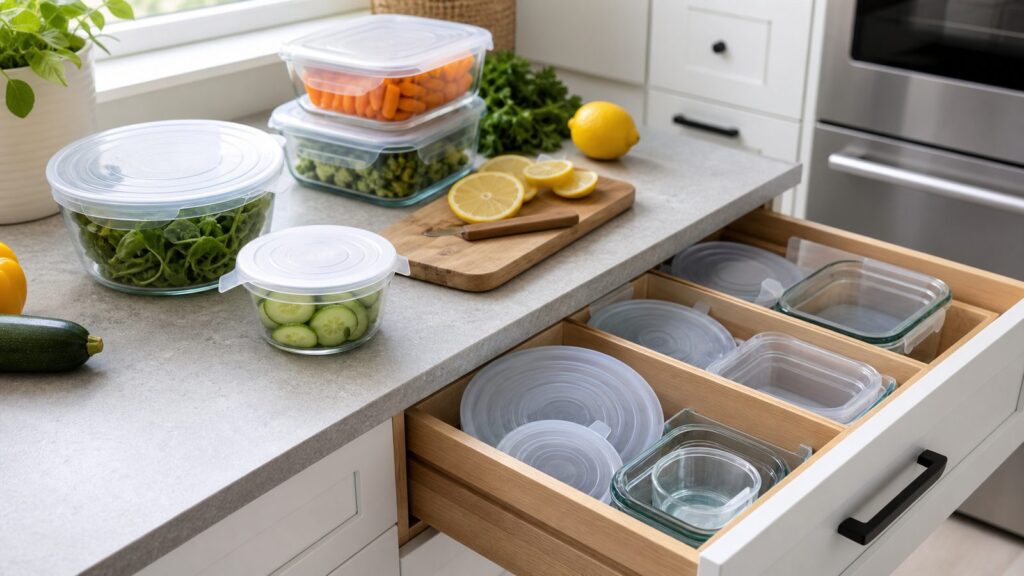
During kitchen planning, we like to create a reusable-storage zone near the prep sink or dishwasher. A practical setup is one drawer for silicone lids and reusable bags, one drawer or shelf for glass containers, and a vertical slot for cutting boards and sheet pans. This keeps the pieces close to where food is prepped and cleaned.
For cabinet planning, small changes matter. A shallow 3- to 5-inch interior drawer can hold lids flat. A deeper 8- to 12-inch drawer can hold nested glass containers. Adjustable dividers keep lids from becoming a pile. If the kitchen includes a pantry wall, a pullout shelf near eye level can work well for meal-prep containers because people can see what they have.
Dishwasher placement also affects whether reusable storage stays clean and convenient. If the dishwasher is 10 feet from the storage drawer, small lids are more likely to dry on the counter and never make it back. If the dishwasher, sink, prep counter, and storage drawer form a tight work zone, cleanup is easier.
Free tools Windows power users keep installed
One-click scans. No signup required.
Sustainable Kitchen Upgrades That Pair Well With Reusable Lids
Silicone lids are a small purchase. A kitchen remodel is a major investment. In 2026, national kitchen remodel ranges are commonly cited around $15,000 to $75,000, with many typical projects around $27,000 to $35,000. High-cost coastal markets can run 20% to 60% above national averages, while some inland markets may be lower on labor but similar on nationally distributed materials.
Within that budget, storage inserts and organization are small line items compared with cabinets, counters, plumbing, and electrical. But they have an outsized effect on how the kitchen works. A homeowner may spend thousands on new cabinets and still be irritated every day if lids, containers, wraps, spices, and waste bins have no assigned home.
Other sustainable upgrades to consider include durable counters that do not need frequent replacement, low-VOC cabinetry and finishes, efficient dishwashers, compost pullouts, LED task lighting, induction-ready electrical planning, and better ventilation. These are not trendy add-ons. They are practical decisions that reduce waste, improve indoor air quality, and make the kitchen easier to maintain.
Independent reader supportYour contribution helps us test, update, and keep practical guides available for everyone.When To DIY And When To Hire A Pro
Buying silicone lids is a straightforward DIY purchase. Measuring containers, choosing a set, organizing a drawer, and replacing disposable wrap habits do not require a contractor. Most households can handle this in one afternoon with a tape measure, a drawer divider, and a realistic look at which containers actually get used.
Quick wins for a faster PC:
Fix the driver behind crashes, sound loss and screen glitchesFind Drivers →Clear out junk files and repair common Windows errorsFree Scan →DIY also makes sense for light storage improvements: adding drawer bins, installing a removable divider, labeling containers, or setting up a small drying rack. Expect to spend about $10 to $40 for basic drawer organization and $20 to $100 for a more complete reusable-storage setup with dividers, bins, and a few glass containers.
Hire a pro when storage improvements become part of a larger kitchen remodel or require electrical, plumbing, cabinetry modification, countertop work, or layout changes. Moving a dishwasher, adding a prep sink, changing cabinet runs, installing new lighting, or modifying walls is no longer a storage project. It is construction work.
Also popular on Amazon

- Notice:If the silicone bowl cover doesn't stick to the container, please try these solutions: ①Clean both the container and the silicone bowl cover: Ensure that both surfaces are clean and free from any dust. Wash the container and the bowl cover with warm water , then dry them thoroughly.②Select the correct size and Adjust the position of the bowl cover: When placing the silicone bowl cover on the container, try adjusting its position.
- [14piece,7 different sizes] – Longzon Silicone storage covers come in 7 sizes (2.6", 3.8",4.5", 5.7",6.5", 8.1" and 9.8’’ diameter).Besides, here has an Arabic numeral number on each round longzon brand lids, so you can identify which size product you need at a glance! You don't need to pick one by one to choose the suitable size lids for you. (Attention: No exceed the maximum diameter value in the Instruction Manual.)
- [Dishwasher Safe & Plastic wrap Replacement ]-- Put silicone food cover in the dishwasher and refrigerator, the elasticity of cover remained the same. Longzon thick silicone covers are durable and will not tear or warp. Easy to use, they can be used over and over again and are dishwasher and freezer safe. Significantly reducing plastic waste, they are more eco-friendly and the good replacement for plastic wraps, baggies, or your traditional containers.
- [ Practical and easy to handle]-- Pure silicone material. Longzon silicone lids directly fit over bowls, jar lids, and hot food items themselves, helping you avoid a container transfer. Please NOTE: Due to the material nature of the silicone, to avoid slipping, make sure that your hands and the outer edge of the bowl and the silicone covers are perfectly dry (NO oil and water) during operation. It is not suitable for sharp objects.
- [ Include 2pc 9.8'' diameter Size Lids ]-- Longzon offers you 2pc silicone lids with a diameter size of 9.8 inches. Our flexible silicone lid is compatible with many containers, including pots, soup bowls and glass jars. You can save time transferring food to another container!
Permit requirements vary by city and scope. Published 2026 contractor guides cite examples such as $400 to $2,500 for kitchen and bath permits in Chicago and Southern California line items around $500 to $2,500 for building permits, $200 to $800 for electrical, and $200 to $600 for plumbing. Your local building department and contractor should confirm what applies before work starts.
Common Mistakes To Avoid
The biggest mistake is buying a universal-looking set without measuring. Silicone stretches, but it is still sized. If most of your bowls are larger than 8 inches and your set tops out around 8.3 inches, you will be forcing the lid every time.
The Tool Desk
Outbyte PC Repair FREEClear out junk files and repair common Windows errorsFree Scan →Outbyte Driver Updater FREEFix the driver behind crashes, sound loss and screen glitchesFind Drivers →Another common mistake is expecting an airtight seal on the wrong rim. Silicone needs a clean, dry, smooth edge. Wet rims, oily bowls, chipped ceramics, and irregular handmade dishes are poor candidates. Dry the rim first and use the right size lid.
Do not assume every silicone lid is oven-safe. Many are marketed for refrigerator, freezer, dishwasher, and microwave use, but oven exposure is a different condition. Heat near burners, toaster ovens, broilers, and hot pans can damage products that were never designed for that use.
Finally, do not overload the kitchen with too many specialty pieces. A drawer full of avocado-shaped, onion-shaped, tomato-shaped, and half-can gadgets can become clutter. Start with a useful stretch-lid set and add produce-specific pieces only for foods you regularly store.
Our Practical Recommendation
For most homeowners, the best starting point is a mid-range 6- to 12-piece silicone stretch-lid set in the $13 to $25 range, plus a few glass food-storage containers if your current containers are stained, warped, or missing lids. Look for food-grade silicone, clear size information, dishwasher-safe labeling, microwave instructions, grip tabs, and enough sizes to cover your most-used rims.
Recommended Free Tools
If you are remodeling, treat reusable storage as part of the kitchen plan. Assign a drawer near the dishwasher or prep zone for silicone lids and reusable bags. Store glass containers close by. Add dividers so the system stays organized after the first week. Keep compost, recycling, and trash pullouts in the same general cleanup zone so waste reduction is built into the daily rhythm of the room.
Silicone lids are not a complete sustainability strategy, and they are not a construction product. They are a practical kitchen tool. When they are properly sized, food-safe, easy to clean, and stored where people use them, they can reduce disposable wrap, make leftovers more visible, and support a better-designed kitchen.
Frequently Asked Questions
Are silicone lids safe for food storage?
Food-grade silicone lids are generally appropriate for repeated food storage when used according to the manufacturer’s instructions. Look for clear food-contact language, such as FDA-compliant materials, rather than vague claims like “non-toxic.”
Are silicone lids better than plastic wrap?
They can be better when you use them consistently. Silicone lids are reusable, durable, and can reduce single-use plastic wrap, but they are not biodegradable and only make environmental sense if they stay in regular rotation.
Can silicone lids go in the microwave, dishwasher, freezer, or oven?
Many silicone lids are labeled for freezer, dishwasher, and microwave use, but temperature limits vary. Follow the product label, vent lids in the microwave if directed, and do not use them in the oven unless the manufacturer specifically says they are oven-safe.
How do I choose the right size silicone lid?
Measure the outside rim diameter of your most-used bowls, mugs, cans, and containers. Buy lids whose resting sizes are slightly smaller than those rims so the silicone stretches and grips securely.
Do silicone lids create an airtight seal?
They can create a tight seal on clean, dry, smooth rims, but performance depends on fit and surface condition. Wet, greasy, chipped, warped, or irregular rims often prevent a reliable seal.
Do I need a permit for sustainable kitchen storage upgrades?
No permit is usually needed to buy silicone lids or add removable drawer organizers. Permits may be required when storage upgrades are part of construction work involving cabinets, plumbing, electrical, walls, or appliance relocation.
Free tools Windows power users keep installed
One-click scans. No signup required.
Quick Recap
Product prices and availability are accurate as of the date/time indicated and are subject to change. Any price and availability information displayed on Amazon at the time of purchase will apply.

