Some links on this page are affiliate links: if you buy through them we may earn a commission, at no extra cost to you.
If you are trying to stop ice dams, the best roof heat cable is usually a UL-listed, self-regulating roof-and-gutter deicing cable installed with proper clips, protected power, and controls. For simple asphalt-shingle eaves, a pre-terminated constant-wattage kit can work. For recurring ice dams, metal roofs, valleys, dormers, long downspouts, or upper roofs draining onto lower roofs, we recommend a professionally designed self-regulating system.
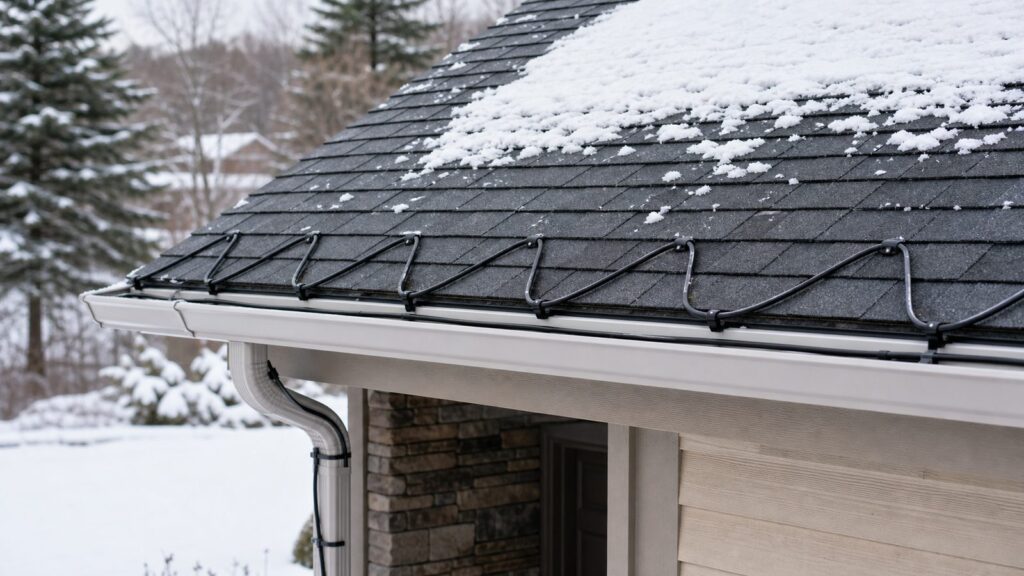
The key is understanding what heat cable does and does not do. It does not melt the whole roof clean. It opens narrow drainage channels through snow and ice so meltwater can move from the warmer roof area, across the eave, through the gutter, down the downspout, and away from the house. If the cable only makes a pretty zigzag at the roof edge but water refreezes in the gutter or downspout, the system has failed.
As an Amazon Associate I earn from qualifying purchases.
On our job sites, we treat heat cable as targeted ice-dam risk reduction. It is not a substitute for attic air sealing, insulation, ventilation, good roof detailing, and ice-barrier underlayment. But in the right location, with the right power and controls, it can be the difference between a dry ceiling and a winter leak.
Best Roof Heat Cable: The Short Answer
For most permanent residential installations in cold US climates, choose self-regulating roof-and-gutter cable with a UV-resistant jacket, a listing for the roof material, compatible roof clips or adhesive mounts, gutter and downspout hangers, and ground-fault-protected power. Add a thermostat or moisture/temperature controller so the cable runs when conditions call for it instead of burning electricity all winter.
#1 Best Overall

- Wide Application: The heat tape is suitable for all roof and gutter configurations such as roofs with noncombu-stible shingles, metal or plastic gutters/downspouts, etc. (Note: You can also wrap it around the water pipes to keep them from freezing)
- One-stop De-icing: Our updated 152FT roof heat cable effectively prevents roof, gutter and downspouts from freezing. Protect your roof from damage and leaks by ensuring water properly flows through gutters and downspouts (Power cord length: 9.8FT)
- 4-Layer Safety Design: Our heat cable consists of waterproof outer jacket, insulation layer, shielding layer and PTC layer. It is made of AL-MG Alloy Wire with 100% screening rate, polyolefin and tinned copper core
- Overlapping Cables in Any Pattern: The 120V 8W/FT self-regulating roof heat tape won't short out or burn out if the heat tape overlap, unlike ordinary roof heat cables. More energy efficient and safer
- Easy Installation: With 60 spacers and clips, the roof heat tape are easy to install. Make the smart choice for quality and safety—Choose Eastrexon Roof Heat Tape
A good system should cover the ice-dam origin zone, not just the gutter. A common design benchmark is to run the cable pattern high enough that it reaches at least 6 inches above the exterior wall plane. That matters because many ice dams form near the transition where the warm house stops and the cold overhang begins. If the cable does not cross that zone, it may not create a reliable drainage path.
For a small, straightforward asphalt-shingle roof, a 100-foot or 200-foot retail kit may be enough. In 2026, common 100-foot constant-wattage roof deicing kits are often under $100 at large retailers, with 200-foot kits commonly around the mid-$100 range. That is material only. Installed systems are a different cost category. National pricing commonly lands around $5 to $15 per linear foot installed for basic work, while professional or specialty ice-dam systems often run about $13 to $26 per cable foot, or roughly $30 to $60 per running foot of eave in heavy cold-climate work.
Free tools Windows power users keep installed
One-click scans. No signup required.
Heat Cable vs Heat Tape: What Homeowners Actually Need
People use the terms roof heat cable, roof heat tape, deicing cable, and heat trace interchangeably. In practice, you are shopping for an electric heating product that is specifically listed for roof, gutter, and downspout deicing. Do not buy pipe heat tape and assume it belongs on a roof. Roof systems need outdoor-rated jackets, UV resistance, correct watt density, approved attachment methods, and compatibility with shingles, metal panels, gutters, and downspouts.
Constant-wattage cable
Constant-wattage cable puts out a fixed amount of heat per foot whenever it is energized. Many retail roof deicing kits are in this category. A typical example is 5 watts per foot. A 100-foot cable at 5 watts per foot draws about 500 watts, or 0.5 kilowatts.
The upside is price and simplicity. These kits are pre-terminated, easy to understand, and practical for limited problem areas on simple asphalt-shingle roofs. The downsides are less adaptability, stricter layout limits, and higher risk if the homeowner ignores the instructions. Many constant-wattage cables cannot be cut, crossed, overlapped, stapled, or installed on every roof material. They also keep drawing their rated wattage whenever they are on.
Self-regulating cable
Self-regulating cable changes output based on temperature along the cable. Colder sections produce more heat; warmer sections produce less. That does not mean it uses no power, and it does not eliminate the need for controls, but it is better suited for permanent systems with changing roof conditions.
For professional installations, self-regulating cable is usually the better choice. It can be cut to length when used with manufacturer-approved power connection kits and end seals. It handles complex rooflines more cleanly, works well in gutters and downspouts when rated for that use, and is commonly specified with commercial-grade controls. The installed price is higher, but so is the design flexibility.
Comparison Table: Which Roof Heat Cable Type Fits Your Situation?
| Situation | Best Fit | Typical 2026 Cost | Best Use | Watchouts |
|---|---|---|---|---|
| Simple asphalt-shingle eave with one gutter run | Pre-terminated constant-wattage kit | About $95 for a 100-ft kit; about $136 for a 200-ft kit before clips, power, or labor | DIY-friendly limited ice buildup | Follow length, spacing, roof-material, and outlet instructions exactly |
| Moderate recurring ice at eaves and gutters | Self-regulating plug-in roof-and-gutter kit | Often about $90 to $300+ depending on length and brand | Better output control than basic cable with simpler installation than full custom systems | Still needs correct layout, protected power, and dry-roof installation |
| Valleys, dormers, inside corners, long downspouts, or repeat leaks | Pro cut-to-length self-regulating system | About $13 to $26 per cable foot, or $30 to $60 per running foot of eave for robust cold-climate systems | Permanent drainage-path design | Electrical work, controls, and roof access can add cost |
| Metal roof with sliding snow or specialty panels | Manufacturer-approved self-regulating cable with non-penetrating attachments | Usually pro-priced due to layout and attachment complexity | Standing seam, exposed fastener metal, and specialty roof assemblies | Do not puncture panels or compromise coatings without manufacturer approval |
| Whole-house ice dams every winter | Attic remediation, insulation, ventilation, and roof detailing first | Varies by scope; often a better long-term investment than more cable | Chronic heat-loss problems | Heat cable may still be useful at valleys and gutters, but it is not the root fix |
How Roof Heat Cable Stops Ice Dams
An ice dam forms when snow melts higher on the roof, runs down, and refreezes at the colder eave. The growing ice blocks water. That backed-up water can work under shingles, reach the roof deck, and show up as stains, wet insulation, swollen trim, or active ceiling leaks.
Heat cable interrupts that cycle by creating open paths through the frozen edge. The best layouts connect the warmer melt zone to a safe discharge path. That path should continue through the eave, into the gutter, down the downspout, and to grade or another safe drainage point. A cable pattern that stops at the roof edge may melt a channel, but if the gutter is frozen solid, the water has nowhere to go.
Rank #2
- Wide Application: The heat tape is suitable for all roof and gutter configurations such as roofs with noncombu-stible shingles, metal or plastic gutters/downspouts, etc. (Note: You can also wrap it around the water pipes to keep them from freezing)
- One-stop De-icing: The 100FT roof heat cable effectively prevents roof, gutter and downspouts from freezing. Protect your roof from damage and leaks by ensuring water properly flows through gutters and downspouts (Power cord length: 9.8FT)
- 4-Layer Safety Design: Our heat cable consists of waterproof outer jacket, insulation layer, shielding layer and PTC layer. It is made of AL-MG Alloy Wire with 100% screening rate, polyolefin and tinned copper core
- Overlapping Cables in Any Pattern: The 120V 8W/FT self-regulating roof heat tape won't short out or burn out if the heat tape overlap, unlike ordinary roof heat cables. More energy efficient and safer
- Easy Installation: With 45 spacers and clips, the roof heat tape are easy to install. Make the smart choice for quality and safety—Choose Eastrexon Roof Heat Tape
On a typical asphalt-shingle eave, cable is installed in a triangular or zigzag pattern. The loops extend up the roof far enough to cross above the exterior wall line, then drop to the gutter. The spacing and height depend on the manufacturer’s chart, roof pitch, overhang depth, and local conditions. Valleys often need their own runs because they collect snow and water from two roof planes. Dormer cheeks and inside corners deserve special attention because they often produce concentrated meltwater.
Do these 3 things before closing this tab:
1Repair Windows errors before they cause bigger problems2Scan for outdated or missing drivers - takes under a minute3Clear out junk files and repair common Windows errorsDownspouts are not optional when they are part of the drainage route. If a heated gutter dumps into an unheated vertical downspout, that downspout can freeze shut and turn the gutter into an ice trough. We typically continue cable down the downspout and, where needed, back up to avoid leaving an unheated dead end.
How Much Roof Heat Cable Do You Need?
Do not size a system by roof edge length alone. A 40-foot eave may need 80, 120, or 180 feet of cable once you account for zigzags, gutter runs, downspouts, valleys, and returns. This is one reason homeowner estimates often miss the real budget.
The variables are practical: roof pitch, overhang depth, gutter length, downspout height, number of roof planes feeding the area, valleys, dormers, and whether an upper roof drains onto a lower roof. A shallow overhang with a single 10-foot downspout may be simple. A two-story house with a 24-inch overhang, two inside valleys, a dormer, and a 25-foot downspout is not.
As a rough planning range, many residential systems fall between 100 and 200 linear feet of cable. Larger homes, complicated rooflines, metal roofs, and long downspout runs can go much higher. We prefer to estimate both cable feet and eave feet. Cable feet tell you material and electrical load. Eave feet tell you the visible building area being protected. Explaining both prevents the common surprise where a homeowner expects 40 feet of cable for a 40-foot roof edge.
2026 Cost to Install Roof Heat Cable
For 2026 US budgeting, installed roof heating cable commonly ranges from about $5 to $15 per linear foot for basic installations. Many small-home projects land around $800 to $1,200. Medium homes are often around $1,200 to $2,000. Larger homes may be around $2,000 to $2,500 before unusual access, electrical upgrades, or complex roof geometry.
Professional installations with better materials, custom self-regulating cable, layout design, and more difficult roof access often price higher. A realistic pro range is about $13 to $26 per cable foot including materials and labor. Specialty ice-dam contractors in cold regions may price robust systems around $12 to $17 per foot of cable installed, or roughly $30 to $60 per running foot of eave when the layout is dense and includes gutters, downspouts, valleys, and controls.
Electrical work can change the estimate quickly. A dedicated circuit, exterior-rated receptacle, ground-fault equipment protection, controller, or licensed-electrician modification can add roughly $500 to $1,000 on some projects. That is not padding; it is often what makes the system safe, code-compliant, and usable without extension cords.
What drives the price?
Roof height and pitch matter because access controls labor time and safety requirements. A one-story walkable roof is not the same job as a steep two-story eave over frozen landscaping. Eave depth affects how high the cable pattern must extend. Valleys, dormers, and inside corners add cable and labor because they concentrate water. Metal roofs need compatible attachment methods. Controls add upfront cost but can reduce operating cost. Local labor rates and whether the work is bundled with roofing or gutter repairs also affect the final number.
Quick wins for a faster PC:
Scan for outdated or missing drivers - takes under a minuteDriver Scan →Repair Windows errors before they cause bigger problemsFix Now →Fix the driver behind crashes, sound loss and screen glitchesFind Drivers →Rank #3

- Self-Regulating vs. Fixed Power: Be sure to distinguish between self-regulating and fixed-power cables when purchasing. Fixed-power cables, often cheaper, provide only 5W/ft and may struggle in cold conditions. Our 8W/ft self-regulating cable adjusts to temperature drops, delivering up to 158°F for reliable snow and ice melting.
- Advanced Self-Regulating Technology: Automatically adjusts output based on ambient temperature, ensuring optimal heat distribution and maintaining a consistent 158°F, unlike other brands with fixed temperature cables.
- Durable Construction: Built with polyolefin inner insulation, a TPE protective layer, and a tinned copper core, this heat cable offers high safety and long-lasting performance, even in harsh winter conditions.
- Versatile Use: Perfect for roof de-icing and gutter protection, this cable also doubles as a reliable freeze protection solution for pipes, making it a versatile addition to any home.
- Easy Installation with Extended Reach: Equipped with a 5.4ft power cord, our heat cable is easy to install and offers extended reach, providing flexibility for various roof and gutter configurations.
Operating Cost: What It Costs to Run Roof Heat Tape
Heat cable is an electrical load, and homeowners should budget for it. A simple example: 100 feet of constant-wattage cable at 5 watts per foot equals 500 watts, or 0.5 kilowatts. Running continuously for 24 hours uses 12 kilowatt-hours. At roughly 17 to 19 cents per kWh, that costs about $2.04 to $2.28 per day. A 200-foot system doubles that before considering controls or self-regulating behavior.
Monthly cost depends on weather and controls. If a 100-foot system ran 24 hours per day for 30 days, the simple math would be about $61 to $68. A 200-foot system would be about $122 to $137. In real use, a controlled self-regulating system should not run at full output every hour of the winter. A thermostat, moisture sensor, or smart outdoor-rated control can materially reduce runtime by turning the system on during snow and freeze conditions and off when it is dry or warm enough.
Electric rates vary a lot by state, and 2026 residential electricity prices remain elevated in many markets. The right way to localize the estimate is simple: cable feet multiplied by watts per foot equals watts. Divide by 1,000 for kilowatts. Multiply by hours of runtime and your utility rate. That gives you the operating cost before controls reduce actual runtime.
Controls, Power, and Electrical Safety
Roof heat cable should be treated as exterior electrical equipment exposed to water, snow, ice, UV, and physical stress. That means weatherproof connections, proper strain relief, correct circuit sizing, and ground-fault protection. For many systems, especially larger heat-trace and snow-melt installations, ground-fault equipment protection is part of the safety conversation. Homeowners should not solve power by running an indoor extension cord through a window.
The Tool Desk
Outbyte PC Repair FREEClear out junk files and repair common Windows errorsFree Scan →Outbyte Driver Updater FREEFix the driver behind crashes, sound loss and screen glitchesFind Drivers →At minimum, the cable should plug into or connect through an exterior-rated, properly protected power source that matches the manufacturer’s requirements. Larger systems may need a dedicated circuit. Some jurisdictions require an electrical permit for new circuits, hardwired controls, or exterior modifications. Roofing work may also affect warranty language, especially if clips, adhesives, fasteners, or penetrations are not approved by the roof or cable manufacturer.
On our projects, we want the power plan decided before the cable layout is finalized. That prevents overloading a circuit, placing the controller in a bad location, or discovering after installation that the cord cannot safely reach a protected receptacle.
When to DIY vs When to Hire a Pro
DIY can make sense when the roof is simple
A homeowner may be able to install a pre-terminated roof-and-gutter cable kit when the work is low, accessible, and limited to a simple asphalt-shingle eave. The roof should be dry, the weather should be calm, and the installation should happen before winter conditions make the roof unsafe. The cable kit must be listed for roof and gutter use, long enough for the layout, compatible with the roof material, and installed exactly as the manufacturer directs.
DIY is not a good place for improvisation. Do not cut a cable unless the product is specifically designed for field cutting with approved components. Do not cross or overlap cable unless the instructions allow it. Do not staple, nail, or pinch it. Do not use a permanent extension cord. Do not install it after a thick ice dam has already formed and expect it to clear the roof quickly.
PC Slower Than It Used to Be?
A free scan shows the junk files, broken settings and background clutter dragging Windows down - then fixes them in one click.Free scan · Windows 10 & 11Outdated Drivers Are Slowing You Down
One free scan finds every outdated or missing driver and matches the right update for your exact hardware.Free scan · exact hardware matchHire a pro when the problem is recurring or complex
Bring in a roofing contractor, ice-dam specialist, or electrician-supported installer when the house has repeated leaks, a steep or high roof, metal roofing, multiple valleys, dormers, long downspouts, upper roofs dumping onto lower roofs, or no suitable exterior power. Also hire a pro if the system needs to be hardwired, controlled by a panel, or coordinated with gutter replacement, roof repairs, or attic improvements.
Rank #4
- Wide Application: The heat tape is suitable for all roof and gutter configurations such as roofs with noncombu-stible shingles, metal or plastic gutters/downspouts, etc. (Note: You can also wrap it around your water pipes to keep them from freezing)
- One-stop De-icing: The 50FT roof heat cable effectively prevents roof, gutter and downspouts from freezing. Protect your roof from damage and leaks by ensuring water properly flows through gutters and downspouts (Power cord length: 9.8FT)
- 4-Layer Safety Design: Our heat cable consists of waterproof outer jacket, insulation layer, shielding layer and PTC layer. It is made of AL-MG Alloy Wire with 100% screening rate, polyolefin and tinned copper core
- Overlapping Cables in Any Pattern: The 120V 8W/FT self-regulating roof heat tape won't short out or burn out if the heat tape overlap, unlike ordinary roof heat cables. More energy efficient and safer
- Easy Installation: With 20 spacers and clips, the roof heat tape are easy to install. Make the smart choice for quality and safety—Choose Eastrexon Roof Heat Tape
A good installer should ask where the ice forms, where water backs up, where it leaks inside, how the attic is insulated and ventilated, what roof material is present, and where meltwater can drain. If the proposal only counts gutter length and ignores the roof geometry, it is incomplete.
Metal Roofs, Gutters, and Downspouts
Metal roofs need extra care. Snow can slide, panels expand and contract, and coatings can be damaged by the wrong attachment. Use cable that is approved for the roof type and attachment methods that do not puncture panels or void warranties. Standing-seam roofs often require clamps or approved adhesive-mounted hardware rather than screws through the panel. Exposed-fastener metal roofs still need manufacturer-compatible methods.
Gutters and downspouts also need compatible cable. Not every roof cable is rated for every gutter condition, and not every kit allows the same downspout routing. In cold climates, the downspout is often the weak point. A warm gutter connected to a frozen downspout can back up fast. The layout should keep water moving all the way to discharge.
Recommended Free Tools
Heat Cable Is Not the Whole Ice-Dam Fix
If a home gets heavy ice dams every winter across broad roof areas, the building is usually telling you something. Warm air is escaping into the attic, insulation is thin or uneven, soffit vents are blocked, exhaust ventilation is poor, or roof details are concentrating meltwater. Heat cable can manage symptoms at eaves, valleys, and gutters, but it does not correct heat loss.
The better long-term sequence is often attic first. Air seal penetrations around plumbing stacks, bath fans, recessed lights, top plates, attic hatches, and mechanical chases. Verify insulation depth and coverage. Keep soffit vents open with baffles. Confirm balanced intake and exhaust ventilation. During reroofing, install code-compliant ice-barrier underlayment at eaves and other required areas. Current residential roofing code language requires ice barrier protection in areas where there has been a history of ice forming along eaves and causing water backup, with placement tied to the exterior wall line and roof edge details.
That does not mean cable is wrong. It means cable should be used where drainage needs help, while the house is also corrected so it produces less meltwater in the first place.
Common Mistakes We See With Roof Heat Cable
The first mistake is buying the cheapest heat tape without checking the listing, roof-material compatibility, wattage, jacket rating, warranty, and whether it can be used in gutters and downspouts. A roof is not the place for mystery electrical products.
The second mistake is putting cable only along the gutter. Ice dams often start above the gutter at the warm-roof-to-cold-eave transition. The cable pattern needs to reach high enough to create a path from above that point to the drainage system.
The third mistake is ignoring valleys and upper roof discharge. A small upper roof can dump meltwater onto a lower eave and create a serious ice block. Valleys collect water from two planes and deserve their own design attention.
Best Value

- 【ETL Certified for Superior Safety】ETL certification, trusted in North America, ensures safety and quality compliance with rigorous standards. Our self-regulating heating cable holds full ETL certification, guaranteeing exceptional performance and reliability. The plug is also UL certified for extra safety. Always choose a fully certified heating cable for true safety. Plug-only certification is insufficient; the entire cable must be certified.
- 【More functional】Suitable for use on plastic and metal water pipes( including inlet pipes, drain pipes, sewer, palm tree frost protection etc). Industrial grade self-regulating heating cable. The cable output will adjust automatically based on the ambient temperature at each point along the cable. No worry about the overheating risk. More Safe. Can be used by straight, spiral, and overlap. More functional.
- 【Protect pipes up to 2 1/2” in diameter】For better freeze protection, at least 1/2 inch thick or thicker insulation material is recommended, especially for extremely cold weather. If the ambient temperature is lower than -20°F(-29°C), please use 1” thick insulation material. ETL approved. 50 degrees F for pipe freeze protection.3 ft 18/3 cold lead with grounded plug.
- 【Roof deicing application】HEATIT JHSF1 was designed to prevent the ice dam formation not to melt the ice dams which were already formed. Please turn on the cable at the beginning of snowing. Can be used on flat roofs, metal roofs, asphalt roofs, rubber roofs, slate roofs, stone roofs, metal roofs, ceramic roofs, composite (tar and gravel) roofs, and so on. Rated 10W/ft at 32°F (0°C) for roof deicing. For roof deicing applications, you may need to buy clips and hangers separately.
- 【Energy Saving】Designed to maintain water temperature in the supply piping system, reducing or eliminating the delay in obtaining hot water at each fixture. You don’t need to run showers or sinks for long periods of time to draw new hot water into the unit, which is a significant waste of water. Simply wrap the self-regulating heating cable around your hot water lines within the house to provide you with instant hot water.
The fourth mistake is poor power. Extension cords, indoor receptacles, unprotected outlets, and cords routed through windows are not acceptable permanent solutions. Exterior electrical work needs proper protection.
The fifth mistake is waiting until there is already a thick ice dam. Heat cable works best before or during snow and ice-forming conditions. It is not a fast emergency removal tool. If ice has already backed water into the house, the immediate answer may be professional ice removal and leak control, followed by a permanent plan in dry weather.
What’s actually slowing this PC down?
Pick the symptom - the matching free tool is one click away.
What We Recommend for Most Homeowners
For a one-time small trouble spot on a simple asphalt roof, a listed pre-terminated kit can be a reasonable seasonal fix if installed correctly. For a house that sees ice dams most winters, step up to self-regulating roof-and-gutter cable with controls and a real drainage layout. For complex roofs, metal roofs, steep access, or electrical changes, hire a professional.
Budget the installed work honestly. A basic system may be under $1,500. A medium project may land between $1,200 and $2,000. Larger or more complex projects may exceed $2,500, especially with electrical upgrades or specialty cold-climate detailing. Then budget operating cost using your local electric rate. Controls are not a luxury; they are part of making the system practical.
The best roof heat cable system is not the longest cable or the hottest cable. It is the one that keeps water moving from the melt zone to a safe discharge point, uses listed components, protects the electrical circuit, respects the roof material, and fits into a broader plan for insulation, ventilation, drainage, and roof durability.
Frequently Asked Questions
Do roof heat cables actually stop ice dams?
They can reduce ice-dam leaks by keeping narrow drainage channels open through snow and ice. They do not melt the whole roof clean or fix the attic heat loss that often causes ice dams.
What is the best roof heat cable for ice dams in 2026?
For most permanent systems, the best choice is UL-listed self-regulating roof-and-gutter cable with UV-resistant jacketing, proper clips, ground-fault-protected power, and thermostat or moisture controls.
How much does roof heat cable installation cost?
Basic installed systems commonly run about $5 to $15 per linear foot. Professional or specialty systems often cost about $13 to $26 per cable foot, with robust cold-climate work around $30 to $60 per running foot of eave.
Is self-regulating cable better than constant-wattage heat tape?
Self-regulating cable is usually better for permanent and complex installations because it adjusts output with temperature and can often be cut to length with approved components. Constant-wattage kits are cheaper and can work for simple DIY asphalt-shingle eaves.
How much electricity does roof heat tape use?
A 100-foot constant-wattage cable at 5 watts per foot draws about 500 watts. Running 24 hours uses 12 kWh, which costs about $2.04 to $2.28 per day at 17 to 19 cents per kWh.
Do these 3 things before closing this tab:
1Repair Windows errors before they cause bigger problems2Scan for outdated or missing drivers - takes under a minute3Clear out junk files and repair common Windows errorsCan heat cable be used on metal roofs?
Yes, but only with cable and attachments approved for the specific metal roof. Use non-penetrating or manufacturer-approved attachment methods so panels, coatings, seams, and warranties are not compromised.
Quick Recap
Product prices and availability are accurate as of the date/time indicated and are subject to change. Any price and availability information displayed on Amazon at the time of purchase will apply.

