What’s actually slowing this PC down?
Pick the symptom - the matching free tool is one click away.
Some links on this page are affiliate links: if you buy through them we may earn a commission, at no extra cost to you.
The best lumber rack is not the one with the biggest number on the box. It is the rack that safely holds the lumber you actually store, fits the structure you are fastening into, keeps material dry and accessible, and does not create a falling-load problem over your workbench, vehicle, or walkway.
For most homeowners and small workshops, the best all-around choice is a heavy-duty wall-mounted steel lumber rack with 4 to 6 vertical standards, 3 to 5 tiers, and a published capacity in the 600 to 1,000 lb range when installed into solid framing. For sheet goods, a vertical panel cart or low, full-depth horizontal support is usually better than stacking plywood on narrow wall arms. For professional shops, lumberyards, and contractor storage yards, engineered cantilever racking is the standard because it handles long stock, heavy lifts, forklift access, and posted load ratings.
As an Amazon Associate I earn from qualifying purchases.
Windows Errors? Fix Them Before They Spread
Repair common Windows errors and clear accumulated junk for a smoother, more stable PC - no reinstall needed.Free scan · no reinstallOutdated Drivers Are Slowing You Down
One free scan finds every outdated or missing driver and matches the right update for your exact hardware.Free scan · exact hardware matchOn our job sites, we treat lumber storage as a safety and workflow decision first. A rack has to answer four questions: How much does the material weigh? What is carrying that load? Can the crew load and unload it without fighting gravity? What happens if one board bows, rolls, or gets bumped?
This guide breaks down the main lumber rack types, real 2026 cost ranges, sample load calculations, installation details, and when a DIY rack is fine versus when you should involve a professional.
#1 Best Overall

- Storage Master – These high-impact lumber storage racks are designed to store long objects such as lumbers, pipes, or skiing equipment to create more space in your house or even outdoor workspaces.
- Premium Heavy-duty Support – These wood organizer racks are made of scratch-resistant materials, each shelf can hold up to 330 lb overall, which can store all those heavy and large items with these durable racks for your everyday work.
- Ultimate Space Saving – Effectively utilize your space and eliminate garage room clutter with these metal racks. Utilize every wall space in garage and workshop rooms to maximize conveniences. Keeping your space well-organized and everything comes handy.
- Easy Installation – This lumber storage rack includes all the necessary parts and clear step-by-step instructions to make assembly a snap. The intuitive design and hassle-free setup get your organizer up and ready to use in no time.
- Customization – Standard mounting hardware included in the package to make installation process as convenient as possible. Every customer can feel welcomed to contact us in any minutes regarding to any product services.
Start With the Load, Not the Rack
Before buying any lumber rack, estimate the heaviest realistic load you will put on it. Published rack capacities are usually based on evenly distributed loads, correct fasteners, sound framing, and all brackets installed exactly as the manufacturer requires. They do not mean one arm can take the full advertised rating, and they definitely do not mean drywall anchors are acceptable.
A modest remodel pile gets heavy faster than most people expect. A single 4 ft. x 8 ft. sheet of sheathing plywood can weigh about 42 to 44 lb. Ten sheets can put roughly 420 to 440 lb on a rack before you add any framing lumber. A 20-sheet stack can be near 850 lb, plus the leverage of the sheets if they are not supported properly.
Do these 3 things before closing this tab:
1Clear out junk files and repair common Windows errors2Fix the driver behind crashes, sound loss and screen glitches3Repair Windows errors before they cause bigger problemsDimensional lumber is lighter per piece, but the count adds up. If you keep 20 pieces of 2x4x8 framing lumber, several 2x6s, trim boards, and a few plywood sheets in the same area, you can easily reach several hundred pounds. That is why a light-duty 2-bracket rack that looks fine for a few boards can become overloaded during one busy weekend project.
A Simple Load Example
Here is a realistic garage scenario for a homeowner or remodeler:
- 20 pieces of 2x4x8 framing lumber
- 6 sheets of 1/2 in. plywood or sheathing
- 10 pieces of 1x trim or furring
- A few offcuts and short boards that accumulate over time
The plywood alone may be about 250 to 265 lb. The 2x4s and trim can add another 180 to 260 lb depending on species, moisture content, and grade. That puts the storage load in the 430 to 525 lb range before you account for uneven loading, someone adding wet treated lumber, or material leaning against the rack.
For that type of inventory, we would not choose a 300 lb light-duty rack. We would look for a wall-mounted system rated around 600 to 1,000 lb, spread across multiple studs, with the heaviest material on lower arms. If sheet goods are a regular part of the work, we would separate them into a panel cart or floor-supported panel rack instead of forcing them onto cantilever arms.
Best Lumber Rack Types Compared
There is no single best rack for every user. The right choice depends on whether you are storing 8 ft. boards in a garage, 12 ft. trim in a cabinet shop, plywood for weekend projects, or bunks of material in a contractor yard.
| Rack type | Best use | Typical 2026 cost | Strengths | Watch-outs |
|---|---|---|---|---|
| Wall-mounted steel lumber rack | Home garages, small shops, remodelers | $25-$60 light-duty; $60-$150 mid-range; $150-$400+ heavy-duty systems | Saves floor space, keeps boards flat, good access for common stock | Depends heavily on studs, fasteners, wall condition, and even loading |
| Ceiling-mounted rack | Light or infrequently used stock, bins, seasonal material | $150-$500+ per unit; premium systems around $400+ | Uses overhead space, clears wall and floor areas | Poor choice for heavy daily lumber or sheet goods; loading can be awkward |
| Rolling lumber cart | Woodworkers, small shops, sheet goods, cutoffs | $100-$500+ depending on build or brand | Mobile, floor-supported, good for plywood and offcuts | Consumes floor space; casters and base must match load |
| DIY 2×4 lumber rack | Budget garage storage, custom-length walls | $50-$250 in materials | Custom fit, inexpensive, easy to modify | Requires sound layout, structural fasteners, bracing, and conservative loading |
| Commercial cantilever rack | Contractor shops, lumberyards, warehouses | Used systems often $800-$1,900+ per bay or starter kit before freight and install | Best for long and heavy stock, forklift access, posted capacities | May trigger engineering, permitting, anchorage, seismic, and fire-code review |
Wall-Mounted Lumber Racks: Best All-Around for Garages
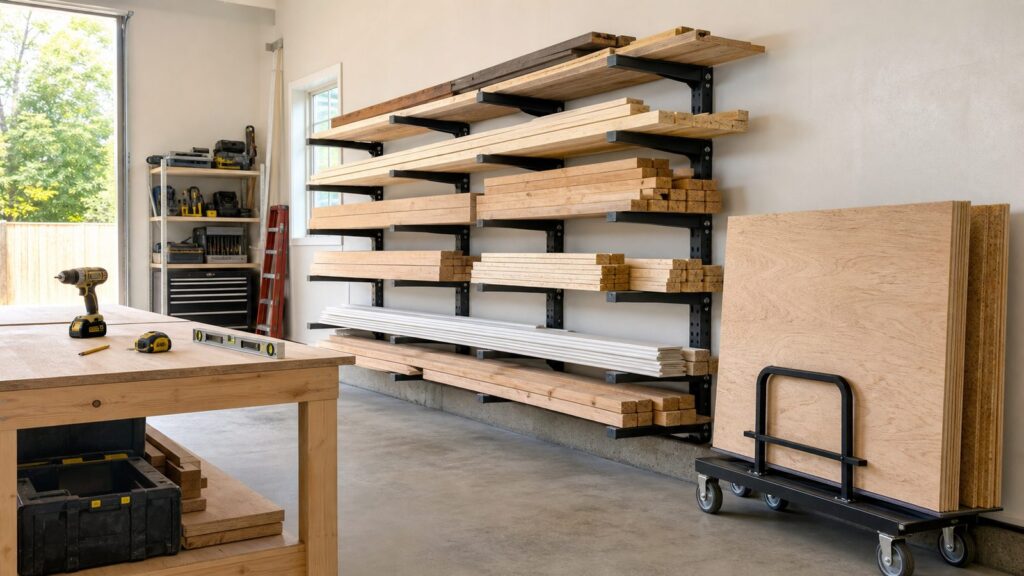
A wall-mounted lumber rack is usually the best first choice for a homeowner garage or compact workshop. It gets boards off the floor, frees up wall-to-wall floor space, and makes it easy to sort lumber by length, species, or project.
Common residential wall racks use vertical steel standards with cantilever arms. Budget sets may include 2 to 4 brackets and advertise capacities around 300 lb or more. Mid-range systems commonly run about $60 to $150 and may advertise 600 to 1,000+ lb total capacity. Larger heavy-duty wall systems and garage storage kits can run $150 to $400+ before installation.
For a typical garage, we prefer more supports over fewer. Three brackets can work for short stock, but 4 to 6 vertical standards distribute the load better across the wall and reduce sagging in long boards. For 8 ft. lumber, three support points is a practical minimum. For 10 ft. or 12 ft. stock, four or more support points is better.
Recommended Free Tools
Rank #2

- 【Perfect for Storage】 Ideal for shed, workshop, garage, outdoor workspace or any area where long items need to be stored neatly; This is a very strong storage solution for lumber, firewood, sheet metal, PVC, pipes, ladders, skis, snowboards, golf clubs and more!
- 【Weight Capacity of 1200 LBS】YYR lumber storage rack wall mounted is made of powder-coated 1⅙” (3 cm) steel tube construction。After many tests, each shelf can hold up to 200 lbs, which means a total weight capacity of 1200 lbs.
- 【No Assembly Required】Wood storage racks arrives fully assembled. This industrial-grade design is also one of the reasons it can hold a lot of weight.
- 【Fast & Simple Installation】YYR lumber shelf comes with mounting screws and instructions so you can have it on your wall in 15 minutes.
- 【Free Up Valuable Floor Space】YYR wall mounted storage rack will make full use of wall space to increase your storage space. Keep your garage or shed tidy and clutter-free by utilizing unused garage wall space.
What to Look For
- Capacity: Look for a total rating above your calculated load, with a margin. If your expected load is 450 lb, a 600 lb rack is the low end; 800 to 1,000 lb gives more room for real-life use.
- Arm depth: Many garage racks use arms around 12 to 16 in. deep. Deeper arms hold more material but create more leverage on the wall.
- Tier count: Three to five tiers is enough for most garages. Too many tiers invite overloading and make upper material hard to handle.
- End stops: Upturned arm ends or removable pins help keep pipe, round stock, and warped boards from rolling off.
- Finish: Powder-coated steel resists garage humidity better than bare steel.
Installation Details That Matter
The rack is only as strong as the wall assembly behind it. Fasten into wall studs, not drywall alone. Use the fastener type and size specified by the manufacturer. If the rack layout does not align with studs, install continuous horizontal blocking or a structural ledger that transfers load across multiple studs.
On finished garage walls, remember that the wall may be part of the garage-to-house separation. If you open drywall to add blocking, repair it properly and maintain the required fire separation details for that assembly. Do not leave random holes, missing gypsum, or unsealed penetrations where the wall separates garage space from living space.
We also keep heavy material low. Put wet treated lumber, dense hardwood, and larger framing stock on the bottom tiers. Use upper tiers for trim, conduit, light molding, spare PVC, or short stock. This reduces the consequences of a dropped board and makes the rack easier to load safely.
Ceiling Lumber Racks: Useful, But Often Misused
Ceiling-mounted garage storage racks are popular because they turn overhead space into storage. They can be a good solution for bins, light trim, seasonal material, or a small quantity of seldom-used boards. They are usually not our first choice for heavy lumber storage.
The Tool Desk
Outbyte PC Repair FREERepair Windows errors before they cause bigger problemsFix Now →Outbyte Driver Updater FREEFix the driver behind crashes, sound loss and screen glitchesFind Drivers →Common ceiling-mounted garage racks cost roughly $150 to $500+ per unit in 2026. Premium overhead systems can be around $400+ and may advertise capacities around 750 to 800 lb. Those numbers sound generous, but the practical issue is not just static load. It is loading and unloading long, awkward material above shoulder height while standing near vehicles, tools, ladders, and garage doors.
If you use a ceiling rack for lumber, keep it conservative. Store lighter, straight material. Avoid heavy sheet goods. Confirm that the rack is fastened into ceiling joists or approved structural framing, not just drywall or thin sheathing. Watch garage door track clearance, opener travel, light fixtures, sprinkler heads, and the swing path of tall vehicles or ladders.
Ceiling racks are best for material you rarely touch. Daily-use 2x4s, 10 ft. trim, and plywood belong where one person can handle them without working overhead for every pull.
Rolling Lumber Carts and Panel Storage
If you store plywood, MDF, doors, cabinet panels, or mixed offcuts, a rolling cart may beat a wall rack. Sheet goods need full-depth support and a storage angle that prevents bowing, tipping, and corner damage. Narrow cantilever arms can work for some boards, but they are not ideal for a stack of 4 ft. x 8 ft. panels unless the rack is specifically designed for that load.
Free tools Windows power users keep installed
One-click scans. No signup required.
A basic shop-built rolling cart can cost $100 to $250 in plywood, 2x material, screws, glue, and casters. A more refined cart with heavy-duty locking casters, vertical dividers, and sheet-good compartments can land in the $250 to $500+ range. The most important parts are the base width, caster rating, and center of gravity.
For sheet goods, we like a low, wide cart with panels stored nearly vertical at a slight lean. Four 4 ft. x 8 ft. sheets at roughly 42 to 44 lb each already put about 170 lb on the cart. Add 3/4 in. plywood, MDF, melamine, or hardwood panels and the weight climbs quickly. Use casters with a combined rating well above the expected load, and remember that rolling over a floor joint or extension cord creates shock loads.
Rank #3

- 【Perfect for Storage】 Ideal for shed, workshop, garage, outdoor workspace or any area where long items need to be stored neatly; This is a very strong storage solution for lumber, firewood, sheet metal, PVC, pipes, ladders, skis, snowboards, golf clubs and more!
- 【Weight Capacity of 1200 LBS】YYR lumber storage rack wall mounted is made of powder-coated 1⅙” (3 cm) steel tube construction。After many tests, each shelf can hold up to 200 lbs, which means a total weight capacity of 1200 lbs.
- 【No Assembly Required】Wood storage racks arrives fully assembled. This industrial-grade design is also one of the reasons it can hold a lot of weight.
- 【Fast & Simple Installation】YYR lumber shelf comes with mounting screws and instructions so you can have it on your wall in 15 minutes.
- 【Free Up Valuable Floor Space】YYR wall mounted storage rack will make full use of wall space to increase your storage space. Keep your garage or shed tidy and clutter-free by utilizing unused garage wall space.
Cutoffs need their own system. Tossing short pieces onto long-board racks makes the rack messy and dangerous. Use bins, divided cubbies, or a cart compartment for pieces under 4 ft. Keep the main lumber rack for straight stock that benefits from horizontal support.
DIY 2×4 Lumber Racks: Good When Built Conservatively
A DIY lumber rack can be a smart choice when the wall length is unusual, the budget is tight, or you want storage tailored to a specific saw station. In 2026, a basic 2×4/blocking/fastener build often lands around $50 to $250 depending on length, lumber prices, plywood shelves, coatings, and structural fasteners.
DIY does not mean casual. A rack made from construction lumber still needs solid load paths. The vertical members should be fastened into studs or blocking. Arms should be braced or built with enough bearing and fastener strength to resist downward load and pullout. The rack should have predictable spacing so boards do not sag between supports.
For most garage DIY racks, 16 in. to 24 in. vertical spacing between tiers is practical. Twelve-inch spacing looks efficient on paper but becomes frustrating when you try to load warped 2x material or mixed stock. Arm depth around 12 to 16 in. is enough for typical dimensional lumber. Going deeper increases leverage and encourages overloading.
If you build with pipe fittings, threaded rod, or metal brackets, check the real load path carefully. The weak point is often not the pipe itself. It is the fastener, the wall connection, the edge distance in the stud, or the way the bracket twists under an uneven load.
Commercial Cantilever Racks for Contractors and Shops
For professional lumber storage, cantilever racks are the cleanest solution. They use upright columns, bases, and projecting arms, leaving the front open for long stock. That makes them practical for framing lumber, engineered lumber, pipe, conduit, trim bundles, and other long materials that do not fit well on pallet rack beams.
Quick wins for a faster PC:
Clear out junk files and repair common Windows errorsFree Scan →Scan for outdated or missing drivers - takes under a minuteDriver Scan →Used commercial cantilever rack systems in 2026 commonly appear around $800 to $1,900+ per bay or starter kit before freight, anchoring, engineering, permitting, installation, and seismic upgrades. New systems can cost more, especially for outdoor-rated finishes, tall uprights, high-capacity arms, or engineered layouts.
The key difference between a garage rack and a commercial cantilever system is documentation. A professional rack should have known capacities by arm, upright, and bay. Capacity labels should be posted where crews can see them. Load documents should be kept with the facility records. Damaged arms, bent columns, loose anchors, corrosion, and impact marks should be part of a routine inspection.
Commercial storage also introduces code questions. Building departments and fire officials may care about rack height, anchorage, seismic design, aisle width, egress, sprinkler clearance, and whether the storage qualifies as high-piled combustible storage. Lumber is combustible. A tall, dense storage layout inside a building can trigger requirements that a simple homeowner garage rack never would.
Safety Rules That Apply to Lumber Storage
Whether the rack is in a garage or on a job site, the basic safety principle is the same: stored material must not slide, fall, collapse, or overload the structure supporting it.
Rank #4

- Perfect for storage: Store all your building supplies without taking up too much space in your Garage, basement, shed or outdoor workspace. This is a very strong storage solution for lumber, firewood, gutters, sheet metal, PVC, pipes, Ladders, skis, snowboards, golf clubs, construction Tools, old rugs and more!
- Wall mounted: our storage saver is easy to install on the walls of your garage or workshop to increase your storage space. Keep your workbench area well organized with this great space-saver for your home or business. Dimensions are 41” height x (up to) 72” wide x 12 ½” shelf depth.
- Weight capacity of 660 lbs. : quality industrial storage equipment holds a significant amount of weight, which is why each shelf holds up to 100 lbs. – that’s a 600-pound weight capacity for all six shelves! Store all those heavy boards or logs with the assurance that your organizer can handle the weight.
- 12 levels of storage: configure the portamate PBR-001 wood organizer to fit your storage needs. Use the first few Tiers as a wood and pipe rack and add wooden boards to the others to instantly increase shelf space!
OSHA construction storage requirements in 29 CFR 1926.250 state that materials must be stacked, racked, blocked, interlocked, or otherwise secured to prevent sliding, falling, or collapse. The same rule also addresses safe load limits for floors and storage areas. For lumber specifically, OSHA guidance includes stacking lumber on level, supported sills, keeping stacks stable and self-supporting, removing nails from used lumber before stacking, and limiting stack heights to 16 ft. for manually handled lumber or 20 ft. when handled mechanically.
For a homeowner, those OSHA rules may not directly govern a private garage, but they are still good construction logic. Store material on level support. Do not create unstable piles. Pull nails from used lumber before stacking. Do not overload a slab, loft, mezzanine, wall, or ceiling framing system.
Practical Safety Checks
- Keep the heaviest stock on the lowest arms or floor-supported rack levels.
- Use at least three support points for 8 ft. lumber and more for longer stock.
- Do not place the entire load on one arm or one bracket.
- Install end stops where material can roll or slide.
- Keep racks out of door swings, vehicle paths, and main walking routes.
- Do not store lumber above a frequently used bench unless the rack and loading are very controlled.
- Inspect fasteners after the first heavy loading and periodically after that.
Moisture, Warping, and Material Value
Lumber racks are not only about tidiness. They protect material that may be worth hundreds or thousands of dollars. Current 2026 retail examples show 2x4x8 framing lumber around the mid-single digits per board in many listings, 1/2 in. plywood around the high-$20s per sheet, and 3/4 in. plywood around $50 to $70+ per sheet depending on grade and material. A small remodel package can put $500 to $2,000 of wood products in one garage corner.
Keep lumber off the floor, especially concrete. Concrete can transfer moisture into wood, stain material, and accelerate warping. Leave a small air gap between stored wood and exterior masonry or concrete walls, particularly where condensation is possible. Avoid trapping wet lumber tightly against dry finish material.
Separate treated lumber from interior finish stock. Wet pressure-treated boards can be heavy, damp, and chemically treated for exterior exposure. They do not belong stacked directly on cabinet plywood, stain-grade trim, or hardwood boards. If you bring wet lumber into a garage, give it airflow and expect movement as it dries.
For boards that need to stay straight, support them evenly. Long stock sitting on two distant points can sag. Thin trim with poor support can take a set. Plywood stored flat on uneven arms can bow. Good storage is boring: level, supported, dry, ventilated, and easy to access without dragging one piece across ten others.
Cost Guide: What You Should Expect to Spend
The installed cost depends on the rack type, whether blocking is needed, and whether the work is residential or commercial. For a simple garage wall rack, the rack itself may cost less than the labor to install it correctly.
| Storage setup | Likely 2026 material cost | Typical installed cost factors | Best fit |
|---|---|---|---|
| Light-duty wall rack | $25-$60 | DIY install, light stock only, must hit studs | Trim, short boards, occasional hobby use |
| Mid-range wall rack | $60-$150 | DIY or handyman install; often 600-1,000+ lb advertised capacity | Most homeowner garages and small workshops |
| Heavy-duty wall system | $150-$400+ | Professional install can add about $200-$350 per simple rack | Active remodelers, larger garages, frequent use |
| Ceiling rack | $150-$500+ | Higher labor if joists are hard to locate or ceiling is tall | Light, infrequent overhead storage |
| DIY wood rack | $50-$250 | More time layout and building; quality depends on execution | Custom garage or shop storage |
| Commercial cantilever rack | $800-$1,900+ used per bay/starter kit | Freight, slab review, anchors, engineering, permits, installation | Contractor shops, warehouses, lumber storage yards |
Labor varies by market and site conditions. A clean garage with exposed studs is straightforward. A finished garage with unknown framing, electrical in the wall, high ceilings, or required blocking takes longer. Commercial installation can be a separate project with layout drawings, slab verification, anchor specifications, forklift coordination, and inspections.
When to DIY vs. When to Hire a Pro
DIY is reasonable when the rack is light to moderate duty, the framing is visible or easy to locate, the load is modest, and you are comfortable fastening into structure. Installing a 4-bracket wall rack for trim, 2x4s, and a few project boards is within reach for many capable homeowners.
Hire a pro when the load is heavy, the wall is finished and needs blocking, the rack is going overhead, the ceiling is high, or you are not sure what the fasteners are biting into. Also hire help when the rack will hold expensive material above vehicles, tools, or occupied work areas. The cost of a proper installation is small compared with repairing a damaged truck hood, garage wall, or injured hand.
Best Value

- HIGH STRENGTH MATERIAL : Lumber wall rack is made of 1.5mm high quality thick steel pipe. It will not deform and bend easily, and its safe load-bearing capacity is beyond doubt. The surface of the garage storage rack is powder-coated, and the sturdy design enables it to withstand daily wear and tear. It is not only beautiful, but also waterproof and not easy to rust
- 1320 LBS WEIGHT CAPACITY : Wall-mounted wooden storage rack adopts a more supportive triangular one-piece design. each shelf can hold up to 220 lbs, the 2-pack wood rack organizer can hold up to 660 lbs, and the 4-pack wood storage system can hold up to 1320 lbs, so you can store all your heavy and bulky items, these metal organizer units are roomy enough for your everyday needs.
- 6-LEVEL WALL-MOUNTED WOOD STORAGE RACK : Lumber storage rack for organization garage are intricately welded industrially and come complete with drywall anchors and high-strength screw kits. Lumber storage rack orange arms are 13.12 inches long. Suitable for various walls, such as concrete walls, wooden walls, red brick walls, etc.
- EFFECTIVELY UTILIZE SPACE : Portable Metal Utility Rack is the perfect wall storage solution, preventing construction materials from spilling on the floor and keeping your garage organized for easy cleaning. Save space in your garage, basement, shed, or outdoor work space. Storage racks and shelves for storing lumber, firewood, tool boxes, metal panels, PVC pipes, ladders, skis, construction tools, bicycles, tires, carpentry tools and more.
- EASY INSTALLATION : Assembly of the garage organization requires the use of a power drill and a level (make sure to install in a straight line). Drill holes and fix screws at designated locations according to the lumber racks. The product comes with clear instructions to easily DIY your garage storage rack in six easy steps (All Mounting Screws Included)
For commercial shops, treat racking as equipment, not shelving. If forklifts are involved, if storage is tall, if the rack is anchored to a slab, or if the building department may ask for calculations, involve a qualified rack supplier, installer, engineer, or the authority having jurisdiction early. Retrofitting anchors, replacing underrated arms, or moving a full rack after inspection can cost more than doing the layout correctly the first time.
What Should You Buy?
Use the buying decision below as a practical starting point.
| User type | Best rack choice | Recommended setup |
|---|---|---|
| Weekend DIYer | Mid-range wall-mounted steel rack | 3 to 4 tiers, 4 brackets if possible, 600+ lb advertised capacity, heavy boards low |
| Active remodeler | Heavy-duty wall system plus cutoff bins | 4 to 6 standards, multiple lumber lengths sorted by tier, posted weight limit for the household or crew |
| Woodworker | Wall rack plus rolling cutoff and panel cart | Horizontal support for boards, vertical storage for sheet goods, separate bins for short hardwood and plywood scraps |
| Garage with low ceiling | Wall rack or low rolling cart | Avoid overhead storage that interferes with doors, openers, lights, or safe lifting |
| Sheet-good-heavy projects | Vertical panel cart or low panel rack | Wide base, locking casters if mobile, support for 4 ft. x 8 ft. sheets, avoid narrow wall arms |
| Commercial lumber storage | Engineered cantilever rack | Posted capacities, slab and anchor review, forklift clearances, permit and fire-code coordination |
If you want one practical answer for a typical two-car garage, buy a heavy-duty wall-mounted steel rack with more brackets than the minimum, install it into confirmed framing or blocking, keep plywood somewhere else, and put the heavy material on the lower levels. That setup solves the majority of homeowner lumber storage problems without giving up valuable floor space.
Final Contractor Advice
A good lumber rack should make your shop calmer and safer the day after it is installed, not just look organized in a product photo. The strongest setup is usually simple: enough support points, conservative loading, sound anchors, dry storage conditions, and a layout that matches how you actually work.
Do the weight math before you buy. Respect the difference between rack rating and wall capacity. Keep sheet goods on supports designed for panels. For commercial storage, use engineered cantilever racks and keep capacity information visible. Those choices cost a little more up front, but they prevent the common failures: sagging boards, overloaded arms, pulled fasteners, damaged material, and unsafe handling.
Frequently Asked Questions
What is the best lumber rack for a home garage?
For most garages, a heavy-duty wall-mounted steel lumber rack with 4 to 6 standards, 3 to 5 tiers, and a 600 to 1,000 lb advertised capacity is the best fit when installed into solid framing. Keep heavy boards on lower arms and use separate storage for plywood.
The Tool Desk
Outbyte Driver Updater FREEFix the driver behind crashes, sound loss and screen glitchesFind Drivers →Outbyte PC Repair FREEClear out junk files and repair common Windows errorsFree Scan →Can I store plywood on a wall-mounted lumber rack?
You can only do it safely if the rack is designed for that load and provides enough support depth. In most garages, 4 ft. x 8 ft. sheet goods are better stored vertically in a panel cart or on low, full-depth supports because each sheet can weigh about 42 to 44 lb or more.
Are ceiling racks good for lumber storage?
Ceiling racks are useful for light, infrequently used boards, trim, or bins, but they are not ideal for heavy lumber or sheet goods. Loading long boards overhead is awkward and increases the risk of drops, vehicle damage, and overloading ceiling framing.
How much does a lumber rack cost in 2026?
Light-duty wall racks often cost about $25 to $60, mid-range wall racks about $60 to $150, and larger heavy-duty garage systems about $150 to $400+. Ceiling racks commonly run $150 to $500+. Used commercial cantilever racks often start around $800 to $1,900+ per bay before freight and installation.
Do lumber racks need permits?
Most simple residential garage wall racks do not require a permit, but local rules can vary. Commercial racks, tall storage, high-piled combustible lumber storage, seismic anchorage, sprinkler clearance, and warehouse layouts may require building or fire department review.
Recommended Free Tools
Is a DIY lumber rack safe?
A DIY lumber rack can be safe when it is conservatively designed, fastened into structural framing, braced properly, and loaded within realistic limits. It is not safe if the arms rely on drywall anchors, weak screws, poor edge distance, or an unknown wall assembly.
Quick Recap
Product prices and availability are accurate as of the date/time indicated and are subject to change. Any price and availability information displayed on Amazon at the time of purchase will apply.

