Quick wins for a faster PC:
Fix the driver behind crashes, sound loss and screen glitchesFind Drivers →Clear out junk files and repair common Windows errorsFree Scan →Junipers are not one plant choice. They are a whole toolbox: low groundcovers for slopes, mounded shrubs for open beds, narrow evergreens for privacy screens, and larger native trees for windbreaks and wildlife cover. The best juniper tree type is the one that fits the job, the mature space, and the site conditions without forcing you into constant pruning later.
On our job sites, the most common juniper mistake is buying a plant based on the size of the container instead of the mature width on the tag. A 3-gallon juniper may look small at the nursery, but some creeping types can spread 6 to 10 feet wide. Upright cultivars that look pencil-thin at purchase can still need 3 to 6 feet of width when mature. That affects sidewalks, driveways, windows, siding, eaves, utilities, and property lines.
As an Amazon Associate I earn from qualifying purchases.
If you want the short answer: choose creeping juniper for sunny slopes and erosion control, mounded juniper for open landscape beds, narrow upright junipers for screens where arborvitae struggles with deer or drought, and Eastern red cedar or Rocky Mountain juniper where you have enough room for a larger native or near-native tree form. Avoid junipers in deep shade, soggy clay, tight foundation beds, high-fire-risk zones near the house, and sites with serious cedar-apple rust concerns near apples, crabapples, or hawthorns.
Start With the Job, Not the Species Name
Juniper selection gets easier when you group plants by form. The name on the nursery tag matters, but the shape matters more. A groundcover juniper and an upright privacy juniper may both be in the same genus, but they solve completely different problems.
Most landscape junipers want full sun and well-drained soil. Plan on at least 6 hours of direct sun per day. In shade, they usually thin out, stretch, lose color, and become more disease-prone. They are drought tolerant after establishment, but they are not magic plants. A newly installed juniper still needs regular water until roots grow into the surrounding soil.
#1 Best Overall

- Key Feature: Procumbens Nana Juniper features dense, blue-green needle-like foliage with a low, spreading habit that forms a soft, evergreen groundcover.
- Mature Size Info: Reaches about 1 foot tall and spreads 4 to 6 feet wide at maturity.
- Sun Exposure Info: Grows best in full sun and tolerates heat and drought once established.
- USDA Growing Zone Info: Hardy in USDA Zones 4 through 9.
- Landscape Use: Perfect for slopes, rock gardens, retaining wall edges, foundation plantings, and as a ground-hugging accent.
Use this first filter before comparing cultivars:
- Groundcover junipers: best for slopes, banks, curb strips, and large sunny areas where turf is hard to maintain.
- Mounded or spreading junipers: best for open beds, commercial-style landscapes, and low-maintenance massing where there is room for mature spread.
- Narrow upright junipers: best for privacy, vertical accents, driveway edges, and tight screens where the soil drains well.
- Tree-form junipers: best for windbreaks, wildlife value, acreage, and larger properties where mature height and width are not a problem.
For most residential yards, the deciding factors are mature height, mature width, drainage, sun, local pest pressure, and how close the plant will sit to hardscape or the house.
Best Juniper Types by Use Case
The table below gives practical starting points. Always verify the exact cultivar at your local nursery because mature size and cold tolerance vary by selection.
| Use case | Good juniper options | Typical mature size | Plant spacing | Best fit | When not to use it |
|---|---|---|---|---|---|
| Sunny slope or erosion control | Creeping juniper, Blue Rug, Blue Pacific | 6 to 18 inches tall, often 4 to 10 feet wide | 3 to 6 feet apart depending on cultivar and desired coverage speed | Banks, curb strips, dry sunny slopes | Wet clay, heavy shade, areas needing foot traffic |
| Low evergreen groundcover | Blue Rug, Bar Harbor, Prince of Wales | 6 to 12 inches tall, 4 to 8 feet wide | 3 to 5 feet apart | Large beds, retaining wall edges, low-maintenance coverage | Small beds where spread will become a problem |
| Mounded shrub | Sea Green, Old Gold, Gold Coast | 2 to 5 feet tall, 3 to 8 feet wide | 4 to 7 feet apart | Open foundation beds, commercial landscapes, sunny islands | Narrow beds under windows or tight walkways |
| Narrow privacy screen | Spartan, Taylor, Skyrocket, Blue Point, Wichita Blue | 10 to 20+ feet tall, often 3 to 8 feet wide | 3 to 6 feet apart for screening, wider for specimen use | Privacy rows, side yards, driveway screening | Soggy soil, high-fire-risk zones against the house, heavy shade |
| Native or large tree form | Eastern red cedar, Rocky Mountain juniper | 20 to 50+ feet tall, 8 to 20+ feet wide | 10 to 20 feet apart depending on final use | Windbreaks, acreage, wildlife cover, large screens | Small urban lots, near fruit trees where rust is a concern |
Groundcover Junipers for Slopes and Erosion Control
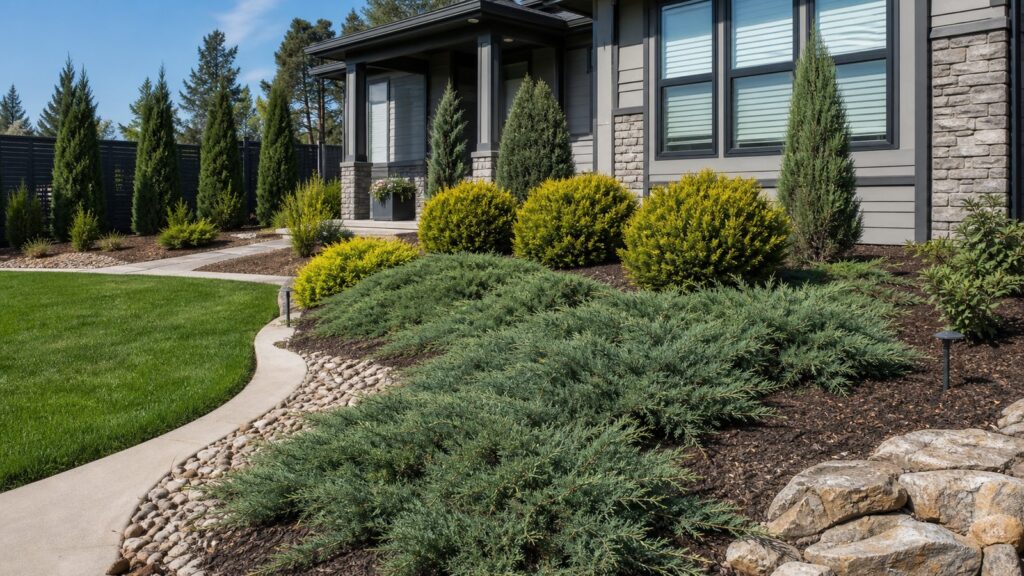
Groundcover junipers are often the best choice when mowing is unsafe or impractical. Creeping juniper can stay around 1.5 feet tall while spreading as much as 10 feet wide, depending on the cultivar. That makes mature spread more important than purchase size.
For a sunny slope, we usually think in layers. The juniper is the long-term groundcover, but mulch and temporary erosion control carry the site while the plants fill in. A 1-gallon or 3-gallon creeping juniper may take 2 to 4 growing seasons to knit together, depending on spacing, watering, soil, and local climate. Weed pressure is highest during that open period.
Good Groundcover Choices
Blue Rug juniper is a classic low, blue-toned groundcover. It is useful where you want a flat evergreen mat and have plenty of horizontal room. Plan for several feet of spread.
Blue Pacific juniper has a softer, coastal look and works well in broad sunny beds. It is often used where salt tolerance and drought tolerance matter.
The Tool Desk
Outbyte Driver Updater FREEScan for outdated or missing drivers - takes under a minuteDriver Scan →Outbyte PC Repair FREERepair Windows errors before they cause bigger problemsFix Now →Shore juniper and creeping juniper selections are good candidates for dry, exposed sites, but they still need drainage. If water stands after rain, fix the grade or choose another plant.
Groundcover Spacing
For coverage, space small groundcover junipers about 3 to 5 feet apart for a faster fill or 5 to 6 feet apart for a lower-cost installation that takes longer to close. On a steep bank, tighter spacing reduces the open soil window, but it also increases the plant budget.
Do not plant groundcover junipers where people need to walk. They are not a turf replacement for traffic. They are a living groundcover for areas you want to stabilize, cover, and stop mowing.
Mounded and Spreading Junipers for Landscape Beds
Mounded junipers can be tough, handsome plants in the right bed. They are also some of the easiest shrubs to misuse around houses. A plant that matures at 4 feet tall and 6 feet wide does not belong in a 30-inch strip between a sidewalk and siding.
Sea Green, Old Gold, Gold Coast, and similar spreading types work best in open beds with airflow on all sides. They can handle heat and drought once established, and many perform well in urban and coastal sites. Their weakness is crowding. Once junipers become woody inside, they do not respond like boxwood or privet. Hard cuts into old, bare wood often leave permanent holes.
Foundation Planting Rules
For foundations, use the mature width as the starting point. If a juniper matures at 6 feet wide, the center of the plant should generally be at least 3 feet from the wall, plus service access. In practice, that often means 4 to 5 feet from siding, brick, utility meters, hose bibbs, vents, and windows. More room is better.
Keep plants low enough that they will not cover windows, vents, address numbers, or exterior outlets. Also think about maintenance access. Painters, window crews, pest control technicians, and gutter crews all need space. A shrub that saves $75 at planting can create hundreds of dollars in labor headaches later if it blocks access.
Narrow Upright Junipers for Privacy Screens
Upright junipers are useful when you need vertical screening but do not have room for a wide evergreen. Spartan, Taylor, Skyrocket, Blue Point, and Wichita Blue are common examples. They are often selected for narrow side yards, driveway edges, pool equipment screening, and property-line privacy.
Recommended Free Tools
The key is to match the mature width to the available corridor. A narrow cultivar may mature at 3 to 4 feet wide. A broader upright type may need 6 to 8 feet. If you plant a row too tight, it may close faster, but it also traps humidity, reduces airflow, increases disease pressure, and creates more pruning work.
Privacy Screen Spacing Formula
Use this simple field rule: start with the mature width, then adjust for how fast you want the screen to close. If a juniper matures at 4 feet wide, 4-foot spacing gives each plant full room. Spacing at 3 feet may close faster but creates a denser hedge that needs better airflow and more monitoring. Spacing at 5 to 6 feet gives a looser, healthier row but takes longer to look solid.
For most residential privacy rows, we see these practical ranges:
- Small upright junipers: 3 to 4 feet apart for a tight screen.
- Medium upright junipers: 4 to 6 feet apart for balanced coverage and airflow.
- Large tree-form junipers: 8 to 15+ feet apart, depending on whether the goal is a windbreak, wildlife row, or full screen.
Do not forget the property line. If a plant matures at 6 feet wide, setting it 18 inches from the line means half the plant will eventually live in your neighbor’s space. A better layout centers the plant far enough inside your property to account for mature width and pruning access.
Crashes, No Sound, or Screen Glitches?
Random freezes, missing sound and display glitches usually trace back to one bad driver. Find and replace yours safely.Free scan · under a minuteWindows Errors? Fix Them Before They Spread
Repair common Windows errors and clear accumulated junk for a smoother, more stable PC - no reinstall needed.Free scan · no reinstallNative and Tree-Form Junipers
Eastern red cedar and Rocky Mountain juniper are better thought of as small to medium evergreen trees, not foundation shrubs. They can be excellent for wildlife cover, windbreaks, rural screening, and large properties. They also bring real size. Eastern red cedar can reach 30 to 50 feet tall in favorable conditions, with a spread that can overwhelm a small yard.
These larger junipers are often more durable than fussy ornamental screens, especially in dry, sunny, exposed sites. They can handle drought once established and are often browsed less by deer than many softer evergreens. Still, they are not right for every site.
Rank #2

- Creates a dense, silver-blue carpet that beautifies landscapes year-round with minimal effort.
- Perfectly suited for rock gardens, slopes, and borders, enhancing outdoor spaces with texture and color.
- Exceptionally drought-tolerant, making it a top choice for eco-friendly and low-water garden designs.
- Offers a robust ground cover solution, effectively minimizing erosion and suppressing weed growth.
- Adaptable to a variety of conditions, including sunny and partially shaded areas, for versatile landscaping.
Be cautious near apples, crabapples, and hawthorns. Junipers are alternate hosts for cedar-apple rust and related diseases. If you are maintaining fruit trees or ornamental crabapples, ask your local extension office or nursery about rust pressure before planting a row of junipers nearby.
Site Conditions That Make or Break Junipers
Junipers have a reputation for being low-maintenance, but that does not mean they tolerate every bad condition. They are tough when the site matches their needs.
Sun
Full sun is the baseline. Plan for 6 or more hours of direct sun. In partial shade, some plants may survive, but they usually become thinner and less attractive. In deep shade, choose a different plant.
Drainage
Well-drained soil is non-negotiable. Junipers do not fix wet soil problems. In compacted builder-grade soil, our crews look at drainage before planting. If the planting hole fills with water and stays wet, or if roof runoff dumps into the bed, the plant is being set up to fail.
Heavy clay can work if it drains, but compacted clay that stays wet needs correction. That may mean regrading, adding drainage, breaking up compaction across the whole bed, or choosing a plant better suited to wet conditions.
Water During Establishment
New junipers need regular water for the first growing season and often into the second, especially in hot regions. A reasonable starting point is deep watering 1 to 2 times per week during dry weather for the first few months, then tapering as roots establish. Soil type and rainfall matter, so check moisture 4 to 6 inches down instead of watering blindly.
Do these 3 things before closing this tab:
1Scan for outdated or missing drivers - takes under a minute2Clear out junk files and repair common Windows errors3Fix the driver behind crashes, sound loss and screen glitchesDrip or soaker irrigation is better than overhead watering. Wet foliage late in the day increases disease pressure. Once established, many junipers are drought tolerant, but overwatering can be worse than underwatering in poorly drained sites.
Airflow and Disease
Tip blights, including Phomopsis and Kabatina, are common juniper problems in many regions. Spider mites can also show up, especially in hot, dry, dusty sites. Prevention is mostly practical: full sun, spacing, drainage, airflow, resistant cultivars, and watering at the root zone instead of soaking foliage.
When disease history is known in your area, choose resistant cultivars. A local nursery or extension office is often more useful than a national plant list because pest and disease pressure varies by region.
Juniper Costs in 2026
Juniper installation cost depends heavily on plant size, quantity, access, soil work, irrigation, and whether the job is a simple bed planting or a full privacy screen. Small plants are inexpensive, but they take time. Large plants create instant structure but cost more to buy, deliver, and install.
What’s actually slowing this PC down?
Pick the symptom - the matching free tool is one click away.
| Juniper size or project | Typical 2026 cost | What affects the price |
|---|---|---|
| 1-gallon juniper plant | $8 to $15 material only | Best for groundcovers, mass planting, and patient budgets |
| 3-gallon shrub | $25 to $45 material only | Common residential size with better visual impact |
| 5-gallon shrub | $40 to $75 material only | Good for mounded shrubs and smaller upright screens |
| 15-gallon upright juniper | $150 to $350 material only | More immediate privacy, higher delivery and labor cost |
| Specimen or caliper tree | $500 to $2,000+ material only | Used for larger tree-form junipers or instant landscape impact |
| Professionally installed 1-5 gallon junipers | $75 to $200 each | Quantity, bed prep, mulch, access, warranty, and soil conditions |
| Installed 15-gallon upright junipers | $300 to $800 each | Weight, equipment, delivery, staking, irrigation, and access |
| Large privacy screen row | $1,500 to $6,000+ | Row length, spacing, plant size, irrigation, grading, and removals |
National tree-planting averages land around $540 to $680 for a typical professionally planted tree, with small sapling jobs near $50 and very large trees approaching $5,000. Professional planting labor commonly runs about $50 to $150 per hour. Shrub-scale installation is usually lower; landscaper pricing for shrubs commonly falls around $25 to $85 per shrub including plant and labor for smaller stock, but juniper privacy screens often exceed that because of plant size and layout work.
The cheapest 1-gallon juniper is not always the cheapest finished landscape. If you need a 6-foot privacy screen soon, small plants may take years. A 15-gallon row costs more upfront but buys time. On the other hand, overspending on large plants in bad soil is a poor trade. Drainage correction, spacing, and irrigation usually matter more than buying the biggest container on the lot.
When to DIY vs When to Hire a Pro
Junipers are reasonable DIY plants when the project is small, access is easy, and the soil drains well. A homeowner with a shovel, hose, mulch, and a free weekend can usually handle a few 1-gallon, 3-gallon, or 5-gallon plants.
DIY makes sense when:
- You are planting fewer than 10 small junipers.
- The site is flat or gently sloped.
- No grading, drainage, or irrigation changes are needed.
- You can carry the plants safely without equipment.
- You have confirmed utilities before digging.
Hire a pro when the job affects drainage, structures, utilities, slopes, or expensive plant material. A 15-gallon upright juniper can be heavy and awkward. A long privacy row needs a straight layout, consistent spacing, proper planting height, and sometimes irrigation. Slopes may need erosion-control fabric, mulch strategy, or temporary stabilization until the plants fill in.
Free tools Windows power users keep installed
One-click scans. No signup required.
Professional help is also worth it when existing roots, stumps, compacted fill, buried construction debris, or hard clay are involved. Those conditions turn a simple planting into site work.
Safety, Utility, HOA, and Fire Notes
Before digging, call 811 or use your state’s 811 utility locating system. Do this even for shrubs. Irrigation lines, low-voltage lighting, gas, electric, cable, and communications lines can all be closer to the surface than expected. On many projects, utility marking requires a few business days, so build that into the schedule.
Check HOA rules before planting a privacy row along a property line or street-facing yard. Many communities regulate hedge height, approved species, setbacks, and sight triangles at driveways and corners. Municipal rules may also limit plantings near sidewalks, alleys, fire hydrants, meters, and drainage easements.
In wildfire-prone areas, be careful with junipers near structures. Junipers are resinous evergreens and can be combustible. Even if they are drought tolerant and attractive, they may be the wrong plant directly against siding, under windows, below eaves, or inside a defensible-space zone. Local wildfire codes and guidance should control the planting plan. In those areas, use wider spacing, keep plants away from the house, remove dead interior growth, and consider less combustible alternatives near the structure.
How to Plant Junipers Correctly
Good planting is straightforward, but details matter. The goal is to set the root ball at the right height, keep water moving through the soil, and avoid burying the crown.
Rank #3

- A dense mound of ground-hugging branches that radiate from the center. New growth is bright green turning to bluish green as it matures. Winter color has a purple tint.
- Grow in average, medium moisture, well-drained soils in full sun. Adapts to a wide range of soils, but prefers a dryish, sandy soil. Tolerates hot, dry growing conditions, somewhat poor soils and many city air pollutants.
- ‘Nana’ is a dwarf, less vigorous form that features spiny-pointed blue-green needles (to 1/3” long). It typically grows 8-12” tall and spreads to 6’ wide over time. Foliage may turn purplish in winter.
- A versatile, sprawling ground cover that tolerates hot, dry locations in full sun. Rock gardens. Foundations. Slopes. Mass plantings. Cascade over retaining walls.
- x
- Mark utilities first. Contact 811 before digging, especially for rows, slopes, and foundation beds.
- Lay out mature spacing. Use flags or marking paint. Measure from walls, walks, driveways, fences, and property lines.
- Dig wide, not deep. The hole should be about 2 to 3 times as wide as the root ball and no deeper than the root ball height.
- Set the crown slightly high. The top of the root ball should sit level with or slightly above surrounding grade, especially in heavier soils.
- Backfill with native soil. Avoid creating a soft, amended bathtub inside hard clay. Improve the whole bed if soil correction is needed.
- Water deeply. Settle soil around the roots, then monitor moisture during establishment.
- Mulch correctly. Use 2 to 3 inches of mulch over the bed, but keep it pulled back from the trunk or crown.
Do not mound mulch against the stem. Do not plant too deep to hide the container root ball. Do not assume rain is enough during the first season, especially under eaves or in dry summer weather.
Pruning and Long-Term Maintenance
Junipers need less pruning than many shrubs, but they need the right kind. Selective thinning is better than repeated hard shearing. Stay in green growth. Most junipers do not push new growth from old bare wood, so a hard cut can leave a permanent dead-looking gap.
For upright screens, remove broken, crossing, or awkward branches early. Lightly shape the sides if needed, but avoid turning the plant into a dense wall with no interior airflow. For spreading junipers, guide branches away from walks and driveways before they become woody and heavy.
Windows Errors? Fix Them Before They Spread
Repair common Windows errors and clear accumulated junk for a smoother, more stable PC - no reinstall needed.Free scan · no reinstallOutdated Drivers Are Slowing You Down
One free scan finds every outdated or missing driver and matches the right update for your exact hardware.Free scan · exact hardware matchRefresh mulch as needed, usually every 1 to 2 years depending on climate and mulch breakdown. Watch for browning tips, webbing, dusty foliage, or dead patches. These can point to mites, tip blight, poor drainage, winter injury, or shade stress. The fix depends on the cause, so avoid simply adding more water every time a juniper browns.
Common Juniper Mistakes to Avoid
The biggest mistake is planting for today’s size instead of mature size. A $45 shrub can become a removal job if it blocks a sidewalk, traps moisture against siding, or grows into a driveway sight line.
Other common mistakes include planting in shade, overwatering established plants, using junipers as a wet-soil solution, crowding privacy rows, and shearing into old wood. We also see junipers planted too close to foundations because they look tidy on installation day. Three years later, they are covering vents and scraping siding.
Another overlooked issue is plant choice near fruit trees. If cedar-apple rust is common in your area, junipers near apples, crabapples, and hawthorns can contribute to disease cycles. That does not mean junipers are banned everywhere, but it does mean the site context matters.
Quick wins for a faster PC:
Clear out junk files and repair common Windows errorsFree Scan →Fix the driver behind crashes, sound loss and screen glitchesFind Drivers →Final Recommendation
Choose junipers when you have sun, drainage, and enough room for the mature plant. They are strong candidates for dry slopes, low-maintenance beds, deer-pressure areas, coastal or urban conditions, and narrow evergreen screens. They are weak candidates for shade, soggy clay, tight foundation strips, high-fire-risk planting next to the house, and sites where cedar-apple rust will create problems.
If you are comparing types, start with the job. For erosion control, look at creeping junipers. For open landscape beds, use mounded or spreading types with enough room. For privacy, compare Spartan, Taylor, Skyrocket, Blue Point, Wichita Blue, Eastern red cedar, and Rocky Mountain juniper against the exact width of the space. Then price the project by installed size, not just plant cost.
A well-chosen juniper can be one of the tougher plants in the landscape. A poorly placed one becomes a pruning problem that never really gets better. Measure first, plan for mature size, call 811, and fix drainage before planting.
Frequently Asked Questions
What type of juniper is best for privacy?
Narrow upright junipers such as Spartan, Taylor, Skyrocket, Blue Point, and Wichita Blue are common privacy choices. For larger properties, Eastern red cedar or Rocky Mountain juniper can work well. Match the cultivar to the available width, because many upright junipers still mature 3 to 8 feet wide.
Do these 3 things before closing this tab:
1Fix the driver behind crashes, sound loss and screen glitches2Clear out junk files and repair common Windows errors3Scan for outdated or missing drivers - takes under a minuteHow far apart should juniper trees be planted?
Use mature width as the starting point. If a juniper matures 4 feet wide, plant about 4 feet apart for full spacing or 3 feet apart for faster hedge closure. Groundcover junipers are often spaced 3 to 6 feet apart, while larger tree-form junipers may need 10 to 20 feet.
Can junipers grow in shade?
Junipers perform best in full sun, usually 6 or more hours of direct sun per day. In shade, they commonly become thin, leggy, and more prone to disease. For deep shade, choose a different plant.
Are juniper trees good near a house foundation?
They can be, but only with enough room. Keep the plant far enough from siding for at least half its mature width plus service access. Avoid large, resinous junipers directly under windows, vents, eaves, or against structures in wildfire-prone areas.
How much does it cost to plant juniper trees in 2026?
Small DIY junipers often cost $20 to $90 per plant including basic materials. Professionally installed 1- to 5-gallon junipers commonly run $75 to $200 each, while installed 15-gallon upright junipers often cost $300 to $800 each. Large privacy rows can run $1,500 to $6,000 or more.
Can you cut back overgrown junipers?
Only lightly and selectively. Most junipers do not regrow well from old bare wood, so hard pruning can leave permanent holes. Keep cuts in green growth, thin selectively for airflow, and replace badly overgrown plants when pruning cannot restore the shape.
Quick Recap
Product prices and availability are accurate as of the date/time indicated and are subject to change. Any price and availability information displayed on Amazon at the time of purchase will apply.

