Some links on this page are affiliate links: if you buy through them we may earn a commission, at no extra cost to you.
Foam gutter guards are the budget end of the gutter-guard market. That does not make them useless. It does mean they need to be chosen with clear expectations. The best foam gutter guards are easy to cut, fit snugly in 5-inch or 6-inch K-style gutters, let water move through quickly, resist UV breakdown, and can be removed for cleaning without falling apart.
For most homeowners in 2026, foam gutter guard material costs about $1 to $4 per linear foot. A typical 150- to 200-foot house can often be fitted with DIY foam inserts for about $150 to $800, depending on brand, gutter size, waste at corners, and whether the gutters need repair first. If a contractor supplies, cleans, cuts, installs, and hauls away debris, foam projects commonly land around $7 to $10 per linear foot.
As an Amazon Associate I earn from qualifying purchases.
Our honest contractor take: foam guards are best for simple single-story homes with sound gutters, broadleaf debris, and an owner who is willing to inspect the system seasonally. They are not a lifetime clog-prevention system. They are a low-cost filter. If you have pine needles, heavy roof grit, oak tassels, seed pods, steep roof valleys, wildfire exposure, ice-prone eaves, or gutters that already overflow, foam is usually not the product we would recommend first.
Best Foam Gutter Guards at a Glance
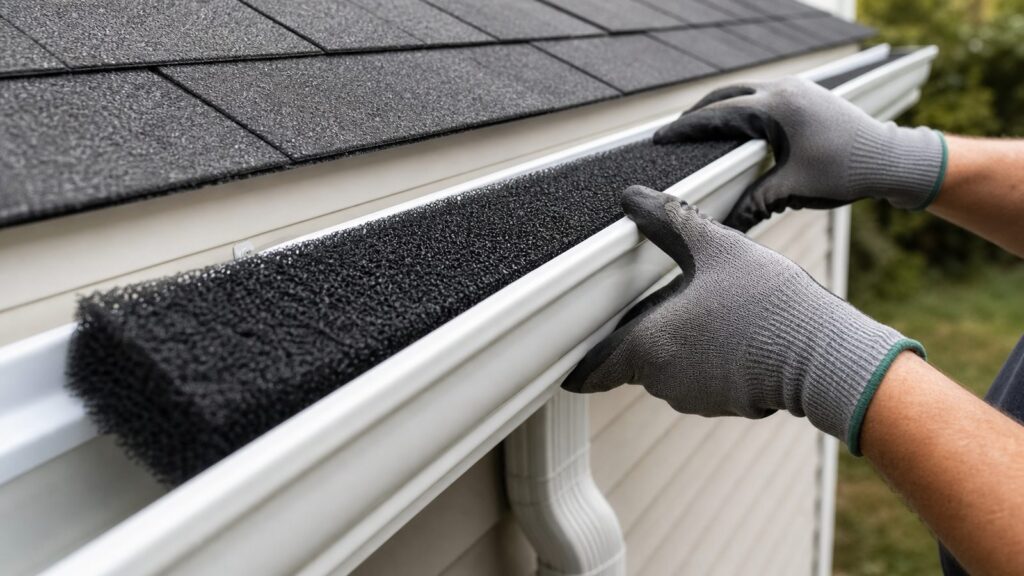
Foam gutter guards are porous inserts, usually made from polyurethane or polyether foam, that sit inside the gutter trough. Rainwater passes through the open pores into the gutter. Leaves and larger debris sit on top, where wind, drying, or manual brushing can remove them. The concept is simple, which is why foam is attractive to DIY homeowners.
Popular on Amazon

- EZ SERIES GUTTERSTUFF - Designed to be effective and affordable GutterStuff EZ seals out leaves and allows water to flow through quickly. No other gutter cover, gutter screen or gutter guard system can compare.
- EASY DIY INSTALLATION - Arriving as eight 4ft pieces, GutterStuff offer easy installation perfect for homeowners looking for high quality, cost effective gutter protection.
- NO SHOW GUTTER PROTECTION - This gutter foam insert fits completely inside the gutter providing full leaf protection without sacrificing aesthetics, like other gutter covers and gutter screens.
- SAFE LEAF GUARD SOLUTION - GutterStuff takes the worry out of your annual gutter cleaning making them an easy alternative to other rain gutter guards.
- NO CONTRACTOR NEEDED - Unlike otyher systems, installation of GutterStuff's foam guttter inserts is simple and does not require special tools or a professional installer.
The tradeoff is also simple: foam lives inside the gutter, so anything that gets into the pores can stay wet. Pollen, shingle granules, decomposed leaves, seed pods, and pine needles can build up in or on the foam. Once that happens, the gutter may look protected from the ground while the water path is slowly getting restricted.
Here is how we would sort the main foam options for a typical U.S. homeowner.
| Foam guard type | Best use | Typical 2026 material cost | Expected service window | Contractor verdict |
|---|---|---|---|---|
| Standard K-style foam inserts | Budget DIY on simple 5-inch gutters | $1 to $3 per linear foot | Roughly 3 to 5 years in harsher sun or debris conditions | Good short-term value if you inspect and clean |
| Coated premium foam inserts | Homeowners wanting better UV and material durability | $2 to $4+ per linear foot | Often longer than basic foam; warranty varies by product | Better choice if you are committed to foam |
| 6-inch gutter foam | Larger residential gutters, heavier roof flow | $2.50 to $5 per linear foot | Similar to 5-inch foam, depending on exposure | Useful only if the existing drainage is sized correctly |
| Foam combined with frequent maintenance | Leaf-heavy but accessible single-story homes | $1 to $4 per linear foot plus cleaning time | Depends on cleaning frequency | Can work, but do the lifecycle math |
| Foam under pine, pods, or heavy grit | Usually not recommended | Low upfront cost | Often shortened by clogging | Consider aluminum screen or stainless micro-mesh instead |
Our Top Foam Gutter Guard Picks
There are many private-label foam inserts, but the category is not as deep as metal screen or micro-mesh. Most products use the same basic idea: a triangular or wedge-shaped foam strip sized for common K-style gutters. The differences that matter are coating, fit, density, warranty, and how easily the foam can be removed for cleaning.
Best Overall Foam Guard: GutterStuff Pro
For homeowners set on foam, a fully coated premium insert is usually the smarter buy. GutterStuff Pro is the upgraded version we would look at first because the full coating and longer warranty make more sense in the real conditions gutters face: sun exposure, wet organic debris, roof grit, and repeated freeze-thaw cycles in colder states.
The Pro line is commonly positioned with a 15-year warranty, while basic foam products may carry much shorter coverage. Warranty language matters. A material warranty is not the same thing as a promise that the gutter will never need cleaning. Keep the receipt and product documentation, especially if you are paying a contractor to install it.
Where it fits best: 5-inch or 6-inch K-style aluminum gutters on homes with mostly broadleaf debris, manageable roof valleys, and safe access for inspection. It is a better fit for a homeowner who wants a cleaner gutter trough but accepts that the top of the foam still needs seasonal attention.
Free tools Windows power users keep installed
One-click scans. No signup required.
What we watch in the field: inside corners, downspout outlets, and any roof valley that dumps concentrated water into one short gutter section. Foam that performs fine along a straight eave can still get overwhelmed where two roof planes meet.
Best Budget Foam Guard: GutterStuff Original
GutterStuff Original is the common entry-level choice. It is widely available, installs without special tools, and is often sold in 4-foot sections for standard K-style gutters. Retail pricing can sit around the low-to-mid $2 per foot range depending on package size and store pricing, which puts it squarely in the budget DIY category.
The Original version is generally described as having a UV and germicide surface coating and a shorter 5-year warranty than the Pro version. For a simple ranch home with clean 5-inch gutters and light leaf load, that may be enough. For a shaded property under maples, oaks, or pines, we would temper expectations.
Where it fits best: a homeowner who wants to reduce big leaf clogs without spending thousands on a professional guard system. It is also a reasonable temporary guard if you plan to replace gutters in a few years.
Where it struggles: roofs that shed a lot of asphalt granules, homes under pine trees, and gutters that are already holding sludge. Foam should never be installed over old muck. The gutter must be cleaned and hose-tested first.
Best for Larger Gutters: 6-Inch K-Style Foam Inserts
Many newer homes, larger roofs, and homes with steep pitches use 6-inch K-style gutters instead of 5-inch gutters. If your gutter is 6 inches across the top, do not force a 5-inch foam insert into it and expect it to behave. Loose foam can shift, float, or leave gaps. Oversized foam can buckle and reduce the water channel.
A proper 6-inch foam insert should fill the gutter profile without blocking the outlet opening or lifting at the front lip. Larger gutters often exist for a reason: more roof area, more concentrated water, or longer runs between downspouts. Foam does not increase gutter capacity. It occupies space inside the trough, so correct sizing and outlet clearance matter.
Where it fits best: homes with sound 6-inch gutters, broad roof edges, and moderate leaf load. If the gutter system is already close to capacity during heavy rain, a guard of any type should be evaluated carefully before installation.
What’s actually slowing this PC down?
Pick the symptom - the matching free tool is one click away.
Best Temporary Fix: Standard DIY Foam Inserts
Sometimes the practical answer is not the most permanent answer. If a homeowner has a small single-story house, safe ladder access, and gutters that clog once or twice each fall, a standard foam insert can be a reasonable temporary fix. The material is cheap, fast to install, and easy to remove later.
We would use this approach when the gutter system is otherwise healthy and the homeowner understands the maintenance. That means checking the foam after spring pollen, after heavy leaf drop, and after the first hard rain following installation.
Where it fits best: sheds, garages, small additions, rental properties with simple rooflines, or homes where the owner wants to buy time before a full gutter replacement.
Foam Gutter Guard Costs in 2026
Foam looks inexpensive because the material price is low. That is true, but the full cost depends on ladder time, cleaning, access, and replacement frequency. A $2 per foot foam insert is not expensive on day one. If it gets replaced twice and cleaned repeatedly over a 10- to 15-year period, the gap between foam and a longer-lasting metal guard narrows.
The Tool Desk
Outbyte Driver Updater FREEScan for outdated or missing drivers - takes under a minuteDriver Scan →Outbyte PC Repair FREEClear out junk files and repair common Windows errorsFree Scan →Also popular on Amazon

- PRO SERIES GUTTERSTUFF - Designed with an added moss protective full coating for extended life, PRO series GutterStuff seals out leaves and allows large volumes of water to flow through quickly.
- EASY DIY INSTALLATION - Arriving as eight 4ft pieces, GutterStuff offer easy installation perfect for homeowners looking for high quality, cost effective gutter protection.
- NO SHOW GUTTER PROTECTION - This gutter foam insert fits completely inside the gutter providing full leaf protection without sacrificing aesthetics, like other gutter covers and gutter screens.
- SAFE LEAF GUARD SOLUTION - GutterStuff takes the worry out of your annual gutter cleaning making them an easy alternative to other rain gutter guards.
- NO CONTRACTOR NEEDED - Unlike otyher systems, installation of GutterStuff's foam guttter inserts is simple and does not require special tools or a professional installer.
| Project type | Typical 2026 cost | What is included |
|---|---|---|
| DIY foam material only | $1 to $4 per linear foot | Foam inserts only; no cleaning or repairs |
| Full-house DIY foam project | $150 to $800 for 150 to 200 linear feet | Foam, extra waste at corners, possible basic supplies |
| Contractor-installed foam | $7 to $10 per linear foot | Cleaning, ladder work, cutting, fitting, debris disposal |
| Vinyl or plastic screen material | Often below $1 per linear foot | Basic screen guard material |
| Aluminum screen material | About $1.50 to $3 per linear foot | Metal screen sections or rolls |
| DIY stainless micro-mesh kits | About $2.50 to $4 per linear foot | Mesh panels, usually with fasteners |
| Installed premium micro-mesh | Commonly $16 to $47 per linear foot | Professional system, labor, warranty, fitting |
For a typical 175-linear-foot house, foam material at $2 per foot is about $350 before tax and waste. At $4 per foot, the same house is about $700. If the gutters need cleaning, minor re-pitching, new outlets, elbows, or fascia repair, those costs are separate.
Professional gutter guard projects across all guard types vary widely. Many full-house professional installations fall between roughly $622 and $2,053, with many homeowners paying around $1,179 for moderate projects. Larger professional systems, especially proprietary micro-mesh systems, can run $3,000 to $6,000 for 200 linear feet, and high-end systems can exceed that. Foam sits at the low end because it is simple material and fast installation.
The cost drivers are straightforward: linear footage, number of stories, roof pitch, gutter height, landscaping that blocks ladders, decks, existing gutter condition, debris level, downspout repairs, regional labor rates, and whether the work is bundled with gutter replacement.
How Foam Gutter Guards Work
A foam guard sits inside the gutter instead of fastening over the top. Most residential versions are shaped to fit K-style gutters, the common gutter profile with a decorative front edge. The foam usually has a flat or angled top surface and a lower profile that rests inside the trough.
Rainwater hits the roof, runs into the gutter, passes through the foam, and moves toward the downspout. Leaves stay on top. In ideal conditions, those leaves dry and blow away. In less ideal conditions, they mat down, decay, and form a wet layer that slows water entry.
Foam has three practical advantages. First, it is nearly invisible from the ground. Second, it does not usually require screws through the gutter face or lifting shingles. Third, it is easy to cut around hangers, miters, and outlets with a utility knife.
The weakness is that foam is both the filter and the storage area for fine debris. Shingle granules, pollen, dust, seed fragments, and decomposed leaf matter can settle into the pores. Once the pores clog, the guard can hold moisture. Wet organic material can encourage plant growth, increase odor, and keep aluminum or steel gutters damp longer than they should be.
When Foam Is the Right Choice
Foam guards make the most sense when the roof and gutter system are already performing correctly. On our job sites, we treat guards as accessories, not repairs. If water is overshooting the gutter now, a foam insert will not fix bad pitch, undersized gutters, too few downspouts, or a valley that delivers too much water into one spot.
Do these 3 things before closing this tab:
1Clear out junk files and repair common Windows errors2Fix the driver behind crashes, sound loss and screen glitches3Repair Windows errors before they cause bigger problemsFoam is a reasonable choice when the home has 5-inch or 6-inch K-style gutters in good condition, the roof is one or two stories with safe access, the main debris is broad leaves, and the owner is comfortable checking the system a few times per year. It is especially attractive when the goal is to reduce hand-cleaning rather than eliminate maintenance entirely.
It can also work on detached garages, porches, workshops, and simpler outbuildings where spending thousands on a premium guard system does not pencil out. In those cases, a foam insert may be good enough if water can still reach the downspout quickly.
When We Would Skip Foam
We would be cautious with foam under pine trees. Pine needles can bridge across the surface, stick into the pores, and create a mat that is hard to brush off. The same concern applies to oak tassels, maple helicopters, seed pods, heavy pollen, and roofs that shed a lot of asphalt granules.
We would also skip foam where wildfire exposure is a serious concern. Gutters can collect dry leaves, needles, and windblown debris. A foam insert is not the upgrade we would choose for a home in a high-risk fire zone. Noncombustible metal options and defensible-space maintenance deserve a closer look.
Windows Errors? Fix Them Before They Spread
Repair common Windows errors and clear accumulated junk for a smoother, more stable PC - no reinstall needed.Free scan · no reinstallCrashes, No Sound, or Screen Glitches?
Random freezes, missing sound and display glitches usually trace back to one bad driver. Find and replace yours safely.Free scan · under a minuteFoam is also a weak match for ice-prone roof edges. If the home already has ice dams, poor attic ventilation, or repeated freeze-thaw buildup at the eaves, do not expect foam to solve it. In winter climates, trapped moisture and blocked flow can make maintenance more frustrating.
Finally, never use foam to cover up failing gutters. Sagging runs, pulled hangers, rotted fascia, leaking miters, undersized downspouts, and bad slope need to be corrected first. A guard hides the gutter trough from view, which can delay the moment a homeowner realizes the system is still failing.
Foam vs Screen vs Micro-Mesh
Foam is not competing with metal guards on equal terms. It wins on upfront price and installation speed. It loses on long-term durability, fine-debris performance, fire considerations, and maintenance tolerance.
Plastic screens can be even cheaper than foam, often below $1 per foot at retail, but they may become brittle in sun and can lift or warp. Aluminum screens are usually a stronger low-to-mid-cost choice, often around $1.50 to $3 per foot for material. They shed larger leaves better than foam and do not fill the gutter trough, but fine debris can still enter.
Recommended Free Tools
Stainless micro-mesh is the better category for pine needles, small debris, and homeowners who want a longer service life. DIY micro-mesh kits are often about $2.50 to $4 per foot for material, similar to premium foam. Professionally installed micro-mesh systems cost much more, commonly $16 to $47 per foot, but they are usually the better long-term answer for heavy debris properties.
The decision comes down to site conditions. If the house has light broadleaf debris and easy access, foam can be sensible. If the home sits under pines, has multiple valleys, or the owner does not want to inspect gutters, foam is usually false economy.
Also popular on Amazon

- PRO SERIES GUTTERSTUFF - Designed with an added moss protective full coating for extended life, PRO series GutterStuff seals out leaves and allows large volumes of water to flow through quickly.
- EASY DIY INSTALLATION - Arriving as eight 4ft pieces, GutterStuff offer easy installation perfect for homeowners looking for high quality, cost effective gutter protection.
- NO SHOW GUTTER PROTECTION - This gutter foam insert fits completely inside the gutter providing full leaf protection without sacrificing aesthetics, like other gutter covers and gutter screens.
- SAFE LEAF GUARD SOLUTION - GutterStuff takes the worry out of your annual gutter cleaning making them an easy alternative to other rain gutter guards.
- NO CONTRACTOR NEEDED - Unlike otyher systems, installation of GutterStuff's foam guttter inserts is simple and does not require special tools or a professional installer.
How to Buy Foam Gutter Guards
Match the gutter size and profile
Measure the gutter opening across the top. Most homes use 5-inch K-style gutters, but 6-inch gutters are common on larger roofs and newer upgrades. Buy foam made for that exact size and profile. A loose insert can shift. A compressed insert can buckle and slow water.
Look at coating and warranty
Basic foam may carry a shorter warranty, such as 5 years. Premium coated foam may advertise 15 years. Read what the warranty actually covers. Material breakdown, UV degradation, and clogging performance are not always treated the same way.
Quick wins for a faster PC:
Repair Windows errors before they cause bigger problemsFix Now →Fix the driver behind crashes, sound loss and screen glitchesFind Drivers →Clear out junk files and repair common Windows errorsFree Scan →Check pore density
Very open foam may move water quickly but allow more fine debris into the gutter. Very dense foam may filter more but clog faster at the top surface. For most homes, we want a balanced open-cell structure that drains quickly during hard rain.
Confirm removal is easy
Foam guards should be removable for cleaning. If a product tears apart when pulled out after one season, maintenance becomes expensive and irritating. This is one reason we prefer not to jam oversized foam into a gutter.
Think about tree type
Broad leaves are the best match. Pine needles, fir needles, seed pods, oak tassels, and heavy spring pollen are poor matches. The smaller and stickier the debris, the less attractive foam becomes.
Consider roof pitch and valleys
Steep roofs and inside valleys concentrate water. During a hard storm, water can overshoot the gutter even if the guard itself is clean. At valleys, inspect after the first hard rain. You may need a diverter, larger gutter, extra downspout, or a different guard style.
Installation Tips From the Field
Start with a full gutter clean. Remove leaves, sludge, sticks, and roof granules. Flush the run with a hose and confirm water moves to each outlet. If water stands in the gutter, fix the pitch before installing anything.
Check downspout outlets and elbows. A clean gutter guard is meaningless if the outlet is packed with granules and leaves. We see this often: the visible trough looks acceptable, but the outlet hole is restricted to half its size.
Cut foam cleanly around internal hangers. Do not shove the insert over a hanger until it deforms. Make relief cuts so the foam sits flat. At downspout outlets, keep the opening clear. The foam should filter water, not block the fastest path out of the gutter.
At corners, cut tight but not compressed joints. Inside miters collect debris first because flow slows and roof lines meet. A sloppy corner leaves gaps; an overstuffed corner blocks capacity. Both create problems.
The Tool Desk
Outbyte PC Repair FREERepair Windows errors before they cause bigger problemsFix Now →Outbyte Driver Updater FREEScan for outdated or missing drivers - takes under a minuteDriver Scan →After installation, run a hose test. Start at the high end of the gutter and watch water reach the downspout. Then check the fascia and soffit for leaks or overflow. The first real storm is the second test. Inspect valleys and inside corners afterward.
Independent reader supportYour contribution helps us test, update, and keep practical guides available for everyone.When to DIY vs When to Hire a Pro
Foam is one of the few gutter guard types that a careful homeowner can install without specialized tools. For a single-story ranch with level ground, 150 feet of accessible gutters, and no repairs needed, DIY installation may take a Saturday. The actual foam placement is quick; cleaning and setup usually take longer than inserting the product.
DIY makes sense when ladder access is safe, the gutters are one story, the roof edge is simple, the gutters are firmly attached, and you can hose-test every run. You should also be comfortable cutting around hangers and outlets. Basic supplies include gloves, a hose, a stable ladder, a scoop, contractor bags, a utility knife, and eye protection.
Hire a pro when the home is two or more stories, the grade is uneven, the roof pitch is steep, the gutters are high over decks or landscaping, or the gutters need repair. Also hire a pro if you see sagging, loose spikes or hangers, rotted fascia, leaking seams, standing water, or downspouts that discharge too close to the foundation.
Free tools Windows power users keep installed
One-click scans. No signup required.
From a safety standpoint, gutter work is ladder work first and product installation second. A $400 material project is not worth a fall. Professional labor also brings a second benefit: a competent crew should notice drainage issues before guards hide them.
Permits, Code, and Drainage Notes
Most foam gutter guard installations do not require a building permit because they are maintenance accessories, not structural alterations. That said, local rules can vary, especially when gutter work is bundled with roof replacement, fascia repair, stormwater changes, or commercial construction.
The bigger issue is drainage performance. Gutters and downspouts exist to move roof water away from the building. Downspouts should discharge away from the foundation, not dump water beside the footing, basement wall, crawlspace, walkway, or driveway edge. If you install guards but leave a downspout elbow disconnected at the base of the wall, you have not solved the water problem.
For rainwater collection systems, local plumbing and health rules may also affect screens, filters, and roof-wash devices. Foam gutter inserts are not a substitute for a properly designed potable or non-potable rainwater harvesting filter system.
Also popular on Amazon

- EASY DIY INSTALLATION: Install in minutes with no tools or cutting required. The 15 ft kit includes 3 ft. sections that slide directly into 5-inch K-style gutters. Just fill the whole gutter. Ideal for small gutter runs, sheds, porches, and quick home projects.
- STOPS CLOGGING: Dense 4.25" diameter brush allows water to flow freely while stopping leaves, pine needles, sticks, and roof debris. Prevents clogs and overflow, protecting fascia, landscaping, and walkways from water damage.
- YEAR-ROUND CLIMATE PERFORMANCE: Works reliably in any season—rain, storms, snow, or ice. The galvanized steel core and UV-protected bristles are guaranteed to last over 10 years, helping reduce winter ice buildup and keeping gutters flowing smoothly.
- MADE IN USA QUALITY: Proudly made in the USA since 2004 using durable, long-lasting materials. Backed by a 10-year warranty, this gutter leaf guard offers a simple and effective alternative to complex screens and covers—easy to install and built to last.
- SMOOTH WATER FLOW & EASY MAINTENANCE: Fits standard 5-inch K-style gutters and helps keep downspouts clear by preventing debris buildup. Sections bend easily around corners and fold to length without cutting—offering a low-maintenance, affordable gutter protection system.
Common Mistakes to Avoid
The most common mistake is installing foam into dirty gutters. Existing sludge immediately restricts flow and can compress into the foam pores. Clean first, then install.
The second mistake is buying the wrong size. A 5-inch insert in a 6-inch gutter can move around. An oversized insert can deform and reduce capacity. Measure before buying.
The third mistake is assuming foam means no maintenance. Foam reduces some clogs, but it does not eliminate cleaning. Inspect after heavy leaf drop, spring pollen, and major storms.
The fourth mistake is ignoring valleys. Roof valleys deliver fast, concentrated water. If water overshoots during heavy rain, the issue may be capacity, pitch, or flow direction rather than the foam itself.
Quick wins for a faster PC:
Clear out junk files and repair common Windows errorsFree Scan →Scan for outdated or missing drivers - takes under a minuteDriver Scan →Repair Windows errors before they cause bigger problemsFix Now →The fifth mistake is blocking outlets. Downspout openings need clear flow. Cut foam carefully so the outlet is not pinched or covered.
The sixth mistake is covering failing gutters. Guards should be installed after repairs, not before. Bad slope, rotted fascia, pulled hangers, and leaking seams need attention first.
Lifecycle Math: Is Foam Really Cheaper?
Foam is cheaper upfront. Over time, the answer depends on maintenance and replacement. Consider a 175-foot house. At $2 per foot, foam material is about $350. If the homeowner installs it and gets 4 years out of it, the material cost is low. If that same foam is replaced twice over 12 years, material alone is about $700 to $1,050 depending on price changes and waste.
If the homeowner pays a contractor $7 to $10 per foot for installed foam, that same 175-foot house costs about $1,225 to $1,750 per installation. Replacing it twice can push the 10- to 15-year cost into the same range as a more durable metal system.
This is why we do not call foam a universal bargain. It is a bargain when access is easy, debris is moderate, and the owner handles inspection. It is less attractive when every cleaning requires a crew, tall ladders, or difficult roof access.
Final Verdict
The best foam gutter guards are premium coated inserts that fit the gutter correctly, move water quickly, and can be removed for cleaning. For most homeowners committed to foam, we would start with a coated product such as GutterStuff Pro, then consider a lower-cost original-style insert for simple, lower-risk situations.
Foam guards are worth considering in 2026 if you want a low-cost DIY filter for sound gutters and moderate broadleaf debris. Expect material costs around $1 to $4 per linear foot and professional installed costs around $7 to $10 per linear foot. Inspect seasonally, clean when debris mats on the surface, and check valleys and outlets after storms.
If your home has pine needles, seed pods, heavy canopy, roof grit, wildfire exposure, ice problems, or existing drainage failures, foam is probably not the best long-term answer. In those cases, compare aluminum screen and stainless micro-mesh systems before spending money. A gutter guard should support a working drainage system, not hide a failing one.
Do these 3 things before closing this tab:
1Clear out junk files and repair common Windows errors2Fix the driver behind crashes, sound loss and screen glitches3Repair Windows errors before they cause bigger problemsFrequently Asked Questions
Are foam gutter guards worth it in 2026?
Foam gutter guards are worth it for simple homes with clean, sound gutters, light to moderate broadleaf debris, and safe access for seasonal inspection. They are not ideal for pine needles, heavy seed pods, roof grit, wildfire-prone areas, or gutters that already overflow.
How much do foam gutter guards cost per linear foot?
In 2026, most DIY foam gutter guard materials cost about $1 to $4 per linear foot. Contractor-installed foam commonly runs about $7 to $10 per linear foot because the job includes cleaning, ladder work, cutting, fitting, and disposal.
How long do foam gutter guards last?
Basic foam may last roughly 3 to 5 years in harsh sun, heavy debris, or high-grit roof conditions. Premium coated foam can last longer, and some products advertise warranties up to 15 years, but performance still depends on maintenance and site conditions.
Do foam gutter guards work with pine needles?
Foam is usually a poor choice under pine trees. Needles can stick into the foam pores and form a mat on the surface. For pine needles and fine debris, stainless micro-mesh is usually a better long-term option.
Can foam gutter guards cause gutters to overflow?
Foam can contribute to overflow if it is clogged, oversized, installed into dirty gutters, or blocking downspout outlets. Overflow can also come from bad gutter pitch, too few downspouts, undersized gutters, or heavy roof valley flow.
Should I install foam gutter guards myself or hire a contractor?
DIY is reasonable for a single-story home with level ground, safe ladder access, clean gutters, and no repairs needed. Hire a contractor for two-story work, steep rooflines, uneven grade, sagging gutters, rotted fascia, leaking seams, or drainage problems.
Quick Recap
Product prices and availability are accurate as of the date/time indicated and are subject to change. Any price and availability information displayed on Amazon at the time of purchase will apply.

