Some links on this page are affiliate links: if you buy through them we may earn a commission, at no extra cost to you.
Best overall efficiency-oriented portable pick: the Midea Cube 20-pint MAD20S1QWT, provided the exact model is still listed as ENERGY STAR certified when you buy it. It is a practical choice for a moderately damp bedroom, living area, garage, or smaller basement. For a large, wet, or persistently humid basement, the Midea Cube 50-pint MAD50PS1QWT-A is the better fit because it has substantially more capacity and a built-in condensate pump.
The important qualification is that energy efficiency is not determined by the lowest wattage on a product label. The most reliable first filter is current ENERGY STAR certification, followed by the model’s Integrated Energy Factor (IEF), expressed in liters of water removed per kilowatt-hour. A higher IEF is better, but the correctly sized unit will usually save more energy than an undersized model that has to run continuously.
Quick picks
| Best for | Recommended model or category | Why it stands out | Important limitation |
|---|---|---|---|
| Moderately damp rooms and smaller basements | Midea Cube 20-pint MAD20S1QWT | Efficiency-focused pick with smart controls, wheels, a lift-and-twist tank, and continuous-drain capability | Do not use a 20-pint unit as the default for a large, wet basement or a space with water intrusion |
| Large, wet, or persistently humid spaces | Midea Cube 50-pint MAD50PS1QWT-A | Higher capacity, manufacturer-listed coverage up to 4,500 square feet, and a built-in pump | Confirm the current ENERGY STAR listing and exact IEF before treating it as an efficiency leader |
| Conventional mid-size operation | GE ADHR35LB | 35-pint capacity, ENERGY STAR positioning, Smart Dry, and an empty-bucket alarm | The accessible product page does not provide a numeric IEF |
| Compact conventional smart unit | Midea Smart Access 22-pint MAD22S1AWWT | Side-access bucket, app control, wheels, timer, automatic shutoff, and continuous drainage | Its efficiency ranking should be confirmed in the current ENERGY STAR record or Energy Guide |
| Small rooms and low-temperature operation | Frigidaire FFAD2233W1 | 22-pint capacity, custom humidity control, washable filter, continuous drainage, and operation down to 41°F | Retail availability and certification can change; verify before purchase |
| Persistent humidity throughout the house | Whole-home ducted dehumidifier | Designed to work with ductwork and central HVAC rather than treating one room at a time | Requires correct sizing, installation, duct design, and usually professional HVAC work |
Coverage figures in the table are manufacturer or retailer claims, not guarantees of performance in every building. Basement construction, air leakage, outdoor humidity, water intrusion, temperature, and drainage all affect the result.
Free tools Windows power users keep installed
One-click scans. No signup required.
As an Amazon Associate I earn from qualifying purchases.
What makes a dehumidifier energy-efficient?
Dehumidifiers remove moisture by moving humid air across a cold coil and collecting the condensed water. Their energy performance depends on how much water they remove for the electricity they consume, not simply on the appliance’s running wattage.
The most useful comparison is the Integrated Energy Factor, or IEF. IEF measures liters of water removed per kilowatt-hour while accounting for dehumidification energy as well as standby and off-mode energy. Higher IEF means more moisture removal for each unit of electricity under the program’s test conditions.
#1 Best Overall

- Semiconductor dehumidifiers use thermoelectric cooling to remove moisture from the air. They create a drier, more comfortable environment by reducing humidity and improving air quality.
- Our home dehumidifier features intelligent auto-shutoff, automatically powering down when the water tank is full. Set it and forget it, knowing your dehumidifier is working efficiently and safely, giving you true peace of mind.
- Our dehumidifier features a captivating 7-color ambient light, allowing you to bathe your room in a spectrum of soothing hues. Choose from a calming blue, energizing green, romantic red, and more – easily select the perfect color to create your desired atmosphere and enhance your living space. Dehumidify in style and set the perfect mood, every time.
- Sleep Mode creates the perfect sleep sanctuary. The dehumidifier's atmosphere lights automatically turn off, and noise fades to a whisper. Experience truly undisturbed dehumidification for a night of perfect rest.
- Elevate your home's comfort and style with our sleek and compact dehumidifier. Designed to seamlessly blend into any space, from the living room and bedroom to the bathroom, basement, and even your RV. Its modern aesthetics and space-saving footprint make it the perfect dehumidification solution for every corner of your home.
For current ENERGY STAR portable-dehumidifier criteria, the minimum IEF depends on the rated capacity:
Quick wins for a faster PC:
Scan for outdated or missing drivers - takes under a minuteDriver Scan →Repair Windows errors before they cause bigger problemsFix Now →- 1.70 L/kWh for units rated at 25 pints per day or less.
- 2.01 L/kWh for units rated above 25 and up to 50 pints per day.
- 3.30 L/kWh for units rated at least 50 pints per day.
Whole-home units use a separate set of IEF thresholds based on the volume of the product case, so their ratings should not be compared directly with portable units.
ENERGY STAR says certified dehumidifiers use about 20% less energy than comparable conventional models under its program definition. That is a useful screening rule, not a promise that every certified model will have the same operating cost. A 50-pint unit may remove much more water than a 20-pint unit, and a smaller unit may use less power at any given moment but consume more total energy if it runs around the clock because it is undersized.
The best energy-efficient dehumidifiers
Best overall for moderate moisture: Midea Cube 20-pint MAD20S1QWT
The Midea Cube 20-pint dehumidifier is the strongest efficiency-oriented portable recommendation for a moderately damp room or smaller basement. Midea lists coverage up to 1,500 square feet, smartphone and voice-assistant control, wheels, a lift-and-twist design, and continuous drainage using the included hose. A current Home Depot listing identifies the MAD20S1QWT as ENERGY STAR Most Efficient, which makes it particularly relevant for an efficiency-led purchase.
The Cube design is useful when storage and bucket handling matter. The tank can be lifted and separated from the main unit, and the appliance can be rolled into position rather than carried. Smart control also makes it easier to check the unit or adjust operation without entering a basement or utility area.
Recommended Free Tools
Its limitation is capacity. A 20-pint unit is not automatically appropriate for a very damp large basement, crawl space, or area with seepage. If the appliance fills quickly, cannot maintain the selected humidity, or runs almost continuously, the lower rated capacity can erase the expected efficiency advantage.
Choose it when: the room is slightly to moderately damp, the area is relatively contained, and compact storage or smart control is valuable. Confirm the exact current ENERGY STAR record and Energy Guide before purchase because certification, model suffixes, and retailer listings can change.
Best for large or wet spaces: Midea Cube 50-pint MAD50PS1QWT-A
The Midea Cube 50-pint dehumidifier is the better choice for a large, wet, or persistently humid basement, garage, or similar space. Midea lists a 50-pints-per-day capacity, coverage up to 4,500 square feet, wheels, smart control, and a built-in pump.
The pump is the key practical advantage. It can move condensate to a sink, standpipe, or other elevated drain when gravity drainage is not possible. That is materially different from a standard continuous-drain outlet, which normally needs a hose running downhill to a suitable drain.
The manufacturer product information establishes the capacity and features, but the accessible specification text does not provide a current numeric IEF. Do not infer an IEF from the 50-pint rating. Check the exact MAD50PS1QWT-A record in the current ENERGY STAR Product Finder or its Energy Guide before calling it one of the most efficient models.
Rank #2
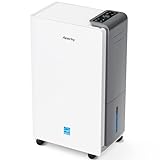
- 【ENERGY STAR 25 ≠ ENERGY STAR Most Efficient 2025】Don't fall for competitors' word games. With only 2.6% of ENERGY STAR models earning "Most Efficient 2025" title, these options are exceptionally rare on the market. RHEA-001 is one of the few to truly hold this top-tier certification. Many brands use misleading phrases like "Energy Star Efficient 25" or "Energy Star 25" to imply a standard they haven't met. Choosing them is a risk.With AEOCKY, you get verified performance and the peace of mind of authentic, top-tier efficiency.
- 【True ENERGY STAR Most Efficient 2025 Compressor Dehumidifier for homes (5500 sq.ft)】80 pint/day in the humid Mid-summer (95℉, 95%RH); 56 pint/day in the warm, damp basement (86℉, 80%RH)! Among all ENERGY STAR dehumidifiers, only an elite 2.6% earn the ENERGY STAR "Most Efficient 2025" certification. It is this top-tier capability that allows the RHEA-001 to completely outperform its competitors in both performance and energy efficiency.(Dehumidification capacity≠Water Tank Volume)
- 【Top-Rated Efficiency - Save More Energy】Breaking industry barriers, one of the first brands to achieve ENERGY STAR Most Efficient 2025. Compared to non-Energy Star inefficient products,RHEA-001 efficiency is increased by ≤50%, saving ≤1000 on electricity bills annually (running 24/7 year-round). Energy efficiency is the domain of absolute dominance for our RHEA-001. This relentless pursuit of technological innovation in efficiency is the ironclad moat that has established AEOCKY as the leading dehumidifier brand.
- 【Powered by Exceptional Core Components】AEOCKY utilizes Cutting-Edge High-Efficiency Rotor Compressor Pro+ to RHEA-001, whose core components evaporator and condenser adopt“3+2”structure with one more row than others. Never use aluminum tubes, we unswervingly use 7mm diameter high-tooth internal thread pure copper pipes.We also equipped with advanced blue hydrophilic aluminum foil, achieving breakthrough heat exchange efficiency meeting the most rigorous energy efficiency standards in history.
- 【Cutting-Edge Smart Humidity Control for Unprecedented Precision】Newly designed architecture breaks industry's decade-long lack of innovation, enabling it have high-performance chip. Millisecond-level dynamic detection keep humidity within ideal range,with full-stack proprietary humidity compensation algorithm ensuring RHEA-001 exceeds industry standard for humidity accuracy.Exclusive power-off memory function can be used with smart socket, automatically resuming function after power restoration, suitable for smart home or special area like RV.
Choose it when: moisture loads are high, the basement is large, the unit will need to operate for long periods, or condensate must be pumped upward. If water is entering through walls, floors, plumbing, or foundation cracks, correct that source rather than expecting a dehumidifier to solve the underlying problem.
Best conventional mid-size alternative: GE ADHR35LB
The GE ADHR35LB is a reasonable conventional alternative for a moderately damp room or basement. GE identifies it as a 35-pint ENERGY STAR model and lists Smart Dry, an empty-bucket alarm, and dimensions of 19.5 by 13.25 by 10 inches.
Its straightforward upright form may appeal to shoppers who prefer conventional controls and easy retail availability over the Cube’s removable-tank design. Smart Dry can adjust operation based on the detected humidity, while the bucket alarm helps prevent an unexpected shutdown.
Outdated Drivers Are Slowing You Down
One free scan finds every outdated or missing driver and matches the right update for your exact hardware.Free scan · exact hardware matchPC Slower Than It Used to Be?
A free scan shows the junk files, broken settings and background clutter dragging Windows down - then fixes them in one click.Free scan · Windows 10 & 11The accessible GE product page does not expose a numeric IEF in its main product text. GE indicates that IEF is available in the specifications or details area for current dehumidifiers. Verify the exact model in the current ENERGY STAR database or Energy Guide before ranking this unit above the Midea Cube on efficiency.
Best compact smart alternative: Midea Smart Access 22-pint MAD22S1AWWT
The Midea Smart Access MAD22S1AWWT is a useful alternative when a conventional vertical form factor is preferable to the Cube. Midea lists it for spaces up to 1,500 square feet and includes smart control, wheels, a side-access bucket, multiple operating modes, two fan speeds, a timer, automatic shutoff, and continuous-drain capability.
This is best viewed as a convenient room-to-room and smaller-basement option, not as an automatic efficiency winner. Check its current ENERGY STAR record and Energy Guide if efficiency is the deciding factor. The 22-pint rating should also be interpreted using current test conventions rather than compared directly with older ratings.
Best small-room, low-temperature alternative: Frigidaire FFAD2233W1
The Frigidaire FFAD2233W1 is a 22-pint model that Lowe’s lists for rooms of approximately 151 to 400 square feet. Listed features include custom humidity control, a washable filter, continuous-drain capability, automatic shutoff, caster wheels, and operation down to 41°F. Lowe’s lists noise levels of approximately 43 to 49 dBA depending on fan speed.
Low-temperature operation can be useful in a cool basement, although the exact performance depends on room temperature, coil frosting, defrost controls, and the manufacturer’s operating instructions. This model is an availability-sensitive alternative: confirm that the exact model is still sold, currently certified, and accompanied by the expected Energy Guide before relying on it as an efficiency purchase.
Rank #3

- 【Compact Size, Big Efficiency】 The upgraded 2025 Waykar dehumidifier features cutting-edge rotary compressor technology. It’s more compact but still powerful, capable of removing up to 34 pints of moisture per day (at 95℉, 90% RH), ideal for spaces up to 2,000 sq. ft. such as living rooms, basements, bedrooms, and offices. The adjustable humidity range from 30% to 80% helps you easily maintain the ideal indoor humidity
- 【High Savings, Low Power Use】 Certified as 2025 ENERGY STAR Most Efficient, this unit uses 50% less energy than traditional models, saving you approximately $1,000 annually on electricity bills while meeting strict U.S. efficiency standards. Additionally, it is DOE and TUV certified for energy efficiency and safety, ensuring stable performance, durability, and reduced energy consumption
- 【1 Device, 2 Drainage Options, 3 Modes】 This versatile unit offers dehumidifying, drying, and continuous modes to handle various moisture levels. You can choose between the included 3.3 ft drain hose or the 0.62-gallon water tank for easy drainage. The detachable, washable filter keeps your air fresh and healthy. Note: When using the water tank, please ensure the drain pipe switch is tightened to prevent leaks
- 【High Airflow, Low Noise】 Equipped with 2 adjustable fan speeds—low and high—you can easily adjust the airflow to match varying humidity levels. Advanced noise reduction technology ensures quiet operation, with a minimum noise level of just 38 dB—much quieter than the typical 45 dB—making it perfect for bedrooms, offices, and nighttime use, creating a calm and peaceful environment
- 【Smart Safety, Efficient Operation】 The unit features multiple automated safety functions, including overload protection, power outage memory, auto shutoff when the tank is full, and high-precision sensors for automatic defrosting. It ensures stable and efficient operation in any environment. Additionally, the built-in child lock prevents accidental changes, making it especially suitable for households with children and pets
Portable versus whole-home dehumidification
A portable appliance is appropriate when moisture is concentrated in one room, one basement, or another defined area. It can also be a temporary response while a construction or water-management problem is being diagnosed.
A portable unit is often the wrong long-term solution when:
- Humidity is high throughout the house rather than in one area.
- Several rooms need separate appliances to stay comfortable.
- The central air conditioner operates but indoor humidity remains consistently above roughly 55%.
- The building has a ducted HVAC system that could distribute dry air throughout the home.
- Access for emptying buckets or routing several drain hoses is poor.
In those situations, discuss a whole-home dehumidifier and HVAC installation with a qualified HVAC professional. Whole-home systems are generally installed into ductwork and must be sized for the building, climate, ventilation, air-sealing level, and existing HVAC equipment. Duct leakage, poor return-air design, and incorrect condensate disposal can undermine the result.
The Tool Desk
Outbyte Driver Updater FREEFix the driver behind crashes, sound loss and screen glitchesFind Drivers →Outbyte PC Repair FREEClear out junk files and repair common Windows errorsFree Scan →Whole-home dehumidification is a design and installation decision, not simply a larger version of buying a portable appliance. ENERGY STAR uses separate case-volume-based efficiency thresholds for this category. A professional should also check whether the humidity is caused by inadequate cooling, excessive outdoor-air infiltration, crawlspace conditions, drainage problems, or building-envelope defects.
How to choose the right capacity
Capacity is normally stated in pints of water removed per day, but the number only has meaning when paired with the current test conditions and the actual moisture load. Square footage is a starting point, not a guarantee.
1. Find and correct the moisture source
Before buying a larger appliance, look for plumbing leaks, foundation seepage, wet insulation, poor grading, overflowing gutters, condensation on cold pipes, unsealed crawlspaces, and excessive outdoor-air leakage. A dehumidifier can lower relative humidity while consuming electricity, but it cannot waterproof a foundation or repair a leaking supply line.
2. Classify the space by dampness
| Observed condition | Reasonable starting point | What to watch for |
|---|---|---|
| Slightly damp; occasional musty odor or mild condensation | Approximately 20 to 30 pints per day for a small or medium space | Whether the unit can reach the target humidity without continuous operation |
| Moderately damp; persistent mustiness or visible moisture on cool surfaces | Upper end of the 20- to 30-pint range, or a mid-size 35-pint unit depending on area | Drainage, runtime, and whether multiple connected rooms add to the load |
| Very damp or wet; damp floors, frequent condensation, or laundry-related moisture | Approximately 30 to 50 pints per day, with more capacity for larger areas | Water intrusion, low temperatures, and whether a pump is needed |
| Large basement, garage, or persistent high humidity | A 50-pint portable unit or a whole-home system, depending on the affected area | Whether a portable unit can circulate air throughout the space and drain continuously |
These are starting ranges rather than guaranteed sizing rules. ENERGY STAR’s guidance increases the recommended capacity as dampness and area increase. When in doubt, a slightly larger correctly controlled unit is usually more practical than a small unit that never catches up, but oversizing also has trade-offs: shorter cycles can reduce drying time and may not provide the desired stable humidity if the controls are poor.
Do these 3 things before closing this tab:
1Repair Windows errors before they cause bigger problems2Scan for outdated or missing drivers - takes under a minute3Clear out junk files and repair common Windows errors3. Do not compare old pint ratings casually
Capacity labels and testing conventions changed around 2021. A current 22-pint model should not be assumed to be weaker than an older 30-pint model, and current 35-, 50-, and 70-pint ratings should not be compared as if they were measured under identical conditions. Compare current models using the same test convention and verify the exact model’s documentation.
Rank #4

- 【80 Pint Capacity for Up to 5,000 Sq.Ft Spaces】Quickly removes excess moisture from basements, bathrooms, bedrooms, RVs, and other large living areas, delivering 80 pints per day (95°F, 90% RH).conditions. Designed as a powerful dehumidifier for basement, home, and large spaces, it helps eliminate damp air, condensation—and pet-related odors caused by excess humidity. Even during humid seasons, it works continuously to maintain a dry, comfortable, and healthier indoor environment.
- 【90° Auto Swing Airflow for Even Coverage】Distributes dry air evenly across the room, helping cover every corner and reduce uneven humidity levels. The 90° auto swing function enhances air circulation and drying efficiency, bringing a level of airflow distribution typically not available in standard models. It delivers balanced airflow without direct drafts, creating a more comfortable indoor environment.
- 【30%–80% Smart Humidity Control for Flexibility】 Unlike many standard dehumidifiers limited to a minimum of 40% RH, this unit can reach as low as 30%, offering a wider and more flexible control range. Engineered with advanced technology, it adapts to real-world conditions and maintains a stable, comfortable humidity level across different environments—including basements, bathrooms, bedrooms, closets, RVs, and other high-humidity areas.
- 【Energy Star Certified for Efficient Operation】Engineered for consistent, real-world performance, this ENERGY STAR certified dehumidifier delivers reliable results across everyday conditions—not just controlled test settings. It helps minimize unnecessary energy use while maintaining strong dehumidification efficiency, supporting lower operating costs over time.
- 【AI-Smart Protection System for Reliable Performance】Equipped with intelligent sensing technology, this dehumidifier detects frost buildup and abnormal operation in real time. It automatically activates auto defrost and overload protection to maintain stable performance and help prevent potential damage. With AI-assisted monitoring, it optimizes operation to reduce unnecessary energy use while ensuring reliable performance in low-temperature and extended-use environments.
Drainage: a small feature that affects real-world performance
Bucket drainage is simple but can cause an appliance to stop when the tank fills. In a damp basement, that can allow humidity to rise until someone empties the tank. Continuous drainage avoids that interruption when the installation is correct.
Gravity drainage: connect the manufacturer-approved outlet to a suitable drain and route the hose continuously downhill. The unit must generally sit higher than the drain entry point, and the hose must not kink or rise into a loop that blocks flow.
Pumped drainage: use a built-in pump, such as the one in the Midea Cube 50-pint, when condensate has to be lifted to an elevated sink or drain. A separate condensate pump may also work, but compatibility, tubing size, float control, and maximum lift must be checked against the dehumidifier and pump manuals.
What’s actually slowing this PC down?
Pick the symptom - the matching free tool is one click away.
For a standard unit without a built-in pump, a dehumidifier drain hose or compatible condensate pump can make continuous drainage possible. Do not assume that a universal hose fits every outlet, and do not route condensate where it can damage framing, flooring, electrical equipment, or a foundation wall.
Humidity settings that reduce unnecessary runtime
Use the built-in humidistat rather than running the appliance continuously without a target. ENERGY STAR identifies approximately 30% to 50% relative humidity as the general optimum range for indoor conditions. In colder climates during the heating season, a setting closer to 30% to 40% may help reduce window condensation, but the correct target depends on outdoor temperature, window performance, furnishings, and occupant comfort.
A setting around 45% to 50% is a reasonable starting point for many basements. If condensation remains, lower the target gradually while checking whether the source is actually air leakage or water intrusion. Avoid driving humidity unnecessarily low: it increases runtime and can make the space uncomfortable without solving a construction defect.
If the appliance does not show a dependable relative-humidity reading, place a digital hygrometer for basement use in the space. Position it away from the dehumidifier’s discharge air, exterior doors, direct sunlight, and obvious drafts so it measures room conditions rather than a local pocket of air.
Cold basements and automatic defrost
Portable compressor dehumidifiers generally work less effectively as room temperature falls. Frost can form on the coil, restricting airflow and reducing moisture removal. Automatic defrost or low-temperature capability can make a meaningful difference in a cool basement, but it does not make every portable unit suitable for an unheated winter space.
Check the manufacturer’s minimum operating temperature and defrost instructions. The Frigidaire FFAD2233W1 listing, for example, specifies operation down to 41°F. That is a listed operating capability, not a guarantee of the same water-removal rate at that temperature.
Maintenance that protects efficiency
- Clean the washable filter at the interval specified in the manual. A clogged filter restricts airflow and can increase runtime.
- Keep intake and discharge areas clear. Do not push the unit tightly against stored materials, walls, curtains, or boxes.
- Inspect the drain hose. Look for kinks, algae, blockages, loose fittings, and leaks.
- Clean the bucket and condensate path as directed to reduce odor and biological buildup.
- Check for frost and unusual cycling in cool spaces. Persistent icing can indicate unsuitable temperature, restricted airflow, or a mechanical problem.
- Use a stable, grounded electrical connection and follow the manufacturer’s instructions for outlet requirements, extension cords, and clearance.
These steps are operating-practice guidance rather than model-specific laboratory results. A dirty filter or blocked airflow will not necessarily show up in the product’s published IEF, but it can cause the appliance to run longer in the real building.
Best Value

- 【Reduce humidity - Enhance comfort】:Massive Capacity + Wide Coverage. This dehumidifier has dehumidification capacity ranging 45- 80 pints—outperforming standard units while covering 4,500 sq. ft. of living space. Great dehumidifier for basements, large house, garages, bedroom, bathroom and gyms where excess humidity triggers cause unpleasant odors and discomfort. The result? A noticeably drier, fresher, and more comfortable environment for your entire family.
- 【90° Adjustable Airflow for Targeted Drying】:Dehumidifier 90° adjustable outlet gives you precise control over where dry air goes—direct it into stuffy corners to eliminate trapped moisture, angle it upward to avoid direct skin contact, or point it straight at wet laundry for faster drying. With drying mode activated, this dehumidifier for bathroom becomes a powerful clothes‑After each shower or watering, it can effectively dry the towels and solve the problem of slippery floors.
- 【Library‑Level Quiet Operation】:At just 40 dB—quieter than a library—this unit lets you work, rest, or sleep without distraction. Great ideal choice among dehumidifiers for home use. The self‑developed rotary compressor saves 55% internal space for smoother airflow, while upgraded ventilation ducts minimize operational noise. One‑tap sleep mode further reduces sound to near‑silent levels, ensuring uninterrupted rest throughout the night.
- 【Smart Sensors with Auto Defrost & Overload Protection】: Dehumidifier built-in intelligence monitors coil frosting and system stress in real time. When risks are detected, the unit automatically activates defrost cycles and overload cutoffs—preventing breakdowns and extending component life. This makes it a reliable dehumidifier for basement, garages, and other high-humidity zones where continuous run-time is common.
- 【Energy Star Certified for Maximum Savings】: Meeting strict Energy Star standards, this efficient dehumidifier with drain hose option delivers powerful dehumidify while consuming minimal electricity. Reduced energy usage lowers your monthly bills and reduces wear on internal components—giving you long-term durability and immediate cost savings.
How to estimate operating cost
When a verified IEF is available, a simple comparison is:
Approximate electricity use per day = liters of water removed per day ÷ IEF
To estimate cost, multiply the resulting kilowatt-hours by the local electricity rate. This is only an estimate because actual water removal varies with temperature, relative humidity, airflow, setpoint, cycling, filter condition, and standby time. The IEF is measured under standardized conditions and should not be treated as a prediction of a particular basement’s annual bill.
Compare IEF among units in the same capacity class first. Then check whether the capacity is adequate. A small appliance with a favorable IEF can still use more electricity overall if it operates continuously, while a correctly sized larger unit may reach the humidity target and cycle off sooner.
Buying checklist
- Check current ENERGY STAR certification for the exact model number and suffix, not merely the product family.
- Record the IEF from the current ENERGY STAR record or Energy Guide when available. Higher is better.
- Match capacity to moisture load and area. Do not select by square footage alone.
- Choose a humidistat and plan to operate near a reasonable relative-humidity target rather than continuously.
- Plan drainage before delivery. Decide whether gravity drainage is possible or whether a built-in or separate pump is required.
- Check low-temperature capability if the appliance will operate in a cool basement, garage, or other unheated area.
- Confirm noise, footprint, and access. Dimensions, caster wheels, bucket design, and controls can matter as much as the headline efficiency rating.
- Verify availability and price immediately before purchase. Retail inventory, rebates, model suffixes, Energy Guide values, and certification records are not permanent.
- Investigate water intrusion. If the space is wet rather than merely humid, repair drainage, grading, plumbing, or foundation problems first.
Bottom line
For most efficiency-focused portable purchases, start with the Midea Cube 20-pint MAD20S1QWT for moderate moisture and a smaller basement, subject to current ENERGY STAR verification. Move to the Midea Cube 50-pint MAD50PS1QWT-A when the space is larger or wetter and a built-in pump will prevent bucket shutdowns. The GE ADHR35LB, Midea Smart Access 22-pint, and Frigidaire FFAD2233W1 are sensible alternatives when conventional controls, compact-room operation, or low-temperature capability matter more.
Recommended Free Tools
For humidity throughout the house, stop comparing portable appliances and evaluate a properly sized whole-home ducted system. In every case, the most efficient dehumidifier is the one with verified efficiency, adequate capacity, a workable drainage plan, and a humidity setpoint that addresses the moisture load without running unnecessarily.
Frequently Asked Questions
Is an ENERGY STAR dehumidifier automatically the most energy-efficient model?
No. ENERGY STAR certification is a strong screening filter, and certified units use about 20% less energy than comparable conventional models under the program definition. Models can still differ in IEF, capacity, controls, and real-world operating cost. Check the exact model’s current IEF and Energy Guide before ranking it above another certified unit.
What size dehumidifier is best for a basement?
It depends on both area and moisture. ENERGY STAR guidance starts around 20 to 30 pints per day for slightly to moderately damp small or medium spaces and rises to roughly 30 to 50 pints per day for wet conditions, with more capacity for larger areas. Water intrusion should be repaired rather than handled only with a larger appliance.
Do I need a dehumidifier with a built-in pump?
You need a pump when condensate must travel upward to an elevated sink or drain. If a hose can run continuously downhill to a suitable drain, gravity drainage may be sufficient. Confirm hose, tubing, lift, float-control, and drain compatibility in the product manuals.
The Tool Desk
Outbyte PC Repair FREERepair Windows errors before they cause bigger problemsFix Now →Outbyte Driver Updater FREEScan for outdated or missing drivers - takes under a minuteDriver Scan →What humidity should a basement dehumidifier maintain?
A setting around 45% to 50% relative humidity is a reasonable starting point for many basements. ENERGY STAR identifies 30% to 50% as the general optimum range; in cold climates during the heating season, 30% to 40% may help limit window condensation. Use an independent hygrometer if the appliance’s display is uncertain.
The Bottom Line
Best efficiency-oriented portable: Midea Cube 20-pint MAD20S1QWT for moderate moisture. Best for large or wet spaces: Midea Cube 50-pint MAD50PS1QWT-A, especially when its built-in pump is useful. Verify current ENERGY STAR certification and IEF for the exact model, size for moisture load rather than square footage alone, and fix leaks or seepage before relying on a dehumidifier.
Quick Recap
Product prices and availability are accurate as of the date/time indicated and are subject to change. Any price and availability information displayed on Amazon at the time of purchase will apply.

