The best commercial deep fryers are not one universal model: the right choice matches peak workload, fuel service, ventilation, footprint, vat layout, filtration routine, and local certifications. High-volume kitchens often shortlist floor-standing gas or electric fryers with large vats and filtration, while smaller operations may need a countertop, standard-vat, or split-vat unit.
Commercial fryers are infrastructure decisions as much as equipment decisions. Gas-line sizing, electrical capacity, hood and make-up-air requirements, fire suppression, clearances, drainage, sanitation, and local inspection can eliminate an otherwise attractive model before price becomes relevant.
As an Amazon Associate I earn from qualifying purchases.
The guide below compares the main commercial fryer configurations and uses official manufacturer, ENERGY STAR, NSF, FDA, and UL information. Manufacturer performance claims are identified as claims; the supplied research does not include hands-on or independent testing.
Key takeaways
- A commercial deep fryer should be selected by peak workload, available gas or electrical service, ventilation, vat design, filtration process, certification, and service support rather than by brand name alone.
- Official Pitco examples range from 35–50 lb oil capacities in standard-size fryers to 65–90 lb capacities in larger 18-by-18-inch configurations, but oil capacity alone does not establish hourly throughput.
- Gas fryers can suit high-volume kitchens that already have gas service and commercial ventilation, while electric fryers can be more practical where electrical capacity and installation constraints favor electric equipment.
- According to ENERGY STAR’s 2016 criteria, qualifying standard open gas fryers need at least 50% heavy-load cooking efficiency and qualifying standard open electric fryers need at least 83%; idle-energy limits also apply.
- NSF/ANSI 4 covers commercial cooking equipment including fat/oil fryers and filters, but local health, fire, building, gas, electrical, and ventilation requirements still control whether a particular installation is approved.
- A fryer with filtration, accessible drains, dependable temperature control, available replacement parts, and local service may deliver more practical value than a cheaper fryer with a lower purchase price.
What is the best commercial deep fryer?
The best commercial deep fryer depends on the kitchen’s workload and infrastructure. A high-volume restaurant with an existing gas line, hood, and fire-suppression system may favor a floor-standing gas fryer with a large vat and filtration. A café, concession stand, or mobile operation may need a smaller countertop commercial fryer, an electric model, or a split vat that supports separate products and temperatures.
#1 Best Overall

- Precise Temperature Control:Boosted by Germany Made EGO Theremostat,temperature deviation within 7 degrees!
- SAFE TO USE:ETLus and ETLsanitation certified,safety and sanitation becomes a sure thing.
- SOLID BASKET:Large Wire Mesh Basket with cool to touch handle comes in one piece,no more assembling needed,say goodbye to flimsy basket!
- Dual Tank Fry:Dual Tanks Equipped,Each for a sole purpose.
- BUILT TO LAST:Solid construction-made out of 0.8mm thick commercial grade stainless steel,designed and manufactured for commercial kitchens
There is no responsible universal winner in the supplied evidence. The research does not include hands-on testing, independent laboratory testing, real-world throughput tests, durability testing, or verified street pricing. Manufacturer specifications are useful for building a shortlist, but the final choice should be based on the exact model, configuration, local approval, installed cost, and service plan.
| Kitchen situation | Logical starting point | Why it may fit | What must be verified |
|---|---|---|---|
| High-volume restaurant | Floor-standing gas or electric fryer; large vat or multiple frypots | More cooking area, greater oil volume, and potential for higher peak production | Utility capacity, hood and fire protection, recovery performance, filtration, and service access |
| Restaurant with separate fried products | Split-vat commercial fryer | Different products, oil types, or temperatures can be kept separate in one footprint | Practical batch limit on each side, per-side heat input, cleaning, and filtration workflow |
| Small café or concession stand | Standard-vat countertop or compact floor model | Smaller footprint and oil load can better match lower or intermittent demand | Counter loading, electrical or gas connection, ventilation, clearances, and peak queue volume |
| Food truck or mobile concession | Compact fryer selected around the vehicle’s approved utility and ventilation design | Footprint and available power or fuel are usually more restrictive than in a permanent kitchen | Vehicle code, fire suppression, make-up air, exhaust, electrical load, fuel storage, and inspection |
How should you compare commercial fryer designs?
Compare commercial fryer designs by the operating decisions they affect: fuel, installation, vat layout, oil capacity, cooking area, recovery, filtration, controls, efficiency, certification, and serviceability. The Frymaster commercial fryer catalog illustrates why a product search should expose more than a brand and a price: the catalog separates gas and electric power types, open-pot and tube designs, oil-capacity ranges, frypot count, filtration, controllers, options, and certifications.
| Comparison criterion | What to examine | Why the criterion matters |
|---|---|---|
| Fuel | Natural gas, propane/LP, or electric; input requirements and utility capacity | The fuel choice affects installation, ventilation, operating context, and peak-load planning. |
| Installation | Countertop, drop-in, or floor-standing construction; footprint and clearances | A fryer that fits the menu but not the approved line, hood, aisle, or service space is not a workable purchase. |
| Vat design | Standard vat, large vat, or split vat | Vat geometry affects batch flexibility, oil volume, product separation, and how much usable cooking area is available. |
| Oil capacity | Published shortening capacity in pounds | Capacity helps match the oil load to batch size, but it does not independently prove recovery speed or hourly output. |
| Heat and recovery | Heat input, thermostat behavior, cooking area, and documented recovery performance | Peak demand is determined by how the fryer handles repeated loads, not by oil capacity alone. |
| Filtration | None, manual, built-in, or automatic filtration; drain and filter-media compatibility | Filtration affects oil-management labor, disposal workflow, cleaning, and ongoing consumable costs. |
| Controls | Thermostat, digital controls, timers, touchscreen, basket lift, or auto-top-off | Controls can improve repeatability and labor efficiency, but more features can add service and cleaning points. |
| Certification | NSF/ANSI 4, applicable UL or gas-equipment standards, and ENERGY STAR where relevant | Certification must apply to the exact model and configuration and may be required by the authority having jurisdiction. |
| Serviceability | Drain access, cleaning access, cool-zone design, parts, warranty, dealer support, and commissioning | Maintenance access and parts availability affect downtime and the real cost of ownership. |
Once you have narrowed the required configuration, a commercial deep fryer listing can help you compare currently available dimensions, fuel types, vat sizes, and accessories. Treat an online listing as a starting point: verify the manufacturer’s exact specification sheet, certification, utility requirements, seller details, installation scope, and local approval before ordering.
PC Slower Than It Used to Be?
A free scan shows the junk files, broken settings and background clutter dragging Windows down - then fixes them in one click.Free scan · Windows 10 & 11Crashes, No Sound, or Screen Glitches?
Random freezes, missing sound and display glitches usually trace back to one bad driver. Find and replace yours safely.Free scan · under a minuteAre gas or electric commercial fryers better?
Neither fuel is universally better. A commercial gas fryer is often a sensible shortlist for a high-volume kitchen that already has suitable gas service and commercial ventilation. A commercial electric fryer may be preferable where sufficient electrical capacity is available, combustion equipment is undesirable, or the building makes electric installation more practical.
The decision depends on utility rates, installation cost, fryer design, duty cycle, ventilation requirements, and local rules. A claim that gas is always cheaper or electric is always faster would be too broad without a specific site and operating schedule.
| Fuel type | Potential advantages | Installation questions | Best initial fit |
|---|---|---|---|
| Natural gas | Can suit sustained, high-volume cooking where gas infrastructure is already present | Gas-line size and pressure, combustion air, hood, exhaust, clearances, fire protection, and inspection | Permanent restaurants and high-demand kitchens with approved gas service |
| Propane/LP gas | Can serve sites without natural-gas service when the installation permits it | Fuel storage, regulator and line requirements, ventilation, fire protection, and jurisdiction-specific approval | Operations where LP service is designed and approved for the equipment |
| Electric | Can be practical where electrical service is available and combustion equipment is undesirable | Voltage, phase, amperage, breaker and disconnect requirements, heat load, ventilation, and make-up air | Sites with suitable electrical capacity or constraints that favor electric installation |
UL Solutions’ commercial foodservice guidance identifies UL 197 for commercial electric cooking appliances and ANSI Z83.11/CSA 1.8 for gas-fired foodservice equipment. Applicability depends on the equipment and jurisdiction, so ask the installer and authority having jurisdiction which approvals are required for the exact fryer.
What size commercial fryer do I need?
Choose fryer size from the largest expected batch, peak hourly demand, available cooking area, and menu mix—not from oil capacity alone. A standard 35–50 lb fryer may be appropriate for moderate production, while a larger 65–90 lb configuration can provide more oil volume and cooking area for sustained demand. Those ranges are examples from official manufacturer specifications, not universal throughput categories.
Quick wins for a faster PC:
Repair Windows errors before they cause bigger problemsFix Now →Fix the driver behind crashes, sound loss and screen glitchesFind Drivers →Clear out junk files and repair common Windows errorsFree Scan →How many pounds of oil does a commercial fryer hold?
Commercial fryer oil capacity varies by model and vat design. Official Pitco economy-gas specifications provide the following examples:
| Pitco model | Published oil capacity | Published heat input | Published cook area | Configuration note |
|---|---|---|---|---|
| 35C+ | 35–40 lb | 90,000 Btu/hr | 14 × 14 in | Standard-size economy gas example |
| 45C+ | 42–50 lb | 122,000 Btu/hr | 14 × 14 in | Standard-size economy gas example |
| 65C+ | 65–80 lb | 150,000 Btu/hr | 18 × 18 in | Larger-vat economy gas example |
| SG14 | 40–50 lb | 110,000 Btu/hr | 14 × 14 in | Standard-size gas example |
| SG14T | 40–50 lb total | 50,000 Btu/hr per side | Not specified in the cited range | Split-pot configuration |
| SG18 | 70–90 lb | 140,000 Btu/hr | 18 × 18 in | Larger-vat gas example |
| VF35 | 35 lb | 70,000 Btu/hr | Not specified in the cited range | Reduced-gas-consumption example |
| VF65 | 65 lb | 95,000 Btu/hr | Not specified in the cited range | Reduced-gas-consumption example |
These specifications come from Pitco’s official economy gas fryer range. They are manufacturer specifications, not independent performance tests. Heat input, oil volume, product load, recovery behavior, operator workflow, filtration, and menu mix all affect actual production.
What is the best 40 lb commercial fryer?
The best 40 lb commercial fryer is the one that meets the operation’s batch and peak-demand requirements while fitting the site’s utilities, ventilation, filtration process, and service plan. A 40–50 lb label does not tell you whether a model recovers temperature quickly enough for the menu, whether the fryer has the required cooking area, or whether its drain and filter system suits the kitchen.
Rank #2
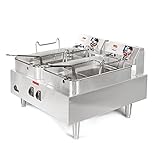
- HIGH-CAPACITY DUAL POT PERFORMANCE: Designed with twin fry pots and a combined 30 lb oil capacity, this fryer allows operators to cook multiple items simultaneously, increasing throughput and improving efficiency in high-demand commercial kitchen environments.
- IMMERSION HEATING SYSTEM: Equipped with immersion-style heating elements that deliver even heat distribution for consistent frying results, while swinging up for easy access, simplifying maintenance and ensuring reliable operation during continuous use.
- ENHANCED COOKING FLEXIBILITY: Twin pot configuration allows separation of different food items, reducing flavor transfer and supporting varied menu preparation, making it ideal for operations requiring versatility and consistent product quality.
- SAFE AND DURABLE CONSTRUCTION: Built with a safety thermostat to prevent overheating and heavy-duty metal knobs for long-term durability, this fryer ensures dependable performance and safe operation in demanding foodservice environments.
- STAR MANUFACTURING PURPOSE: With over a century of innovation since 1921, Star Manufacturing delivers durable, high-performance commercial cooking equipment, trusted worldwide for reliability, versatility, and a legacy of industry-leading solutions across a wide range of foodservice applications.
Compare at least the 14-by-14-inch cooking area where published, heat input, thermostat or control design, vat depth, split-pot options, oil-filter workflow, electrical or gas requirements, certifications, and parts support. For a 40 lb search, also check whether the stated capacity is total oil for a split vat or oil for one full vat; those configurations do not provide the same usable cooking arrangement.
Recommended Free Tools
What is the difference between a standard vat and a split vat?
A standard vat provides one continuous frying area, while a split vat divides the fryer into separate oil compartments that can run different products, oil types, or temperatures. A split vat can increase menu flexibility within one footprint, but each side has less oil volume and may have a different practical batch limit.
| Vat design | Best suited to | Main advantage | Main trade-off |
|---|---|---|---|
| Standard vat | One product family or operations prioritizing a larger continuous cooking area | Simpler workflow and one uninterrupted oil volume | Different products and temperatures share the same oil unless the kitchen uses another vat |
| Large vat | High-volume production and larger batches | More oil volume and generally more cooking area in the larger configurations | Higher oil load, larger footprint, greater utility demand, and more cleaning volume |
| Split vat | Menus requiring separate products, oil types, or temperatures | Independent frying zones in one fryer footprint | Less oil and cooking capacity per side, plus additional workflow and cleaning considerations |
Published labels are not perfectly interchangeable between brands. Confirm the exact oil capacity, dimensions, heating arrangement, and per-side specifications on the model documentation rather than assuming that every standard, large, or split vat has the same geometry.
Are ENERGY STAR commercial fryers worth it?
ENERGY STAR certification is a meaningful efficiency screen, but it is not a guarantee that a fryer will have the lowest total cost at every site. Installation cost, utility rates, duty cycle, production volume, maintenance, oil use, and downtime still determine the business case.
According to ENERGY STAR’s 2016 commercial-fryer criteria, qualifying open fryers must meet both heavy-load cooking-efficiency and idle-energy requirements:
| Fryer category | Minimum heavy-load cooking efficiency | Maximum idle-energy rate |
|---|---|---|
| Standard open deep-fat gas fryer | At least 50% | No more than 9,000 Btu/hr |
| Large-vat open deep-fat gas fryer | At least 50% | No more than 12,000 Btu/hr |
| Standard open deep-fat electric fryer | At least 83% | No more than 800 watts |
| Large-vat open deep-fat electric fryer | At least 80% | No more than 1,100 watts |
ENERGY STAR states that certified commercial standard-vat gas fryers are about 30% more energy efficient than standard models and reports estimated savings of about 50 MMBtu and $560 annually, with average lifetime utility-bill savings of $4,400. Those are program-level estimates, not promises for every fryer, utility territory, menu, or operating schedule. Use the ENERGY STAR certified commercial fryer dataset to verify certification and model-level data such as fuel type, installation, fryer width, shortening capacity, cooking efficiency, and idle-energy rate. The supplied dataset is marked updated July 31, 2026.
ENERGY STAR’s own summary is direct: “Commercial fryers must meet the requirements provided in the tables below to qualify as ENERGY STAR.” Check the individual model rather than assuming that every fryer in a manufacturer’s product family is certified.
Do commercial fryers need to be NSF certified?
Commercial fryers do not have one automatically binding NSF requirement in every location, but NSF/ANSI 4 is directly relevant to commercial cooking equipment and may be required by a purchaser, health department, code official, or other authority. Certification should be checked for the exact model and configuration.
NSF International explains: “NSF/ANSI 4 establishes minimum food protection and sanitation requirements for the materials, design, construction and performance of commercial cooking, rethermalization and powered hot food holding and transport equipment and their related components.” NSF identifies fat/oil fryers and fat/oil filters within the scope of the standard.
What’s actually slowing this PC down?
Pick the symptom - the matching free tool is one click away.
The FDA Food Code is an important reference, but it is a model code rather than automatically binding federal law in every jurisdiction. The FDA Food Code page states, “The 2022 Food Code is the most recent full edition published by FDA.” States, territories, tribes, and local jurisdictions may adopt the code with amendments or use other requirements. Confirm the applicable rules with the local health department and the authority having jurisdiction.
Rank #3

- Precise Temperature Control:Boosted by Germany Made EGO Theremostat,temperature deviation within 7 degrees!Grab it without a second thought:UL and ETLsanitation for use in the US.
- POWERFUL PERFORMANCE: Powerful 3600-watt deep fryer with 12-liter oil capacity to serve profitable fried foods to your hungry customers,this deep fryer can not only fry fast and but also reach the perfect crisp.
- SAFE TO USE:UL or ETL certified Power Cord,Thermostat,Temperature Limmiter,Micro Switch to ensure safety of you and your property
- EZ CLEAN: Thanks to Quality Copper draining valve,cleaning or changing oil will no longer be a Donkey Work.
- LARGE SOLID BASKET: Assembling with wingscrew can be done easily with bare hands,say goodbye to the hard assembling flimsy basket
| Standard or program | What it addresses | How to use it when buying |
|---|---|---|
| NSF/ANSI 4 | Food protection and sanitation for commercial cooking, rethermalization, and powered hot-food equipment, including fat/oil fryers and filters | Verify the exact fryer and configuration carry the required sanitation certification or listing. |
| UL 197 | Commercial electric cooking appliances | Use for applicable electric equipment and confirm the required listing with the installer or AHJ. |
| ANSI Z83.11/CSA 1.8 | Gas-fired foodservice equipment | Confirm applicability for a natural-gas or LP installation and the local approval path. |
| UL 1889 | Commercial cooking-oil filters | Check applicable certification for a separate or integrated oil-filtration component. |
UL Solutions’ foodservice equipment guidance identifies these standards as relevant categories. A brand name or product family is not enough evidence of compliance; request the certification information for the exact model, fuel, vat, filtration, and control configuration.
Independent reader supportYour contribution helps us test, update, and keep practical guides available for everyone.Do I need a commercial fryer oil filter?
A separate filter is not automatically required for every operation, but oil filtration can be valuable when the fryer runs frequently, oil-quality consistency matters, or the kitchen needs a controlled oil-disposal and maintenance workflow. The right choice may be no filter, a manual system, a built-in filter, or an automatic system depending on volume, labor, fryer design, and sanitation procedures.
| Filtration approach | Potential fit | Questions to ask |
|---|---|---|
| No dedicated filtration | Very low-volume or infrequent frying where the oil-management process is simple | How will oil be cooled, removed, stored, discarded, and replaced safely? |
| Manual filtration | Operations that can schedule filtering and provide trained labor | Is the drain accessible, is the filter pan compatible, and what media and cleaning steps are required? |
| Built-in filtration | Regular frying where saving handling steps and keeping the system close to the fryer matter | Does the filter fit the exact vat, how is it cleaned, and what replacement parts are stocked locally? |
| Automatic filtration | Higher-volume operations seeking a programmed or less labor-intensive routine | What controls, pumps, sensors, service parts, and operator procedures does the system require? |
Do not buy a universal commercial fryer oil filter or replacement media without checking fryer model, pan and connection dimensions, operating temperature range, filter-media type, electrical requirements, and applicable sanitation or safety listings. A filter that cannot be drained, cleaned, serviced, or supplied with replacement media becomes a maintenance liability.
Do these 3 things before closing this tab:
1Scan for outdated or missing drivers - takes under a minute2Repair Windows errors before they cause bigger problems3Fix the driver behind crashes, sound loss and screen glitchesWhich fryer is best for a food truck, restaurant, concession stand, or high-volume kitchen?
The best fryer for each operation is the smallest configuration that can handle the real peak demand without creating an unapproved utility, ventilation, or service condition. Site constraints should narrow the fryer category before a buyer compares brands.
| Operation | Likely shortlist | Primary decision | Common mistake to avoid |
|---|---|---|---|
| Food truck | Compact countertop or other approved compact configuration | Available electrical service or approved fuel system, exhaust, fire protection, and vehicle layout | Buying a restaurant fryer without confirming vehicle weight, clearances, ventilation, and inspection requirements |
| Concession stand | Countertop or compact floor fryer matched to intermittent or event-driven demand | Peak queue volume, portability or footprint, utility availability, and oil handling between events | Choosing by nominal capacity without checking recovery, cleaning, and transport or storage needs |
| Restaurant | Standard-vat or split-vat floor fryer; gas or electric based on the building | Menu separation, expected batch size, hood capacity, filtration, and service coverage | Assuming a fryer fits because its width fits while ignoring gas, electrical, drain, hood, or clearance requirements |
| High-volume kitchen | Large-vat, multiple-frypot, or high-capacity gas or electric system with filtration | Peak production, recovery under repeated loads, oil-management labor, redundancy, and downtime risk | Using oil capacity as a substitute for verified throughput and commissioning information |
What do Frymaster, Pitco, and Vulcan examples show?
Manufacturer examples are useful for understanding the market’s range, not for declaring a universal winner. The cited documentation does not provide independent rankings.
| Manufacturer example | What the documentation helps illustrate | How to interpret it |
|---|---|---|
| Frymaster | Gas and electric categories, open-pot and tube designs, oil-capacity ranges, frypot count, filtration, controllers, options, and certifications | Use the catalog to build a configuration-based shortlist, then verify the exact model and local installation requirements. |
| Pitco economy gas range | Standard, larger-vat, split-pot, and reduced-gas-consumption configurations with published capacities and heat inputs | Useful for comparing design categories; the listed specifications are manufacturer data rather than independent throughput tests. |
| Pitco VF35 and VF65 | Pitco describes the VF35 as using 35% less gas than the 35C+ and the VF65 as using 40% less gas than the 65C+ at the same production rate | These are Pitco’s comparative claims, not independent rankings or guarantees of actual savings in a particular kitchen. |
| Vulcan PowerFry3 TR Series | A ThreePass heat-transfer system is presented as intended to improve energy efficiency, throughput, and cook times | Use it as an example of a high-capacity gas-fryer design, not proof that it is the best commercial fryer overall. |
The linked Vulcan page is labeled as a 65lb PowerFry3 TR Series gas freestanding fryer, while the supplied research description refers to a 70 lb model. Treat the capacity label as a specification to verify rather than repeating either number as a general product fact. Review the current Vulcan product page and request the exact configuration and installation documentation before purchase.
How much does a commercial fryer cost to own?
The supplied research does not establish a reliable current purchase price for any model, and online prices, seller quality, inventory, and marketplace eligibility require a live check at publication time. The equipment price is only one part of the financial decision.
| Cost category | What to include | Why it can change the purchase decision |
|---|---|---|
| Equipment | Fryer, baskets, controls, filtration, optional automation, and compatible accessories | A lower base price may exclude the filtration or controls needed for the actual workflow. |
| Installation | Gas line or electrical work, hood modifications, exhaust, make-up air, clearances, fire suppression, permits, and commissioning | Site work can determine whether one fuel type is practical even when the fryer itself is cheaper. |
| Consumables | Cooking oil, filter media, replacement baskets, seals, and other compatible parts | Recurring oil and filtration costs depend on volume and the chosen maintenance process. |
| Maintenance | Cleaning labor, inspections, service visits, replacement components, and planned downtime | Accessible drains and available parts can reduce disruption even when initial equipment cost is higher. |
| Utilities and downtime | Gas or electricity, idle operation, production interruptions, and recovery during peak service | Efficiency and service support matter most when the fryer operates frequently or downtime is costly. |
Ask dealers and installers for a total installed-cost proposal rather than comparing equipment prices alone. The proposal should state the fryer model and options, utility requirements, ventilation and fire-protection work, permits, delivery, installation, commissioning, warranty, service response, and expected consumables.
What should you verify before ordering a commercial fryer?
- Measure demand. Record the maximum expected hourly volume, typical batch size, peak service period, products fried simultaneously, and whether the menu needs separate oil or temperatures.
- Choose the vat layout. Decide between a standard vat, large vat, multiple frypots, or split vat. Confirm whether a published oil capacity is total capacity or capacity per compartment.
- Confirm utilities. Verify natural gas, LP gas, or electrical availability, including voltage, phase, amperage, line sizing, pressure, disconnects, regulators, and capacity for other kitchen equipment.
- Have the site reviewed. Confirm hood, exhaust, ventilation, make-up air, fire suppression, clearances, floor or counter loading, drain access, and local inspection requirements before ordering.
- Verify compliance. Check NSF/ANSI 4 and applicable UL or gas-equipment certification for the exact model and configuration. Confirm requirements with the health department and authority having jurisdiction.
- Check efficiency at model level. Look for ENERGY STAR status and model-level cooking-efficiency and idle-energy data where applicable; do not infer certification from a manufacturer family name.
- Inspect oil management. Compare filtration type, filter-pan access, drain design, filter-media cost, oil disposal, cleaning steps, cool-zone design, and safe handling procedures.
- Review serviceability. Ask about local dealer support, warranty coverage, parts availability, control and pump service, installation commissioning, and expected response time.
- Price the complete project. Include fryer, options, installation, ventilation, fire protection, permits, oil, filtration media, maintenance, utilities, and the cost of downtime.
- Reconfirm the exact specification. Before payment, match the quote, product page, certification, dimensions, fuel, vat, controls, filtration, and accessories. Resolve any difference in model name or capacity in writing.
Bottom line
Choose a commercial deep fryer as a piece of a complete foodservice installation, not as an isolated appliance. For sustained high-volume cooking, shortlist large-vat or multiple-frypot gas or electric models that fit the approved utilities and hood. For smaller or specialized operations, a countertop standard vat or split vat may be the better fit. In every case, compare verified capacity, recovery, filtration, efficiency, certification, serviceability, and total installed cost.
The Bottom Line
The best commercial deep fryer is the one that matches peak demand and can be legally, safely, efficiently, and serviceably installed in the kitchen. Confirm fuel capacity, ventilation, vat design, filtration, exact-model certifications, ENERGY STAR data where relevant, and total installed cost before choosing a brand or seller.
Quick Recap
Product prices and availability are accurate as of the date/time indicated and are subject to change. Any price and availability information displayed on Amazon at the time of purchase will apply.
The Tool Desk
Outbyte Driver Updater FREEFix the driver behind crashes, sound loss and screen glitchesFind Drivers →Outbyte PC Repair FREERepair Windows errors before they cause bigger problemsFix Now →
