Some links on this page are affiliate links: if you buy through them we may earn a commission, at no extra cost to you.
A ceiling-mounted range hood can be one of the best upgrades in an open kitchen, especially when the cooktop sits on an island and a wall hood is not an option. The best choice is not simply the most powerful or most attractive model. It is the hood that can capture cooking smoke at your ceiling height, move air through a properly sized duct, pass inspection, run quietly enough that you will actually use it, and fit the finished kitchen design.
For most homeowners, ceiling-mounted range hoods fall into two practical categories: suspended island hoods and flush ceiling hoods. Suspended island hoods hang down over the cooktop like a chimney-style canopy. Flush ceiling hoods recess into the ceiling plane and preserve more sightlines, but they are usually harder to install and often need more airflow because they sit farther from the cooking surface.
As an Amazon Associate I earn from qualifying purchases.
Do these 3 things before closing this tab:
1Scan for outdated or missing drivers - takes under a minute2Clear out junk files and repair common Windows errors3Fix the driver behind crashes, sound loss and screen glitchesIn 2026, a straightforward new range hood installation with duct and electrical work commonly lands around $650 to $2,100. Many island hood projects fall around $500 to $1,400 when the route is simple. Complex flush ceiling or island retrofits can reach $3,000 to $6,500 or more once framing, roof penetration, electrical relocation, drywall, paint, and makeup air are included. On our job sites, the difference between a clean install and an expensive one is almost always decided before the hood is ordered.
What Counts as a Ceiling-Mounted Range Hood?
A ceiling-mounted range hood is any kitchen exhaust hood supported from the ceiling instead of mounted to a wall cabinet or under-cabinet location. In residential kitchens, that usually means one of two designs.
Popular on Amazon

- EFFICIENT AIRFLOW: 380 CFM removes smells and odors with ease for a clean kitchen. Ducted range hood vents outside and away from your home. Converts to ductless range hood with Carbon Filter Kit Purchase Part # CFK1-TM (sold separately). Noise level as low as 45 dB on lowest fan speed with rigid ducting (sold separately) under optimal conditions; range hood comes with flexible ducting for convenient installation
- EASY-TO-CLEAN FILTERS: Cosmo ARC-FLOW Permanent Filters are dishwasher-safe and extremely durable. No need to replace these range hood filters, simply drop in the dishwasher for easy maintenance and cost savings
- SOFT TOUCH CONTROLS: Range hood equipped with soft touch control panel to manage multiple functions, including fan speed, lights and power
- ENERGY-EFFICIENT LIGHTS: Part of the Lumin Collection. The energy-efficient, 2-watt LEDs are long-lasting and provide the range hood with bright, high lumen lighting for better visibility at night
- 2-YEAR LIMITED PARTS: Our customer support team is based proudly in the USA. Range Hood Product Dimensions: 29.2 in. (W) x 23.6 in. (D) x Adjustable 26.3 in. - 46 in. (H). Electrical: 120V/60Hz, 3-prong plug. Duct Size: 6 in.
Suspended island range hoods
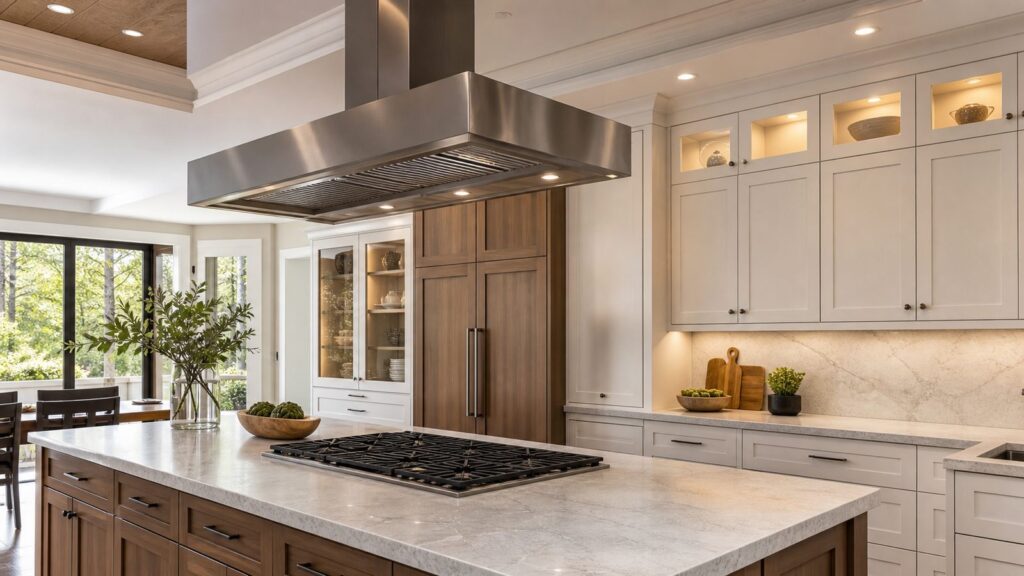
Suspended island hoods are the most familiar option. They hang above an island cooktop, usually with a stainless steel or painted canopy and a vertical chimney cover that hides the duct. Common widths include 30, 36, 42, and 48 inches, though consumer models can range from about 24 to 60 inches wide. Many mass-market island hoods advertise airflow from roughly 343 CFM to 900 CFM.
This style usually captures better than a flush ceiling model because the intake is closer to the cooking surface. It also gives the kitchen a clear focal point. The tradeoff is visual: the hood occupies space in the sightline between the kitchen, dining area, and living room.
Flush ceiling range hoods
Flush ceiling hoods are recessed into the ceiling and often look like a flat stainless, white, or glass panel with perimeter suction or metal filters. They are popular in modern kitchens because they keep the island visually open. Some premium flush ceiling models advertise 1,200 CFM or more.
The performance challenge is distance. Smoke, steam, grease vapor, and combustion byproducts spread as they rise. If the ceiling is 9, 10, or 12 feet above the floor, the hood may be several feet above the recommended capture zone for a traditional canopy. That does not make flush ceiling hoods useless, but it does mean sizing, duct design, and cooking habits matter more.
The Best Ceiling-Mounted Range Hood Depends on the Kitchen
There is no single best ceiling-mounted range hood for every kitchen. The right choice depends on the cooktop location, fuel type, ceiling height, joist direction, duct route, cooking style, and local code requirements.
For a serious island cooking station, we usually start with three questions: What are you cooking? Where can the duct actually go? How much finished ceiling and roof work are you willing to open up? A homeowner who boils pasta and uses an induction cooktop twice a week has different needs than someone who sears steaks, stir-fries, deep-fries, or cooks on a high-output gas range.
What’s actually slowing this PC down?
Pick the symptom - the matching free tool is one click away.
As a rule, a suspended island hood is the better performance choice when the homeowner is comfortable with a visible hood. A flush ceiling hood is the better design choice when sightlines matter most and the project budget can support stronger ventilation, careful duct planning, and finish repair.
| Best fit | Recommended hood type | Typical size range | Typical airflow range | Construction difficulty |
|---|---|---|---|---|
| Island cooktop, frequent high-heat cooking | Suspended island hood | 36 to 48 in. | 600 to 900 CFM | Moderate to high |
| Modern open kitchen where sightlines matter | Flush ceiling hood | 36 to 60 in. | 900 to 1,200+ CFM | High |
| Light electric or induction cooking | Lower-profile island or ceiling hood | 30 to 42 in. | 350 to 600 CFM | Moderate |
| Existing island with no duct route | Ducted retrofit if feasible; ductless only as compromise | Varies | Varies | Often high |
How to Choose the Right Width and Capture Area
Width matters because island cooking is exposed on all sides. A wall hood benefits from the wall behind the range, which helps contain the plume. An island hood has no wall to help capture smoke, so cross-drafts from people walking, HVAC registers, open windows, and ceiling fans can push the plume away from the filter area.
For many island cooktops, we like the hood to be at least as wide as the cooking surface, and often 3 to 6 inches wider on each side when the layout allows it. For a 36-inch island cooktop, that usually means a 42-inch hood is worth considering. For a 48-inch pro-style range or rangetop, a 54- to 60-inch hood may be appropriate if the ceiling and cabinetry layout can support it.
Flush ceiling hoods need even more attention to capture area. Because they sit high, the intake should be generous and centered over the cooking surface. A narrow flush unit above a wide island cooktop may look clean on a rendering but miss smoke in real use.
The Tool Desk
Outbyte PC Repair FREERepair Windows errors before they cause bigger problemsFix Now →Outbyte Driver Updater FREEScan for outdated or missing drivers - takes under a minuteDriver Scan →CFM Is Only Part of the Performance Story
CFM, or cubic feet per minute, tells you how much air the blower can move under rated conditions. It does not guarantee that smoke will be captured from your actual cooktop. A quiet 600 CFM hood with a short, smooth, properly sized duct can outperform a loud 1,200 CFM hood forced through undersized ductwork, tight elbows, and a restrictive roof cap.
For ceiling-mounted hoods, we look at CFM together with capture area, mounting height, duct diameter, blower quality, and noise rating. Many homeowners shop by the largest CFM number on the box. That can create problems. Oversized airflow can trigger makeup air requirements, increase heating and cooling loads, pull conditioned air out of the house, and create comfort issues if the home is tight.
For moderate electric or induction cooking, 350 to 600 CFM may be enough in many kitchens. For island gas cooking, frequent frying, searing, wok cooking, or a larger rangetop, 600 to 900 CFM is more common. For flush ceiling installations, especially over taller ceilings or heavy cooking zones, 900 to 1,200 CFM may be considered, but only if the ductwork and makeup air plan can support it.
Ducted vs. Ductless: Use Outdoor Exhaust When You Can
A ducted ceiling-mounted range hood exhausts air outdoors through rigid metal duct. A ductless hood recirculates air through grease and charcoal filters and returns it to the kitchen. Ductless models can reduce some grease and odors, but they do not remove moisture, heat, carbon monoxide, nitrogen dioxide, or fine particles from the house.
Quick wins for a faster PC:
Scan for outdated or missing drivers - takes under a minuteDriver Scan →Repair Windows errors before they cause bigger problemsFix Now →Fix the driver behind crashes, sound loss and screen glitchesFind Drivers →For a construction-grade kitchen upgrade, ducted is the performance choice. This is especially true for gas cooking. Cooking ventilation is not just about smell. It is about indoor air quality, moisture control, grease management, and keeping combustion byproducts out of the living space.
We do not route range hood exhaust into attics, soffits, crawl spaces, garages, or wall cavities. Kitchen exhaust should terminate outdoors through an approved wall or roof cap. Dumping warm, greasy, moisture-heavy air into an enclosed space can create odor problems, staining, condensation, and long-term building damage.
Duct Design Can Make or Break the Hood
The duct route is where many range hood projects succeed or fail. Every elbow, transition, long horizontal run, and undersized section adds resistance. More resistance means less real airflow and more noise.
Use rigid metal duct, not flexible dryer-style duct. Match the hood manufacturer’s required duct diameter from the beginning. If the hood calls for 8-inch duct, do not reduce it to 6 inches just because an old duct is already there. Necking down can increase noise, reduce performance, and undermine the entire upgrade.
The best duct run is short, straight, and direct. For an island hood, that often means going up through the ceiling, through attic space if available, and out through the roof. In some layouts, the duct can run between joists to an exterior wall, but joist direction and depth determine whether that is realistic. A roof termination may be cleaner mechanically, but it adds roofing scope and must be flashed correctly.
On remodels, we verify the duct path before ordering the hood. That means checking joist direction, ceiling cavity depth, attic access, roof pitch, roof material, exterior termination location, and whether any structural members, plumbing, electrical, or HVAC lines are in the way.
Noise: Why Sones Matter
A hood that is too loud will not get used. Noise is usually measured in sones. Lower sone ratings are quieter, though ratings vary by speed setting. A hood may be comfortable on low speed and unpleasant at maximum speed.
Noise comes from the blower, the duct route, and air turbulence. Undersized ducts, too many elbows, abrupt transitions, and restrictive caps all make a hood louder. If the kitchen is part of an open living area, this matters. A loud island hood can interrupt conversation and make homeowners avoid using it until smoke is already visible.
Crashes, No Sound, or Screen Glitches?
Random freezes, missing sound and display glitches usually trace back to one bad driver. Find and replace yours safely.Free scan · under a minuteWindows Errors? Fix Them Before They Spread
Repair common Windows errors and clear accumulated junk for a smoother, more stable PC - no reinstall needed.Free scan · no reinstallFor premium kitchens, remote or inline blowers can help. A remote blower moves the fan motor away from the hood body, often to an attic, exterior wall, or roof location. This can reduce perceived kitchen noise, but it adds cost, wiring, access requirements, and service considerations. We like remote blowers when the design calls for strong airflow and quiet operation, but they need to be planned like mechanical equipment, not treated as an accessory.
Ceiling Height and Flush Hood Performance
Ceiling height is one of the biggest decisions for flush ceiling hoods. A canopy hood mounted 30 to 36 inches above the cooktop has a much easier job than a flush unit mounted at an 8-, 9-, or 10-foot ceiling. The farther the intake is from the cooking surface, the more the cooking plume spreads before it reaches the filters.
At an 8-foot ceiling, a flush hood may perform reasonably well if it is wide enough, powerful enough, and protected from cross-drafts. At 9 feet, the design needs more scrutiny. At 10 feet or higher, we have a more serious conversation about cooking style, CFM, hood size, and whether a suspended hood or a lowered ceiling feature would perform better.
Also popular on Amazon

- SUPER QUIET INNOVATIVE SPLIT CEILING MOUNT - The blower unit is mounted in the attic and the hood unit is mounted in the ceiling. Ceiling mount improves ventilation and lighting over your stove while providing a very strong performance and a sleek look for your kitchen. Built with high quality 1mm thick stainless steel with brush finishing.
- DUCTED VENT OUTSIDE, 6” ROUND TOP VENT - 6” round top exhaust vent (NO rear vent). CAUTION: please check your existing venting duct before purchasing, there are rectangle or round ducts at different sizes. Ducts are not included.
- 4 SPEEDS POWERFUL OPERATION WITH LED LIGHTS - 4 speeds approximately (200, 400, 600, up to 800 CFM), touch sensor panel with wireless white plastic remote control with wall mount holder. (Note: AAA batteries are NOT included) 2 of 3W energy saving cold bright LED lights. 1 motor in the blower unit. Power rating: 120V/60Hz, 110W Min /160W Max. 12 ft split control cord and power cord with plug is included. Noise level at low: 40 dB, 2.5 sones. Noise level at high: 52 dB, 5.5 sones. NOT compatible with wall switch controls.
- 2 DISHWASHER SAFE BAFFLE FILTERS: dishwasher safe commercial style stainless steel baffle filters with built-in latch. The oil is contained in the filters; no oil holders are needed.
- 1 YEAR USA LIMITED PARTS WARRANTY - ETL Certified. Free parts, repair or exchange within 1 year. Awoco high quality product reputation and supreme customer service is a guarantee. Hood unit overall dimensions: 27-5/8"W x 14-1/2"D x 4-1/8"H. Hood weight: 15.5 lbs. Blower unit overall dimensions: 13-1/2"W x 11-7/8"D x 18"H. Blower weight: 20.4 lbs.
A flush hood can be a good fit for light to moderate cooking, induction cooktops, and homeowners who value open sightlines. For heavy gas cooking, wok cooking, blackening, or frequent high-heat searing, a closer canopy-style island hood is usually more effective.
Installed Cost in 2026
Ceiling-mounted range hood costs vary widely because the hood itself is only one part of the job. The real cost is the combination of appliance, ductwork, electrical, structure, roof or wall penetration, drywall repair, paint, and inspection.
| Project type | Typical 2026 cost | What is usually included |
|---|---|---|
| Basic replacement with existing duct | $300 to $850 | Remove old hood, install similar new hood, connect to existing duct and power |
| New standard range hood with duct and outlet | $650 to $2,100 | New ductwork, electrical outlet or connection, basic finish work |
| Typical island hood installation | $500 to $1,400 | Hood hanging, ceiling support, duct connection, standard labor conditions |
| Ducted install with existing ductwork | $200 to $850+ labor | Base labor when duct and power are already suitable |
| New duct run or more involved retrofit | $1,200 to $2,500+ | New duct route, roof or wall cap, added electrical, more labor |
| Complex flush ceiling or island retrofit | $3,000 to $6,500+ | Framing, ceiling opening, roof work, electrical relocation, drywall, paint, possible makeup air |
Product-only pricing also has a wide spread. Basic mass-market island hoods may start around $300 to $500. Better stainless island hoods commonly run $600 to $1,500. Flush ceiling and designer units often run $1,500 to $4,000 or more. High-CFM systems, premium controls, and remote blowers can push the appliance package above that.
Permits and inspections may add roughly $50 to $300 or more depending on the jurisdiction and the scope. Mechanical, electrical, roofing, and structural work may all be involved. Local rules vary, so the right answer is always project-specific.
Independent reader supportYour contribution helps us test, update, and keep practical guides available for everyone.Makeup Air and the 400 CFM Threshold
Makeup air is replacement air brought into the house to balance air exhausted by the range hood. Many residential codes require makeup air for kitchen exhaust systems over 400 CFM, with specific requirements varying by state and local jurisdiction. This is a common surprise for homeowners shopping for 600, 900, or 1,200 CFM hoods.
Recommended Free Tools
The concern is not paperwork. A powerful exhaust hood can depressurize a tight house. That can affect fireplace draft, atmospherically vented water heaters, furnaces, indoor comfort, and HVAC performance. In cold or hot climates, dumping large amounts of conditioned air outdoors can also increase energy use.
When a hood is over 400 CFM, we discuss makeup air early. The solution may involve a passive inlet, a powered makeup air unit, a damper tied to the hood, tempering, or coordination with the HVAC system. The correct approach depends on the home, equipment, climate, and local code.
Permits, Safety, and Code Details Homeowners Should Know
Range hood work can touch several trades. A simple replacement may be treated differently than a new island hood that penetrates the roof, adds a circuit, and changes framing. Homeowners should expect permit requirements to vary by city and county.
Common inspection concerns include proper outdoor termination, duct material, duct size, clearances, electrical connection, roof flashing, fireblocking, structural support, and makeup air. The hood must be supported by framing or blocking, not just drywall. A ceiling-mounted hood has weight, vibration, and leverage, especially when suspended over an island.
Free tools Windows power users keep installed
One-click scans. No signup required.
For gas ranges, ventilation should be used every time cooking starts, especially during high-heat frying, searing, broiling, wok cooking, and oven preheating. Running the hood after smoke is already in the room is late. Start it before the pan is hot and let it run for several minutes after cooking ends.
When to DIY vs. When to Hire a Pro
A homeowner with electrical comfort and carpentry experience may be able to replace a similar hood using existing ductwork, existing power, and the same mounting location. That is the narrow DIY lane: same size, same route, same support conditions, no roof work, no new circuit, no structural changes, and no code-triggered makeup air issue.
Hire a professional when the project involves an island hood, a flush ceiling hood, a new duct route, roof penetration, electrical relocation, ceiling framing, drywall repair, makeup air, or a hood over 400 CFM. Those are not just appliance tasks. They are construction tasks.
On our remodel projects, ceiling hood installation often involves a carpenter, electrician, HVAC or mechanical contractor, roofer, drywall finisher, and painter. Coordinating those trades in the right order prevents the common problem of opening a finished ceiling twice.
Common Mistakes to Avoid
The first mistake is buying by appearance only. A hood can look perfect online and still perform poorly if it is too narrow, too high, or connected to poor ductwork. The second mistake is buying too much CFM without planning duct size, noise, makeup air, and HVAC impact.
Another common problem is using ductless mode for serious gas cooking and assuming charcoal filters provide the same result as outdoor exhaust. They do not. Ductless filtration may be better than nothing in a difficult retrofit, but it is not equivalent to exhausting cooking pollutants outdoors.
We also see homeowners reduce duct size to fit existing framing or old ductwork. That shortcut usually makes the hood louder and less effective. Finally, never exhaust into an attic, soffit, crawl space, garage, or wall cavity. The termination needs to be outdoors with the correct cap and flashing.
Our Practical Recommendation
If performance is the priority, choose a ducted suspended island hood sized wider than the cooktop, with moderate-to-strong CFM, low sone ratings, rigid metal duct, and the shortest clean route outdoors. For many island kitchens, that means a 36- to 48-inch hood in the 600 to 900 CFM range, adjusted for the actual cooking equipment and local makeup air requirements.
If sightlines are the priority, consider a flush ceiling hood, but treat it as part of the remodel plan from day one. Verify ceiling cavity depth, joist direction, duct path, service access, blower location, and finished distance from cooktop to intake before purchasing the unit. For tall ceilings or heavy cooking, be realistic about performance.
The best ceiling-mounted range hood is not the one with the flashiest spec sheet. It is the one designed as a system: hood, duct, blower, roof or wall cap, makeup air, structure, and finishes all working together. Plan it that way, and the kitchen will look better, smell cleaner, stay more comfortable, and function like it was built intentionally.
Frequently Asked Questions
What is the best ceiling-mounted range hood for an island cooktop?
For most island cooktops, the best performer is a ducted suspended island hood that is at least as wide as the cooktop and often 3 to 6 inches wider on each side. A 36-inch cooktop often pairs well with a 42-inch hood when the layout allows it.
How much does it cost to install a ceiling-mounted range hood in 2026?
A new standard range hood installation with duct and electrical work commonly costs about $650 to $2,100. Island hood installs often run $500 to $1,400 in simpler conditions, while complex flush ceiling or retrofit island projects can reach $3,000 to $6,500 or more.
Is a flush ceiling range hood as effective as an island hood?
Usually not for heavy cooking. A flush ceiling hood can work well when it is properly sized and ducted, but because it sits farther from the cooktop, smoke and steam have more time to spread. A suspended island hood mounted closer to the cooking surface generally captures better.
Do ceiling-mounted range hoods need to vent outside?
For best performance, yes. Ducted hoods exhaust smoke, grease vapor, heat, moisture, odors, and cooking pollutants outdoors. Ductless hoods can filter some grease and odor, but they do not remove moisture, heat, carbon monoxide, nitrogen dioxide, or fine particles from the home.
Do I need makeup air for a 600 CFM or 1,200 CFM range hood?
Many codes require makeup air for kitchen exhaust systems over 400 CFM, but local rules vary. A 600 CFM or 1,200 CFM hood should be reviewed early with the contractor or HVAC professional because makeup air can affect comfort, energy use, combustion safety, and inspections.
Can a ceiling-mounted range hood be installed in an existing kitchen?
Yes, but the difficulty depends on the duct route, ceiling framing, attic access, roof or wall termination, electrical access, and finish repair. A simple replacement may be modest. A new island or flush ceiling hood in a finished kitchen can become a multi-trade remodel.
What’s actually slowing this PC down?
Pick the symptom - the matching free tool is one click away.
Quick Recap
Product prices and availability are accurate as of the date/time indicated and are subject to change. Any price and availability information displayed on Amazon at the time of purchase will apply.

