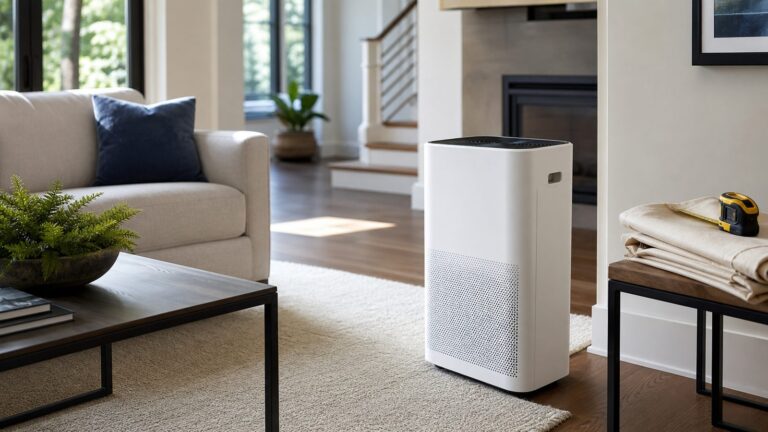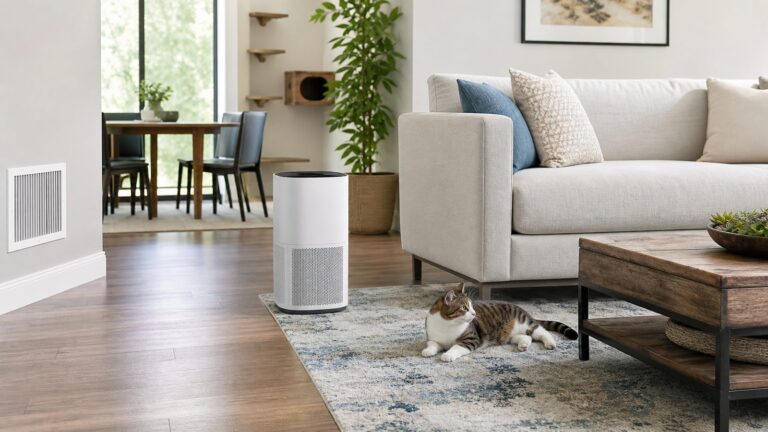
If your home smells like ammonia, the best air purifier is not simply the one with the biggest HEPA label or the largest advertised room size. Ammonia is a gas. HEPA filters are excellent for particles like dust, pollen, pet dander, drywall dust, and fine debris, but they are not the primary tool for removing ammonia vapor. For ammonia odor, you need source control first, then ventilation, then a purifier with substantial gas-phase media such as activated carbon, treated carbon, zeolite blends, or specialty chemisorbent media rated for alkaline gases.
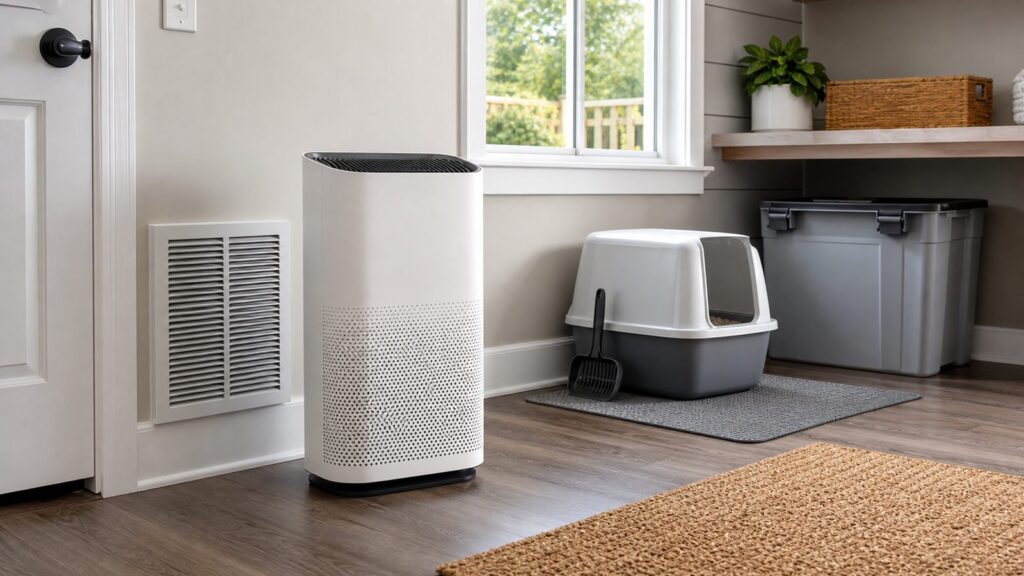
For most homes, the best choice is a high-carbon portable purifier placed near the odor source and run continuously, especially in a litter-box room, laundry room, pet area, home gym, storage room, or finished basement. If the odor is moving through the HVAC system, returns, crawlspace, garage, or wall cavities, a whole-house approach may be the better investment.
On our job sites, we treat ammonia odor as a home performance problem, not just an appliance purchase. That means we look for the source, check moisture and air pathways, correct exhaust or ventilation issues, and then size filtration to the room or system. A purifier can help a lot, but it cannot permanently fix pet urine soaked into subflooring, a leaking drain, a damp crawlspace, or a return duct pulling odor from the wrong place.
What Works Best for Ammonia Odor?
The strongest residential setup for ammonia odor has four parts: remove or isolate the source, increase exhaust or fresh-air ventilation, use a purifier with a deep gas filter, and replace carbon media when odor breaks through. If one of those pieces is missing, results are usually disappointing.
Recommended Free Tools
#1 Best Overall

- MOOKA B-D02L AIR PURIFIER FOR LARGE ROOM: With the high-efficiency filtration system, the air purifier covers an area up to 1076 ft². 6 air changes per hour in 215 ft², 1 air changes per hour in 1076 ft². Modern design fits in any space from small to large rooms, bedrooms, living rooms, offices, nurseries, kitchens and basements. Perfect for pet owners, babies, children, the elderly, or anyone wanting to improve the air quality
- TRUE HEPA AIR PURIFIER: The pre-filter, true HEPA filter and high-efficiency activated carbon filter capture pet hair, dander, smoke, odor, and large dust particles, in addition to removing all airborne contaminants as small as 0.3 microns
- ULTRA-QUIET, ENERGY-SAVING & SAFE: Thanks to the new brushless motor, the 20dB noise level is almost voiceless. It cleans your air, doesn't affect your work, study or sleep. Running in low power makes it extremely energy-saving. Child lock prevents error operations caused by pets or children. The replacement filter should be replaced every 3-6 months depending on the environment and usage frequency (Search for B08PK4WM4W)
- 4 TIMER SETTINGS, 4 FAN MODES, AND NIGHT LIGHT: 4 timer options (1H/2H/4H/8H) allow you set the air purifier operating time. Adjust the required fan speed mode (Sleep/Low/Med/High) to capture as much air pollutants as required. Soft night light, that prevents falls, can be turned off to enjoy the perfect dreaming. Press the top power button for 3 seconds to turn ON/OFF the night light when the machine is running
- EXCELLENT CUSTOMER SERVICE: We love our customers and take pride in providing a pleasant shopping experience. If you have any questions, please contact us. Note:1.The power adapter is placed with the filter, please open the bottom base cover to find it.2.Please remove the new filter plastic bag before running the air purifier
Ammonia odor can often be detected around 5 ppm, but smell is not a reliable safety gauge. Odor fatigue can happen during longer exposure, which means a person may stop noticing the odor even while the gas is still present. NIOSH occupational benchmarks list ammonia at 25 ppm for an 8-hour time-weighted average, 35 ppm for short-term exposure, and 300 ppm as immediately dangerous to life or health. Those are workplace limits, not target levels for a house, but they give useful perspective: a strong ammonia smell should not be treated as normal household odor.
The EPA’s guidance on home air cleaners is clear on the basic physics: particle CADR ratings apply to particles, not gas removal. To remove gases, an air cleaner needs activated carbon or another sorbent designed for gases. That distinction matters because many retail purifiers advertise HEPA performance loudly while including only a thin carbon sheet or coated prefilter. That type of carbon can reduce light cooking or general stale-room odors, but it saturates quickly under persistent ammonia loading.
Best-fit purifier categories
For ammonia, look at these categories before comparing brand names:
- High-carbon portable purifiers: Best for one room or localized odor. Look for pounds of carbon, not a token carbon mesh.
- Carbon plus zeolite or specialty gas cartridges: Better when odors are chemical, alkaline, or persistent. Zeolite can help with ammonia, but media quality and quantity still matter.
- Impregnated or treated activated carbon: Often better than standard carbon for ammonia because the media is modified to capture specific gas families.
- In-duct media cabinets: Useful when odors are being circulated through return air or multiple rooms.
- ERV or HRV ventilation upgrades: Helpful when the home is tight, stale, damp, or short on controlled fresh air.
- Targeted exhaust and source repairs: Often the most cost-effective fix when the source is a pet room, laundry area, crawlspace, drain, or chemical storage zone.
HEPA vs Carbon: Why Many Purifiers Fail on Ammonia
A true HEPA filter can be valuable in the same room as an ammonia problem because pet areas, basements, and storage rooms often have dust, dander, hair, litter particles, and other airborne debris. But HEPA is not the ammonia-removal engine. The gas filter is.
The Tool Desk
Outbyte PC Repair FREERepair Windows errors before they cause bigger problemsFix Now →Outbyte Driver Updater FREEFix the driver behind crashes, sound loss and screen glitchesFind Drivers →The practical difference is simple. HEPA captures particles. Ammonia passes through unless the unit also contains media that adsorbs or chemically binds gases. A purifier with a large HEPA filter and a thin carbon fabric layer may look impressive on the box, but if the ammonia source is active, that light carbon layer can be exhausted in days or weeks. A unit with a deeper carbon bed can last much longer, especially if the source has been reduced.
When we review air quality problems in homes, we pay attention to filter depth and weight. A small purifier with a half-inch odor pad is not in the same class as a specialty unit carrying several pounds of carbon or treated media. For ammonia specifically, impregnated carbon, treated carbon, or chemisorbent media rated for alkaline gases is usually more realistic than standard activated carbon alone.
What to check before buying
- Carbon weight: More media generally means more capacity. For persistent odor, think in pounds, not grams.
- Media type: Look for treated carbon, impregnated carbon, zeolite blends, or ammonia-rated gas media.
- Airflow: The purifier still needs enough fan capacity to move room air through the media repeatedly.
- Filter cost: Specialty cartridges commonly cost more than standard HEPA filters.
- Replacement schedule: Carbon can be exhausted before the HEPA filter looks dirty.
- Ozone status: Avoid ozone generators and be cautious with ionizers or plasma features in occupied homes.
Ammonia Air Purifier Comparison Matrix
The right purifier depends on where the odor is coming from and how much source control you can do. A litter-box closet, a pet-damaged bedroom, and a crawlspace odor pulled into the return duct are three different problems. Use the table below as a practical buying guide.
| Solution type | Best use | What to look for | Typical 2026 cost | Limitations |
|---|---|---|---|---|
| Basic portable purifier with HEPA and light carbon | Light general odors, dust, dander, small rooms | True HEPA, washable prefilter, replaceable carbon layer | $100-$300 | Usually weak for persistent ammonia; carbon pads saturate quickly |
| High-carbon portable purifier | Litter-box rooms, pet areas, laundry rooms, odor-prone storage | Several pounds of activated carbon, sealed filter path, continuous fan operation | $300-$900 mainstream; specialty units often $600-$1,600 | Works only in the room where air circulates through the unit |
| Specialty gas purifier with treated carbon or chemisorbent media | Persistent ammonia, cleaning-chemical odors, strong pet-waste odor | Impregnated carbon, ammonia-rated media, carbon plus zeolite blend | Commonly $700-$1,600+ | Higher filter cost; still requires source correction |
| In-duct media cabinet or whole-house air cleaner | Odors moving through returns or multiple rooms | Proper duct sizing, low static pressure impact, accessible filter cabinet | Installed systems often $400-$4,000; wide market range $59-$12,000 | Requires HVAC evaluation; restrictive filters can hurt airflow |
| ERV or HRV ventilation upgrade | Tight homes, stale air, moisture-prone rooms, poor fresh-air exchange | Balanced ventilation design, controls, duct routing, condensate handling | Often several thousand dollars depending on scope | Ventilation dilutes odors but does not remove a contaminated source |
| Source repair and local exhaust | Pet urine in flooring, drains, crawlspaces, laundry rooms, chemical storage | Moisture repair, sealing, exhaust fan, duct sealing, flooring or subfloor repair | Small fixes can be under $100; construction repairs vary widely | May require opening floors, walls, ducts, or crawlspace areas |
Our Shortlist Criteria for Ammonia Odor Control
Instead of naming a purifier solely by advertised square footage, we rank ammonia solutions by how the equipment handles gases in real rooms. A bedroom that is 12 by 14 feet with an 8-foot ceiling contains about 1,344 cubic feet of air. A 250 CFM purifier can theoretically move that room volume more than 10 times per hour, but real-world performance drops with fan speed, filter loading, furniture layout, closed doors, and leakage paths. Gas removal also depends on contact time with the media, not just airflow.
Free tools Windows power users keep installed
One-click scans. No signup required.
Rank #2

- Why Choose the AirHub Air Purifier? AHAM VERIFIED Performance: Certified by the Association of Home Appliance Manufacturers (AHAM), this air purifier has been independently tested to rigorous industry standards for dust, smoke, and pollen removal. With verified CADR ratings, it delivers 4.8 ACH in a 209 ft² room, covers up to 1,092 ft² with 1 ACH. Designed to help improve indoor air quality, it is a trusted, reliable, and professional air purifier for home.
- Dual-Side Air Intake U.S. Patent, PetFreshAir 2.0 Tech: Dual-Sided Air Intake U.S. Patent Application Publication: US 20240221871 A1. Featuring a large-area dual-sided air intake design for more efficient purification. Received multiple industry recognitions in 2026, including the Family Choice Awards 2026, Parents' Picks Awards 2026, and Mom's Choice Awards 2026. Ideal for home use. Compliant with FCC, CE, RoHS, CARB, and California Proposition 65 requirements, and SGS tested for safety and quality.
- High-Performance 3-Stage Filtration System, True HEPA Air Purifier: Built with a high-performance 3-stage filtration system, this air purifier features a washable pre-filter, a True HEPA filter, and a porous activated carbon pellet filter. It captures up to 99.97% of airborne particles as small as 0.3 microns, including dust, pollen, pet dander, PM2.5, and smoke, while helping reduce household odors. The pre-filter is removable and washable for repeated use. It is a high-performance and cost-effective air purifier for home use.
- PM2.5 Sensor and Auto Mode, Smart and Convenient: Equipped with a high-precision PM2.5 sensor, this smart air purifier continuously monitors indoor air quality in real time and displays results through four color-coded air quality levels. In Auto Mode, it automatically adjusts fan speed based on detected pollution levels, delivering efficient air cleaning while reducing energy consumption. It is a smart and convenient air purifier suitable for bedrooms, living rooms, offices, and pet-friendly homes.
- Multi-Function Design, Built for Everyday Convenience: This air purifier includes multiple useful features: sleep mode, timer, child lock, filter replacement reminder, auto mode, fan speed settings, air quality display, and filter life indicator. As one of the quietest air purifiers for home, it operates at just 20 dB in Sleep Mode with display lights turned off. It also includes an essential oil diffuser slot. It is a smart home purifier designed to meet many needs.
That is why a very high fan speed with a tiny carbon sheet is not automatically better than a moderate fan moving air through a deep carbon bed. For ammonia, capacity and media chemistry matter.
1. Substantial carbon or specialty gas media
For mild odors, a replaceable carbon filter may be enough. For persistent ammonia, look for a deep bed of activated carbon or a specialty cartridge. Premium chemical-focused portable units commonly fall in the $600-$1,600 range. Examples in the 2026 market include high-carbon units around $895 and premium multi-gas units near $1,600, depending on configuration and retailer.
2. Treated media for alkaline gases
Ammonia is alkaline. Standard activated carbon can help, but treated carbon, impregnated carbon, zeolite blends, or chemisorbent media designed for ammonia generally perform better. Product descriptions should identify gas-phase filtration beyond a vague “odor reduction” claim.
3. Enough airflow for the room
For a small 100- to 150-square-foot room, many quality portable units have enough airflow if run above low speed. For a 250- to 400-square-foot pet room, home gym, or basement zone, choose a larger unit and plan to run it continuously during odor events. Closed doors matter. A purifier in the hallway will not do much for a closed litter-box room.
4. Realistic filter replacement cost
Light carbon prefilters can cost under $50. Large specialty carbon and HEPA cartridges often run $150-$450. Heavy odor loading can exhaust carbon sooner than the normal calendar schedule, so budget by odor breakthrough, not just manufacturer intervals. If ammonia smell returns after weeks of improvement, the carbon may be saturated or the source may still be active.
5. Low-ozone or no-ozone operation
Do not use ozone generators to treat ammonia odors in occupied homes. Ozone is itself a respiratory irritant, and it is not a substitute for cleaning, ventilation, or proper filtration. If a purifier has ionizer, plasma, or electronic air-cleaning features, look for clear ozone information and use mechanical filtration modes when possible.
Where Ammonia Smells Come From in Homes
Before spending $900 on a purifier, spend 30 minutes looking for the source. Ammonia-like odor is often a symptom. The building is telling you something about waste, moisture, storage, air pressure, or ventilation.
Pet urine and litter boxes
This is the most common residential source. Cat litter, puppy accidents, old carpet, baseboards, trim, underlayment, and subflooring can hold odor even after surface cleaning. If urine has reached wood subfloor, filtration will only reduce what is airborne. It will not neutralize material contamination. In remodel work, we have seen odor persist until carpet, pad, tack strip, base trim, and sealed subfloor areas were addressed.
Rank #3

- WHY CHOOSE AHAM VERIFIDE AIR PURIFIERS: AHAM (Association of Home Appliance Manufacturers) is an ANSI-accredited organization that sets strict standards for appliance performance. Air purifiers with the AHAM VERIFIDE seal have been independently tested for air cleaning performance and energy efficiency. When you choose an AHAM certified air purifier, you're choosing a product trusted for reliable and effective indoor air quality improvement
- HIGH-PERFORMANCE AIR PURIFICATION: A powerful 56W high-torque motor and 143 CFM CADR delivers fast, effective cleaning. The Levoit Original Filter is HEPA-grade while operating in Sleep Mode (Based on IEST RP C001.7). Ideal for home, bedroom, or office
- AHAM VERIFIDE, PROVEN PERFORMANCE: AHAM VERIFIDE with a CADR (Clean Air Delivery Rate) rating of 143 CFM for smoke, 153 CFM for dust, and 167 CFM for pollen—refreshing air in a 222 ft² room 4.8 times per hour and a 1,073 ft² room once per hour
- GENUINE REPLACEMENT FILTERS: For the best performance and longest lifespan, use official Levoit filters designed specifically for Levoit air purifiers. Levoit replacement filters ensure the best fit and high-efficiency filtration, while off-brand filters may be unreliable and may damage your Levoit air purifier
- FIND COMFORT: Our filter has strong filtration performance of fine particles. 99.97% filtration efficiency for 0.1 to 0.3μm airborne particulates, including pollen, dust, and animal dander allergens. Tested by an independent lab
Cleaning chemical mistakes
Never mix ammonia cleaners with bleach. That combination can create dangerous chloramine fumes. If a strong odor starts after cleaning, leave the area, increase ventilation from outside air if it can be done safely, and do not try to “treat” the event with a consumer purifier while people remain exposed.
Drains, plumbing, and sewer-gas confusion
Homeowners often describe several odors as ammonia. A dry trap, poor venting, biofilm in a drain, or sewer-gas pathway can be misidentified. Check floor drains, laundry standpipes, unused bathrooms, basement utility sinks, and condensate drains. If the smell is strongest near a drain or mechanical room, solve that first.
Crawlspaces and damp basements
Damp materials release odors more readily. Crawlspace moisture, missing vapor barrier, organic debris, pest contamination, or return-duct leaks can pull unpleasant air into the living space. If the smell gets worse when the HVAC blower runs, inspect returns and pressure relationships before buying a larger purifier.
Garages and storage rooms
Fertilizers, cleaning supplies, trash bins, pet-waste bins, and stored chemicals can produce or mimic ammonia odor. Keep these materials sealed, separated from return-air paths, and out of conditioned living zones when possible.
Quick wins for a faster PC:
Scan for outdated or missing drivers - takes under a minuteDriver Scan →Repair Windows errors before they cause bigger problemsFix Now →How to Use a Portable Purifier for Ammonia
Placement and runtime make a noticeable difference. A good gas purifier sitting in the wrong spot on low speed may disappoint, while a properly placed unit near the source can make the room usable again.
Placement rules that work
- Place the purifier in the same room as the source, usually 3 to 8 feet away if practical.
- Keep at least 12 to 24 inches of clearance around intakes and discharge grilles.
- Avoid tight corners, curtains, bedding, furniture blockage, and closet placement unless the closet has deliberate airflow.
- Keep doors open when you want the purifier to clean adjacent areas.
- For litter boxes, place the purifier near the room’s air path, not where pets will block or tip it.
Run the purifier continuously during odor problems and for several hours after cleaning. Carbon only works when contaminated air passes through it. Auto mode can be useful for particles, but gas sensors in consumer units are not always reliable for ammonia. During odor events, use a manual medium or high setting, then step down once the room is stable.
Room sizing example
For a 12-by-12-foot room with an 8-foot ceiling, the room volume is 1,152 cubic feet. A purifier delivering 150 CFM moves 9,000 cubic feet per hour before real-world losses. That is roughly 7.8 room volumes per hour in ideal conditions. With furniture, filter resistance, and lower fan speeds, actual performance may be closer to 4 to 6 effective air changes per hour. That is a reasonable target for a localized odor room, provided the carbon media is substantial.
Whole-House Options and HVAC Considerations
A whole-house air purifier can make sense when odor moves through multiple rooms, returns, or the central air system. It is not always the first step. If one litter-box room smells bad, a portable high-carbon purifier plus better cleaning and exhaust may be more efficient. If the smell appears when the blower runs, or if several rooms have the same odor pattern, the HVAC system deserves attention.
Rank #4

- Effortless Operation: Simplified control panel with intuitive design makes it easy to operate. No complicated setup—just one tap, and you're on your way to cleaner air, saving time and letting you relax with ease
- Compact Yet Powerful: Covers up to 1,076 ft² while maintaining a compact size of just 6.69 x 6.69 x 9.84 inches. Its small frame makes placement a breeze—whether on your desk or in a corner, it's ready to work hard wherever you need it (Laboratory Tested: Our air purifier efficiently cleans 250 ft² every 15 minutes, covering up to 1,076 ft² per hour)
- 360° Airflow & High Efficiency Filtration: The elegantly engineered 360° surround air intake, coupled with the sophisticated a triple-layer filtration system, meticulously captures an astounding 99.97% of airborne pollutants, transforming your living space into a sanctuary of purity and vitality
- Quiet with Essential Oil Option: Operates as quietly as 22dB, perfect for undisturbed sleep. The built-in essential oil tray lets you add 3–5 drops to infuse your space with soothing scents while enjoying purified air
- Fully Certified: Backed by DOE, ETL, FCC, CARB, CE, and ROHS certifications, our air purifier meets the highest standards for performance, giving you peace of mind with every use
Installed whole-house air purifier costs commonly cluster around $400-$4,000 for many systems, but national pricing can range from about $59 for simple add-ons to $12,000 for premium or complex installations. A typical average near $2,610 appears in 2026 cost data because equipment types vary widely: media cabinets, electronic air cleaners, UV systems, HEPA bypass units, duct modifications, and premium gas filtration are not the same job. HVAC labor often runs about $100-$250 per hour. Permit allowances of $250-$400 may apply in some areas, depending on city or county requirements and scope.
Do not ignore static pressure
Any in-duct filter can restrict airflow if it is too small, too dense, poorly installed, or added to a duct system that was already marginal. Before installing a restrictive whole-house filter, a pro should check static pressure, blower capacity, filter cabinet size, return-air volume, and duct leakage. A filter that chokes airflow can reduce comfort, increase energy use, freeze coils, overheat furnaces, or shorten equipment life.
When ventilation beats filtration
If ammonia odor is caused by poor exhaust or stale indoor air, ventilation may matter more than filtration. Laundry rooms, pet rooms, bathrooms, home gyms, and storage spaces often benefit from a properly ducted exhaust fan, timer switch, or balanced fresh-air system. ASHRAE residential ventilation principles focus on consistent outdoor air exchange and local exhaust. In practical terms, that means pollutants should be removed near the source before they spread through the house.
Independent reader supportYour contribution helps us test, update, and keep practical guides available for everyone.What It Costs to Solve Ammonia Odors in 2026
Costs vary because the real problem may be a filter purchase, a cleaning issue, or a construction repair. A homeowner with one litter box may spend under $300 and solve the issue. A homeowner with pet urine in subflooring, a leaky return, and a damp crawlspace may need filtration plus repair work.
What’s actually slowing this PC down?
Pick the symptom - the matching free tool is one click away.
| Item or project | Typical 2026 cost | Best use |
|---|---|---|
| Sealed pet-waste bin, washable mats, enzyme cleaners | Often under $25-$100 | First step for pet rooms and litter areas |
| Replacement HVAC filter | Commonly $15-$75 depending on size and rating | Particle control and system maintenance; not a stand-alone ammonia fix |
| Basic portable purifier | $100-$300 | Light odor plus dust and pet dander |
| Mainstream activated-carbon purifier | $300-$700 | Moderate room odor when source is controlled |
| High-carbon specialty portable purifier | $600-$1,600 | Persistent ammonia or chemical odor in a defined room |
| Replacement specialty filters | $150-$450 | Large carbon, gas, and HEPA cartridges |
| Whole-house air purifier installation | Commonly $400-$4,000; wide range $59-$12,000 | Odors moving through HVAC or whole-home IAQ upgrades |
| HVAC labor | About $100-$250 per hour | Duct, blower, cabinet, electrical, and airflow work |
| Permit allowance | About $250-$400 where required | Jurisdiction-dependent HVAC or electrical work |
The biggest cost drivers are room size, target air changes per hour, carbon media weight, ammonia-specific media, filter replacement frequency, duct access, return-air layout, electrical work, ERV or HRV needs, local labor rates, and whether the job includes crawlspace, plumbing, flooring, or source remediation.
When to DIY vs When to Hire a Pro
Many ammonia odor problems are reasonable DIY projects at first. The dividing line is persistence, strength, location, and whether building systems are involved.
DIY is reasonable when
- The odor source is obvious, such as a litter box, pet-waste bin, trash area, or stored cleaning product.
- The smell is localized to one room.
- No one has symptoms such as burning eyes, coughing, chest tightness, dizziness, or trouble breathing.
- You can improve cleaning, add a sealed container, increase exhaust, and use a high-carbon purifier.
- The odor improves within 24 to 72 hours after source control and continuous filtration.
Hire a contractor, HVAC pro, or plumber when
- The odor returns quickly after cleaning and filter replacement.
- The smell is strongest near drains, crawlspaces, garages, basements, laundry areas, or HVAC returns.
- The odor spreads when the HVAC blower runs.
- There is visible moisture, staining, soft flooring, mold-like growth, or damaged subflooring.
- You are considering an in-duct purifier, ERV, HRV, exhaust fan, duct sealing, or electrical work.
- The odor is sharp, intense, or associated with health symptoms.
Permits depend on scope and jurisdiction. A plug-in portable purifier does not require a permit. A simple fan timer replacement may or may not, depending on local rules. New ductwork, electrical circuits, ERV or HRV installation, and some whole-house purifier installations may require permits or licensed trades. If the project touches the HVAC cabinet, high-voltage wiring, combustion equipment, or structural assemblies, bring in the right pro.
Safety Notes Homeowners Should Not Skip
Strong ammonia odor deserves caution. If the smell is intense, if anyone has respiratory symptoms, or if the odor began after mixing cleaners, leave the area and ventilate from outdoors only if it can be done safely. Do not stay in the room trying to troubleshoot with a consumer purifier.
Do these 3 things before closing this tab:
1Fix the driver behind crashes, sound loss and screen glitches2Repair Windows errors before they cause bigger problems3Scan for outdated or missing drivers - takes under a minuteBest Value

- 𝐀𝐇𝐀𝐌 𝐕𝐞𝐫𝐢𝐟𝐢𝐞𝐝 & 𝐇𝐢𝐠𝐡 𝐂𝐀𝐃𝐑 𝐕𝐚𝐥𝐮𝐞: Certified by the Association of Home Appliance Manufacturers, this air purifier provides reliable performance with a Smoke/Dust/PM2.5 CADR of 226 CFM (384 m³/h) and a Pollen CADR of 244 CFM (415 m³/h). AHAM certification guarantees effective, high-speed air purification for your home.
- 𝐄𝐟𝐟𝐢𝐜𝐢𝐞𝐧𝐭 𝐀𝐢𝐫𝐟𝐥𝐨𝐰 𝐃𝐞𝐬𝐢𝐠𝐧: Engineered with dual front-and-back air intakes and dual side outlets, this purifier maximizes circulation for faster air exchange. It refreshes the air 4.8 times per hour in rooms up to 350 ft², reaching up to 80% purification efficiency, while still delivering 1 full air refresh per hour in larger spaces up to 1695 ft² with about 45% efficiency, helping maintain cleaner, fresher air throughout your home.
- 𝐃𝐮𝐚𝐥 𝐅𝐢𝐥𝐭𝐞𝐫𝐬 & 𝟑-𝐒𝐭𝐚𝐠𝐞 𝐃𝐞𝐬𝐢𝐠𝐧: Equipped with dual front-and-back cartridges, each featuring a three-stage filtration system: a washable pre-filter for larger particles, a High-Efficiency filter, and an activated carbon filter. 3-in-1 filter system traps everything from pet hair to microscopic particles, ensuring thorough purification. (Please remove the filter’s plastic packaging before installation.)
- 𝐏𝐄𝐓 & 𝐄𝐂𝐎 𝐌𝐨𝐝𝐞𝐬: PET Mode increases airflow to tackle pet hair, dander, and odors, refreshing the air in just 30 minutes. ECO Mode saves energy and extends filter lifespan by entering standby when air quality is excellent, then restarting automatically when purification is required.
- 𝐌𝐮𝐥𝐭𝐢𝐩𝐥𝐞 𝐌𝐨𝐝𝐞𝐬 & 𝐅𝐚𝐧 𝐒𝐩𝐞𝐞𝐝𝐬: Includes Sleep Mode with noise levels as low as 22-24 dB for ultra-quiet nights, Auto Mode for effortless adjustments, and four fan speeds for personalized comfort. Select the setting that suits your needs any time of day.
Never mix ammonia cleaners with bleach or products that may contain bleach. Do not use ozone generators in occupied homes. Do not rely on smell alone during prolonged exposure because odor fatigue can occur. If the odor might be from a spill, chemical reaction, sewer gas, or unknown source, treat it as a safety issue before treating it as a comfort issue.
For pet urine contamination, use enzyme cleaners according to label directions, but understand the limits. If urine has penetrated carpet pad, tack strips, baseboards, underlayment, or subflooring, surface cleaning is often not enough. In construction terms, absorbed contamination is a material problem. It may need removal, sealing, or replacement.
Bottom Line: The Best Air Purifier Setup for Ammonia
For most homeowners, the best air purifier for ammonia is a portable unit with true HEPA for particles and a large, replaceable gas filter using activated carbon, treated carbon, zeolite, or ammonia-rated chemisorbent media. Place it in the room where the odor starts, give it clear airflow, and run it continuously during odor events. Expect to spend $300-$700 for stronger mainstream units and $600-$1,600 for specialty high-carbon gas units. Budget $150-$450 for large replacement cartridges when odor loading is heavy.
If the odor is mild and the source is obvious, start with cleaning, sealed storage, local exhaust, and a better purifier. If the odor is persistent, spreads through the HVAC system, appears near drains or crawlspaces, or comes back after filter changes, stop upsizing appliances and inspect the building. The permanent fix may be duct sealing, moisture control, plumbing repair, flooring replacement, ventilation upgrades, or source removal.
PC Slower Than It Used to Be?
A free scan shows the junk files, broken settings and background clutter dragging Windows down - then fixes them in one click.Free scan · Windows 10 & 11Crashes, No Sound, or Screen Glitches?
Random freezes, missing sound and display glitches usually trace back to one bad driver. Find and replace yours safely.Free scan · under a minuteA good purifier can clean air that reaches it. A good home solution makes sure the odor source is removed, the air has a controlled path out, and the filtration media is actually built for ammonia gas.
Frequently Asked Questions
Do air purifiers remove ammonia smell?
Yes, but only if they include substantial gas-phase media such as activated carbon, treated carbon, zeolite, or ammonia-rated chemisorbent media. A purifier with only HEPA filtration will not reliably remove ammonia gas.
Is HEPA enough for ammonia gas?
No. HEPA filters capture particles, not gases. HEPA is useful for dust, pet dander, litter particles, and aerosols, but ammonia removal requires activated carbon or another gas sorbent.
What type of filter removes ammonia best?
For persistent ammonia odor, look for a deep bed of activated carbon, impregnated or treated carbon, zeolite blends, or specialty chemisorbent media rated for ammonia or alkaline gases. Thin carbon prefilters usually saturate quickly.
Are ozone generators safe for ammonia smells?
No. Ozone generators are not recommended for occupied homes. Ozone is a respiratory irritant and should not be used to mask or treat ammonia odors where people or pets are present.
When does an ammonia smell mean I need a contractor or HVAC pro?
Call a pro if the odor spreads when the HVAC blower runs, appears near drains or crawlspaces, returns after cleaning, or is tied to moisture, damaged flooring, duct leakage, plumbing issues, or ventilation problems.
How often should carbon filters be replaced for ammonia odor?
Replace carbon when odor breakthrough occurs, even if the HEPA filter still looks clean. Light carbon filters may last only weeks under heavy odor loading, while larger specialty cartridges may last months depending on source control and runtime.
Quick Recap
Product prices and availability are accurate as of the date/time indicated and are subject to change. Any price and availability information displayed on Amazon at the time of purchase will apply.