Crashes, No Sound, or Screen Glitches?
Random freezes, missing sound and display glitches usually trace back to one bad driver. Find and replace yours safely.Free scan · under a minutePC Slower Than It Used to Be?
A free scan shows the junk files, broken settings and background clutter dragging Windows down - then fixes them in one click.Free scan · Windows 10 & 11Some links on this page are affiliate links: if you buy through them we may earn a commission, at no extra cost to you.
A 900 CFM range hood is not a cosmetic appliance upgrade. It is a high-capacity kitchen ventilation system, and when it is selected and installed correctly, it can make a serious cooking kitchen feel cleaner, quieter, and easier to live with. When it is selected by CFM alone, it can become loud, underperforming, expensive, or even a code problem.
The short answer: a 900 CFM hood is best for larger gas ranges, 36- to 48-inch cooktops, island cooking layouts, frequent searing, wok cooking, frying, grilling, and kitchens where odor and grease control matter. It is more hood than most standard residential kitchens need. For many everyday 30-inch electric or induction ranges, a well-designed 400 to 600 CFM ducted hood is often the smarter choice.
On our kitchen remodeling projects, we treat a 900 CFM hood as part of the mechanical design, not just something to hang over the range. The appliance matters, but the duct route, duct diameter, exterior termination, makeup air, hood depth, blower location, and noise level matter just as much. A bargain 900 CFM hood connected to a restrictive 6-inch duct with three elbows may perform like a much smaller hood while making more noise than the homeowner expected.
Recommended Free Tools
What 900 CFM Actually Means
CFM stands for cubic feet per minute. A 900 CFM range hood is rated to move up to 900 cubic feet of air per minute under specific test conditions. That rating does not guarantee that 900 CFM will move through your finished kitchen after ductwork, elbows, dampers, roof caps, wall caps, and filters are added.
As an Amazon Associate I earn from qualifying purchases.
Actual airflow depends on static pressure. Every restriction in the system adds resistance. A long duct run, undersized duct, crushed flex duct, tight elbows, poor roof cap, or unnecessary transition can reduce the delivered airflow dramatically. This is why two kitchens with the same hood can perform very differently.
For a homeowner comparing models, 900 CFM should be viewed as capacity, not a promise. The right question is not only, “Which hood has the highest CFM?” The better question is, “Can this hood, duct, and makeup-air system actually move enough air quietly and safely in this kitchen?”
Popular on Amazon

- 【Modern Design】: IKTCH Insert Range Hood is made from stainless steel, which has an elegant appearance and comes with remote control. The novel gesture sensing function gives you a whole new experience.
- 【Powerful Airflow】: Maximum 900 CFM large airflow with good balance fans efficiently removes large amounts of smoke and cooking odors with ease from the air in your kitchen.
- 【Ultra-Quiet Operation】: Customize your kitchen stove vent with the 4-speed setting to play with the suction and noise level. The noise level is at 40 decibels on the lowest setting and only 65dB max noise level.
- 【Bright Energy Saving Lamps】: 2pcs 3W LED lights, adjustable brightness to meet your cooking need, can also save energy in your kitchen while emitting enough lights.
- 【Superior Filtration】: Includes 2 matching dishwasher safe and easy removable stainless steel permanent filters to trap cooking grease and oil.
Who Should Consider a 900 CFM Range Hood?
A 900 CFM hood makes sense when the cooking equipment and cooking style justify it. We usually consider this size when a kitchen has a professional-style gas range, a wide cooktop, a range located on an island, or a household that cooks with high heat several times a week.
Good Candidates for 900 CFM
A 900 CFM hood is usually worth considering for a 36-inch or 48-inch gas range, especially if the appliance has high-output burners. It is also a strong candidate for island ranges because island hoods have to fight cross-drafts from multiple directions. Without a back wall to help contain steam and smoke, the hood needs more capture area and often more airflow.
Heavy cooking is another reason to step up. If you regularly sear steaks, stir-fry with a wok, deep-fry, use cast iron at high heat, or cook foods that produce persistent odors, a higher-capacity ducted hood can make the kitchen and nearby rooms more comfortable.
When 900 CFM Is Probably Too Much
For a standard 30-inch electric or induction range used for typical weeknight cooking, 900 CFM is often unnecessary. A properly installed 400 to 600 CFM hood may be quieter, less expensive, and less complicated from a code standpoint. More airflow is not automatically better. Oversizing can pull conditioned air out of the house quickly, increase noise, and create makeup-air complications.
Quick wins for a faster PC:
Scan for outdated or missing drivers - takes under a minuteDriver Scan →Clear out junk files and repair common Windows errorsFree Scan →Fix the driver behind crashes, sound loss and screen glitchesFind Drivers →A 900 CFM hood is also a poor fit if the house cannot support proper ducting. If the only available route is a long, twisting path through framing with an undersized termination, the finished system may disappoint. In that case, redesigning the duct path or selecting a different hood may be better than forcing a high-CFM unit into a bad route.
Best Types of 900 CFM Range Hoods
The best 900 CFM range hood is the one that matches the cooking layout, not just the cabinet style. Wall-mounted, under-cabinet, island, insert, and remote-blower systems all have a place.
Under-Cabinet 900 CFM Hoods
Under-cabinet hoods mount below existing upper cabinets. Budget stainless models commonly run about $280 to $600 before installation. They are practical for many remodels because they can fit into a familiar cabinet layout, but the cabinet above must be able to handle duct routing and clearances.
For a 900 CFM under-cabinet hood, we want to confirm cabinet depth, mounting strength, duct size, and whether the hood allows vertical or rear discharge. Many under-cabinet units look simple from the front but still require careful cutting, blocking, and electrical planning.
Wall-Mounted 900 CFM Hoods
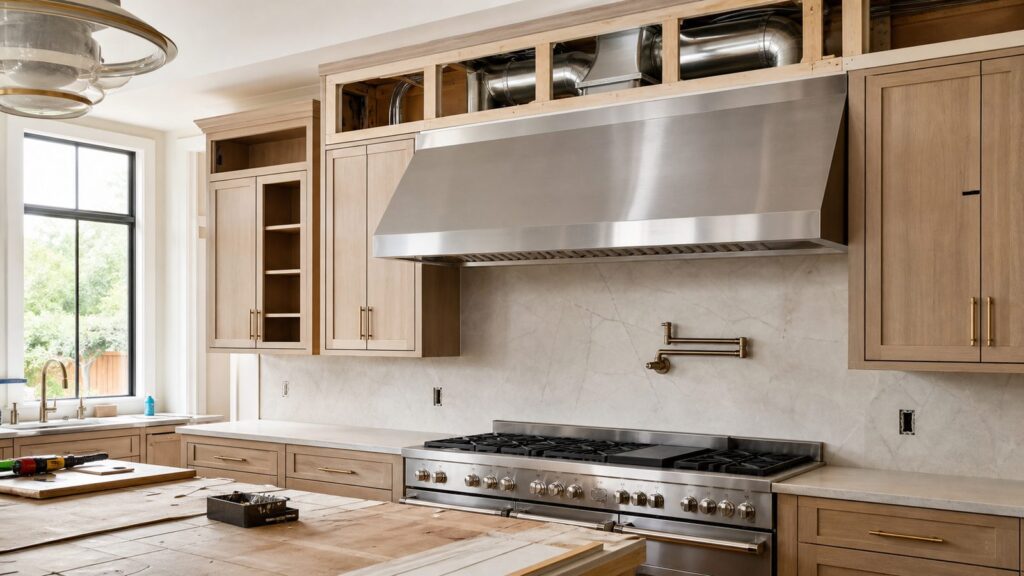
Wall-mounted hoods are often the best balance of performance and appearance. The wall behind the range helps contain the plume of heat, steam, and grease, so a wall hood can often capture better than an island hood at the same rated airflow.
A proper wall hood should be at least as wide as the cooking surface. For high-output gas ranges, we prefer extra overhang when the design allows it. A useful target is 3 inches beyond the cooktop on each side. That means a 36-inch range is often better served by a 42-inch hood if cabinet layout allows.
Island 900 CFM Hoods
Island hoods need more attention. They are exposed to cross-drafts from walking paths, HVAC registers, open windows, and ceiling fans. Because there is no wall to help trap the cooking plume, island hoods should usually be wider and deeper than a wall-mounted hood over the same cooking surface.
Island models often start around $550 to $900 for budget stainless units, with premium versions costing far more. Installation is usually more expensive because the duct often has to travel through ceiling framing or roof structure, and the hood needs secure overhead blocking.
Also popular on Amazon

- Modern Design: IKTCH Wall Mount Range Hood is made from stainless steel, which has an elegant appearance and comes with remote control. The novel gesture sensing function gives you a whole new experience
- Powerful Airflow: Maximum 900 CFM large airflow with good balance fans efficiently removes large amounts of smoke and cooking odors with ease from the air in your kitchen
- Ultra-Quiet Operation: Customize your kitchen stove vent with the 4-speed setting to play with the suction and noise level. The noise level is at 40 decibels on the lowest setting and only 65dB max noise level
- Bright Energy Saving Lamps: 2pcs 3W LED lights, adjustable brightness to meet your cooking need, can also save energy in your kitchen while emitting enough lights
- Superior Filtration: Includes 2 matching dishwasher safe and easy removable stainless steel permanent filters to trap cooking grease and oil
Range Hood Inserts and Custom Hoods
Inserts are used inside custom wood, plaster, or metal hood surrounds. They are common in higher-end kitchens because they let the designer control the look while the mechanical insert does the work. The installed cost can climb quickly. The insert, liner, blower, custom surround, ducting, and finish work may push the hood portion of the project into the $2,000 to $8,000-plus range, depending on materials and complexity.
Remote or Inline Blower Systems
For premium kitchens, remote or inline blowers can reduce perceived noise at the cooking area. Instead of placing the blower directly above the cooktop, the fan may be located in the attic, on the roof, or along the duct run. This can make high-capacity ventilation more livable, but it requires manufacturer-compatible parts, service access, proper wiring, and careful commissioning.
How to Size a 900 CFM Hood Correctly
Rules of thumb are starting points, not final design. Manufacturer instructions and local code always matter. Still, sizing rules help homeowners understand why 900 CFM might be justified.
For wall hoods, a common guideline is about 100 CFM per linear foot of cooktop width. A 36-inch range is 3 linear feet, which suggests about 300 CFM as a baseline for moderate cooking. Island hoods are often estimated at about 150 CFM per linear foot, which would suggest about 450 CFM for a 36-inch island cooktop before considering burner output or cooking style.
Gas cooking is often estimated at about 1 CFM per 100 BTU of total burner output. A gas range with 75,000 total BTU could point toward roughly 750 CFM. A professional-style 36-inch or 48-inch range with multiple high-output burners can quickly move into the 700 to 1,200 CFM conversation.
Capture area is just as important as airflow. A shallow hood that does not cover the front burners may allow smoke to roll past the hood even if the blower rating looks impressive. On our job sites, we check width, depth, mounting height, and the actual burner locations before ordering the hood. For high-output cooking, the hood should cover the cooking surface well, and extra width is valuable.
Duct Size, Duct Route, and Real Performance
A 900 CFM range hood should almost always be ducted to the exterior. Recirculating charcoal-filter hoods can reduce some odor, but they do not remove combustion gases, moisture, and heat from the home. For heavy cooking, ductless performance is not in the same class.
Duct size is one of the biggest make-or-break details. Industry guidance commonly places 900 CFM systems in the 8-inch duct class. Larger or engineered ducting may be needed for long runs, multiple elbows, island hoods, or remote blowers. Always follow the hood manufacturer’s minimum duct size. Reducing a 900 CFM hood into a smaller duct is one of the fastest ways to create noise and poor airflow.
Do these 3 things before closing this tab:
1Clear out junk files and repair common Windows errors2Scan for outdated or missing drivers - takes under a minute3Repair Windows errors before they cause bigger problemsThe best duct route is short, straight, smooth metal duct to an exterior wall. A direct wall termination is usually simpler and less expensive than a roof termination. Roof vents can work well, but they add flashing, waterproofing, roof access, and future leak risk if the work is careless.
We avoid unnecessary elbows and transitions. Each elbow adds resistance. A tight 90-degree turn directly above the hood is worse than a smoother route with more breathing room. We also avoid flexible duct for kitchen exhaust unless a manufacturer specifically allows a limited use, because grease accumulation and turbulence are real concerns.
Makeup Air: The Rule Many Buyers Miss
In many US jurisdictions using language based on the International Residential Code, domestic kitchen exhaust hoods over 400 CFM require makeup air. The common requirement is that makeup air must be provided at a rate approximately equal to the exhaust rate, and it must be equipped with a means of closure and controlled to operate automatically with the exhaust system.
That matters because 900 CFM is well above the 400 CFM threshold. If your local inspector enforces this requirement, the hood purchase can trigger additional mechanical work. This is not a small technicality. A powerful exhaust hood can depressurize a tight house, pull air down chimneys or water heater vents, and interfere with combustion appliances.
Also popular on Amazon

- 【Modern Design】: IKTCH Insert Range Hood is made from stainless steel, which has an elegant appearance and comes with remote control. The novel gesture sensing function gives you a whole new experience.
- 【Powerful Airflow】: Maximum 900 CFM large airflow with good balance fans efficiently removes large amounts of smoke and cooking odors with ease from the air in your kitchen.
- 【Ultra-Quiet Operation】: Customize your kitchen stove vent with the 4-speed setting to play with the suction and noise level. The noise level is at 40 decibels on the lowest setting and only 65dB max noise level.
- 【Bright Energy Saving Lamps】: 2pcs 3W LED lights, adjustable brightness to meet your cooking need, can also save energy in your kitchen while emitting enough lights.
- 【Superior Filtration】: Includes 3 matching dishwasher safe and easy removable stainless steel permanent filters to trap cooking grease and oil.
Makeup air can be simple or complex. A basic system may use a motorized damper that opens when the hood runs. In colder or hotter climates, or in tighter high-performance homes, the makeup air may need to be tempered or integrated with HVAC. That can add hundreds of dollars for a simpler setup or several thousand dollars for a conditioned system with controls, ducting, and mechanical-room work.
Before buying a 900 CFM hood, ask the contractor or mechanical designer how makeup air will be handled. The answer should include the hood CFM, local code approach, damper location, control method, outdoor air path, freeze or comfort concerns, and combustion safety testing if the home has atmospherically vented appliances.
Noise: How to Keep a 900 CFM Hood Livable
A high-CFM hood does not have to be obnoxious, but poor installation can make any hood loud. Noise comes from the blower, air velocity, duct turbulence, vibration, rattling dampers, and restrictions.
Look at sound ratings at the speeds you will actually use. Many homeowners do not run high speed for normal simmering. A good 900 CFM hood on low or medium can be more pleasant than an undersized hood forced to run at full speed every time cooking starts.
Free tools Windows power users keep installed
One-click scans. No signup required.
The practical approach is to start the hood early. Turn it on before smoke-heavy cooking begins, use the back burners when possible, and run the hood for 10 to 15 minutes after cooking. Waiting until smoke has spread through the room makes the hood work harder and makes the result worse.
For quiet operation, use proper duct size, keep the run short, avoid tight turns, use solid mounting, and consider a remote or inline blower where the budget supports it. During commissioning, we listen for duct rattle, damper chatter, vibration through cabinets, and excessive air noise at the termination.
Filters, Controls, Lighting, and Build Quality
For serious cooking, baffle filters are usually the better choice. They handle grease well, are durable, and are often dishwasher-safe. Mesh filters are common on budget hoods and can work for lighter cooking, but they may clog faster and require more frequent cleaning.
Controls should be simple enough that people actually use the hood. Multi-speed control is valuable. A delay-off timer is useful because ventilation should continue briefly after cooking. LED lighting should illuminate the front and back burners, not just create a glow at the rear wall.
The Tool Desk
Outbyte PC Repair FREERepair Windows errors before they cause bigger problemsFix Now →Outbyte Driver Updater FREEFix the driver behind crashes, sound loss and screen glitchesFind Drivers →Stainless steel thickness, weld quality, smooth interior surfaces, filter fit, damper quality, and service access all affect long-term satisfaction. On a construction site, we also care about whether the hood can be mounted securely, whether the chimney extension fits the ceiling height, and whether parts are available if something fails later.
Independent reader supportYour contribution helps us test, update, and keep practical guides available for everyone.2026 Cost Guide for 900 CFM Range Hoods
The hood itself may be the easiest number to understand, but it is rarely the whole budget. In 2026, budget stainless under-cabinet and wall-mounted 900 CFM models are commonly about $280 to $600 at major retailers. Island models often start around $550 to $900. Premium brands, custom inserts, decorative metal hoods, liners, and remote blowers can run $1,000 to $4,000-plus before installation.
National installation guides place typical range hood installation around $400 to $1,800, with a national average near $900. More complete ducted projects commonly land around $650 to $2,500 and average about $1,750. Basic vent hood installation benchmarks start around $564 to $1,030 per hood before unusual site conditions, premium finishes, electrical upgrades, or extensive ductwork.
For a realistic 900 CFM retrofit where new ducting and code-compliant makeup air are required, many homeowners should budget roughly $1,500 to $4,500 installed. Custom or luxury installations can exceed that.
What’s actually slowing this PC down?
Pick the symptom - the matching free tool is one click away.
Also popular on Amazon

- 【Modern Design】: IKTCH Insert Range Hood is made from stainless steel, which has an elegant appearance and comes with remote control. The novel gesture sensing function gives you a whole new experience.
- 【Powerful Airflow】: Maximum 900 CFM large airflow with good balance fans efficiently removes large amounts of smoke and cooking odors with ease from the air in your kitchen.
- 【Ultra-Quiet Operation】: Customize your kitchen stove vent with the 4-speed setting to play with the suction and noise level. The noise level is at 40 decibels on the lowest setting and only 65dB max noise level.
- 【Bright Energy Saving Lamps】: 2pcs 3W LED lights, adjustable brightness to meet your cooking need, can also save energy in your kitchen while emitting enough lights.
- 【Superior Filtration】: Includes 3 matching dishwasher safe and easy removable stainless steel permanent filters to trap cooking grease and oil.
| Project Type | Typical 2026 Cost Range | What Usually Drives the Price |
|---|---|---|
| Simple replacement with existing suitable duct | $300-$850 labor, plus hood | Fit, electrical connection, minor trim work |
| Budget 900 CFM wall or under-cabinet hood installed | $900-$2,000 total | Basic hood, short duct route, limited modifications |
| New ducted 900 CFM retrofit | $1,500-$4,500 total | 8-inch duct, exterior termination, cabinet or ceiling work, makeup air |
| Island 900 CFM hood installation | $2,000-$5,500 total | Ceiling framing, roof or long duct run, chimney extension, blocking |
| Custom hood insert with remote blower | $4,000-$8,000+ | Custom surround, liner, premium blower, finish carpentry, HVAC coordination |
The biggest cost driver is usually new ductwork. A direct exterior wall vent is typically the least expensive route. Running duct through upper cabinets, ceilings, roofs, masonry, or multiple floors increases labor, patching, waterproofing, and inspection requirements. Other cost drivers include hood width, island versus wall placement, duct size, elbows, roof versus wall termination, cabinet modifications, electrical circuit availability, ceiling height, blower location, structural blocking, tile work, and local labor rates.
When to DIY and When to Hire a Pro
A simple range hood replacement can be a reasonable DIY project if the new hood matches the old opening, the existing duct is correctly sized, the electrical connection is already present, and local rules allow homeowner work. Even then, confirm that the hood exhausts outdoors, not into an attic, soffit, wall cavity, or cabinet void.
For a 900 CFM hood, DIY gets limited quickly. Hire a pro when new ductwork is needed, when the hood is installed over an island, when roof penetration is required, when makeup air is required, when cabinets need modification, when electrical work is needed, or when combustion appliances are present in the home.
Permits vary by jurisdiction, but a 900 CFM hood can involve mechanical, electrical, roofing, and sometimes HVAC coordination. If makeup air is required locally, it should be part of the permit discussion before the hood is ordered. Retrofitting makeup air after cabinets and finishes are complete is more expensive and more frustrating than planning it early.
Free tools Windows power users keep installed
One-click scans. No signup required.
Questions to Ask Before Buying
Before ordering a 900 CFM range hood, ask these questions. What is the total BTU output of the range? Is the cooktop against a wall or on an island? What hood width and depth will actually cover the burners? What duct size does the manufacturer require? Can the duct run be short and straight? Where will the hood terminate outdoors? Will local code require makeup air? If yes, will that air be tempered? How loud is the hood at normal cooking speeds? Are the filters baffle or mesh? Is there service access for the blower and controls?
Those answers matter more than small differences in product listings. A cheaper hood can become expensive if it requires roof work, cabinet rebuilding, or a complicated makeup-air system. A premium hood can still perform poorly if connected to the wrong duct.
Our Practical Recommendation
For most serious home kitchens, the best 900 CFM range hood is a ducted wall-mounted or properly sized under-cabinet model with stainless baffle filters, multi-speed controls, LED task lighting, an 8-inch or manufacturer-approved duct path, and a makeup-air plan confirmed before installation. For island cooking, prioritize hood width, depth, and capture area as much as blower rating. For high-end kitchens where noise is a top concern, consider a remote or inline blower, but only with compatible parts and service access.
Do not buy a 900 CFM hood just because it sounds powerful. Buy it because the cooking equipment, layout, and duct path justify it. Then install it as a complete system. That is how a high-capacity hood actually improves the kitchen instead of becoming a loud stainless box over the range.
Frequently Asked Questions
Is 900 CFM too much for a home kitchen?
It can be. A 900 CFM hood is usually best for high-output gas ranges, 36- to 48-inch cooktops, island installations, and frequent high-heat cooking. For a standard 30-inch electric or induction range, 400 to 600 CFM is often enough.
Does a 900 CFM range hood require makeup air?
In many US jurisdictions, yes. Common IRC-based code language requires makeup air for domestic kitchen exhaust hoods over 400 CFM. A 900 CFM hood should be reviewed with your local inspector or contractor before purchase.
What duct size do I need for a 900 CFM range hood?
Many 900 CFM systems fall into the 8-inch duct class, but the hood manufacturer’s instructions control. Long runs, elbows, island hoods, and remote blowers may require larger or engineered ducting.
How much does it cost to install a 900 CFM range hood in 2026?
A realistic retrofit budget is often $1,500 to $4,500 installed when new ducting and makeup air are needed. Simple replacements may cost less, while island, custom, roof-vented, or luxury installations can exceed $5,000.
Is a ductless 900 CFM range hood effective?
Not for the kind of cooking that usually justifies 900 CFM. Recirculating hoods can reduce some odor, but they do not remove combustion gases, moisture, heat, and grease-laden air the way exterior ducting does.
Are island range hoods less effective than wall-mounted hoods?
At the same CFM, they often are. Island hoods deal with cross-drafts and lack a back wall to help contain the cooking plume, so they usually need more capture area and careful placement.
Quick Recap
Product prices and availability are accurate as of the date/time indicated and are subject to change. Any price and availability information displayed on Amazon at the time of purchase will apply.

