Do these 3 things before closing this tab:
1Repair Windows errors before they cause bigger problems2Scan for outdated or missing drivers - takes under a minute3Clear out junk files and repair common Windows errorsSome links on this page are affiliate links: if you buy through them we may earn a commission, at no extra cost to you.
Benchtop drill presses are compact machines for repeatable holes in wood, metal, plastic, and composites. For most furniture and cabinetmaking, a 10–12-inch-swing model with about 3 inches or more of spindle travel is a practical choice; larger holes, long stock, deep drilling, or demanding steel work may require a floor-standing press.
The headline swing number is only part of the decision. Chuck capacity, spindle taper, speed range, table slots, depth-stop quality, stability, work-holding, and replacement-parts support determine whether a press fits your construction or workshop tasks.
As an Amazon Associate I earn from qualifying purchases.
Outdated Drivers Are Slowing You Down
One free scan finds every outdated or missing driver and matches the right update for your exact hardware.Free scan · exact hardware matchWindows Errors? Fix Them Before They Spread
Repair common Windows errors and clear accumulated junk for a smoother, more stable PC - no reinstall needed.Free scan · no reinstallKey takeaways
- A 10–12-inch-swing benchtop drill press suits many furniture, cabinetmaking, repair, and general workshop tasks.
- Swing measures the width of stock that can be drilled to its center; vertical clearance measures the available height, so both dimensions matter.
- At least about 3 inches of spindle travel is a useful target for general woodworking, while depth stops improve repeatability.
- Large bits normally require slower speeds, and a press must be clamped or mounted securely rather than relying on hand pressure.
- A floor-standing drill press becomes more appropriate for unusually large holes, long workpieces, deeper drilling, demanding steel work, or more than roughly 14 inches of swing.
What is a benchtop drill press?
A benchtop drill press is a compact, vertically arranged machine that guides a rotating drill bit straight down through wood, metal, plastic, or composite material. The column, adjustable table, spindle, chuck, motor, and depth-control mechanism make repeated holes more consistent than freehand drilling.
A benchtop drill press is not simply a handheld drill bolted to a stand. The fixed column and controlled spindle movement provide more repeatable alignment, while the table supports fixtures, vises, and clamps. The machine still depends on correct setup: a flexible table, loose workpiece, incorrect speed, or unsuitable bit can produce poor results regardless of the press’s advertised motor power.
Popular on Amazon
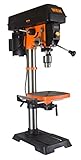
- Features a 6.2-amp induction motor, a 12-inch swing, and a 3-1/8-inch spindle travel
- Adjust the mechanical variable speed anywhere from 580 to 3100 RPM
- Digital speed readout displays current RPM of the machine for maximum precision
- Measures in at 16.8 by 13.5 by 36.6 inches in size with a weight of 85 pounds
- Includes a class IIIA 2.5mW laser, overhead light, adjustable depth stop, table roller extension, beveling 9-1/2 by 9-1/2-inch work table, 5/8-inch capacity keyed chuck, a chuck key with onboard storage, and a two-year warranty
What size benchtop drill press do you need?
For many woodworking and cabinetmaking jobs, a 10–12-inch-swing benchtop drill press is the practical starting point. According to WOOD Magazine’s buying guidance, a 10–12-inch-swing benchtop press handles 90 percent of the boring tasks required for furniture and cabinets. That figure is editorial guidance rather than a guarantee for every shop, so measure your largest workpieces before buying.
Choose the smallest press that provides enough swing, vertical clearance, spindle travel, and table support for the work you actually do. A compact 8-inch machine can be convenient for small parts, but a 12-inch model leaves more room around cabinet components, brackets, and furniture parts. A 15-inch benchtop machine is a larger-capacity option when a 10- or 12-inch press leaves insufficient radial room.
| Typical requirement | What to look for | Why it matters |
|---|---|---|
| Small repairs, crafts, and small parts | Compact swing, adequate table, stable mounting | Reduces footprint and is easier to relocate |
| Furniture and cabinetmaking | 10–12-inch swing and about 3 inches or more of spindle travel | Provides a useful balance of reach and drilling depth |
| Large panels, wide components, or frequent oversized holes | More swing and vertical clearance, potentially a floor-standing press | Keeps the workpiece from colliding with the column, table, or base |
| Long stock, deep mortises, or demanding steel work | More vertical capacity, rigidity, power, and low-speed capability | A benchtop press may run out of physical or practical capacity |
What is the difference between swing and vertical clearance?
Swing is the maximum distance from the spindle centerline to the column, multiplied by two. A 12-inch swing therefore provides approximately 6 inches from the bit centerline to the column, indicating the maximum width of stock that can theoretically be drilled at its center.
Vertical clearance is the space between the chuck and the table or base. Vertical clearance determines whether a tall workpiece, a long bit, or a fixture can physically fit beneath the chuck. A press can have sufficient swing for a wide board but insufficient clearance for a tall assembly. Compare both measurements, along with the table’s adjustment range, before choosing a model.
How much spindle travel and depth-stop control do you need?
Spindle travel is the maximum distance the chuck and bit move downward in one plunge. Roughly 3 inches or more is a flexible target for common woodworking, although the actual hole depth also depends on the bit geometry, chuck position, workpiece thickness, and available clearance.
A positive, locking depth stop matters when several holes must have the same depth or when a bit must stop before breaking through a cabinet part. A depth stop does not increase spindle travel; it controls and repeats the travel the machine already has.
What’s actually slowing this PC down?
Pick the symptom - the matching free tool is one click away.
Two manufacturer specifications illustrate the useful range. The WEN DP1263V specification lists 3-1/8 inches of spindle travel, while the Grizzly T31739 product specification lists 3-1/2 inches.
What chuck capacity and spindle taper should you check?
Chuck capacity describes the shank diameter the chuck can grip; it does not promise that the motor, belt system, or machine rigidity can efficiently drive the largest possible hole. A 5/8-inch chuck accepts larger-shank tooling than a 1/2-inch chuck, but bit type, material, speed, feed pressure, and machine capacity still control the result.
Also popular on Amazon
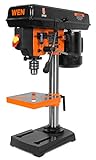
- Features a 2.3A induction motor, an 8-inch swing, and a 2-inch spindle travel
- Includes a 1/2-inch keyed chuck and onboard key storage
- Operates at 5 different speeds: 750, 1100, 1500, 2100, or 3200 RPM
- 6.5 by 6.5 inch height adjustable worktable bevels up to 45 degrees in each direction
- Measures in at 23 inches tall with a 7 by 11-inch base
Check both the supplied chuck and the spindle taper before buying replacement chucks, arbors, or accessories. The WEN DP1263V uses a 5/8-inch keyed chuck and an MT2 spindle taper. The Grizzly T31739 uses a 1/32–5/8-inch JT3 keyless chuck and an MT2 taper, according to the manufacturer’s product information. Replacement parts must also match the model number and physical dimensions.
What RPM should you use on a benchtop drill press?
Use a slower speed for larger bits and materials that generate substantial heat, and use higher speeds for smaller bits or operations that call for them. The correct RPM depends on the bit type, bit diameter, material, lubrication, and the guidance supplied with the bit and machine. The widest numerical range is not automatically the best drilling performance.
Variable speed makes adjustment convenient, particularly when changing between small woodworking bits, large Forstner bits, and metal-drilling operations. Belt-driven machines with stepped pulleys can still provide useful torque and may perform strongly under load when the belt arrangement transfers power effectively. WOOD Magazine’s comparative reporting found that three-pulley machines handled demanding hardwood tests better, while variable-speed models also performed well when their belt systems transferred power effectively.
| Model | Published speed range | Spindle travel | Chuck and taper |
|---|---|---|---|
| WEN DP1263V | 580–3100 RPM, mechanical variable speed | 3-1/8 inches | 5/8-inch keyed chuck; MT2 taper |
| Grizzly T31739 | 400–2700 RPM, variable speed | 3-1/2 inches | 1/32–5/8-inch JT3 keyless chuck; MT2 taper |
| JET JDP-15B / 716200 | 210–3500 RPM across 16 spindle speeds | 3-1/8 inches | 5/8-inch chuck; taper not stated in the supplied specification sheet |
Are benchtop drill presses good for metal?
A benchtop drill press can drill metal when the machine, bit, speed, feed, work-holding, and material are appropriate. The Grizzly T31739 specification lists a 5/8-inch mild-steel drilling capacity, but that manufacturer rating should not be interpreted as a promise for every metal, thickness, bit, or working condition.
Metal drilling generally benefits from low available speed, a sharp suitable bit, controlled feed, adequate rigidity, and appropriate cutting fluid where the bit and material call for it. Clamp the work securely; a metal workpiece can catch on the bit and spin violently. Do not infer metal performance solely from horsepower, amperage, chuck capacity, or the presence of a laser.
Which benchtop drill press features matter most?
The best benchtop drill press is the one whose physical envelope and controls match the work. Prioritize capacity and rigidity before convenience features.
The Tool Desk
Outbyte PC Repair FREERepair Windows errors before they cause bigger problemsFix Now →Outbyte Driver Updater FREEScan for outdated or missing drivers - takes under a minuteDriver Scan →- Swing: Match the stated swing to the width of the parts you need to drill, remembering that the rating describes centerline reach rather than overall table width.
- Vertical clearance: Measure the largest assembled or tall workpiece, not only flat stock.
- Spindle travel: Look for about 3 inches or more for flexible general-purpose woodworking.
- Depth stop: Choose a locking, repeatable stop for production-like work or controlled blind holes.
- Table: A cast-iron table with useful size, tilt, extension support, and slots for clamps or a vise is more valuable than a decorative feature.
- Stability: Assess operating weight, footprint, bench strength, and mounting-hole layout. Benchtop presses are top-heavy and should generally be anchored.
- Speed control: Ensure the lower end is suitable for your larger bits and intended metal work, rather than choosing by maximum RPM alone.
- Parts and documentation: Check the manual, chuck and taper details, replacement-part listings, warranty terms, and local availability before purchase.
- Laser and lighting: Treat these as setup aids. A laser can indicate the approximate drilling center, but it cannot replace a rigid table, accurate setup, correct speed, or secure work-holding.
How do representative models compare?
The following comparison uses published manufacturer and retailer specifications, not hands-on testing or a claim of measured accuracy.
| Model | Best fit | Capacity and motor | Table and controls | Ownership notes |
|---|---|---|---|---|
| WEN DP1263V 12-inch benchtop drill press | General-purpose users wanting variable speed and convenience features | 12-inch swing; 6.2-amp induction motor; 3-1/8-inch travel; 5/8-inch keyed chuck | 580–3100 RPM; beveling cast-iron table; roller extension; laser; LED light; adjustable depth stop | 85 pounds; dimensions 16.8 × 13.5 × 36.6 inches; WEN lists a two-year warranty, support, and stocked replacement parts |
| Grizzly T31739 | Users prioritizing low speed, table slots, and documented mild-steel capacity | 12-inch swing; 1/3 HP, 120-volt motor; 3-1/2-inch travel; listed 5/8-inch mild-steel capacity | 400–2700 RPM; 9-5/8 × 9-5/8-inch cast-iron table; 45-degree left/right tilt; four T-slots; extension; digital speed readout; laser; LED light | 88-pound listed weight; one-year limited warranty; manual, specification sheet, parts list, and parts page are provided |
| JET JDP-15B / 716200 | Readers who need a larger 15-inch benchtop swing | 15-inch swing; 3/4 HP motor; 3-1/8-inch travel; 5/8-inch chuck; 115 volts | 16 spindle speeds; 210–3500 RPM | Confirm current price, stock, warranty, table details, and parts support before purchase |
The WEN DP1263V 12-inch benchtop drill press is a sensible reference point for a feature-rich 12-inch format, while the Grizzly T31739 offers a particularly well-documented table and low-speed specification. Neither specification list alone establishes superior accuracy, torque under every load, or suitability for a specific job.
Also popular on Amazon
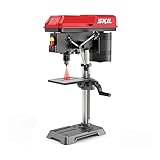
- POWERFUL 6.2 AMP INDUCTION MOTOR—Power through wood, metal, and other materials
- 5-SPEED SYSTEM—Take advantage of 5 speeds from 610 to 2800 RPM for different material types
- LASER ALIGNMENT SYSTEM—Precisely execute drilling maneuvers
- ADJUSTABLE DEPTH STOP—Ensures accurate and consistent depth during drilling
- ADJUSTABLE TABLE HEIGHT—Provides easy depth control
Is a benchtop drill press better than a floor model?
A benchtop drill press is better when a smaller footprint, easier relocation, and adequate capacity matter more than maximum reach and vertical clearance. A floor-standing press is better when the workpiece envelope, drilling depth, rigidity, or power exceeds what the benchtop machine can provide.
According to WOOD Magazine’s benchtop-versus-stationary guidance, reasons to move to a larger machine include more than 14 inches of swing, at least 3-1/2 inches of quill travel, more than 25 inches of vertical drilling capacity, holes larger than about 2 inches, and demanding hardwood or steel work. These are decision thresholds, not universal rules; the correct choice depends on the actual workpiece and tooling.
Recommended Free Tools
| Choose a benchtop press when… | Choose a floor-standing press when… |
|---|---|
| The shop has limited floor space | Large stock must fit around the column and table |
| The machine may need to be relocated | The machine can remain permanently installed |
| Furniture, cabinets, repairs, and maker projects dominate | Long workpieces, deep drilling, or large holes are routine |
| A sturdy bench can support and anchor the machine | Greater mass, reach, rigidity, or capacity justifies the footprint |
Do you need a vise or clamps for a benchtop drill press?
Yes, work-holding is essential whenever the material could catch on the bit, rotate, lift, or shift. Use a vise, hold-down clamp, jig, or other fixture suited to the table and material; never rely on your hand to restrain stock that can spin.
The Grizzly T31739 table has four T-slots intended for optional vises or hold-down clamps, illustrating why slot layout and table dimensions are buying criteria rather than minor details. Check the slot pattern and dimensions before assuming a particular vise or clamp will fit.
OSHA identifies the rotating chuck and swarf as hazards and recommends guarding the point of operation and securing material so it cannot spin. OSHA’s drill-press safety guidance should be read alongside the manual for the specific machine.
What accessories do you need?
Start with work-holding and suitable cutting tools rather than decorative upgrades. A practical setup commonly includes the following:
- A drill press vise, hold-down clamps, or purpose-built fixtures that match the table slots.
- Sharp bits appropriate to the material, such as HSS bits for suitable metal work and Forstner bits for flat-bottomed woodworking holes.
- A depth-stop setting or test piece for repeated holes and controlled breakthrough.
- A method for mounting the press securely to a strong bench or stand.
- Safety glasses or a face shield, with loose clothing, jewelry, and gloves kept away from rotating parts.
- A chuck key stored where it cannot remain in the chuck during startup, if the machine uses a keyed chuck.
Compatibility requires checking dimensions, slot patterns, tapers, and model numbers. A larger chuck, vise, table, or replacement part is not automatically compatible because it has the same nominal size.
Independent reader supportYour contribution helps us test, update, and keep practical guides available for everyone.How should you set up and operate a benchtop drill press safely?
Safe operation starts before the motor runs: anchor the press, choose the correct bit and speed, secure the workpiece, and remove tools from the machine.
Also popular on Amazon
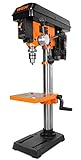
- Features a 6.2-amp induction motor, a 10-inch swing, and a 2-inch spindle travel
- Adjust the mechanical variable speed anywhere from 530 to 3100 RPM
- Digital speed readout displays current RPM of the machine for maximum precision
- Measures in at 13.2 by 19.3 by 33.9 inches in size with a weight of 57 pounds
- Includes a class IIIA 2.5mW laser, adjustable depth stop, beveling 8 by 7.5-inch work table, 1/2-inch capacity keyed chuck, a chuck key with onboard storage, and a two-year warranty
- Anchor the machine. Use a strong, stable bench and the machine’s mounting provisions. Oregon OSHA recommends anchoring a press to prevent walking, movement, or tipping; inspect the bench, footprint, and mounting-hole layout before installation.
- Disconnect power for adjustments. Unplug the press before changing belts, adjusting speed, servicing, or making setup changes. Oregon OSHA specifically recommends unplugging before changing belts or adjusting speed.
- Guard yourself from rotation and swarf. Wear ANSI-approved safety glasses and use a face shield when the machine manual calls for it. OSHA advises protecting the operator from the rotating chuck and material expelled by drilling.
- Secure the workpiece. Clamp stock with a vise, jig, or hold-down fixture so the material cannot rotate. Do not hand-hold material that can catch.
- Keep clothing and hands clear. Avoid gloves, jewelry, and loose clothing around rotating parts, and keep hands away from the point of operation.
- Set speed and depth before drilling. Select a speed appropriate to the bit and material, set the depth stop where required, and verify the setup with the machine switched off.
- Remove the chuck key and tools. Always remove a chuck key and other tools before starting the motor.
- Stop before reaching in. Do not adjust, measure, clear swarf, or leave the press unattended while the bit is rotating. Shut the machine off and wait for rotation to stop.
The Grizzly T31739 manual states, “Always wear ANSI-approved safety glasses and face shield when using this machine,” “Disconnect power before setting up or servicing,” and “Clamp workpiece to table to prevent rotation.” Those instructions apply to that model; every owner should follow the manual supplied with the particular press.
How accurate are benchtop drill presses?
Benchtop drill presses can make repeatable holes, but advertised swing, chuck size, laser alignment, and motor specifications do not establish a measured accuracy figure. Practical accuracy depends on spindle and chuck condition, table rigidity and squareness, bit quality, setup, work-holding, and operator feed.
A laser helps identify the intended drilling center, but a laser is only an alignment aid. Check the bit position with the machine stopped, use a test piece when placement matters, and prioritize a rigid table, secure mounting, and a repeatable depth stop.
What should you verify before buying?
- Measure the widest and tallest workpieces, then compare swing and vertical clearance rather than relying on the headline size.
- Confirm spindle travel and whether the depth stop locks and repeats reliably.
- Check chuck capacity, chuck type, spindle taper, and the availability of matching replacement parts.
- Compare the complete speed range, especially the lowest usable speed for large bits and intended metal work.
- Inspect table dimensions, tilt range, extension support, and T-slot pattern.
- Compare operating weight, footprint, bench strength, and mounting provisions.
- Verify warranty language, parts inventory, price, retailer availability, and geography immediately before purchase because those details can change.
- Do not treat horsepower, amperage, swing, or chuck capacity as interchangeable measures of drilling performance.
Frequently Asked Questions
What size benchtop drill press do I need?
A 10–12-inch-swing benchtop drill press is sufficient for many furniture, cabinetmaking, repair, and general woodworking tasks. Measure the largest workpiece and compare both swing and vertical clearance before buying.
Can a benchtop drill press drill steel?
Yes, a benchtop drill press can drill metal when the machine and bit are suitable and the operator uses the correct speed, feed, rigidity, and work-holding. The Grizzly T31739 manufacturer specification lists a 5/8-inch mild-steel drilling capacity, but that rating does not apply to every metal or thickness.
Do I need a vise for a drill press?
Use clamps, a vise, a jig, or another fixture to prevent the workpiece from catching and spinning. Hand-holding material is unsafe when the bit can grab it.
What is the difference between swing and vertical clearance?
Swing measures the maximum width of stock that can be drilled to its center, while vertical clearance measures the height available between the chuck and table or base. A press needs enough of both dimensions for the intended workpiece.
The Bottom Line
For most furniture, cabinet, repair, and general workshop work, a stable 10–12-inch benchtop drill press with about 3 inches or more of spindle travel, a locking depth stop, useful low-speed control, and a slotted tilting table is the right starting point. Choose a floor-standing machine when the work routinely exceeds the benchtop press’s swing, clearance, depth, rigidity, or metal-drilling capacity.
Quick Recap
Product prices and availability are accurate as of the date/time indicated and are subject to change. Any price and availability information displayed on Amazon at the time of purchase will apply.

