Quick wins for a faster PC:
Clear out junk files and repair common Windows errorsFree Scan →Scan for outdated or missing drivers - takes under a minuteDriver Scan →“Barrier board” is not a standardized product name. In sound-isolation work, the term usually points to a flexible mass-loaded vinyl (MLV) sheet: a dense, limp barrier installed in a wall, ceiling, enclosure, duct, plenum or other partition to resist airborne sound passing through. It is different from an absorptive acoustic panel, which controls reflections inside a room rather than adding a blocking layer to a partition.
MLV can help when it is selected for the right mass, tested in a relevant assembly and installed continuously. A product’s published STC or transmission-loss figure belongs to that named product and test configuration; it is not a guaranteed rating for an entire room or an arbitrary wall.
As an Amazon Associate I earn from qualifying purchases.
What “barrier board” means in sound isolation
Building suppliers and installers sometimes use barrier board as a convenient description for a sound-blocking sheet. The sources for this topic do not identify one universal board specification or one governing product standard under that name. The closest well-supported category is mass-loaded vinyl, commonly abbreviated MLV.
MLV is a flexible, dense sheet supplied in different weights per unit area, thicknesses and roll or sheet formats. Its job is to add a continuous, heavy layer that resists airborne sound transmission through a partition or enclosure. Because it is limp rather than a rigid board, it can often be fitted around framing, equipment housings and services where a conventional panel would be difficult to place.
#1 Best Overall

- High-Efficiency Sound sound barrier quiet wall with a proven 27 STC rating - 1/8 inch thick dense rubberlike material - 1 Pound per Square foot.
- Mass-loaded vinyl 1 lb soundproofing for walls, floors, and ceilings, and more
- Environmentally safe - Non-toxic and odorless, made of Virgin material, no regrind or recycled material
- Improve sound quality, creating a serene environment. many other places providing instant mass with sound barrier insulation to any location.
- Perfect for Apartments, Studios, Classrooms, Medical Facilities, Nightclubs, Cars, Appliances, Pipes, exterior fences, and outdoor sound barrier fences.
Barrier versus absorber
A barrier and an absorber solve different problems:
- Barrier: placed in or on a wall, ceiling, enclosure, duct or plenum to reduce sound passing from one side to the other.
- Absorber: placed on room surfaces to reduce reflections, reverberation and echo within the room.
An MLV layer will not, by itself, turn a reflective room into a quiet one. Conversely, adding absorptive panels to a wall does not substitute for a continuous sound-isolation barrier where the problem is sound travelling through the partition.
How MLV sound barriers work
The useful comparison is mass per area, not merely the word “thick.” Manufacturers publish MLV by values such as pounds per square foot or kilograms per square metre. Heavier products generally provide a more substantial blocking layer, but the result still depends on the complete assembly: framing, gypsum or other skins, cavities, connections, flanking paths and penetrations.
What’s actually slowing this PC down?
Pick the symptom - the matching free tool is one click away.
Thickness, dimensions and handling also matter. A heavier sheet can be harder to lift, cut and hold in place. A roll that is practical for a long wall may be awkward inside a small enclosure. Select a format that can be installed without leaving gaps or poorly supported seams; continuity is part of the acoustic performance.
Do not convert an STC number directly into a promised decibel reduction in a particular home. STC is a rating for a tested product or construction under a defined test method. A wall with an MLV layer can perform differently when its framing, surface layers, junctions or penetrations differ from the laboratory configuration.
Published performance figures—and how to read them
The following figures are product-specific claims published by the named suppliers. They are useful for comparing the options shown, but they are not interchangeable test results or a guarantee for a completed room.
| Product or data set | Published mass or construction | Published rating | How to interpret it |
|---|---|---|---|
| ArmaSound Barrier E (Armacell) | 2 mm; 5 kg/m² | STC 28 | Rating attached to this named product and its stated test configuration. |
| Noise S.T.O.P. barrier (Acoustical Surfaces) | 1/2 lb/ft² | STC 20 | Source-specific barrier data; not a universal value for every 1/2 lb/ft² sheet. |
| Noise S.T.O.P. barrier (Acoustical Surfaces) | 1 lb/ft² | STC 27 | Compare only with the test details supplied for this product line. |
| Noise S.T.O.P. barrier (Acoustical Surfaces) | 2 lb/ft² | STC 31 | Heavier option in that supplier’s published series. |
| Mass Loaded Vinyl (Johns Manville) | Varies by weight | Up to STC 31 | “Up to” depends on the selected weight and the stated test context. |
| TotalMass barrier | 1 lb/ft² | STC 27 standalone | Standalone figure published for that product; it does not rate an arbitrary wall assembly. |
When reviewing a technical sheet, look for the test standard, specimen construction, mounting method and whether the number is an STC rating or a transmission-loss result at particular frequencies. If those details are absent, treat the number as a product-selection reference rather than a design prediction.
Rank #2

- Experience the next level of sound control with our advanced formula, completely re-engineered for superior durability, tear resistance, and a professional finish. The Stronger, Smarter Sound Barrier.
- Blocks noise from entering or leaving your space with soundproofing technology featuring a proven STC rating of 27. Soundsulate Mass Loaded Vinyl (MLV) is highly effective at blocking airborne sounds such as voices, music, street noise, and engine noise. Ideal for use in walls, floors, ceilings, doors, home theaters, automobiles, boats, and RVs.
- One pound per square foot, 4 feet wide by 25 feet long, (100 sf) each roll weighs 100 lbs. Approximately 0.12" thick (commonly referred to as 1/8").
- Non toxic, safely use anywhere. Will not decompose or off-gas. Acts as an air and moisture barrier. Durable & Flexible. Easy to cut and customize to your project needs.
- We prioritize immediate order processing.
Where a sound barrier sheet can be used
Walls and ceilings
MLV is commonly specified as a layer in wall and ceiling assemblies. The sheet may be installed over framing, between layers or in another position defined by the assembly design. The exact location affects how it interfaces with gypsum board, insulation, resilient connections and edge seals, so follow the product and assembly instructions rather than copying a detail from a different system.
Enclosures and equipment housings
A flexible barrier can line or wrap an enclosure around noisy equipment where a rigid board would be difficult to fit. The enclosure still needs a continuous shell, sealed joints and service access that does not create a large open path.
Ducts and plenums
Suppliers identify ductwork and plenums as applications. Check temperature, moisture, fire and mechanical-service limits before using a sheet in these spaces. A material suitable for a dry wall cavity is not automatically suitable inside a duct or near hot equipment.
Floors
Floor guidance is product-specific. TotalMass describes a floating-floor approach, while Vinyl Noise Barrier states that its standard MLV is not recommended as flooring underlayment. These directions are not contradictory when treated as product instructions: one product may be designed for a particular floating assembly and another may not be approved for that use. Never assume that any MLV roll is an acceptable underlayment. Confirm the exact product, load condition, moisture exposure, finish flooring and complete floor assembly.
Do these 3 things before closing this tab:
1Fix the driver behind crashes, sound loss and screen glitches2Clear out junk files and repair common Windows errors3Scan for outdated or missing drivers - takes under a minuteHow to choose the right barrier
Use the following sequence before ordering material.
- Define the path. Identify whether sound is crossing a wall, ceiling, floor, enclosure, duct or plenum. Also inspect likely flanking routes such as doors, service chases and shared framing.
- Set the required mass per area. Compare the published lb/ft² or kg/m² values. Do not choose by thickness alone; two sheets of similar thickness can have different mass.
- Check the tested data. Record the product name, STC or transmission-loss value, test standard and specimen description. Keep the test context with the number in your project notes.
- Confirm dimensions and handling. Measure the run, height and access route. Decide whether rolls or sheets can be lifted, cut and supported safely without creating open seams.
- Verify service conditions. Review fire classification, temperature, moisture, chemical exposure and any restrictions for ducts, plenums or equipment rooms.
- Read the installation instructions. Confirm approved fasteners, adhesives, sealants, tapes, overlaps and edge details for that product.
- Coordinate the whole assembly. A barrier is only one layer. Detail the surrounding boards, framing, insulation, resilient connections and penetrations as a single system.
Installation: a continuity-first method
Product directions govern, but the installation principles below reflect the fastening and sealing guidance published for MLV barriers.
1. Prepare the substrate and layout
Make the receiving surface clean, dry and free of protrusions that could puncture the sheet. Mark studs, joists, service openings and panel joints. Plan seams so they can be supported and sealed rather than hidden behind an inaccessible obstruction.
Rank #3
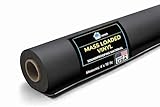
- High-Efficiency Sound sound barrier quiet wall with a proven 27 STC rating - 1/8 inch thick dense rubberlike material - 1 Pound per Square feet.
- Mass-loaded vinyl 1 lb sound proofing for wall, floors, and ceilings and more
- Environmentally safe - Non-toxic and odorless, made of Virgin material (no regrind or recycled material)
- Improve sound quality, creating a serene environment. many other places providing instant mass with sound barrier insulation to any location.
- Perfect for Apartments, Studios, Classrooms, Medical Facilities, Nightclubs, Cars, Appliances, Pipes, exterior fences, and outdoor sound barrier fences.
2. Cut and position the sheet
Cut with a suitable blade and allow enough material to reach the intended edges. Keep the barrier continuous across the field of the partition. Avoid trimming around every small irregularity if doing so creates a network of gaps; instead, detail the opening with a sealed, supported cut as the product instructions show.
Recommended Free Tools
3. Fasten without tearing
TotalMass describes installation with nails, screws or staples and recommends washers with nails or screws to distribute the load and help prevent tearing. Acoustical Solutions lists fasteners, adhesives and acoustical sealants among installation accessories. Use only the fastening method approved for the selected product and substrate.
4. Seal seams and perimeter edges
Bring adjoining sheets tightly together and seal the joint with the specified acoustical sealant or tape. Seal the perimeter to the surrounding construction. A small unsealed edge can become a direct air path that undermines an otherwise heavy layer.
5. Detail penetrations
Electrical boxes, ducts, plumbing and other openings require deliberate treatment. Cut-outs should fit closely, then be sealed with compatible acoustical sealant and tape where specified. Do not leave a barrier stopping short of a service opening or rely on the finish board to close a large void.
6. Protect the completed layer
Inspect for punctures, loose fasteners, open laps and damaged corners before covering the barrier. Repair defects with materials approved by the product instructions. Coordinate the next layer so later trades do not cut through the barrier without resealing it.
The Tool Desk
Outbyte Driver Updater FREEScan for outdated or missing drivers - takes under a minuteDriver Scan →Outbyte PC Repair FREEClear out junk files and repair common Windows errorsFree Scan →Common mistakes and practical fixes
Choosing by the label alone
Problem: “Barrier board” or “soundproof” appears on the package, but no mass, test configuration or application is checked.
Fix: Compare mass per area, thickness, available dimensions, test information, service conditions and intended assembly before selecting.
Rank #4

- [The Pros choose Tönnen] - Our exclusive blend attains a high STC rating (Sound Transmission Class), correlating higher absorption capacity with an elevated STC value. This translates to a very significant gain in sound absorption, yielding disproportionately greater STC returns per square foot. More soundproofing.
- [Premium Soundproofing Material] - Our specially formulated vinyl chemical blend is crafted to achieve optimal soundproofing (STC) across every square foot of wall space. [Premium Material] - Our specially formulated vinyl chemical blend is crafted to achieve optimal soundproofing (STC) across every square foot of wall space. Don't risk closing up your drywall only to discover it's not delivering the desired results. Choose our top-of-the-line MLV product for a confident and seamless installation, ensuring excellent soundproofing results.
- [Rolls with less than 100lb] - While other rolls often surpass the 100lb threshold, necessitating mechanical lifts, our rolls were designed to weigh 97lb, avoiding the need of a lifting device.
- [Frame Compatibility and Wide Application] - Precisely tailored to match standard US framing witdh dimensions, this mass loaded vinyl design establishes a robust sound barrier while maintaining a sleek 1/8-inch thickness. Suitable also for ceilings, floors, doors, HVAC, ducts and pipes, recording studios, home theaters, pool pumps and pet houses.
- [We stand by our product's quality] - Let us surprise you with a remarkable sound reduction.
Treating STC as a room guarantee
Problem: A published STC 27 or STC 31 is presented as the number of decibels a finished room will gain.
Fix: Keep the rating tied to its named product and laboratory configuration. Have the complete wall, ceiling or enclosure evaluated as an assembly when a performance target matters.
Leaving discontinuities
Problem: Sheets are installed with open seams, unsealed edges or large gaps around services.
Fix: Treat seams, perimeters and penetrations as part of the barrier detail. Use the specified tape, sealant and supported fastening pattern.
Using a wall product on a floor without checking
Problem: A standard roll is placed under flooring because it is heavy.
Fix: Verify that the exact product is approved for the floor type and follow the complete floating-floor or underlayment assembly. Supplier directions differ.
Outdated Drivers Are Slowing You Down
One free scan finds every outdated or missing driver and matches the right update for your exact hardware.Free scan · exact hardware matchPC Slower Than It Used to Be?
A free scan shows the junk files, broken settings and background clutter dragging Windows down - then fixes them in one click.Free scan · Windows 10 & 11Ignoring flanking paths
Problem: A wall receives MLV while sound continues through a door, ceiling junction, duct or shared service chase.
Best Value
- [The Pros choose Tönnen] - delivers 23% greater density compared to the 1lb/sf variant. Our exclusive blend attains an STC rating of 32 (Sound Transmission Class), correlating higher absorption capacity with an elevated STC value. This translates to more sound absorption, yielding disproportionately greater STC returns per square foot.
- [Premium Soundproofing Material] - Our specially formulated vinyl chemical blend is crafted to achieve optimal soundproofing (STC) across every square foot of wall space. Don't risk closing up your drywall only to discover it's not delivering the desired results. Choose our top-of-the-line MLV product for a confident and seamless installation, ensuring excellent soundproofing results.
- [Rolls with less than 100lb] - While other rolls often surpass the 100lb threshold, necessitating mechanical lifts, our rolls were designed to weigh 97lb, avoiding the need of a lifting device.
- [Frame Compatibility and Wide Application] - Precisely tailored to match standard US framing witdh dimensions, this mass loaded vinyl design establishes a robust sound barrier while maintaining a sleek 1/8-inch thickness. Suitable also for ceilings, floors, doors, HVAC, ducts and pipes, recording studios, home theaters, pool pumps and pet houses.
- [We stand by our product's quality] - Let us surprise you with a remarkable sound reduction.
Fix: Survey the entire separation and address the weakest connected path. A continuous barrier on one surface cannot close an unrelated bypass.
When a flexible MLV barrier is a sensible choice
MLV is most relevant when you need a dense, flexible layer that can be integrated into a wall, ceiling, enclosure, duct or plenum and you can maintain continuity around the construction. It is particularly useful when roll material is easier to handle than a rigid panel or when an assembly needs additional mass without a thick, inflexible board.
It is a poor choice when the proposed installation has no approved fastening or sealing detail, when the service environment exceeds the product limits, or when the real problem is room reverberation rather than transmission through a partition. In those cases, use the treatment designed for the actual problem: an absorptive room treatment for reflections, or a complete tested partition detail for isolation.
What the published evidence does—and does not—establish
The supplier figures above demonstrate that MLV products are offered in several weights and that published STC values differ by product and weight. They do not establish a typical room-level improvement, a universal decibel reduction or a single “best” barrier for every building. No independent population statistic for ordinary rooms is established by these product pages.
For a construction project, document the selected product, mass per area, dimensions, test information, application, approved accessories and sealing method. That record prevents a product-specific rating from being detached from the assembly in which it was intended to work.
Bottom line
For sound isolation, “barrier board” usually means a mass-loaded vinyl sound barrier rather than a standardized board product. Choose by mass per area and tested application, then install it as a continuous, sealed layer with the correct fasteners and accessories. Use the exact product instructions for floors, ducts, plenums and other special conditions, and judge the result by the complete assembly—not by an STC number copied from a product label.
Quick Recap
Product prices and availability are accurate as of the date/time indicated and are subject to change. Any price and availability information displayed on Amazon at the time of purchase will apply.

