Quick wins for a faster PC:
Fix the driver behind crashes, sound loss and screen glitchesFind Drivers →Repair Windows errors before they cause bigger problemsFix Now →Yes—an open-source laser-sintering printer exists, but it is best understood as a research platform rather than a finished desktop appliance. OpenSLS is a documented selective laser-sintering project that combines a modified 3D-printer-style motion system, a heated powder bed, a laser, open electronics concepts and published design files. It demonstrated sintering nylon and polycaprolactone, but the available evidence does not establish an actively supported retail product, standardized kit or guaranteed parts supply in 2026.
For construction researchers, product developers and advanced makers, OpenSLS can be a valuable foundation for experimenting with powder-bed fusion. For anyone who simply needs dependable parts, the practical alternatives are a commercial open-material SLS machine or an established service bureau.
As an Amazon Associate I earn from qualifying purchases.
What selective laser sintering does
Selective laser sintering (SLS) makes parts from polymer powder rather than filament or liquid resin. The basic sequence is:
- A thin layer of polymer powder is spread over a heated build area.
- A focused laser selectively fuses powder according to one sliced cross-section of the part.
- The build platform moves incrementally, and a recoater spreads a fresh layer.
- The laser scans the next cross-section.
- The cycle repeats until the part is complete.
Unfused powder surrounding the part provides support, so conventional support structures are generally unnecessary. That is useful for complex internal passages, interlocking components and geometries that would be difficult to print with filament. However, “no support structures” does not mean “no post-processing”: finished parts still need to be excavated, brushed, cleaned and often blasted or otherwise finished.
#1 Best Overall
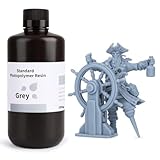
- 【Low Shrinkage and High Precision】ELEGOO photopolymer resin is specially designed for reducing volume shrinkage during the Photocuring process, which ensures the high precision of the print model with smooth finish.
- 【Fast Curing and Great Stability】ELEGOO 405nm Rapid Resin was designed to significantly reduce printing time with its excellent fluidity. Meanwhile its great stability and proper hardness ensure a unworried printing experience and successful printing.
- 【Bright and Stunning Colors】With high quality pigments and photo-initiators inside ELEGOO UV-Curing resin, the models printed with resin have a very pure and stunning color effect just like an artwork.
- 【Wide Applications】Given the outstanding performances, ELEGOO standard resin is suitable for most DLP/LCD 3D printers. Works best with the LCD 3D Printers.
- 【Safe and Secure Packaging】Leak-proof bottle fully wrapped with a plastic bubble bag and exquisite designed package box make sure the resin stays in place where they belong
SLS should not be used as a blanket term for every powder-bed process. Selective laser melting, often described as metal laser powder-bed fusion, uses substantially different laser power, atmospheres, thermal controls and safety systems. Multi Jet Fusion (MJF) uses inkjet-applied fusing agents and heat rather than a scanning laser. FFF or FDM extrudes filament, while SLA and DLP cure liquid photopolymer resin with light.
What is OpenSLS?
OpenSLS—open-source selective laser sintering—was developed as a research and education platform intended to make SLS experimentation more accessible to laboratories. Its design combined laser-cut and 3D-printed structural components with commercially available hardware.
The peer-reviewed project documentation describes a RepRap Arduino Mega Board/RAMBo controller and compatibility with the Marlin firmware architecture. It also published design files and a bill of materials, allowing researchers to inspect, reproduce or modify significant parts of the system. The platform was demonstrated with nylon and biocompatible polycaprolactone powder.
Those facts make OpenSLS a genuine open-source research project. They do not make it a current consumer product. The paper is evidence that the platform was built and used; it is not proof that every original component, firmware version, link or build instruction remains straightforward to reproduce in 2026.
Read the original research documentation in the OpenSLS paper published through PubMed Central.
What “open source” means here
Several different kinds of openness are often confused:
Rank #2

- 【Low Shrinkage and High Precision】ELEGOO photopolymer resin is specially designed for reducing volume shrinkage during the Photocuring process, which ensures the high precision of the print model with smooth finish.
- 【Low Volume Shrinkage】Low shrinkage and good stability reduce volume shrinkage during the curing process. Therefore, after cleaning and post-curing, the molded prints will not be noticeably deformed or cracked over a long period of time.
- 【Low Viscosity & Good Fluidity】With excellent fluidity, the resin can quickly reflow to the area between model and release film, which improves the printing success rate, and reduces printing time.
- 【Safe and Low Odor】ELEGOO standard photopolymer resin is specially formulated with less odor and a very pure and bright color. There is less pungent smell during printing, thus maintaining a freshening printing environment.
- 【Bright and Stunning Colors】With high quality pigments and photo-initiators inside ELEGOO UV-Curing resin, the models printed with resin have a very pure and stunning color effect just like an artwork.
| Type of openness | What it means |
|---|---|
| Open hardware | Mechanical designs, CAD, electronics or wiring are published for inspection and modification. |
| Open software | Firmware, control software or slicing tools can be inspected, changed or replaced. |
| Open materials | The machine can accept user-developed or third-party powders. |
| Open parameters | Users can alter temperatures, scan settings, laser behavior, layer height or recoater behavior. |
| Open documentation | Build instructions, calibration procedures, bills of materials and troubleshooting information are available. |
OpenSLS is relevant to the first and fifth categories because its research design and documentation were published. A commercial printer can be open in materials or parameters without being open-source hardware.
What’s actually slowing this PC down?
Pick the symptom - the matching free tool is one click away.
For example, Sinterit describes the Lisa X as an open SLS system with user-accessible parameters and support for third-party materials. Its hardware, software ecosystem, service arrangements and material profiles nevertheless remain part of a proprietary commercial product. “Open SLS” in that context does not mean that the machine can be freely rebuilt from community hardware files.
How an OpenSLS-style machine is arranged
A working system has more than a laser mounted above a printer bed. Its major subsystems are:
- Powder bed: a build platform or cylinder that holds and incrementally lowers the powder.
- Recoater: a mechanism that spreads a consistent layer of powder across the bed.
- Laser and optics: the source, focusing optics, mounts and beam-steering or motion arrangement.
- Heating system: heaters and sensors that keep the powder near the material’s processing window.
- Motion system: motors, stepper drivers, guides, end stops and a precise Z-axis.
- Controller: electronics and firmware coordinating motion, temperature and laser modulation.
- Enclosure: a rigid, light-tight and interlocked structure containing the beam, heat and powder.
The design challenge is the interaction between these systems. A recoater that moves accurately can still produce poor layers if the bed is uneven. A correctly focused laser can produce inconsistent parts if the powder temperature varies across the build area. A stable motion platform is not enough if powder contaminates its bearings or electronics.
What building one would require
Mechanical hardware
- Rigid frame and alignment hardware
- Powder-bed or build-cylinder assembly
- Build platform with controlled Z movement
- Recoater or powder-spreading mechanism
- Heated build area
- Enclosure and access panels
- Seals or barriers to limit powder leakage into mechanical components
Optical and laser hardware
- A laser appropriate for the selected material and process
- Focusing optics and optical mounts
- Beam-steering or controlled motion hardware
- Light-tight beam enclosure
- Door and cover interlocks
- Emergency shutdown circuit
- Equipment for measuring or calibrating laser output
Electronics and controls
- Motion controller and stepper drivers
- Stepper motors, wiring and power supplies
- Temperature sensors and heater controllers
- Fan or ventilation controls
- Laser modulation and control electronics
- End stops, safety switches and emergency-stop hardware
- Firmware and host-control software
Powder and post-processing equipment
- Powder with known particle-size distribution and thermal behavior
- Appropriate sieve
- Sealable storage containers
- Antistatic tools
- Powder-rated extraction or vacuum equipment
- Depowdering brushes and collection tools
- Personal protective equipment
- A documented method for tracking powder reuse and refresh ratios
The printer is only one part of an SLS installation. Sieving, storage, depowdering, cleaning, recovery and waste handling can determine whether the workflow is practical. Sinterit’s published solutions packages illustrate this broader equipment requirement by listing powder tools, sieves, post-processing equipment, blasting equipment and an ATEX vacuum alongside the printer.
Can you still build OpenSLS today?
Possibly, but reproducing the original research machine and building a dependable modern system are different projects.
Rank #3

- ①【Easy to Use】- SUNLU standard resin has strong fluidity and is compatible with different printers and printing speeds. The printed products are easy to form and are suitable for novices.
- ②【Low Shrinkage】- During the curing process, the standard resin has a low shrinkage rate, providing accurate size and shape of the printed parts.
- ③【Good Stability】- Standard resin has good tolerance to weak acids, greases, etc., and the printed works are not easy to deform, which is suitable for the manufacturing of most printing needs.
- ④【Easy to Post-process】- The surface of standard resin printed works is hard and smooth, and it is easy to color after printing. It is one of the best choices for hand-made printing.
- ⑤【High Cost-Effectiveness】- Standard resin provides good performance and durability at a relatively low cost, making it an affordable choice for those with a limited budget.
- Audit the published files and bill of materials. Check licensing, file completeness, dimensions, wiring diagrams and referenced software.
- Verify component availability. RAMBo boards, sensors, heaters, optics, motors and power supplies may have changed or become obsolete.
- Identify redesigns. Replace unavailable parts only after checking electrical ratings, mechanical interfaces, firmware support and safety implications.
- Build the enclosure and safety circuits first. Do not treat interlocks as an optional upgrade after initial laser testing.
- Validate the mechanics. Check bed flatness, recoater travel, Z-axis increments, backlash, alignment and powder containment.
- Characterize heating. Measure temperature uniformity across the bed rather than relying on one sensor or a displayed setpoint.
- Calibrate the optical system. Confirm focus, beam position, shielding and power behavior using appropriate professional procedures.
- Start with small coupons. Single-layer and small test parts reveal spreading, bonding, warping and shrinkage problems before a full build wastes powder and time.
- Record every process variable. Track powder history, moisture condition, refresh ratio, bed temperature, laser settings, scan speed, hatch spacing, layer height and chamber conditions.
The original publication establishes a valuable proof of concept. It does not guarantee that an old configuration can be assembled from a shopping list and operated safely without engineering work.
Materials and process development
Nylon or polyamide powder is the most obvious starting point for an OpenSLS-style polymer system. The research also demonstrated polycaprolactone, a biocompatible material used in research contexts. Neither example means that ordinary plastic powder can be substituted safely or successfully.
Useful powder characteristics include:
- Particle size and distribution
- Particle morphology and flowability
- Moisture content
- Absorption at the laser wavelength
- Melting range and sintering window
- Thermal stability during long dwell times
- Contamination and previous thermal history
Every material requires a suitable relationship between bed temperature, laser power, scan speed, hatch spacing and layer height. Too little energy can produce weak or porous parts. Too much can cause excessive fusion, dimensional errors, poor surface quality or degradation. Shrinkage and thermal gradients can produce curling, warping and inaccurate dimensions even when individual layers appear to fuse.
The Tool Desk
Outbyte PC Repair FREERepair Windows errors before they cause bigger problemsFix Now →Outbyte Driver Updater FREEScan for outdated or missing drivers - takes under a minuteDriver Scan →Powder reuse is also a process-control issue, not an automatic cost saving. Repeated heating can change powder behavior, while contamination and an incorrect refresh ratio can alter results. A lab should maintain a powder log and define storage, sieving, mixing and disposal procedures.
Sinterit makes a similar qualification for its commercial Lisa X: users can edit profiles or develop profiles for non-compatible and third-party materials, but profile development requires time, knowledge and resources. Open materials increase experimental freedom while removing the assurance that a validated profile already exists.
Safety is a design requirement
Laser safety
A DIY SLS machine should have an engineered, light-tight beam path; controlled access; correctly designed interlocks; an emergency stop; and procedures for service and alignment. Reflective tools, jewelry and internal surfaces can create unexpected beam paths. Eyewear selected for the correct wavelength may be appropriate for specific controlled tasks, but it is not a substitute for enclosure and interlock engineering.
Rank #4

- 【Both Strength and Toughness with High Promotion】 Compared to the excellent tensile and bending strength of the previous version of ABS-like resin + , Anycubic ABS-Like Resin Pro 2 has strengthened the performance of toughness, increases the elongation at break by more than 100%, and the finished model is much stronger, which can be used to print high-strength and high-toughness models such as structural parts, industrial prototype parts, and fixtures.
- 【Performance far Superior to ABS-Like Resin】 Anycubic ABS-Like Resin Pro 2 is developed with a high elongation at break which can even reach to 35~40%. Compared to ABS-like resin +, it has increased by 114%.
- 【High Fluidity, High Success Rate】 Low viscosity and high flowability shorten curing time and make models easier to form. Anycubic ABS-Like Resin Pro 2 enables fast reflow, reducing delamination in model print. At the same time, the backplane adhesion is better, effectively reducing the risk of printing failure.
- 【High Precision with Low Shrinkage】With an even lower shrinkage rate, the chance of distortion is decreased. Achieve top-notch precision and display sharp, vivid details in your prints.
- 【Low Odor for Pleasant Printing】 Our low-odor formula reduces discomfort for those sensitive to smells, creating a more pleasant printing environment.
Laser alignment should not be performed casually with an exposed beam. The required controls depend on the laser classification, wavelength, optical arrangement and workplace. A qualified laser-safety professional should review the design before operation.
Powder safety
Fine polymer powder should not be allowed to become airborne. Review the specific powder’s safety data sheet, control spills, manage static discharge, prevent cross-contamination and use extraction or vacuum equipment suitable for the material and dust hazard. Do not use compressed air as a routine cleanup method because it disperses powder.
Some combustible dusts can create fire or explosion hazards under the right conditions. Commercial SLS workflows therefore treat powder recovery, sieving, extraction and waste handling as dedicated systems. Sinterit lists an ATEX vacuum in its Performance Set and describes ATEX-certified equipment in its Lisa X materials.
Heat, electricity and institutional compliance
The build chamber and powder bed can remain hot after a print. Heaters, power supplies, wiring and moving mechanisms require guarding, grounding, over-temperature protection and emergency shutdown.
A DIY machine may lack CE marking, UL or equivalent electrical certification, validated laser-safety documentation, certified explosion-protection measures and manufacturer liability coverage. Requirements vary by country, state, institution and workplace. A university, school, workshop or commercial facility should involve its environmental-health-and-safety team before construction or operation.
Recommended Free Tools
Typical failure modes
| Area | Possible failure | Likely consequence |
|---|---|---|
| Mechanical | Recoater collision, uneven spreading, Z-axis backlash or bed misalignment | Scraped layers, missing material, dimensional errors or stalled builds |
| Thermal | Uneven heating, edge gradients, excessive heat or long dwell time | Warping, curling, weak bonding, inconsistent density or degraded powder |
| Optical | Misfocus, dirty optics, power drift or an unshielded reflection | Incomplete fusion, inconsistent strength or serious safety exposure |
| Material | Moisture, agglomeration, poor flow or unsuitable particle distribution | Rough layers, voids, poor packing and unpredictable fusion |
| Process | Incorrect energy input, refresh ratio or shrinkage compensation | Parts that are weak, fused into the powder cake or dimensionally inaccurate |
| Operational | Cross-contamination, missing records, unavailable spares or software incompatibility | Unrepeatable results and extended downtime |
OpenSLS versus a commercial open-material system
The Sinterit Lisa X is the clearest commercial comparison because its manufacturer explicitly advertises open parameters and third-party material support. It is still a proprietary commercial machine rather than community-built open-source hardware.
Best Value

- Higher Heat-Resistance: The 3D printed models with ABS-Like 3.0 Plus maintains its physical shape and mechanical properties at higher temperatures (up to 55 celsius grad), which effectively reduces the risk of material failure due to high temperatures.
- High Strength and Impact Resistance: Printed models are tough, bending without breaking easily and can withstand certain levels of tension and stress, featuring high hardness and toughness. Resin products can be tapped and drilled without cracking.
- High Precision and Low Shrinkage: Ensures high model forming accuracy with smooth surfaces and clear printing details and features low shrinkage rates.
- Good Fluidity: ELEGOO ABS-Like Resin 3.0 Plus Resin exhibits excellent fluidity, allowing it to flow back quickly to fill and cure the surface of printed models, which enhances the success rate of model printing by reducing the release force after resin curing.
- Fast Curing: Balances model performance and detail while improving printing speed. Shortens curing time, enhancing the efficiency of LCD 3D printers.
| Criterion | OpenSLS | Sinterit Lisa X |
|---|---|---|
| Form | Published research and open-source project | Commercial SLS printer |
| Hardware openness | Design files and BOM published for the documented project | Proprietary hardware |
| Parameter access | Research-oriented and modifiable | Open parameters and advanced control advertised by the vendor |
| Material approach | Experimental, requiring user development | Third-party materials supported according to vendor claims |
| Support | Research documentation and whatever community support remains available | Vendor support, software and service options |
| Safety certification | Must be engineered and verified by the builder | Vendor offers an ATEX-certified Performance Set |
| Price | No reliable current retail price established | $28,990 printer price observed in August 2026; regional pricing can change |
| Best fit | Research, teaching and hardware experimentation | Professional R&D and low-volume production |
Lisa X specifications listed by the vendor include a build size of up to 130 × 180 × 330 mm for rigid materials and 130 × 180 × 340 mm for flexible materials, with a maximum speed of up to 14 mm/h. These are vendor-listed specifications, not independent test results. See the Lisa X buying page and technical product page for current regional information.
Other commercial paths
For buyers who value an integrated workflow, Formlabs’ Fuse 1+ 30W is listed by Formlabs at a starting price of $29,499 or €28,399 on its comparison page. The company describes it as using a 30 W fiber laser, an 8.2-liter build volume, validated materials and a contained workflow. These are manufacturer-stated characteristics and prices, so they should be checked for the buyer’s region and bundle.
Sinterit positions its SUZY system as a more streamlined alternative with pre-calibrated materials and simpler operation. Its listed SUZY Starter Pack price was €19,990 in the supplied commercial information. This approach can suit users who prioritize repeatability over unusual-material experimentation.
Free tools Windows power users keep installed
One-click scans. No signup required.
Formlabs announced the larger Fuse X1 in June 2026. A secondary report gave a starting price of $84,999 and a 330 × 330 × 565 mm build volume. Treat launch-stage pricing and performance information as announcement or vendor-claimed information until independently tested. The reported announcement provides the available market reference.
Build, buy or use a service bureau?
Build an OpenSLS-style machine when:
- Your primary goal is research, education or process experimentation.
- Your team has mechanical, optical, electronics, thermal and metrology expertise.
- You have a suitable controlled workspace and institutional safety oversight.
- Changing hardware and developing material parameters is part of the project.
- Unsuccessful builds and documentation modernization are acceptable outcomes.
Buy commercially when:
- You need training, support, documented workflows and a supply chain.
- Downtime and calibration risk cost more than the purchase price.
- You need third-party materials but still want integrated hardware and software.
- Several operators must use the system consistently.
- Your budget covers powder tools, extraction, post-processing and service—not just the printer.
Use a service bureau when:
- You need SLS parts only occasionally.
- You do not have a safe powder-handling area.
- Your print volume does not justify ownership.
- You need production validation, certification or industrial material expertise.
- Your organization cannot support calibration, maintenance and waste handling.
Checklist before spending money on a rebuild
- Locate the current design files, repository or archive and confirm the license.
- Check whether the BOM identifies exact ratings, dimensions and substitutes.
- Confirm that firmware, host software and controller hardware still communicate.
- Map the complete laser beam path and specify interlocks before buying the laser.
- Measure the proposed bed’s heating uniformity, not only its maximum temperature.
- Plan powder storage, sieving, extraction, recovery, cleaning and disposal.
- Define a calibration and coupon-testing plan for each powder.
- Budget for optics, sensors, enclosure materials, safety controls, spares and failed experiments.
- Obtain environmental-health-and-safety approval where required.
- Decide in advance what level of repeatability, documentation and certification the finished parts must have.
Verdict
OpenSLS remains a meaningful answer to the question “Can an open-source laser-sintering printer be built?” It shows that a research-grade polymer SLS concept can be assembled from an open design, common motion-control ideas and custom structural parts. It is especially relevant to universities, laboratories and advanced engineering teams that want to learn how powder-bed fusion works rather than operate a sealed appliance.
It is not, on the evidence available, a current plug-and-play product. The difficult work is not just mounting a laser: it is achieving reliable powder spreading, uniform thermal control, optical alignment, process calibration, powder management and engineered safety. For dependable parts, compare the total cost and compliance burden of a commercial system—or outsource the work—rather than comparing the price of a historical bill of materials with the sticker price of a complete modern installation.
Quick Recap
Product prices and availability are accurate as of the date/time indicated and are subject to change. Any price and availability information displayed on Amazon at the time of purchase will apply.
Do these 3 things before closing this tab:
1Fix the driver behind crashes, sound loss and screen glitches2Clear out junk files and repair common Windows errors3Scan for outdated or missing drivers - takes under a minute
