Some links on this page are affiliate links: if you buy through them we may earn a commission, at no extra cost to you.
Playgrounds changed from supervised exercise grounds into places where children could build, invent, and reinterpret their surroundings. The shift unfolded in stages: Friedrich Fröbel’s educational play and sand, Boston’s reform-era sand gardens, highly programmed municipal model playgrounds, wartime scarcity, postwar adventure play, Aldo van Eyck’s abstract neighborhood spaces, and the configurable “novel playgrounds” of the 1950s. This first part follows that history through 1954, when designers began treating the playground itself as an open-ended environment rather than a collection of standard apparatus.
How did playgrounds change over time?
There was no single march from an old-fashioned design to a universally superior modern one. Each form answered a different concern: early reformers wanted healthy outdoor activity and civic order; educators valued contact with materials and constructive learning; municipal planners sought safe, supervised recreation; postwar designers gave children more freedom to build and imagine. The result was a continuing argument about who directs play, what a public playground is for, and how much a design should prescribe.
As an Amazon Associate I earn from qualifying purchases.
| Period and approach | Who directs play | Typical materials or forms | Relationship to the city |
|---|---|---|---|
| Fröbelian and early sand play, mid-19th century to 1880s | Adults create conditions for children to experiment | Sand, water, natural materials and educational objects | Nature-oriented settings and public sand areas |
| Model playground movement, 1880s–1910s | Trained instructors organize activities | Steel pipe, ladders, chains, swings, slides, seesaws, sandboxes and athletic fields | Planned municipal facilities with shelters, toilets, shade and sometimes pools or gardens |
| Depression and wartime playgrounds, 1930s–1940s | Municipal programs remain important, but resources are constrained | Existing equipment, Works Progress Administration construction and improvised repairs | Public works projects followed by wartime material shortages |
| Adventure playgrounds, mid-1940s onward | Play leaders assist while children build and explore | Loose, reclaimed and construction materials | Derelict or bomb-damaged sites adapted as child-led spaces |
| Van Eyck’s Amsterdam playgrounds, 1940s–1950s | Children interpret simple forms for themselves | Concrete sandpits, stepping stones, hoops, domes and other abstract elements | Small neighborhood squares, parks and vacant urban sites woven into daily life |
| Novel playgrounds, beginning in 1954 | Configurable structures invite imaginative use | Virginia Dortch Dorazio’s movable concrete-panel “Fantastic Village” concept | A designed environment becomes an imaginative setting rather than a fixed route through equipment |
Educational roots: Fröbel, nature and the idea that play teaches
German educator Friedrich Fröbel treated play as a means by which children learned about themselves and the world. His kindergarten system used specially designed “gifts” and occupations that encouraged children to construct, combine and test forms. The Friedrich Fröbel Museum describes these materials as invitations to experimentation rather than toys with only one correct use.
Fröbel’s influence also helped establish the value of natural materials. Sand and water could be shaped, poured, mixed and rebuilt, allowing children to see consequences directly. This educational idea should not be confused with the later invention of a standardized sandbox: the principle of learning through material play came first.
#1 Best Overall
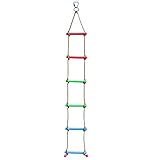
- [Dad-Certified Durability & Join-In Fun] Forget flimsy plastic that cracks. Our climbing rope ladder is built with industrial-grade polypropylene rated for 220 lbs—strong enough for Dad to climb up and check safety himself! Whether it's for a treehouse entry or a ninja course, it offers rock-solid support so you can relax while your little monkeys play wild.
- [The Ultimate Energy Burner] Struggling to get kids off tablets? This ladder is your secret weapon for a Screen-Free Zone. It transforms sedentary time into active, sweat-dripping fun. Within minutes of climbing, swinging, and balancing, your kids burn off that excess energy, building upper body strength and coordination without even realizing it—guaranteeing a sound sleep for them (and you) at night.
- [Instant Adventure: From Backyard to Campsite] - No tools, no drilling, no headaches. Featuring heavy-duty stainless steel hooks, this ladder attaches in seconds to a slackline, swing set, or strong tree branch. Its compact, roll-up design fits easily into a backpack, making it the perfect travel companion to turn a boring camping trip or park visit into an instant adventure park.
- [Infinite Playground] - Don't limit the fun to just climbing up. Hang it horizontally to create a challenging "bridge" or monkey bars; use it as a cool access ramp for a bunk bed; or add it to your indoor sensory gym. It integrates seamlessly with Ninja Warrior courses, swing sets, and treehouses, growing with your child's imagination and evolving play needs.
- [Master the Wobble, Build the Confidence] - Unlike rigid stairs, our dynamic rope design adds a layer of healthy challenge. The natural swing requires kids to engage their core muscles and focus on balance with every step. It’s not just a toy; it’s a confidence builder that helps them master body control, turning a shaky start into a triumphant climb to the top.
Piles of sand appeared in Berlin public parks during the 1850s, according to the American Society of Landscape Architects (ASLA). Fröbel later published sandbox plans in 1889. Those milestones show a gradual transition from informal or educational use of sand to a deliberately designed play feature. A sandbox was not simply a smaller version of a sand pile; it was an attempt to give constructive play a defined, maintainable place in a public landscape.
Boston’s sand gardens: the first American public experiments
In the United States, the sand-garden movement began in Boston in the mid-1880s. Accounts differ on the exact first date. The ASLA and the National Trust for Historic Preservation identify Boston’s first sand garden as 1886 and associate it with physician Marie Zakrzewska. The Social Welfare History Project at VCU Libraries describes an 1885 sandpile experiment led by the Massachusetts Emergency and Hygiene Association and calls it the first American playground to combine recreation with leadership. The safest conclusion is that Boston’s pioneering work occurred across 1885–1886, not that one uncontested date marks an entirely new institution.
Recommended Free Tools
These sand gardens addressed practical urban problems. Industrial neighborhoods offered children few clean outdoor places, while reformers worried about street dangers and unsupervised conditions. Sand gave children a low-cost material for digging, building and social play. Adult leaders supplied a measure of care and order without turning every activity into formal physical training.
The Boston experiments also established a pattern that would recur: playgrounds were both children’s spaces and instruments of public policy. Their supporters described play as essential to health, social development and moral wellbeing, while cities saw supervised recreation as a way to improve neighborhood life.
From sand gardens to organized model playgrounds
The 1906 national association
The Playground Association of America formed in 1906. Its founding principles, quoted by playground designer Naomi Heller from National Recreation Association records, stated: “That inasmuch as play under proper conditions is essential to the health and the physical, social, and moral wellbeing of the child, playgrounds are a necessity for all children as much as schools.” The wording captures the movement’s central claim: play was not a private luxury but a civic service comparable to education.
What a model playground contained
Early model playgrounds were planned and supervised rather than free-form. A site might divide areas by gender, provide athletic fields and organized games, and include shelters, toilets or bathing facilities, shade, gardens and pools. Standard apparatus included swings, seesaws, sandboxes, slides and merry-go-rounds. Galvanized steel pipe, ladders and chains made equipment durable and visually legible to supervisors.
Rank #2

- 【Material】Playground safety net is made of Polyester fiber, which is soft to the touch but very strong and durable.Reinforced playground net with 2-layer construction and thickened border ropes ensures maximum safety for climbing, sitting, and walking (Supports 660+ lbs)
- 【Size Specification】Climbing cargo net , rope thickness is 4mm. Each grid measures 4cm x 4cm. Upgraded Thicken Fine processing.grid uniform distribute weight evenly, featuring stretchable yet firm structure for comfortable play
- 【Double Layer Upgraded Thicken Net】Kids safety net adopts a double-layer design and is upgraded and thickened. Thicker rope is used around the rope net to reinforce the edges. There are extra ropes at the four corners for easy bundling and fixing
- 【Customizable Size & Color】Available in 6 standard sizes (3.2x9.8ft to 14.7x14.7ft) with black and rainbow popular colors, fully customizable dimensions and color combinations available
- 【Wide Application】This versatile kids climbing net is perfect for Perfect for tree houses, swing sets, obstacle courses, sports training nets, loft protection, and outdoor/indoor playground installations
The design prioritized visibility and scheduling. Instructors could direct age groups toward separate activities, monitor large numbers of children and use the grounds for physical training. The playground therefore functioned as a small civic institution, not merely an empty lot with equipment. The VCU history of organized recreation describes a national campaign that helped move recreation into municipal government. By 1917, the ASLA reports, the model playground concept could be seen across the United States.
Why supervision mattered
Supervision reflected contemporary ideas about childhood. Reformers believed children needed safe outdoor activity but also guidance toward cooperation, discipline and healthy bodies. Adults selected the equipment, established rules and often determined which games took place. This approach expanded access to outdoor recreation, yet it left children comparatively little authority over the physical environment.
Depression construction and wartime interruption
The Great Depression altered playground building without ending the municipal commitment to it. ASLA’s history notes that Works Progress Administration workers constructed playgrounds as part of public employment and infrastructure programs. These projects could provide grading, paths, shelters and equipment while putting unemployed workers on payroll. Playground construction thus served two public purposes at once: recreation and relief.
World War II created the opposite pressure. Metal equipment was diverted to scrap, and manufacture of playground apparatus largely halted. Existing sites could become poorly maintained as materials, labor and municipal attention went to the war effort. The period demonstrated that playground design depends not only on educational ideals but also on supply chains and public budgets. A steel swing set required industrial capacity that wartime priorities could remove.
Free tools Windows power users keep installed
One-click scans. No signup required.
Adventure playgrounds: rebuilding play after the war
Bombsites become places for construction
In Europe, children played on bomb-damaged sites with bricks, timber and other loose materials. Observers began to see this activity not simply as dangerous trespass but as evidence that children wanted to build, alter and explore their surroundings. The National Association for the Education of Young Children (NAEYC) connects this experience to the emergence of adventure playgrounds.
British landscape advocate Marjory Allen petitioned in the mid-1940s for a London adventure playground. Similar sites spread in Britain, offering materials that could be moved, assembled and taken apart. Instead of presenting a finished piece of equipment with one obvious action, the site supplied the ingredients for many projects.
Rank #3

- Unlock More Play Options: Our geometric climbing dome includes a swing and a detachable cushion. The cushion can be used as a ground pad or a hammock. Children can climb, swing, jump, and rest freely, experiencing a variety of fun activities. With the ideal size of 10FT for 4-5 kids aged 3-10, it's designed for large families, creating a family playground. In addition to home use, it is also suitable for kindergartens, playgrounds, and other outdoor areas.
- Foster Growth: Through climbing games, kids not only exercise but also gain a sense of achievement and pride. Interacting and cooperating with other children helps develop social skills, teamwork, and communication. You can also play together with your children, creating wonderful memories.
- Durable & Wear-resistant: Our jungle gym is made of thickened steel, with hot-dip galvanizing and coating treatment for enhanced durability. It effectively resists UV, rust, and corrosion, making it perfect for outdoor use even in harsh weather conditions. The hammock is made of PP mesh fabric, providing superior breathability and durability, while also resisting rainwater and UV rays.
- High Safety Standards: We prioritize children's safety with a new climbing handle design to ensure comfort and prevent cuts during climbing. Our dome climber is ASTM and CPC certified, meeting high safety standards for your peace of mind.
- Easy Setup: Everything you need is included, from installation tools to detailed manuals and video guides. Our clear instructions will effortlessly guide you through assembly, allowing you to quickly create a fun playground for your children with our kids climbing dome.
A different role for adults
Adventure playgrounds did not eliminate adults. NAEYC describes play leaders as assisting children’s construction rather than directing every step. Adults could help with tools, mediate conflicts and manage serious hazards while leaving the design decisions to children. This distinction changed the question from “Which activity should the instructor assign?” to “What can children make happen here?”
The model carried trade-offs. Loose materials and changing structures demanded active management and could look untidy compared with a formal municipal playground. Yet that unpredictability was the point: children exercised judgment, negotiated shared projects and experienced the consequences of changing a real environment.
Do these 3 things before closing this tab:
1Clear out junk files and repair common Windows errors2Fix the driver behind crashes, sound loss and screen glitches3Repair Windows errors before they cause bigger problemsAldo van Eyck and Amsterdam’s neighborhood playgrounds
Dutch architect Aldo van Eyck translated the spirit of open-ended play into a dense urban setting. Beginning in the years after the war, he placed playgrounds in neighborhood squares, parks and derelict sites throughout Amsterdam. His projects used a small vocabulary of simple forms—sandpits, stepping stones, hoops, domes and other concrete elements—arranged so that no single prescribed route or game dominated.
Van Eyck’s achievement was as much urban as it was formal. A vacant or neglected site could become a social meeting place close to home. Children and parents encountered one another at the edge of ordinary streets rather than traveling to a distant recreation complex. The playground became an extension of neighborhood life.
Art historian and former Stedelijk Museum director Rudi Fuchs, quoted by ASLA, explained the effect of the objects: “The playgrounds were fantastic because the objects were simple…objects that are not anything in themselves, but which have an open function and therefore stimulate a child’s imagination. A child sits still on a slide or a swing: it is the object that produces the movement. Van Eyck’s objects do not move, but they allow a child to move with all the acrobatism and suppleness he can muster. That was the genius of their simplicity.”
Van Eyck himself described the social purpose in words quoted by NAEYC through Solomon: “With the aid of a little concrete, wood, and aluminum, there have come into existence social centers: places where children and parents meet, true extensions of the doorstep—for it is on the doorstep that the outside and inside worlds, the spheres of collective life and of individual life, intersect.” The doorstep metaphor explains why these playgrounds mattered beyond recreation: they connected domestic life, public space and neighborhood relationships.
What’s actually slowing this PC down?
Pick the symptom - the matching free tool is one click away.
Rank #4

- CLIMBING WALL: Rock climb the 6.5 ft tall four-sided rock wall, fits up to 4 kids to capture the flag
- PLAY & GROW: Climber play strengthens muscles, improves fine motor skills, increases physical and mental strength, encourages imaginative play & discovery
- NATURAL DESIGN: Rock wall blends with the backyard, easy grab junior grips for small hands, jungle gym with over 100 sqft of climbing area, maximum weight: of 300 lbs.
- LOOKOUT: Top platform, 2 climbing cargo nets, 1-floor net, 9 hand grips, a plastic flag, 2 anchors, assembled dimensions: 80" H x 80" W x 52" D
- DURABLE: Built to last, durable double-walled plastic, easy to clean, colors won't chip, fade, crack, or peel
The 1954 “novel playground” and Fantastic Village
In 1954, the Museum of Modern Art sponsored a playground design competition. ASLA identifies Virginia Dortch Dorazio’s configurable concrete-panel design, “Fantastic Village,” as the winning entry and a beginning of the novel-playground approach. Instead of treating a playground as a fixed inventory of swings and slides, the design proposed an environment that could be rearranged and interpreted.
Configurable panels offered enclosure, passage, hiding places and imaginative settings without dictating one storyline. Children could treat the same element as a wall, room, stage or obstacle. This was a formal answer to the question adventure playgrounds had raised with loose materials: how can a designed site remain open to invention?
The novel playground did not erase earlier traditions. It retained the value of physical challenge associated with outdoor gymnasia and model playground equipment, while adding abstraction and flexibility. NAEYC cautions that modern fixed apparatus also drew from outdoor gymnasia and physical-training devices; it did not follow inevitably from Fröbel’s garden-oriented ideas. The history is therefore a convergence of several lines—education, exercise, urban planning, art and child-led exploration—not a direct progression from one inventor.
What these approaches reveal about children and public space
Comparing the periods makes the changing assumptions clear:
- Adult-directed recreation: Model playgrounds treated trained instructors and schedules as safeguards for health, order and equal access.
- Material learning: Fröbelian sand and later constructive activities treated children as experimenters who learn by handling real substances.
- Child-led construction: Adventure playgrounds gave children agency over projects, with adults supporting rather than dictating outcomes.
- Interpretive design: Van Eyck and Dorazio used simple or configurable forms so children could supply the meaning and movement themselves.
- Urban integration: The playground moved from a dedicated civic facility toward a neighborhood square, vacant site or doorstep-like social center.
NAEYC identifies an enduring tension between free-form exploration and the familiarity, safety and predictability of fixed structures. That tension remains visible in playgrounds today. A standardized apparatus can be easier to inspect and understand, while an ambiguous space can offer richer opportunities for negotiation and invention. Neither objective cancels the other; the design question is which balance suits the children, site and public responsibilities involved.
Where Part 1 ends—and what comes next
By the mid-1950s, playground design had acquired several competing identities: supervised athletic facility, educational landscape, construction site, neighborhood meeting place and abstract imaginative environment. The 1954 competition made that plurality visible in a major design institution. Later decades would add new debates about accessibility, liability, developmental research and equipment safety. The Consumer Product Safety Commission was formed in 1972, and National Endowment for the Humanities coverage describes federal safety guidance that drew attention to issues such as equipment height and spacing. Those later standards belong to the next chapter; they should not be projected backward onto the earlier playgrounds discussed here.
For a book-length history, ASLA lists Joe L. Frost’s A History of Children’s Play and Play Environments: Toward a Contemporary Child-Saving Movement in its bibliography. The book’s subject is directly relevant to the development of playgrounds, although current retail availability is not established here.
Quick Recap
Product prices and availability are accurate as of the date/time indicated and are subject to change. Any price and availability information displayed on Amazon at the time of purchase will apply.

