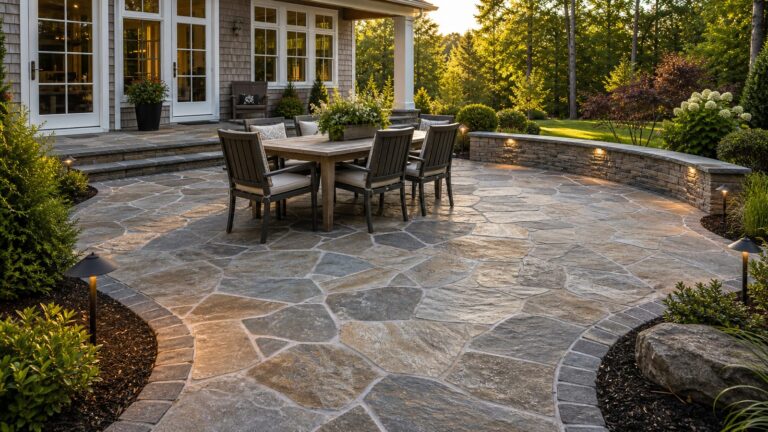
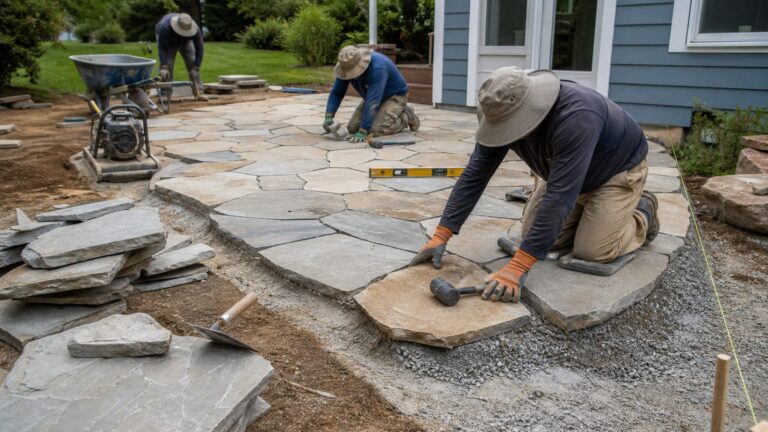
Good flagstone patio ideas start with how you want to use the space, then fit the stone pattern, joints, and outline to the house and site. Cut stones in repeating or random-rectangle patterns can look orderly; irregular pieces create a more relaxed, natural effect. The 21 ideas below are adaptable design directions, not construction specifications: stone availability, drainage, soil, climate, budget, and local requirements all affect what will work.
21 flagstone patio ideas
1. Irregular garden-room patio
Lay naturally shaped flagstones in a loose arrangement and nest the patio into the garden with planting around its perimeter. The uneven outlines make the paving feel like part of the landscape rather than a separate outdoor room.
2. Random-rectangle dining terrace
Use cut rectangular stones in a staggered, non-grid pattern. The geometry brings order without the rigid look of a uniform grid, making it a useful middle ground for a dining area. A more uniform surface can also make furniture easier to move.
3. Tight-joint, clean-lined courtyard
Pair cut stone with restrained joints for a simple, architectural look. Choose edges and geometry that relate to the house, and have a qualified installer confirm the appropriate joint and installation system; a tight-looking design is not itself a construction specification.
Free tools Windows power users keep installed
One-click scans. No signup required.
#1 Best Overall

- 【Natural Stone】Made from natural stone, each stepping stones preserves its unique texture and natural, irregular edges, adding distinctive beauty to your garden, pathway, or lawn. Each walkway pavers outdoor measures approximately 12''×16'' (typically within ±1.5in for size)
- 【Durable & Sturdy】With a hard natural stone structure, these stepping stones withstand long-term foot traffic and outdoor use. They resist wear and shifting, ensuring lasting stability
- 【Easy Installation & Versatile Use】Requiring no complex setup or special tools, these stones can be placed directly on walkways, lawns, or sandy areas. Effortlessly arrange and combine them to create garden paths, lawn stepping routes, or decorative accents for flower beds, tree surrounds, or natural patio features
- 【All-Season Use & Effortless Care】Designed for all-season use, these stepping stones withstand various weather conditions with no need for seasonal maintenance or storage. A quick rinse or sweep is all it takes to keep them looking great, providing you with a long-lasting and reliable pavers for outside walkway
- 【Fun And Functional】You can customize these stepping stones by painting or using markers (not included) to create vibrant, colorful pathways or transform them into meaningful memorial stones
4. Crazy-paving mosaic
Make irregular stone outlines the focal point by fitting pieces together like a puzzle. This expressive pattern suits a garden-led setting, but consider furniture feet: rough edges and uneven gaps can make tables and chairs sit awkwardly or catch.
5. Creeping-thyme joints
Plant selected joints with low-growing creeping thyme to soften the stone. Suitability depends on local sunlight, water, climate, and foot traffic, so check the plant’s needs before using it across a patio.
6. Groundcover quilt
Instead of filling every joint the same way, repeat pockets of low-growing plants between stones as a deliberate pattern. Landscaping Network lists thyme, baby tears, dichondra, mint, sedum, and moss as popular options; choose among them based on local growing conditions and the upkeep you want.
7. Decomposed-granite negative space
Set larger flagstones within a field of decomposed granite for a loose, natural composition. A UC Master Gardener example uses this treatment on a flagstone path; it is a design reference for a patio, not a prescribed construction detail.
8. Metal-edged stone-and-granite composition
Use a crisp metal border between flagstone and decomposed granite to define the edge of an otherwise informal layout. The combination appears in a UC Master Gardener hardscape example and offers a way to contrast loose materials with a clean boundary.
Rank #2

- 【INSTANT GARDEN PATHWAY】Create a beautiful, natural stone walkway in seconds without the hard work. These pre-assembled mats require no digging, mixing cement, or heavy lifting. Simply lay them down on grass, mulch, gravel, or soil to instantly define a path and keep your shoes clean and mud-free.
- 【100% NATURAL RIVER ROCKS】Crafted from genuine, hand-selected river pebbles that have been polished to a smooth finish. Each mat features a unique assortment of earth-toned stones that blend seamlessly with your landscape, adding an elegant, organic aesthetic to any outdoor space compared to plastic or rubber alternatives.
- 【FLEXIBLE & DURABLE MESH BACKING】The stones are securely attached to a high-quality PVC mesh base that is invisible once placed. This flexible design allows the mats to contour to uneven ground for stable footing, while the permeable net allows water to drain freely and grass to grow through, integrating naturally into your lawn over time.
- 【VERSATILE OUTDOOR DECOR】Perfect for a wide range of landscaping projects. Use them to create a wandering path to your patio, as a decorative border around flower beds, near water spigots to prevent mud puddles, or even as a non-slip floor mat for outdoor showers and pool areas.
- 【PRODUCT SPECIFICATIONS】The set includes 6 rectangular stepping stone mats. Each mat measures approximately16"L x 5.5"W, providing ample coverage for a standard garden stride. They are weather-resistant, sturdy, and easy to rearrange or store during winter if desired.
9. Formal geometry against a natural garden
Set straight lines and cut-stone edges against soft planting beds. The contrast makes the patio read as a deliberate architectural feature while allowing the surrounding garden to remain informal.
10. Curving, informal patio edge
Let the patio outline follow a garden bed or the shape of the yard rather than forcing a rectangle into the space. Curving lines and irregular edges reinforce a natural style and can help the patio connect visually to existing planting.
11. Symmetrical outdoor room
Center a dining or seating arrangement and use repeated lines or paired planting areas to create a balanced composition. Symmetry and geometric forms suit a formal look; relate them to the home so the patio feels intentional rather than imposed.
Do these 3 things before closing this tab:
1Clear out junk files and repair common Windows errors2Scan for outdated or missing drivers - takes under a minute3Repair Windows errors before they cause bigger problems12. Shaded retreat
Place a smaller patio in an existing shady part of the yard for reading or quiet seating. First observe the site’s sun and shade, then match the intended use to that setting.
13. Outdoor dining zone
Plan the paved area around the table and the space needed to pull chairs back and move around them. A more uniform surface can be easier for chairs to slide across than irregular paving with gravel-filled or planted gaps.
Rank #3

- Vintage Charm: Natural gray finish features subtle color variation that replicates the look of weathered stone, adding visual texture to gardens, pathways, and outdoor spaces
- Natural Stone Appearance: Irregular shape and textured surface recreate the look of natural stone for decorative pathways, patios, and garden walkways
- Flexible Pathway Layout: Use each piece as individual stepping stones or arrange multiple pavers together to create a continuous decorative garden path
- Paver Details: Each paver measures 15.7” x 16.9” x 1.2” and can be placed in a repeatable pattern to expand across larger areas while maintaining a natural flagstone look
- Durable Material: Fiberclay is durable and lightweight with weather and UV-resistance that help the pavers withstand outdoor conditions
14. Fire-feature gathering circle
Arrange the patio as a social zone around a fire feature, using the stone layout to define the gathering area. Check fire clearances, local rules, and the appliance maker’s requirements separately; the layout idea does not establish safe installation distances.
15. Cooking and serving terrace
Connect the patio to an indoor room or outdoor cooking area so the route between preparation, serving, and seating makes sense. Relating a new landscape feature to rooms in the house and the rest of the yard can make the layout feel more cohesive.
16. Play-adjacent patio
Locate a seating area near children’s play space, but consider how the surface will be used. Where people run, a smoother, easier-to-maintain surface may be preferable; no stone surface is universally suitable for every user or condition.
17. Garden-path-to-patio transition
Carry the visual language of a flagstone path into a wider destination patio, then signal the change with a shift in stone size or surrounding material. This creates a visual transition from circulation to a place to sit or gather.
18. Material echo of the house
Compare stone samples with the home’s existing finishes before choosing a color and texture. Repeating an architectural material or detail in the landscape can make the patio feel connected to the house.
Rank #4

- RUBBER STEPPING STONES: Elevate your outdoor space with these lightweight simulated flagstone rubber pavers that offer the timeless beauty of real stone without the heavy lifting.
- DURABLE: Made from recycled rubber, these stepping stones outdoor are heavy enough to stay put in place and durable to withstand all weather condition.
- ANTI-SLIP SURFACE: These pathway stones are carefully designed with a non-slip surface, ensuring safety and stability as you walk across them even during wet or rainy conditions.
- NATURAL LOOKING: Perfect for creating enchanting walkways or paths in gardens and backyards while its grey color blends in with surrounding foliage for a natural-looking pathway.
- EASY TO USE: The paving stones can simply be placed wherever you choose so are fantastically easy to install with instant results and make a fantastic low maintenance paver.
19. Mixed-material border
Use flagstone as the main field and another paving or loose material around the perimeter to frame it. Coordinate textures and colors; the cost and durability of the combination depend on the specific materials and installation.
Recommended Free Tools
20. Permeability-conscious patio
Consider an open, planted, or otherwise permeable design only after assessing soil, slope, available space, and existing waterlogging. Those site conditions affect whether water can infiltrate or needs a designed route to a rain garden, soakaway, or drain. Flagstone joints alone do not ensure that a patio will drain adequately. UK government guidance on these factors is specific to front gardens in the UK and does not establish rules elsewhere.
21. Smoother, lower-maintenance-use patio
Favor a more regular layout and surface if easier movement, furniture use, or simpler upkeep matters to the household. “Lower maintenance” is not “maintenance-free”: plan drainage and construction details with a professional when site conditions are complex.
Independent reader supportYour contribution helps us test, update, and keep practical guides available for everyone.How to choose a design for your yard
Start with the people and activities the patio needs to serve, then test the visual idea against the site. UC Master Gardener guidance recommends considering intended use, connections to the house, existing landscape, shade, budget, maintenance, and style when planning hardscape.
- Visual character: repeating geometry and cut rectangles read as more formal; irregular shapes and curving lines feel more organic.
- Joints and everyday use: compare tight, uniform joints with wider planted or filled gaps. Consider furniture feet, traffic, and the upkeep of any joint treatment.
- Activity: plan differently for dining, entertaining, quiet seating, play, cooking, or circulation.
- Surface usability: consider smoothness and levelness for furniture and for people who need easier movement. No flagstone should be described as universally slip-proof or accessible.
- Site response: account for slope, soil drainage, shade, waterlogging, and how the patio meets the house and garden.
- Construction and upkeep: dry-laid and mortar-set approaches have different tradeoffs in installation, repair, and maintenance. The right system depends on the site and installer’s details; these design ideas do not prescribe one.
- Material coordination: sample stone in place beside the house and existing landscape before committing to a color and texture.
Are planted or filled joints right for a patio?
They can be, if their appearance and upkeep suit the use. Planted joints soften irregular stone, while gravel or decomposed granite can preserve a looser look. A more uniform joint treatment may work better where furniture needs to slide easily. Joint width, stone edges, traffic, growing conditions, and the installation system all matter, so treat the joint as a design choice to confirm with the installer—not as a guarantee of drainage or easy maintenance.
What’s actually slowing this PC down?
Pick the symptom - the matching free tool is one click away.
Is dry-laid or mortar-set flagstone better?
There is no one answer for every patio. The choice depends on the site, intended use, materials, and installation details. For a main dining and entertaining area, Roger Haywood of Accent Landscapes in Colorado Springs recommends mortar-setting flagstone directly to a concrete base to create a smoother surface for furniture and traffic. That is one professional’s recommendation, not a universal rule. Discuss the appropriate base and setting method with a qualified local installer.
What will a flagstone patio cost?
Get current quotes from local stone suppliers and contractors rather than relying on an old general estimate. Installed cost varies with location, stone type and color, quantity, site preparation, drainage, layout, and installation method. A material price alone is not the price of a completed patio.
Quick Recap
What to settle before choosing a layout
- Define the use. Decide whether dining, entertaining, quiet seating, cooking, play, or circulation is the priority.
- Observe the site. Note sun and shade, slope, soil and drainage behavior, waterlogging, and connections to the house and garden.
- Choose a visual direction. Compare geometric or random-rectangle layouts with irregular, curving designs.
- Test materials in place. View stone samples beside the home and existing landscape in the actual setting.
- Confirm practical details. Work with a qualified installer on joints, surface usability, drainage, base, and installation method; check local rules separately for features such as fire installations.
Product prices and availability are accurate as of the date/time indicated and are subject to change. Any price and availability information displayed on Amazon at the time of purchase will apply.