The Tool Desk
Outbyte Driver Updater FREEFix the driver behind crashes, sound loss and screen glitchesFind Drivers →Outbyte PC Repair FREERepair Windows errors before they cause bigger problemsFix Now →For a shaded yard with deer traffic, the goal is not to find a miracle plant. No plant is truly deer-proof. The goal is to specify plants deer usually pass over, place them where they have the right light and moisture, and protect the installation long enough for roots to establish.
On our job sites, the shade gardens that succeed have three things in common: the plant list matches the actual shade condition, the soil is loosened and amended before planting, and the first growing season includes mulch, deep watering, and temporary protection where deer pressure is high. A flat list of pretty plants will not do that work for you.
The 17 plants below are good candidates for brightening shaded beds because they bring white flowers, pale blooms, silver foliage, chartreuse leaves, evergreen structure, or dense groundcover. Use your local extension deer list and the current USDA Plant Hardiness Zone Map before buying, because deer behavior and winter survival vary by region.
Start With the Site, Not the Plant Tag
Shade is not one condition. A north-facing foundation bed with morning reflected light is different from dry shade under mature maples, and both are different from a damp woodland edge. Before you spend money, walk the bed at 9 a.m., noon, and 3 p.m. on a clear day.
#1 Best Overall

- Size: Deer netting size 7 feet x 100 feet; garden netting mesh size 3/4"; color: black; Easy to use accessories included: 10pcs installation nails & 50pcs cable ties
- Strong & Reusable: Tough deer fence barrier netting is made from high quality polypropylene(PP), lightweight yet heavy duty, It won’t tear easily, rust or rot like metal or wood, doesn't tangle and reusable for longer protection; Can also used as bird netting, chicken netting, rabbit fence, pond & pool netting
- Safe & Economical: The 3/4 inch square mesh design of our deer fencing provides maximum protection for your garden plants, fruits, Arborvitae trees, berries and shrubs without harming birds and small animals or interfering with plant growth
- Easy to Install: Easy to use roll of anti bird deer protection netting, simply attach to stakes or posts(not included); Or you can cut it to any size you need with scissors to put it up around your vegetable garden or individual shrubs
- Enjoy Your Fruits: Don’t let birds, deer, dogs or other animals ruin your harvest and feast on your produce before you get a chance to; Ideal garden protective netting for tomatoes, strawberries, blueberries, fig, cherry etc. Keep your crop peck-free this summer
Use these working definitions:
- Part shade: about 3 to 6 hours of direct sun, often morning sun or filtered afternoon light.
- Full shade: less than 3 hours of direct sun, but still bright enough to read comfortably.
- Dry shade: shaded soil under tree roots, roof overhangs, or large shrubs where rainfall does not penetrate well.
- Moist woodland shade: shaded soil that stays evenly damp but drains after rain.
Deer pressure also changes the design. Plants near a front walk, patio, or busy driveway are often browsed less than plants along a woodland edge. We put the highest-confidence deer-resistant shrubs and groundcovers along browse paths, then use more vulnerable flowering perennials closer to the house or inside a fenced garden room.
For most shade beds, specify 2 to 3 inches of shredded hardwood mulch after planting, keeping mulch 2 to 3 inches away from stems and crowns. Water deeply the first season: usually 1 inch per week from rain or irrigation, and more during hot dry spells. Avoid heavy nitrogen fertilizer. It pushes tender growth that deer notice and shade plants often do not need.
The Best Deer-Resistant Shade Plants by Landscape Role
The list is grouped by job in the landscape. A good shade bed needs structure, seasonal flowers, foliage contrast, and a ground layer. If you plant only spring bloomers, the bed can look empty by July. If you plant only evergreen shrubs, it may hold shape but feel dark.
1. Hellebore
Best use: early-season flowers near entries, patios, and shaded walks.
Recommended Free Tools
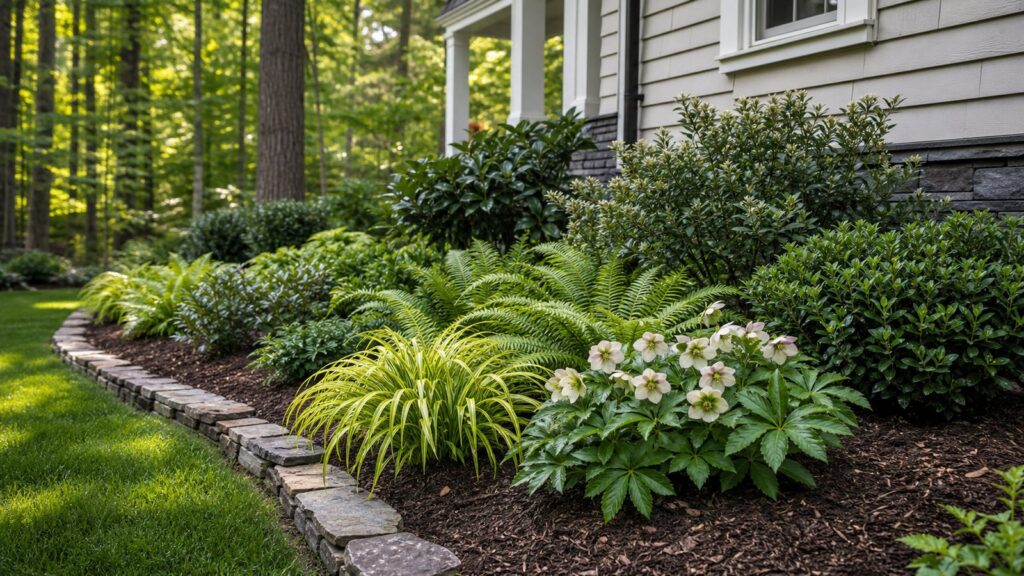
Hellebores are one of the strongest shade choices when you need flowers before most perennials wake up. They typically bloom from late winter into spring, with white, cream, pink, plum, green, or speckled flowers held above leathery evergreen or semi-evergreen foliage.
Specs: part shade to full shade; average to well-drained soil; USDA Zones 4 to 9 depending on variety; commonly 12 to 24 inches tall and wide. Deer-resistance confidence is high because of the tough foliage and plant chemistry.
Safety note: hellebores are toxic if eaten. Use care around children, pets, and livestock, and wear gloves if you have sensitive skin.
2. Barrenwort
Best use: dry shade under trees where many perennials fail.
Barrenwort, also sold as Epimedium, earns its space because it tolerates shade, becomes drought tolerant after establishment, and usually avoids heavy deer damage. The spring flowers are small but elegant, and many varieties have bronze, red, or chartreuse spring foliage that matures to green.
Specs: part shade to full shade; average to dry soil once established; USDA Zones 4 to 8 for many selections; 8 to 18 inches tall, spreading slowly by rhizomes. Deer-resistance confidence is high.
3. Lungwort
Best use: bright silver foliage in front-of-border shade.
Lungwort, or Pulmonaria, is useful because its spotted or silvered leaves reflect light in shade. Blue, pink, or purple spring flowers are a bonus, but the foliage is the reason to plant it.
PC Slower Than It Used to Be?
A free scan shows the junk files, broken settings and background clutter dragging Windows down - then fixes them in one click.Free scan · Windows 10 & 11Outdated Drivers Are Slowing You Down
One free scan finds every outdated or missing driver and matches the right update for your exact hardware.Free scan · exact hardware matchSpecs: part shade to full shade; moist, well-drained soil; USDA Zones 3 to 8; 8 to 12 inches tall and 12 to 24 inches wide. Deer-resistance confidence is medium to high. It performs best where summer soil does not bake dry.
4. Astilbe
Best use: pale summer plumes in moist shade.
Astilbe is not the toughest dry-shade plant, but in the right site it gives shade beds a clear lift. White, blush, pink, red, or lavender plumes rise above ferny foliage in late spring to summer. For brightening a dark corner, white and pale pink varieties show up better than deep red.
Specs: part shade to filtered shade; consistently moist soil; USDA Zones 3 to 8; 12 to 36 inches tall depending on variety. Deer-resistance confidence is medium. Water is the deciding factor.
5. Japanese Painted Fern
Best use: silver foliage contrast beside stone, brick, and dark evergreens.
Rank #2

- COMPLETE PROTECTION KIT - Professional-grade 7ft x 100ft deer netting with 3/4" fine mesh that effectively blocks deer, rabbits, birds, and small pests. Includes 10 metal landscape staples and 50 zip ties for immediate installation - everything you need in one package.
- HEAVY-DUTY UV-PROTECTED MATERIAL - Made from premium polyethylene with enhanced UV protection that withstands harsh weather without tearing or degrading. Designed for multi-season use while allowing sunlight, water, and air to reach your plants naturally.
- PROVEN GARDEN PROTECTION - 3/4-inch precision mesh provides reliable barrier against deer, birds, squirrels, and rabbits without harming animals. Protects fruits, vegetables, shrubs, and young trees while maintaining healthy plant growth.
- QUICK & EASY INSTALLATION - Cut to any size needed and secure with included stakes and zip ties. Perfect for covering individual plants, raised beds, or entire garden rows. Lightweight design makes setup simple for one person.
- FEED GARDEN QUALITY GUARANTEE - Trusted by thousands of gardeners nationwide. If you're not completely satisfied with the protection and durability of your deer netting, contact us for a prompt solution. Your garden's success is our priority.
Japanese painted fern brings silver, green, burgundy, and pewter tones without relying on flowers. It works well in shaded foundation beds and woodland edges where the soil stays reasonably moist.
Specs: part shade to full shade; moist, well-drained soil; USDA Zones 4 to 8; 12 to 18 inches tall and wide. Deer-resistance confidence is high. Most ferns are lower on the deer menu than Hostas and daylilies.
6. Christmas Fern
Best use: native evergreen texture for shaded slopes and woodland beds.
Christmas fern is a dependable Eastern native fern with dark green fronds that can remain visible through winter in many climates. It is not flashy, but it gives the bed structure when flowering perennials are dormant.
Free tools Windows power users keep installed
One-click scans. No signup required.
Specs: part shade to full shade; average to moist well-drained soil; USDA Zones 3 to 9; 18 to 24 inches tall and wide. Deer-resistance confidence is high. It is a good choice where native planting value matters.
7. Japanese Forest Grass
Best use: chartreuse movement along paths and shaded steps.
Japanese forest grass, especially gold or chartreuse cultivars, is one of the best ways to make shade look lighter. Its arching blades soften hardscape edges and help a bed read as designed rather than leftover space.
Specs: part shade; moist, well-drained soil; USDA Zones 5 to 9; 12 to 18 inches tall and 18 to 24 inches wide. Deer-resistance confidence is medium. Use it away from the heaviest browse path if deer pressure is severe.
8. Coral Bells
Best use: foliage color in small pockets of part shade.
Coral bells, or Heuchera, are grown mostly for foliage. Silver, lime, caramel, rose, and green varieties can brighten small shade beds, especially near entries and containers. Native species and hybrids vary in heat and humidity tolerance, so buy regionally proven cultivars.
Specs: part shade; well-drained soil; USDA Zones 4 to 9 depending on variety; 8 to 18 inches tall and 12 to 24 inches wide. Deer-resistance confidence is medium. They are worth using, but we do not treat them as a perimeter defense plant.
9. Columbine
Best use: spring flowers in naturalized woodland gardens.
Quick wins for a faster PC:
Scan for outdated or missing drivers - takes under a minuteDriver Scan →Repair Windows errors before they cause bigger problemsFix Now →Columbine brings airy spring flowers in red, yellow, pink, blue, purple, or white. It can self-seed lightly where it is happy, which helps a woodland bed feel established over time.
Specs: part shade to dappled shade; average well-drained soil; USDA Zones 3 to 8 for many species; 12 to 30 inches tall. Deer-resistance confidence is medium. Native red columbine is especially useful in Eastern gardens where site conditions fit.
10. Bleeding Heart
Best use: spring focal plant in moist shade.
Bleeding heart is a classic shade perennial for good reason. The arching stems and heart-shaped flowers are highly visible in spring. The tradeoff is that old-fashioned bleeding heart often goes dormant in summer, so pair it with ferns, barrenwort, or sedges that cover the gap.
Specs: part shade to full shade; moist, rich, well-drained soil; USDA Zones 3 to 9 depending on type; 18 to 36 inches tall. Deer-resistance confidence is medium to high.
Do these 3 things before closing this tab:
1Repair Windows errors before they cause bigger problems2Scan for outdated or missing drivers - takes under a minute3Clear out junk files and repair common Windows errorsRank #3

- 【Garden Netting Kit】7.5ft x 100ft bird netting, 3/4" fine square netting mesh to keep any small birds out. Accessories included: 10 pcs metal U shaped staples, 50 pcs zip ties
- 【Protect Your Garden】Strong bird netting for garden is designed with 3/4 inch mesh, fine enough to provide maximum protection for your ripening fruits, trees, plants, blueberry bushes, strawberries, and vegetables from hungry birds, deer, pigeons, rabbits, squirrels and other critters
- 【Strong and Reusable】Our deer fence net is made from UV resistant new material, strong and weatherproof, UV-stabilized to last for years. Much sturdier than other diamond mesh garden bird nets. Besides, it is non-toxic, safe and animal friendly, will not harm birds and small animals, also will not interfere with plant growth
- 【Easy to Cut and Install】The garden fence animal barrier can be cut to size without fraying. Drape it directly over berry bushes, fruit trees and vegetable rows, or suspend it with stakes or hoops support. Effective physical bird and pest barrier when installed properly
- 【Customers First】If you meet any problems, we offer 7 days, 24 hours worry-free customer support service. And we care about every single customer and your experience with our fruit tree netting.
11. Bugbane
Best use: tall late-season bloom in back-of-border shade.
Bugbane, often sold as Actaea or formerly Cimicifuga, gives shaded beds height. White bottlebrush flowers can rise 3 to 6 feet in late summer or fall, depending on variety. Dark-leaved cultivars need enough light to color well, but white-flowering green forms brighten shade best.
Specs: part shade; moist, humus-rich soil; USDA Zones 3 to 8; 3 to 6 feet tall and 2 to 4 feet wide. Deer-resistance confidence is medium to high. Do not plant it in dry root competition and expect it to perform.
12. Wild Ginger
Best use: native ground layer under shrubs and trees.
What’s actually slowing this PC down?
Pick the symptom - the matching free tool is one click away.
Wild ginger is a low, spreading woodland perennial with rounded or heart-shaped leaves. The flowers are usually hidden near the soil, so the value is foliage mass, erosion control, and ecological fit.
Specs: part shade to full shade; average to moist woodland soil; USDA Zones 4 to 8 for many native types; 4 to 8 inches tall, spreading slowly. Deer-resistance confidence is high. It is a strong native alternative to more aggressive non-native groundcovers.
13. Jack-in-the-Pulpit
Best use: native woodland accent in damp shade.
Jack-in-the-pulpit is not a mass-market bedding plant. It is a woodland accent for gardeners who want something distinctive and regionally appropriate. The hooded spring flower and later berries add interest in a naturalistic planting.
Specs: part shade to full shade; moist, organic soil; USDA Zones 4 to 9 depending on species; 1 to 2 feet tall. Deer-resistance confidence is high.
Safety note: Arisaema species can be toxic and irritating if eaten. Keep away from children and pets that chew plants.
14. Pieris
Best use: evergreen structure with spring flowers in acidic shade.
Pieris, also called lily-of-the-valley shrub or Japanese andromeda, is a useful evergreen shrub where soil is acidic and drainage is good. It offers glossy foliage, clusters of white or pink spring flowers, and often colorful new growth.
Specs: part shade; acidic, well-drained soil; USDA Zones 5 to 8 for many varieties; commonly 3 to 8 feet tall depending on cultivar. Deer-resistance confidence is high.
What’s actually slowing this PC down?
Pick the symptom - the matching free tool is one click away.
Safety note: Pieris is toxic if eaten. Do not use it where livestock browse or where pets are likely to chew shrubs.
15. Leucothoe
Best use: evergreen massing on shaded slopes and foundation beds.
Leucothoe has arching stems, evergreen leaves, and small white spring flowers. Variegated selections can brighten shade, while green forms blend well into woodland edges. It is particularly good in acidic soil with steady moisture.
Specs: part shade to full shade; acidic, moist, well-drained soil; USDA Zones 5 to 9; often 2 to 4 feet tall and 3 to 5 feet wide. Deer-resistance confidence is high.
Quick wins for a faster PC:
Fix the driver behind crashes, sound loss and screen glitchesFind Drivers →Repair Windows errors before they cause bigger problemsFix Now →Rank #4

- COMPLETE PROTECTION KIT - Professional-grade 7ft x 200ft deer netting with 3/4" fine mesh that effectively blocks deer, rabbits, birds, and small pests. Includes 20 metal landscape staples and 50 zip ties for immediate installation - everything you need in one package.
- HEAVY-DUTY UV-PROTECTED MATERIAL - Made from premium polyethylene with enhanced UV protection that withstands harsh weather without tearing or degrading. Designed for multi-season use while allowing sunlight, water, and air to reach your plants naturally.
- PROVEN GARDEN PROTECTION - 3/4-inch precision mesh provides reliable barrier against deer, birds, squirrels, and rabbits without harming animals. Protects fruits, vegetables, shrubs, and young trees while maintaining healthy plant growth.
- QUICK & EASY INSTALLATION - Cut to any size needed and secure with included stakes and zip ties. Perfect for covering individual plants, raised beds, or entire garden rows. Lightweight design makes setup simple for one person.
- FEED GARDEN QUALITY GUARANTEE - Trusted by thousands of gardeners nationwide. If you're not completely satisfied with the protection and durability of your deer netting, contact us for a prompt solution. Your garden's success is our priority.
16. Sweetbox
Best use: fragrant evergreen ground shrub near walks and entries.
Sweetbox, or Sarcococca, is a quiet plant until winter or early spring, when its small flowers produce strong fragrance. It tolerates shade better than many broadleaf evergreens and works well near porches, steps, and shaded courtyards.
Specs: part shade to full shade; average to moist well-drained soil; USDA Zones 6 to 9 depending on species; 1 to 5 feet tall depending on selection. Deer-resistance confidence is high.
17. Inkberry Holly
Best use: native evergreen structure in moist acidic shade.
Recommended Free Tools
Inkberry holly is a native evergreen shrub that can replace boxwood in some shaded or partly shaded sites, especially where soil is acidic and moisture is consistent. Compact cultivars work better near foundations than straight species, which can get leggy with age.
Specs: part shade to sun; acidic, moist, well-drained soil; USDA Zones 4 to 9; 2 to 8 feet tall depending on cultivar. Deer-resistance confidence is medium to high. It is not immune, but it is generally a better bet than many tender broadleaf shrubs.
Quick Comparison: Light, Size, and Deer Confidence
| Plant | Best Shade Condition | Typical Mature Size | Brightening Value | Deer Confidence |
|---|---|---|---|---|
| Hellebore | Part to full shade | 12-24 in. tall/wide | Late-winter flowers, evergreen leaves | High |
| Barrenwort | Dry part/full shade | 8-18 in. tall | Spring flowers, bronze new foliage | High |
| Lungwort | Moist shade | 8-12 in. tall | Silver-spotted leaves | Med-high |
| Astilbe | Moist part shade | 12-36 in. tall | White or pale plumes | Medium |
| Japanese painted fern | Moist shade | 12-18 in. tall | Silver foliage | High |
| Japanese forest grass | Part shade | 12-18 in. tall | Gold/chartreuse blades | Medium |
| Pieris | Acidic part shade | 3-8 ft. tall | Evergreen leaves, spring flowers | High |
| Sweetbox | Part/full shade | 1-5 ft. tall | Evergreen form, fragrance | High |
| Inkberry holly | Part shade to sun | 2-8 ft. tall | Evergreen structure | Med-high |
Plants to Use Carefully: Groundcovers, Hostas, and Toxic Picks
Some shade plants need extra judgment. Japanese pachysandra is often deer resistant and useful in dry shade, but it can spread aggressively and is not the best ecological choice in many regions. Allegheny spurge, a native Pachysandra, is usually a better option where available and adapted. Lily of the valley is also deer resistant, fragrant, and shade tolerant, but it spreads hard and is toxic. We avoid recommending it as a default solution.
Hostas deserve a clear warning. They are excellent shade plants, but deer treat many hostas like salad. If a client wants hostas in deer country, we place them inside a fenced courtyard, near active living areas, or behind temporary protection, and we still assume some browse risk.
Toxic plants are not automatically bad plants. Many deer-resistant species are avoided because their foliage is irritating, bitter, leathery, aromatic, or toxic. The responsible move is to locate them correctly. Hellebore, Pieris, lily of the valley, foxglove, and Jack-in-the-pulpit are examples that should be kept away from grazing livestock and monitored around pets and children.
Independent reader supportYour contribution helps us test, update, and keep practical guides available for everyone.What a Deer-Resistant Shade Bed Costs in 2026
Costs depend on access, soil condition, slope, irrigation, plant size, and whether the work includes grading or hardscape repair. For a straightforward planted shade bed, national 2026 pricing commonly falls around $4.50 to $13.50 per square foot for simple planted beds with soil amendment, mulch, and mixed annual or perennial planting. Broader landscaping work often runs about $4.50 to $17 per square foot.
For a typical 150-square-foot shade bed along a foundation or fence line, that puts a basic professional installation around $675 to $2,025 before major drainage, tree-root work, lighting, or irrigation upgrades. A more developed shade garden with shrubs, perennials, groundcovers, edging, drip irrigation, and deer protection can land closer to $2,500 to $6,500 for that same footprint.
| Item | Typical 2026 Cost Range | Notes |
|---|---|---|
| Simple planted bed | $4.50-$13.50 per sq. ft. | Soil prep, mulch, mixed planting |
| Broader landscape installation | $4.50-$17 per sq. ft. | May include grading, access work, irrigation, larger plants |
| Flower bed installation | $800-$3,000 | Common national range for standard beds |
| Shrub planting labor | $25-$85 per shrub | Plant material may be separate |
| Installed small-to-midsize shrubs | $25-$230 per shrub | Higher for mature specimens or difficult access |
| Typical landscaping project | $3,300-$13,200 | Larger renovations can reach $15,000-$50,000+ |
Plant size changes the budget quickly. One-gallon perennials establish faster than plugs and usually cost less than large containers. For shrubs, a 2- or 3-gallon plant is often the best balance of cost and establishment speed. Larger specimens give an immediate look but need larger holes, more labor, more water, and sometimes staking or temporary fencing.
The Tool Desk
Outbyte PC Repair FREERepair Windows errors before they cause bigger problemsFix Now →Outbyte Driver Updater FREEScan for outdated or missing drivers - takes under a minuteDriver Scan →A phased plan controls cost. Phase 1 should handle grading, drainage, soil preparation, shrubs, and mulch. Phase 2 can add perennials. Phase 3 can fill groundcovers over the next 1 to 3 seasons. That order matters because shrubs and drainage define the bed; perennials are easier to adjust later.
Installation Specs That Make the Plant List Work
Most shade planting failures are not caused by the wrong flower color. They come from compacted soil, poor drainage, dry tree-root competition, or plants set too deep. Construction activity around homes can leave foundation beds with dense subsoil, gravel, mortar droppings, and inconsistent grade. We correct that before planting.
For a new bed, remove construction debris and loosen the top 8 to 12 inches of soil where feasible without damaging major tree roots. Incorporate 2 to 3 inches of compost into poor soil, but do not turn a planting hole into a bathtub of rich soil surrounded by clay. In heavy clay, plant slightly high, with the root flare or crown just above surrounding grade, and feather amended soil into the broader bed.
Set shrubs with the top of the root ball at or 1 inch above finished grade. Dig holes 2 to 3 times as wide as the root ball, but no deeper than the root ball. For perennials, keep the crown at nursery level. Mulch after watering, not before, so you can confirm the root ball is fully soaked.
Free tools Windows power users keep installed
One-click scans. No signup required.
Where deer pressure is heavy, temporary protection is part of the installation, not an afterthought. Use wire cages, black mesh, or seasonal netting for the first growing season. Protect evergreen shrubs during winter when deer browse pressure rises and natural food is limited. Repellents can help, but rotate products and reapply after rain according to the label.
Fence, HOA, and Permit Notes
A deer fence can solve problems that plant selection cannot, but it needs to be planned like a site feature. Many jurisdictions regulate fence height, location, visibility near driveways, materials, and front-yard placement. In some cities, a standard backyard fence may be allowed within certain limits, while taller deer fencing, front-yard fencing, retaining walls, or fencing near a right-of-way may require review. HOA rules can be stricter than municipal rules.
Best Value

- UPGRADED REINFORCED AND ENCRYPTED EDGES WITH ROPES: Quick installation with tangle-free setup, securely fastening to the ground or posts for enhanced protection. The 5/8” square mesh effectively restricts animal movement, providing safety for your garden, poultry, and pets
- 55 gsm HIGH-STRENGTH HDPE WEAVE: It's 2-3 times the weight of regular net and offers excellent tear resistance, UV protection, and corrosion resistance, keeping out deer, dogs, and other animals. It creates a strong barrier
- VERSATILE USE: Not just for gardens! This fence can also serve as a temporary fence, snow fence, plant protector, animal barrier, or poultry fence. Perfect for deer fencing, pool barriers, or providing safety for kids and pets. An ideal solution for various outdoor needs
- EASY INSTALLATION AND STORAGE: Setting up this fence is quick and hassle-free. Each set includes 50 zip ties and 8 ground stakes for extra convenience. Simply secure it to posts, trees, or the ground. After use, it rolls up easily for compact storage, making it perfect for portability
- METAL FENCE ALTERNATIVE: Our black plastic fencing compares favorably to metal fencing that won't rust, costs less, and is easy to install. It's a must-have for homeowners, farmers and ranchers who want reliable plant and animal protection
Deer can clear surprisingly tall barriers when motivated. For serious exclusion, many properties use fencing around 7 to 8 feet tall, angled extensions, or double-fence layouts where code and neighborhood rules allow. That is not always acceptable in a front yard or tight urban lot. Before installing posts, verify property lines, easements, utility locations, and local fence height rules.
For smaller beds, temporary cages around new shrubs are often more practical than a full perimeter fence. They are cheaper, removable, and less likely to trigger permit questions. For a kitchen garden, orchard, or high-value woodland planting, permanent deer fencing may be worth pricing as part of the larger landscape scope.
When to DIY vs. When to Hire a Pro
DIY is reasonable for a small, accessible shade bed if the grade is stable, drainage is good, and you are planting container perennials or small shrubs. A homeowner can usually prep and plant a 50- to 100-square-foot bed over a weekend with hand tools, compost, mulch, and a simple watering plan.
Hire a pro when the project involves drainage correction, compacted construction soil, slopes, retaining edges, irrigation, mature shrubs, tree-root conflicts, or fence work. Also hire help if the bed touches foundation drainage. Planting against a house should respect siding clearance, weep holes, vents, basement windows, downspout discharge, and positive grade away from the structure.
Our practical dividing line is simple: if the work changes how water moves, changes grade, requires machinery, or could affect a structure, bring in a contractor or landscape professional. If the work is only plant placement, hand digging, mulch, and watering, a careful DIY approach can work.
A Simple Planting Plan for a Brighter Deer-Resistant Shade Bed
For a 12-foot by 8-foot part-shade bed, start with structure: one compact Pieris or inkberry holly near the back corner, three sweetbox or leucothoe shrubs in a loose drift, and a front edge of barrenwort or wild ginger. Add five to seven hellebores in groups of three, three Japanese painted ferns for silver contrast, and three clumps of Japanese forest grass where the bed catches morning light.
For moist woodland shade, swap in astilbe, Christmas fern, bugbane, Jack-in-the-pulpit, and lungwort. For dry shade, lean harder on barrenwort, Christmas fern, wild ginger after establishment, and drought-tolerant sedges suited to your region. Do not force astilbe into dry shade unless you are prepared to irrigate.
Space most perennials 12 to 18 inches apart, groundcovers 8 to 12 inches apart for faster coverage, and shrubs according to mature width rather than nursery size. Keep shrubs at least 2 to 3 feet off siding, more for larger varieties, and leave enough room for maintenance access behind the bed.
The best deer-resistant shade garden is not a one-day purchase. It is a small landscape system: the right plants, correct spacing, healthy soil, measured water, mulch, and protection during establishment. Build it that way and the shaded parts of the yard stop looking like a problem area.
Frequently Asked Questions
Are any shade plants completely deer-proof?
No. Deer-resistant means less preferred, not immune. Hungry deer may browse normally avoided plants during drought, winter, or periods of high deer pressure.
PC Slower Than It Used to Be?
A free scan shows the junk files, broken settings and background clutter dragging Windows down - then fixes them in one click.Free scan · Windows 10 & 11Crashes, No Sound, or Screen Glitches?
Random freezes, missing sound and display glitches usually trace back to one bad driver. Find and replace yours safely.Free scan · under a minuteWhat is the best deer-resistant perennial for dry shade?
Barrenwort is one of the best choices for dry shade after establishment. Christmas fern and wild ginger can also work where soil and regional conditions fit.
Can I plant hostas in a deer-resistant shade garden?
Hostas are high-risk in deer country. Use them only inside fenced areas, near active outdoor living spaces, or with consistent protection.
How much mulch should I use around shade plants?
Use 2 to 3 inches of mulch over the bed, but keep it 2 to 3 inches away from plant crowns, stems, and shrub trunks.
Do I need a permit for deer fencing?
Possibly. Fence height, front-yard placement, visibility near driveways, materials, and HOA rules vary by location. Check local rules before setting posts.
What plants brighten shade the most?
Silver lungwort, Japanese painted fern, chartreuse Japanese forest grass, white astilbe, pale hellebores, variegated leucothoe, and light-colored coral bells are strong options.
Quick Recap
Product prices and availability are accurate as of the date/time indicated and are subject to change. Any price and availability information displayed on Amazon at the time of purchase will apply.