The Tool Desk
Outbyte PC Repair FREERepair Windows errors before they cause bigger problemsFix Now →Outbyte Driver Updater FREEFix the driver behind crashes, sound loss and screen glitchesFind Drivers →The wall devices people call outlets are not all different for the same reason. Some are designed for a particular amount or type of power, such as 15-amp, 20-amp, or 240-volt service. Others add protection against shock, electrical fires, child tampering, or moisture. Still others add convenience, such as USB charging or switch control.
Those categories can overlap. A single receptacle may be 20-amp, GFCI-protected, tamper-resistant, weather-resistant, and equipped with USB ports. The right choice depends on the circuit, appliance, location, and hazard—not just on how the face looks.
As an Amazon Associate I earn from qualifying purchases.
Technically, the wall device is a receptacle. Outlet is the everyday term, and this article uses both. It focuses on common U.S. residential receptacles and North American NEMA configurations.
At a glance: what the common receptacles do
| Type | Visual clue | Primary purpose | Typical location or load | What it does not mean |
|---|---|---|---|---|
| Standard grounded duplex | Two slot openings and a round or U-shaped grounding opening | Provides ordinary 120-volt power | Lamps, televisions, chargers, fans, and small appliances | Three openings do not prove that the grounding path is intact |
| 20-amp receptacle | T-shaped neutral slot | Accepts compatible higher-demand 120-volt equipment | Some kitchen appliances, tools, and microwaves | A T-slot does not create a 20-amp circuit |
| GFCI | TEST and RESET buttons | Reduces electric-shock risk from ground faults | Bathrooms, kitchens, garages, laundry areas, basements, and outdoors | It is not ordinary overload or arc-fault protection |
| AFCI-protected circuit or receptacle | Usually a breaker with a test button; sometimes a wall device with test and reset buttons | Reduces fire risk from dangerous arcing | Many residential living-area circuits, depending on the adopted code | It is not a replacement for GFCI protection |
| Tamper-resistant | Internal shutters, often marked TR | Reduces the risk of objects being inserted into energized slots | Homes with children and ordinary household locations | It is not waterproof or automatically GFCI-protected |
| Weather-resistant | Often marked WR | Withstands moisture, sunlight, corrosion, temperature changes, and impact better than an ordinary device | Porches, patios, decks, garages, and exterior walls | WR alone is not a complete outdoor installation |
| USB charging | USB-A and/or USB-C ports built into the face | Charges USB-powered electronics | Phones, tablets, earbuds, watches, and some laptops | USB-C does not automatically mean fast charging, laptop charging, or data |
| Switched, split, or controlled | One or both receptacles are controlled by a switch, timer, sensor, or smart system | Turns plug-in loads on and off from another control | Table lamps, floor lamps, fans, and seasonal lighting | A dead half may be intentionally switched |
| 240/250-volt or high-amperage | Larger or differently shaped openings | Supplies compatible high-power equipment | Dryers, ranges, EV charging equipment, welders, and compressors | Similar-looking 240-volt receptacles are not interchangeable |
These are practical homeowner categories, not nine mutually exclusive electrical species. For example, a bathroom receptacle might combine a 15-amp rating, GFCI protection, tamper resistance, and USB charging.
#1 Best Overall

- 【10 IN 1 USB Wall Outlet Extender】- 6 AC outlet adapter (3 side, 15A/125V/1875W) with built-in 1800 Joules surge protector and 4 USB charging ports (2 USB C, total output DC 5V/3.1A), 180 degree rotating AC plug. The grounded indicator light that assures your devices are secure. WARNING: Please read the user manual before use.
- 【Wide Space & Rotating AC plug】 - Unique 3-Side space-saving design surge protector, 6 AC outlets with wide space in between, are separated enough to fit big plugs without blocking each other. The swivel power strip can turn left and right 90 degrees, no worry for horizontal or vertical sockets. Compact design (5.7*1.9*1.7 Inch), easy to carry.
- 【USB-C Smart Charging Ports】- With built-in smart IC technology, high-speed USB ports automatically detect charging devices and deliver optimal charging speed, USB A up to 2.4A/5V per port, USB C up to 3A/5V max. One is enough.
- 【1800J Outlet Surge Protector】- The multiple plug outlet provide surge protector electrical spikes. 3 complementary Surge Protection Circuits, TVS(transient voltage suppressor) MOV(metal oxide varistor) GDT(gas discharge tube), with response speed less than 1Ns, and minimum energy-absorbing capacity of 1800 Joules, much more quickly and reliably than the traditional MOV surge protector circuit.
- 【Multi Safety Protection】 - Certified by ETL. USB outlet splitter prevent your electric devices from over-current/over-charge/ short circuit/over-heated. Fire-resistant ABS shell (1382℉), and high-quality component can improve durability and safety. For your safety, ensure that the current power DO NOT exceed the rated power of 1875W/15A, or it may cause short circuit and fire explode hazards
Before identifying an outlet: voltage, amperage, and protection
Most ordinary U.S. household receptacles supply nominally 120 volts. Many major appliances use nominally 240 volts. Consumer language sometimes calls these 110 and 220 volts, but 120V and 240V are the more useful nominal terms for residential work.
Amperage describes how much current the circuit and device are designed to carry. The circuit breaker, conductors, receptacle, plug, and appliance must be compatible. Installing a receptacle with a higher face rating does not make more power available and does not turn a 15-amp circuit into a 20-amp circuit.
Protection is a separate question. GFCI protection primarily addresses shock from current flowing along an unintended path. AFCI protection primarily addresses fire risk from dangerous arcing. Tamper resistance addresses object insertion, while weather resistance addresses the materials and construction of the device in damp or outdoor conditions.
The slot pattern is also a safety signal. It is intended to prevent a plug designed for one voltage or amperage configuration from being inserted into an incompatible receptacle. Never force a plug, remove its grounding prong, or use an improvised adapter to overcome a mismatch.
1. Standard grounded duplex receptacles
A standard residential receptacle is usually a duplex device: two plug-in receptacles mounted in one wall box. A common 15-amp, 125-volt version is identified as NEMA 5-15R. It has two vertical slot openings—typically one wider neutral slot—and a round or U-shaped grounding opening. See the specifications for a typical 15-amp grounded duplex receptacle.
What it is supposed to power
- Lamps and lighting accessories
- Televisions and audio equipment
- Phone, tablet, and laptop chargers
- Fans
- Small kitchen appliances when the circuit and location are appropriate
- Ordinary household electronics
A three-slot face does not, by itself, prove that a working equipment-grounding conductor is present. Older wiring may have an ungrounded circuit behind a newer-looking face.
Windows Errors? Fix Them Before They Spread
Repair common Windows errors and clear accumulated junk for a smoother, more stable PC - no reinstall needed.Free scan · no reinstallOutdated Drivers Are Slowing You Down
One free scan finds every outdated or missing driver and matches the right update for your exact hardware.Free scan · exact hardware matchA two-prong appliance can generally be plugged into a properly installed three-slot receptacle. Do not remove the grounding prong from a three-prong plug or bypass it with an unsafe adapter. A standard receptacle is also not automatically GFCI- or AFCI-protected simply because it looks new.
2. 20-amp receptacles
A common 20-amp, 125-volt receptacle is NEMA 5-20R. Its most recognizable feature is a T-shaped neutral slot. The T-slot accepts a compatible 20-amp plug, while a standard 15-amp plug generally fits as well. Manufacturer specifications for a typical 20-amp residential receptacle identify the 5-20R configuration.
What it is supposed to power
- Higher-demand kitchen appliances
- Some microwave ovens
- Workshop tools
- Equipment supplied with a 20-amp plug
- Other loads designed for an appropriately rated 20-amp branch circuit
The critical point is that the receptacle must match the branch-circuit wiring and overcurrent protection, and the appliance must be designed for that configuration. Do not install a 20-amp receptacle simply because you want to accept a 20-amp plug. A 20-amp receptacle on an unknown or incorrectly rated circuit can create a dangerous mismatch.
A 20-amp receptacle is not a 240-volt receptacle. Its typical rating is still 125 volts. It addresses capacity and plug configuration, not a higher household voltage.
Recommended Free Tools
Rank #2
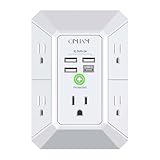
- 【 Multi Function USB Outlet】- Securing onto the wall design. Fit duplex outlet perfectly, just plug in to use. You get 5 AC outlet splitter (3 sides) with wide space in between; 4 USB charger ports; using the screw at the middle to secure it onto the wall for duplex outlet, so it is not pulled out when pulling the plugged in devices and loss power. Note: this works on duplex outlet only, other types of outlet like GFCI outlet cannot be secured onto the wall. Best Ideal Stocking Stuffers for Adults.
- 【The Groove Design on The Back and Wide space 】- 5 AC outlets with 2.1 inches long space in between, larger than standard 1.5-inch socket. Larger spacing makes it easier to use for all kinds of equipment. The groove at the back make it flush against the wall perfectly, good for all Duplex Receptacle Outlet. NOTE: This product can be used on wall outlet with space lager than 1 inches in between, This product cannot be used on outlets with more than 2 set of parallel sockets.
- 【 Smart Charge with USB A & USB C 】- 4 USB Charging ports, Each USB A port features 5V/2.4A Max output. USB C charging port features 5V/3A MAX. Built in smart technology, detecting charging devices and deliver optimal charging speed automatically, compatible with Kindle and most USB devices. NOTE: The UCB-C port is not Quick Charger 3.0, doesn't support any other devices which need 9~22V charging voltage.
- 【Reliable Surge Protector Circuit】: This Outlet Extender provides 1680 joules of surge protection for electronic devices and serves as a reliable Power Strip Multi Plug Adapter(The “Protected” indicator light turns on to indicate that your devices are protected).
- 【 Our After Sale Service 】- ETL Certified, Our friendly and reliable customer service will respond to you within 24 hours. You can purchase with confidence, with our 30-day return and 12-month warranty.
3. GFCI receptacles
A ground-fault circuit interrupter, or GFCI, monitors the current leaving and returning through the circuit. If it detects an imbalance consistent with current leaking through an unintended path—possibly through a person—it interrupts power rapidly to reduce shock risk. It is designed for ground-fault protection, not every overload or wiring fault. The Consumer Product Safety Commission’s GFCI fact sheet explains the protection and common applications.
How to identify one
Look for TEST and RESET buttons. A status light may be red, green, or amber, depending on the manufacturer and model.
Where it is commonly used
- Bathrooms
- Kitchen areas
- Laundry areas
- Garages
- Outdoor receptacles
- Basements, crawl spaces, and other locations where water or dampness may be present
The exact locations required by code depend on the NEC edition adopted locally and the installation details. Do not reduce the rule to a single universal distance from a sink or water source.
The GFCI may be somewhere else
GFCI protection can come from:
- A GFCI receptacle at the wall
- A GFCI circuit breaker in the electrical panel
- An upstream GFCI receptacle protecting ordinary downstream receptacles
- A portable plug-in GFCI in some temporary-use situations
As a result, an ordinary-looking receptacle may still be GFCI-protected. A downstream receptacle is protected only when the circuit is correctly connected to the GFCI’s load terminals and identified as protected where required. The Eaton GFCI instructions illustrate the line-and-load arrangement.
How to test a GFCI
- Plug in a lamp or night-light and switch it on.
- Press the TEST button.
- The lamp should turn off, and the RESET button should trip or pop out.
- Press RESET.
- The lamp should turn back on.
The CPSC recommends testing GFCIs after installation, at least monthly, after a power failure, and according to the manufacturer’s instructions. If the lamp stays on after TEST, or power does not return after RESET, stop relying on the device and have it evaluated.
If a GFCI will not reset
First check whether the circuit breaker has tripped, then unplug devices connected to the GFCI and any downstream receptacles. Try resetting it again. If the device was recently replaced, reversed line and load connections or a lack of incoming power are possible causes. Do not repeatedly force the button. If the cause is not obvious, use a qualified electrician. Leviton’s GFCI troubleshooting information discusses these failure modes.
4. AFCI-protected circuits and receptacles
An arc-fault circuit interrupter, or AFCI, detects electrical signatures associated with dangerous arcing. Damaged insulation, loose connections, damaged cords, and other faults can create arcs capable of starting a fire. AFCI protection is therefore primarily a fire-safety measure. The CPSC AFCI guide explains its purpose.
Most AFCI protection is at the panel
Most homeowners encounter AFCI protection as a breaker in the electrical panel, often with a test button. Some AFCI receptacles also exist. An AFCI breaker is reset at the panel; an AFCI receptacle is reset at the wall device. The AFCI breaker versus AFCI receptacle explanation covers the distinction.
What’s actually slowing this PC down?
Pick the symptom - the matching free tool is one click away.
Under various NEC editions, AFCI protection applies to many 120-volt residential circuits supplying outlets or devices in areas such as bedrooms, living rooms, dining rooms, hallways, closets, kitchens, and laundry areas. The exact scope and permitted method of protection depend on the adopted code edition. It is not accurate to say that every receptacle must have a test-and-reset AFCI face.
AFCI protection does not replace GFCI protection where GFCI is required. It also does not make damaged cords safe. If an AFCI trips, do not replace it with an ordinary breaker simply to stop the trips. Some products combine AFCI and GFCI functions in one device or system.
Rank #3

- 【Premium Quality Electrical Adapter】ETL Listed. JACKYLED 3-2 prong adapter is made of fire-proof material PBT that is high temperature-resistant up to 392℉. With AC 125V/15A and Electrical Rating 1875W Max Wattage, this light socket outlet 3-prong is sturdy enough for working with electrical, household, Industrial, machinery and other appliances.
- 【Wall Outlet Converter】The 2 prong to 3 prong outlet adapter can covert a grounded electric extension power cord to an AC outlet without a grounding pin slot, perfect for older houses or offices with AC wall outlets that can not accept grounded plugs.
- 【Polarized Plug】The 3-prong to 2-prong grounding adapters is polarized and better than the un-polarized plug adapters, because polarized plugs only allow you insert the plug into the outlet slots in one direction, wide blade to wide slot, narrow blade to narrow slot, which ensures neutral-to-neutral, hot-to-hot and provides a measure of safety for the appliances and house wiring to be aligned in terms of polarity. This also explains why most household appliances’ plugs are polarized.
- 【Portable and Easy to Use】It's small and compact so you can take a 2- to 3-prong adapter in your briefcase or laptop bag anywhere. Just plug the adapter to a wall socket and you will have a 3-prong outlet. This 3 prong to 2 prong adapter is also portable for travelling to Japan. All outlets in Japan is 2-prong, so with this adapter, you can easily charge your 3-prong electronic devices.
- 【Grounded Protection】This three-prong to two-prong adapter plug fits snugly into the wall outlet without falling out even when plugging a heavy cord into the adapter. It has a metal grounding tab / terminal to fit neatly under the outlet plate screw and provide a proper grounding for safety. Note: Using a 2-prong to 3-prong outlet adapter on ungrounded 2-prong outlets is not recommended.
5. Tamper-resistant receptacles
Tamper-resistant receptacles, often marked TR, contain shutters behind the slot openings. The shutters remain closed unless equal pressure is applied to both slots by a proper plug. This reduces the likelihood that a child can insert a single object into an energized opening. See the Electrical Safety Foundation International’s explanation of TR receptacles.
What they power
TR receptacles supply the same general household loads as comparable ordinary receptacles: lamps, chargers, televisions, small appliances, and tools when the circuit is appropriate. TR is a child-safety feature, not a different voltage or amperage class.
A normal plug should work in a TR receptacle. Bent or uneven plug blades may have difficulty opening the shutters. Do not confuse TR with waterproofing or GFCI protection. TR, GFCI, WR, and USB features are commonly combined in one device.
Plastic outlet caps are not equivalent to an integrated TR receptacle. ESFI notes that TR receptacles are specifically tested for their intended protection.
6. Weather-resistant receptacles
A weather-resistant receptacle, usually marked WR, uses materials and construction intended to better withstand moisture, ultraviolet exposure, corrosion, temperature changes, and impact. It is commonly used on exterior walls, porches, patios, decks, garages, and similar locations. The Leviton wet- and damp-location guide explains the purpose of WR devices.
What it is supposed to power
- Lawn and garden tools
- Outdoor lighting
- Pumps
- Holiday lights
- Patio entertainment equipment
- Pressure washers and other outdoor equipment
WR is not the whole outdoor solution
Weather-resistant does not mean that an outdoor receptacle can be installed without additional protection. Depending on the location and adopted code, an outdoor installation may also need:
Quick wins for a faster PC:
Fix the driver behind crashes, sound loss and screen glitchesFind Drivers →Clear out junk files and repair common Windows errorsFree Scan →Scan for outdated or missing drivers - takes under a minuteDriver Scan →- GFCI protection
- A weatherproof electrical box or enclosure
- A suitable cover
- An extra-duty while-in-use cover in wet locations
- Tamper resistance
A while-in-use cover protects the receptacle and cord connection while a plug remains inserted. The Leviton outdoor-cover guidance discusses this distinction. A closed cover that only protects an unplugged receptacle may not provide the same protection when equipment is connected.
7. USB charging receptacles
A USB receptacle combines ordinary AC receptacles with built-in USB charging ports. It is meant to charge USB-powered devices; it does not replace the AC receptacle for equipment that requires mains power.
Typical uses
- Phones and tablets
- Wireless earbuds
- Smartwatches
- E-readers
- Small USB-powered devices
- Some laptops, if the USB-C port provides sufficient Power Delivery output
USB-A and USB-C are not interchangeable in capability. A USB-C opening does not automatically promise fast charging, laptop charging, Power Delivery, or data connectivity. Charging output varies substantially by model, and multiple ports may share the available output.
For perspective, manufacturer models include USB-C receptacles rated at 15 watts per port, 30 watts with USB-C Power Delivery, and 65 watts. Those figures come from specific 30-watt and 65-watt Legrand models, not from every USB receptacle. Compare the outlet’s output rating with the device and cable requirements before expecting it to charge a laptop.
Do these 3 things before closing this tab:
1Repair Windows errors before they cause bigger problems2Fix the driver behind crashes, sound loss and screen glitches3Clear out junk files and repair common Windows errorsRank #4

- Multi Plug Wall Outlet Extender:Securing onto the wall design. Fit duplex outlet perfectly, just plug in to use. You get 6 AC outlet splitter (3 sides) with wide space in between; 4 USB charger ports; using the screw at the middle to secure it onto the wall for duplex outlet, so it is not pulled out when pulling the plugged in devices and loss power. Note: this works on duplex outlet only, other types of outlet like GFCI outlet cannot be secured onto the wall.
- Wide space outlets:6 AC outlets built-in 900 Joules surge protector with 2.2 inches long space in between, larger than standard 1.5-inch socket. Larger spacing makes it easier to use for all kinds of equipment.
- Smart Charge USB Ports:4 USB Charging Ports, Each USB A port features 5V/2.4A Max output. Each USB C charging port features 5V/3A MAX. Built in smart technology, detecting charging devices and deliver optimal charging speed automatically, compatible with Kindle and most USB devices. NOTE: The UCB-C port is not Quick Charger 3.0, doesn't support any other devices which need 9~22V charging voltage.
- Reliable Surge Protector Circuit:This Outlet Extender provides 900 joules of surge protection for electronic devices and serves as a reliable Power Strip Multi Plug Adapter(The Green indicator light turns on to indicate that your devices are protected).
- Our After Sale Service:ETL Certified, Our friendly and reliable customer service will respond to you within 24 hours. You can purchase with confidence, with our 30-day return and 12-month Warranty.
8. Switched, split, and controlled receptacles
A switched or controlled receptacle lets a wall switch, timer, occupancy sensor, smart-control system, or energy-management system control one or both plug-in locations.
Typical uses
- Table and floor lamps
- Plug-in lighting
- Fans
- Holiday lighting
- Small appliances that are intended to be switched
In a split duplex arrangement, one half may be controlled while the other remains permanently energized. One half may be labeled controlled or switched, or the receptacle may have a visibly different configuration. A combination switch/receptacle puts a switch and a receptacle in one wall-box position. A consumer outlet and switch guide from Lowe’s shows examples of these arrangements.
A receptacle that appears dead may not be defective; one half may simply be switched. Conversely, do not use a switched outlet for a refrigerator, freezer, sump pump, aquarium pump, medical equipment, network hardware, or another load that must remain powered unless the control arrangement was intentionally designed for it.
Smart receptacles add app, voice, timer, occupancy, or remote control. Many require a neutral conductor, a compatible network or hub, and a load within the device rating. Requirements vary by product; for example, check the manufacturer’s smart receptacle specifications before buying or replacing one.
Free tools Windows power users keep installed
One-click scans. No signup required.
9. 240/250-volt and high-amperage receptacles
Large appliances and high-power equipment often use receptacles that are physically incompatible with ordinary 120-volt plugs. Common examples include:
- NEMA 14-30R: 30 amps, 125/250 volts, four-wire receptacle commonly associated with electric clothes dryers. See a 14-30R product specification.
- NEMA 14-50R: 50 amps, 125/250 volts, four-wire receptacle commonly associated with ranges and some plug-in EV charging installations. See a 14-50R product specification.
- NEMA 6-20R and other configurations: selected tools and equipment may use other 240-volt patterns.
In a 125/250-volt configuration, the two voltage figures describe the available line-to-neutral and line-to-line relationships. The exact receptacle, wiring method, breaker, plug, and equipment still have to match.
What they are supposed to power
- Electric clothes dryers
- Electric ranges and ovens
- Plug-in EV charging equipment
- Welders
- Air compressors
- Other manufacturer-specified 240-volt equipment
A 14-30R and a 14-50R are not interchangeable just because both can be associated with 125/250-volt service. The breaker, cable, receptacle, plug, and equipment must all be compatible.
Do not assume that a standard range receptacle is automatically suitable for EV charging. EV charging can impose a substantial, extended load, and receptacle quality and circuit design matter. Leviton distinguishes heavy-duty EV receptacles from some standard range devices and states that one standard range model is not recommended for EV charging. Follow the vehicle equipment instructions and have the circuit evaluated when necessary.
Outlet features commonly combined in one device
Thinking in combinations is more accurate than treating every label as a separate outlet type. A receptacle can have a power rating, one or more safety features, and a convenience feature at the same time.
| Example | What the combination addresses |
|---|---|
| 15A, 125V, GFCI, TR in a bathroom | Ordinary household power, ground-fault shock protection, and child safety. The applicable code and installation details determine what is required. |
| 20A, 125V, GFCI, TR, WR at a patio | Higher-demand compatible 120-volt loads, shock protection, tamper resistance, and outdoor durability. It still needs the correct weatherproof enclosure and cover. |
| 20A circuit, GFCI, TR at a kitchen counter | Kitchen loads with ground-fault and tamper protection, subject to local code and circuit design. |
| TR receptacle with AFCI protection at the breaker in a bedroom | The wall device may look ordinary while fire protection is provided at the panel. |
| 15A, TR, USB-C Power Delivery at a charging station | Ordinary AC power plus higher-capability USB charging, subject to the specific product’s wattage and installation rating. |
These are typical design examples, not universal prescriptions. Code requirements vary by location, room, wiring method, and adopted NEC edition.
Best Value

- ✅ 【Power More】 This versatile wall adapter tap expands 2 grounded outlets into 6 outlets. Great for plugging in laptops, cell phones, cameras, shavers, etc.
- ✅ 【 Space-Saving Outlet】 Expanding your outlet can be sleek with this slim outlet adapter wall tap to power your devices.
- ✅ 【 Compatibility】 This Outlet Extender works with your existing grounded 3 prong standard receptacle to create a charging station in any room in your home, office, bedroom, kitchen, living room, dorm room or any area with limited outlets.
- ✅ 【 Safety Enough】 Keep the wall tap in place with the center screw to anchor the outlet adapter in place. Features a 125VAC/15A/1875W maximum capacity and is safe for indoor use. ETL Listed.
- ✅ 【Rational Appearance】 This wall tap completely covers your existing wall plate for a seamless look, and the white finish easily integrates into any decoration.
How to choose the right replacement receptacle
- Identify the circuit voltage and breaker rating. Look at the panel labeling and existing installation, but do not infer voltage solely from color or face shape. If the circuit is unclear, have it checked.
- Identify the appliance plug. The plug configuration is a compatibility signal. Match the receptacle to the appliance rather than forcing or adapting the plug.
- Check the environment. Bathrooms, kitchens, laundry areas, garages, unfinished basements, exterior walls, and damp locations may require GFCI protection, WR construction, weatherproof covers, or combinations of these.
- Identify the hazard being addressed. Choose GFCI for ground-fault shock risk, AFCI protection for arc-related fire risk, TR for child safety, weather-resistant construction and suitable covers for moisture and outdoor exposure, and surge protection for transient-voltage protection.
- Check whether the load must remain powered. Avoid switched or smart-controlled receptacles for critical equipment unless the control arrangement is deliberately designed for it.
- Check USB output. Match USB-C Power Delivery wattage to the device. Do not assume every USB-C receptacle can charge a laptop.
- Check installation compatibility. Confirm the device listing, box depth, faceplate fit, wire and grounding arrangement, and manufacturer’s instructions. A receptacle with the right face pattern can still be wrong for the box or circuit.
Turn off the circuit and verify that it is de-energized before any permitted electrical work. Electrical licensing and homeowner-work rules vary by jurisdiction. Use a qualified electrician for uncertain wiring, panel work, 240-volt work, ungrounded circuits, new circuits, or any installation involving repeated trips or signs of overheating.
Common outlet mistakes to avoid
- Replacing a GFCI with a standard receptacle because it trips. A trip is a warning that needs diagnosis, not a reason to remove protection.
- Installing a three-slot face on an ungrounded circuit and assuming it is grounded. The grounding path must actually exist, or the installation must follow the applicable code treatment.
- Assuming every three-slot receptacle is grounded. Older homes may have newer-looking faces on older wiring.
- Installing a 20-amp receptacle on an unverified 15-amp circuit. The breaker, conductors, device, and appliance must be compatible.
- Treating WR as waterproof. Outdoor installations also need the appropriate box, GFCI protection, and cover.
- Assuming every USB-C outlet charges laptops. Check Power Delivery wattage, port sharing, and cable requirements.
- Plugging an EV charger into an unsuitable or worn 14-50 receptacle. Verify the equipment, circuit, receptacle rating, and installation instructions.
- Using a switched receptacle for equipment that must stay on. A switched half can make a refrigerator, pump, aquarium, or network device lose power.
- Defeating a grounding prong with an adapter or removal. The grounding connection is part of the safety design.
- Ignoring heat, looseness, buzzing, discoloration, or a burning smell. These are warning signs, not cosmetic defects.
What to do when a protective device trips
When a GFCI trips
- Unplug devices from the GFCI and any downstream receptacles.
- Reset the GFCI.
- Reconnect devices one at a time to identify a possible faulty appliance or cord.
- If it will not reset, check whether the circuit breaker has tripped.
- If the GFCI was recently installed, suspect a line/load wiring error or lack of incoming power.
- If it repeatedly trips, becomes hot, smells burnt, or will not test correctly, stop using it and call a qualified electrician.
Do not repeatedly force a GFCI reset button. Leviton’s reset guidance lists downstream devices, a tripped breaker, absent incoming power, and line/load reversal among the issues to consider.
Recommended Free Tools
When an AFCI trips
- Unplug recently added or damaged devices.
- Look for damaged cords, loose plugs, buzzing, overheating, or overloaded power strips.
- Reset the breaker or receptacle only according to its manufacturer’s instructions.
- Do not replace the AFCI with a standard breaker to stop the trips.
- Arrange a diagnosis for persistent trips. The cause may be an appliance, wiring fault, shared-neutral issue, or incompatible device.
When to stop using any receptacle
Stop using a receptacle and arrange professional evaluation if it is:
- Warm or hot to the touch
- Loose in the wall
- Cracked or physically damaged
- Discolored, melted, or scorched
- Buzzing, sizzling, or sparking
- Producing a burning smell
- Repeatedly tripping a breaker or protective device
- Unable to hold plugs securely
The CPSC home electrical safety checklist specifically warns consumers to investigate unusually warm or hot outlets and related electrical abnormalities. If there is active smoke or fire, leave the area and call emergency services rather than attempting to troubleshoot the receptacle.
An old two-slot outlet needs special care
Older homes may still have two-slot, nongrounding receptacles. Do not simply install a three-slot face and assume the circuit now has an equipment-grounding conductor.
Under specified conditions, the CPSC explains that an ungrounded receptacle may be replaced with a GFCI receptacle. The installation must be treated and labeled as applicable, including NO EQUIPMENT GROUND and GFCI PROTECTED. This is not the same as adding a grounding path. Have an electrician evaluate the wiring and the permitted solution for the home.
Less common receptacle variants
Some receptacles are defined more by their installation setting or specialized function than by a different household power system:
- Surge-protective receptacles: Help divert or limit transient voltage surges that can damage electronics. They do not replace GFCI or AFCI protection, correct bad wiring, or guarantee protection from a direct lightning strike. Point-of-use protection is different from whole-home surge protection; see ESFI’s surge-protection guidance.
- Smart receptacles: Add app, voice, timer, occupancy, or remote control while retaining ordinary circuit and load limits.
- Locking receptacles: Use a twisting plug connection to help prevent accidental disconnection from equipment.
- Hospital-grade receptacles: Are designed for particular medical-environment requirements and are not automatically necessary in a home simply because they are more robust.
- Floor, ceiling, single, and specialty receptacles: Are selected for their mounting position, mechanical retention, durability, or equipment requirements.
Frequently Asked Questions
Does a three-slot outlet mean the circuit is grounded?
No. The third opening is intended for an equipment-grounding connection, but an older ungrounded circuit may have a three-slot replacement face. Have the circuit checked rather than relying on appearance.
Why is one half of my outlet dead?
It may be a split or switched receptacle, with one half controlled by a wall switch. Other possibilities include an upstream GFCI trip, an AFCI trip at the electrical panel, or a failed device. If the cause is not obvious, stop using it and have it evaluated.
Can I replace a 15-amp receptacle with a 20-amp receptacle?
Not automatically. The receptacle must match the branch-circuit wiring, breaker, box, grounding arrangement, appliance plug, and applicable code. A higher-rated face does not increase the circuit’s capacity.
What’s actually slowing this PC down?
Pick the symptom - the matching free tool is one click away.
What is the difference between GFCI and AFCI protection?
GFCI protection primarily reduces electric-shock risk from current leaking along an unintended path. AFCI protection primarily reduces fire risk from dangerous electrical arcing. One does not automatically replace the other.
The Bottom Line
Choose a receptacle by matching four things: the circuit and appliance rating, the installation environment, the hazard being addressed, and any convenience feature you actually need. A 20-amp T-slot is about capacity; GFCI is about shock protection; AFCI is about arc-related fire protection; TR is about child safety; WR is about outdoor durability; and USB or smart control is about convenience. Because these features can overlap, the safest replacement is the one that matches the complete circuit—not merely the receptacle’s appearance.
Quick Recap
Product prices and availability are accurate as of the date/time indicated and are subject to change. Any price and availability information displayed on Amazon at the time of purchase will apply.

