Free tools Windows power users keep installed
One-click scans. No signup required.
The best 8 Snow Removal Hacks That Aren’t Salt begin with mechanical removal: shovel light snow promptly, push rather than lift when possible, and use grit for traction where melting is unnecessary. Brine can prevent bonding, while selective alternative deicers may help with residual ice—but none is consequence-free or universally better than salt.
“Not salt” also needs a careful definition. Some methods below are genuinely salt-free, such as shoveling and sand. Brine is commonly made from salt dissolved in water, and calcium chloride or magnesium chloride are chloride-based deicers. The practical goal is to reduce unnecessary salt and chloride use, not to promise a magic, harmless replacement.
As an Amazon Associate I earn from qualifying purchases.
Key takeaways
- Prompt shoveling is the safest first step because removing light snow before it becomes packed ice reduces the need for deicer.
- Sand, non-clumping kitty litter, fireplace ash, and bird seed provide traction but do not melt ice.
- Brine helps prevent snow and ice from bonding to pavement, but ordinary brine is a salt solution rather than a salt-free treatment.
- Calcium magnesium acetate, calcium chloride, and magnesium chloride have different costs, temperature performance, corrosion risks, and environmental tradeoffs.
- Target thin residual ice instead of treating an entire cleared surface, apply material evenly, and sweep up excess granules after thawing when practical.
What are the 8 Snow Removal Hacks That Aren’t Salt?
The best 8 Snow Removal Hacks That Aren’t Salt begin with mechanical removal: shovel light snow promptly, push rather than lift when possible, and use grit for traction where melting is unnecessary. Brine can prevent bonding, while selective alternative deicers may help with residual ice—but none is consequence-free or universally better than salt.
“Not salt” also needs a careful definition. Some methods below are genuinely salt-free, such as shoveling and sand. Brine is commonly made from salt dissolved in water, and calcium chloride or magnesium chloride are chloride-based deicers. The practical goal is to reduce unnecessary salt and chloride use, not to promise a magic, harmless replacement.
#1 Best Overall

- Yocada 55" Snow Shovel for Driveway Home Garage Snow Removal: Rapid Snow Clearance with Wide Blade Boasting a 16 inch shovel blade, you can clear pathways in a flash. The aluminum wear strips allow for effortless shoveling, even when dealing with hard snow and ice. Its large capacity ensures fewer stoops, making snow removal efficient
- Yocada 55" Snow Shovel for Driveway Home Garage Snow Removal: The comfortable, ergonomic dual handle design of this snow shovel will help you reduce muscle strain or back injury while shoveling snow. This snow shovel has 3 strong iron handles and 16 inch wide plastic scoop, it makes an essential tool for clearing snow from driveways, sidewalks, or other outdoor areas
- Yocada 55" Snow Shovel: The snow shovel has sufficient length and width to increase the area of snow removal, improve the efficiency of snow removal, and quickly remove a large amount of snow on roads or lanes. It has 3 poles for you to adjust the length, it can be adjusted from 48inch to 55inch. It is an ideal tool for snow removal in winter
- Yocada 55" Snow Shovel for Driveway Home Garage Snow Removal: Our snow shovel boasts a good performance iron handle that's both sturdy and lightweight. The ergonomic D-grip design ensures optimal comfort and ease of use. Detachable for easy storage, this shovel promises longevity even under heavy loads
- Our shovel is easy to install, you can just connect the poles. When installing, you can refer to our installation picture, when connecting the pole, you need to use greater strength. Align with the groove, press the silver ball, insert it firmly, and turn the pole until you hear a click
1. How does shoveling early prevent ice?
Shoveling soon after snowfall is the most broadly useful salt-free method because light snow is easier to remove before footsteps, tires, and melting-and-refreezing compress it into a hard layer. UNH Cooperative Extension describes prompt shoveling as the first and most environmentally safe option, and University of Illinois Extension recommends removing new snow while it is still light and fluffy.
Clear the walking path and vehicle tracks first, then move snow completely off the pavement rather than leaving ridges where meltwater can refreeze. A snow shovel is usually sufficient for steps, walks, and small drives. For a larger driveway, a snow blower can reduce lifting, but the same timing rule applies: remove snow before traffic packs it down.
After shoveling, inspect shaded areas, slopes, thresholds, and tire tracks. Reserve any traction material or deicer for thin patches that remain instead of spreading it across the whole driveway.
Quick wins for a faster PC:
Clear out junk files and repair common Windows errorsFree Scan →Scan for outdated or missing drivers - takes under a minuteDriver Scan →2. Should you push snow instead of lifting it?
A wide snow pusher moves shallow, light snow sideways, reducing the repeated lifting required with a conventional shovel. Pushing is particularly useful on level walks and driveways when the snow is not too deep; a lifting shovel is more practical for steps, uneven surfaces, deep accumulations, and piles that must be thrown farther.
| Tool approach | Best for | Main advantage | Limit |
|---|---|---|---|
| Snow pusher | Broad, shallow snowfall on level pavement | Moves snow without lifting every load | Less useful for deep snow, steps, or heavy piles |
| Conventional lifting shovel | Steps, tight spaces, deep snow, and snow banks | Can lift and throw snow where pushing cannot | More repetitive lifting and greater strain |
| Snow blower | Larger driveways and repeated storms | Mechanizes removal over a wider area | Requires equipment, storage, and safe operation |
Choose a handle and blade that match the user’s strength, height, mobility, and surface. An ergonomic or lightweight snow shovel may make prompt clearing more realistic, but no particular shovel model should be assumed to be superior without product-specific testing.
Disclosure: If this article later includes qualifying product links, the site may earn a commission at no additional cost to the reader. Product selection should be based on the task, not an unverified performance claim.
3. Can brine keep snow from sticking to a driveway?
Applying liquid brine before a storm can reduce the bond between snow or ice and pavement, making later plowing or shoveling easier. Massachusetts guidance identifies brine as a pretreatment, while watershed guidance explains that pretreatment can prevent bonding and reduce the amount of solid salt used in managed programs.
Rank #2

- SNOW SHOVEL AND SHOW PUSHER: 18-in combination blade shape is ideal for shoveling and pushing snow
- DURABLE BLADE: Nylon wear strip prolongs blade life and does not cause damage to deck, patio and other ground surfaces
- ERGONOMIC HANDLE: Ergonomic handle for easier shoveling; 37.4 in. ergonomic handle for more comfortable shoveling
- OVERSIZED HANDLE: Oversized D-Grip handle for comfortable grip with gloved hands
Brine is not automatically salt-free. Ordinary road brine is a salt solution, so this method belongs in a salt-reduction strategy rather than a claim that no salt or chloride is being used. Performance depends on the formulation, concentration, timing, pavement condition, and temperature. A poorly timed or poorly applied liquid treatment may be diluted, displaced, or ineffective.
Use pretreatment selectively where bonding is the main problem and where the product label or local guidance supports the application. Do not assume that a homeowner will reproduce a municipal result with the same efficiency. According to the Commonwealth of Massachusetts (2026), programs moving from solid salt to liquid brine pretreatment reported up to 35 percent less salt applied per winter; that is a program-level figure, not a guaranteed reduction for every driveway or storm.
4. Is sand better than salt for snow and ice?
Sand is better than salt when the immediate goal is traction rather than melting, especially on icy steps, short walks, and very cold surfaces where melting may be limited. Sand does not melt ice. The U.S. Environmental Protection Agency explains that sand and gravel can improve traction but do not melt ice.
Use coarse material sparingly on the areas where people walk or vehicles need grip. Sand can be displaced by traffic, and its effectiveness declines as particles become rounded or get pushed aside. Sand also has an environmental cleanup burden: runoff can carry sediment into drains and waterways, and accumulated material can clog drainage systems.
Sweep up remaining sand after the thaw where practical, especially near catch basins and building entrances. Sand is a traction treatment, not an ice-melt substitute.
5. What household materials add traction without melting ice?
For small areas, non-clumping kitty litter, fireplace ash, wood shavings, and bird seed can add surface grip without applying a chloride deicer. UNH Cooperative Extension lists these materials as traction options, and Massachusetts homeowner guidance identifies ash and kitty litter as ways to minimize contamination.
| Material | Primary function | Best use | Tradeoff |
|---|---|---|---|
| Non-clumping kitty litter | Traction | Small steps and short walks | Messy, trackable, and does not melt ice |
| Fireplace ash | Traction | Small icy areas | Can create residue and should be kept out of drains |
| Wood shavings | Traction | Limited pedestrian areas | Can scatter, become wet, and require cleanup |
| Bird seed | Traction | Small walkways and steps | Can be tracked or attract wildlife; does not melt ice |
These materials are unsuitable as a blanket treatment for a large driveway. Apply only enough to improve footing, keep the material away from indoor floors when possible, and collect residue after conditions improve.
Rank #3
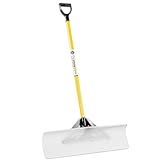
- THE ORIGINAL - THE SNOWPLOW "THE ORIGINAL SNOW PUSHER" is the only shovel on the market using virgin UHMW (Ultra High Molecular Weight) Polyethylene. This material is the highest wearing, impact resistant, cold weather adaptable material available.
- PATENTED - We've developed and patented the handle/brace connector system, The TUFFBRACE is optimized for sturdiness and toughness. Use on concrete, blacktop, pavers, decks, roofs, ice rinks and more with no need to sharpen with the self sharpening blade with every use.
- NON STICK BLADE & STURDY THROUGHOUT - UHMW blade allows snow to slide off vs. stick to generic plastic shovels. The new and improved metal handle has twice the wall thickness of industry snow shovels. Plus reinforced with a plug insert.
- COMFORTABLE & OPERATIONAL CONTROL: Features a stable, ergonomic design. Snow slides off making your shoveling experience significantly less work intense. No lifting or scooping greatly decreasing back injuries.
- MADE IN USA – Proudly designed, sourced and produced in the USA. See our raving reviews from top snow professionals, churches, property managers and other commercial use.
6. Is calcium magnesium acetate a good alternative to rock salt?
Calcium magnesium acetate, or CMA, may be worth considering for thin residual ice where reduced corrosion or lower concern for plants and soil matters more than the lowest purchase price. University of Illinois Extension describes CMA as biodegradable and less harmful to plants and soil than ordinary salt, while EPA materials emphasize that every deicer has strengths and weaknesses.
CMA is not universally harmless, universally effective, or automatically cost-effective. EPA notes that deicing alternatives generally cost more than sodium chloride, and the exact product label controls application instructions and limitations. Compare the label’s coverage guidance, compatible surfaces, temperature information, storage requirements, and warnings rather than relying on marketing terms such as “pet-safe” or “eco-friendly.”
CMA can be a targeted tool for sensitive areas, but mechanical removal and traction remain preferable when they solve the problem without a deicer.
7. How should you match a deicer to the temperature?
More deicer is not automatically better, and different formulations perform differently as air and pavement temperatures change. UNH Extension reports that calcium chloride and magnesium chloride can remain effective below the working range of ordinary rock salt, while also warning that over-application can damage plants and surfaces.
Before choosing a product, check:
- the product label’s stated temperature range and application rate;
- the actual pavement temperature, not only the forecast air temperature;
- whether the surface is concrete, asphalt, masonry, metal, or another material;
- nearby lawns, gardens, trees, pets, and vulnerable plants; and
- where meltwater and dissolved material will drain.
Calcium chloride and magnesium chloride are still chloride-based products. They may solve a low-temperature or performance problem, but they do not eliminate chloride runoff or every corrosion concern. EPA’s technical guidance on highway deicing supports evaluating deicers by their environmental and operational tradeoffs rather than treating one formulation as universally safe.
Windows Errors? Fix Them Before They Spread
Repair common Windows errors and clear accumulated junk for a smoother, more stable PC - no reinstall needed.Free scan · no reinstallCrashes, No Sound, or Screen Glitches?
Random freezes, missing sound and display glitches usually trace back to one bad driver. Find and replace yours safely.Free scan · under a minute8. How can you use less deicer and recover what remains?
Clear snow first, then treat only the thin residual ice that remains. A small, even application is more controlled than piles or blanket coverage; wait for the material to work before adding more. University of Illinois Extension recommends using a small amount, spreading it evenly, and waiting rather than repeatedly adding product.
Target shaded patches, compacted tire tracks, stairs, slopes, and door approaches. Avoid applying material simply because a surface looks damp when it is not frozen. Keep unused product dry and covered, measure rather than scoop indiscriminately, and sweep up excess granules after thawing where feasible.
Rank #4

- Yocada 55" Snow Shovel for Driveway Home Garage Snow Removal: The comfortable, ergonomic dual handle design of this snow shovel will help you reduce muscle strain or back injury while shoveling snow. This snow shovel has 3 strong iron handles and 16 inch wide plastic scoop, it makes an essential tool for clearing snow from driveways, sidewalks, or other outdoor areas
- Yocada 55" Snow Shovel for Driveway Home Garage Snow Removal: Rapid Snow Clearance with Wide Blade Boasting a 16 inch shovel blade, you can clear pathways in a flash. The aluminum wear strips allow for effortless shoveling, even when dealing with hard snow and ice. Its large capacity ensures fewer stoops, making snow removal efficient
- Yocada 55" Snow Shovel for Driveway Home Garage Snow Removal: Our snow shovel boasts a good performance iron handle that's both sturdy and lightweight. The ergonomic D-grip design ensures optimal comfort and ease of use. Detachable for easy storage, this shovel promises longevity even under heavy loads
- Yocada 55" Snow Shovel: The snow shovel has sufficient length and width to increase the area of snow removal, improve the efficiency of snow removal, and quickly remove a large amount of snow on roads or lanes. It has 3 poles for you to adjust the length, it can be adjusted from 48inch to 55inch. It is an ideal tool for snow removal in winter
- Our shovel is easy to install, you can just connect the poles. When installing, you can refer to our installation picture, when connecting the pole, you need to use greater strength. Align with the groove, press the silver ball, insert it firmly, and turn the pole until you hear a click
Recovery matters for both sand and deicer. Massachusetts guidance warns that sand can clog drains, while EPA’s deicing best-practice guidance recommends better application and storage practices to limit environmental losses.
Why reduce salt if salt is convenient?
Road salt can contaminate drinking water, harm wildlife and roadside vegetation, corrode vehicles and infrastructure, and damage property. According to the U.S. Environmental Protection Agency (2020), salt-related corrosion and damage account for approximately $5 billion in annual U.S. repairs.
Recommended Free Tools
Replacing salt with sand does not remove every environmental impact: sediment can enter waterways and clog drains. Replacing sodium chloride with calcium chloride or magnesium chloride also does not eliminate chloride-related concerns. The lowest-impact choice depends on the immediate need: remove snow mechanically when possible, add traction when melting is unnecessary, pretreat only when bonding is likely to be a problem, and use deicer only on remaining ice.
Which snow-removal method should you choose?
| Problem | First choice | When to use it | Important limitation |
|---|---|---|---|
| Fresh, loose snowfall | Shovel or snow blower | During or soon after snowfall | Requires timely action |
| Snow sticking to pavement | Selective brine pretreatment | Before suitable storms | Ordinary brine is a salt solution |
| Thin ice where people walk | Sand, kitty litter, ash, or bird seed | After ice forms when traction is enough | Does not melt ice and needs cleanup |
| Thin residual ice requiring melting | Small, label-directed amount of deicer | After mechanical removal | Temperature, corrosion, plant, and runoff tradeoffs remain |
| Large or repeated snowfalls | Snow blower or snow-removal service | When manual removal is impractical | Equipment, storage, cost, or availability varies |
A practical salt-reduction sequence
- Monitor the storm. Plan to clear new snow before traffic compresses it.
- Remove snow mechanically. Push or lift snow away from the walking and driving surface.
- Check for residual ice. Focus on shaded, compacted, sloped, and high-traffic areas.
- Choose the actual objective. Use grit for traction; use a compatible, label-directed deicer only when melting is necessary; consider pretreatment when preventing bonding is the goal.
- Apply evenly and sparingly. Do not create piles or assume extra material improves performance.
- Inspect after thawing. Sweep up remaining sand or granules where practical and keep material out of drains.
The most credible alternative to rock salt is not one replacement product. It is a sequence: clear snow early, use a pusher or blower when the area warrants it, add traction without pretending it melts ice, pretreat selectively, and reserve carefully chosen deicers for the small amount of ice that remains.
Frequently Asked Questions
What is the most environmentally friendly ice melt?
The most environmentally friendly approach is to remove snow mechanically before it becomes packed ice, then use traction material where melting is unnecessary. No alternative is impact-free: sand can add sediment, brine is commonly a salt solution, and other deicers have corrosion, plant, chloride, cost, or runoff tradeoffs.
Is sand better than salt for snow?
Sand is better than salt when you need traction rather than melting. Sand and gravel can improve grip on icy steps and walks, but they do not melt ice and should be swept up where practical because runoff can carry sediment and clog drains.
The Tool Desk
Outbyte Driver Updater FREEScan for outdated or missing drivers - takes under a minuteDriver Scan →Outbyte PC Repair FREERepair Windows errors before they cause bigger problemsFix Now →How do I remove snow without using salt?
You can remove snow without salt by shoveling or using a snow blower promptly, pushing light snow before it compacts, and applying sand, non-clumping kitty litter, ash, wood shavings, or bird seed for traction. These traction materials do not melt ice.
Can brine prevent snow from sticking to a driveway?
Brine can help prevent snow and ice from bonding to pavement, but ordinary brine is a salt solution and is therefore not a salt-free treatment. Its effectiveness depends on timing, concentration, pavement condition, and temperature.
The Bottom Line
Bottom line: The most environmentally responsible snow-removal strategy is usually mechanical removal first. Sand, kitty litter, ash, and bird seed help with traction but do not melt ice; brine is commonly a salt solution; and CMA, calcium chloride, and magnesium chloride each carry cost, temperature, corrosion, plant, and runoff tradeoffs. Apply only what the remaining problem requires, then clean up excess material.
Quick Recap
Product prices and availability are accurate as of the date/time indicated and are subject to change. Any price and availability information displayed on Amazon at the time of purchase will apply.
What’s actually slowing this PC down?
Pick the symptom - the matching free tool is one click away.

