Crashes, No Sound, or Screen Glitches?
Random freezes, missing sound and display glitches usually trace back to one bad driver. Find and replace yours safely.Free scan · under a minuteWindows Errors? Fix Them Before They Spread
Repair common Windows errors and clear accumulated junk for a smoother, more stable PC - no reinstall needed.Free scan · no reinstallThe safest way to care for an engineered-quartz countertop is simple: clean it with warm water, mild soap, and a soft cloth; rinse and dry it; use a cutting board; and put hot cookware or appliances on a trivet. Do not seal, polish, abrade, or expose the surface to unapproved chemicals. Quartz is low-maintenance, but it is not indestructible.
First, confirm what you have. Engineered quartz is a manufactured surface made from mineral aggregate, resin, and pigments. Quartzite is a natural stone with different porosity and care requirements, including possible routine sealing. Porcelain, granite, marble, and solid-surface countertops also need their own instructions. If you are unsure, check your installation paperwork or ask the fabricator before applying a sealer or specialty cleaner. See MSI’s engineered-quartz care guidance and its separate quartzite care guide.
As an Amazon Associate I earn from qualifying purchases.
1. Do clean gently; don’t scrub aggressively
For routine kitchen and bathroom cleaning, use the least aggressive method that works. Cambria, Caesarstone, MSI, and Silestone all identify warm water and mild or neutral soap as the baseline approach, although their lists of approved specialty products differ.
Free tools Windows power users keep installed
One-click scans. No signup required.
The safest everyday routine
- Remove crumbs and loose grit. Do not drag dry debris across the surface.
- Wet a clean microfiber, cotton, or other soft nonabrasive cloth with warm water.
- Add a small amount of mild dish soap when grease or food residue is present.
- Wipe in broad, overlapping passes with light pressure.
- Rinse with clean water so soap and dissolved residue do not remain behind.
- Dry with a clean soft cloth or paper towel.
Rinsing and drying are not merely cosmetic steps. Soap, cleaner oils, minerals, and hard-water residue can leave a film or water spots. These markings are especially noticeable on dark colors and on honed, concrete, matte, brushed, or rough finishes. Textured finishes may show fingerprints and changes in sheen more readily than polished finishes, but that is not a reason to scrub them harder. Clean them more often and more gently instead.
#1 Best Overall
- SPECIALLY FORUMULATED CLEANER FOR QUARTZ: The #1 newly installed kitchen countertop surface. Our pH neutral formula safely removes grease, soil, surface stains, and watermarks. Using multi-purpose cleaners not formulated for quartz can result in streaking, and unsightly residue
- SUPERIOR PROTECTION: Helps protect the resins in quartz and other stones from fading or darkening from sunlight exposure
- FRESH CITRUS SCENT, SPOTLESS SHINE: Cleans, shines & protects quartz countertops & other sealed stone surfaces. Light and fresh citrus scent will leave your countertops glistening and your kitchen smelling amazing!
- CLEAN WITHOUT LEAVING STREAKS AND RESIDUE: Supreme polishing power brings out a whole new level of luster without damaging surface
- PROUDLY MADE IN THE USA: All Weiman products are manufactured in the United States of America. Trust Weiman with your most valued surfaces in your home!
Do not make a green or red Scotch-Brite pad, steel wool, a metal scouring pad, an abrasive brush, or a powder cleanser your default tool. Abrasion can permanently change the factory sheen. MSI specifically warns against abrasive pads, while Cambria prohibits harsh scrub pads and abrasive products in its care instructions.
2. Do wipe spills and dry the surface; don’t leave residue or standing water
Engineered quartz is generally nonabsorbent or very low-porosity, so ordinary spills are unlikely to soak in as they can with some natural stones. That does not make the surface stain-proof. Dried residue, hard-water deposits, cleaner film, aggressive chemicals, heat, and prolonged exposure can still produce discoloration or a permanent change in the finish.
In a kitchen, wipe coffee, tea, wine, cooking oil, tomato products, food coloring, and cleaner splashes when you notice them. In a bathroom, wipe soap film, body-wash residue, cosmetics, and water around faucets and sinks. Drying after cleaning is particularly useful in areas with hard water.
For a dried spill
- Re-wet the material with water and let it soften for several minutes.
- Wipe with a damp soft cloth.
- Repeat the soaking and wiping rather than increasing pressure.
- If residue remains, use only a specialty cleaner and spot-treatment method approved for your countertop’s brand and finish.
Caesarstone recommends reconstituting dried spills with water before cleaning and warns against abrasive pads. Start with a plastic scraper for hardened food, gum, paint, glue, or similar material. Some Silestone instructions permit a carefully held upright razor or putty knife for specific hardened substances, while Caesarstone guidance has warned against putty knives in other situations. Because those directions conflict, use a metal blade only if your product’s current care guide expressly permits it and explains the procedure. A plastic scraper is the safer first choice.
When a stain is actually finish damage
If gentle cleaning leaves a cloudy, rough, lighter, or unevenly glossy patch, stop scrubbing. The mark may be chemical damage, abrasion, or finish wear rather than removable material sitting on top. More pressure can enlarge the damaged area. Photograph it, note what touched the surface, and contact the retailer, manufacturer, or fabricator.
3. Do use cutting boards and protect edges; don’t cut or drag objects directly on the slab
Quartz is scratch-resistant, not scratch-proof. Always use a cutting board. Cutting directly on the countertop can leave marks, dull knives, and create unnecessary wear. A knife strike or dropped heavy object can also chip an edge, especially around a sink, dishwasher, cooktop cutout, or unsupported overhang.
Lift heavy appliances, cookware, and countertop accessories instead of dragging them. Cast iron, rough ceramic, and metal objects can transfer marks or abrade the finish. Put protective pads under appliances that must remain in place, and do not use the countertop edge as a lever, workbench, or striking surface.
Quartz’s resistance to ordinary scratches and stains does not make it indestructible. Cambria, Caesarstone, Silestone, MSI, and independent guidance from Consumer Reports all recommend cutting boards and caution against impact and edge damage.
Rank #2
- SPECIALLY FORMULATED CLEANER FOR QUARTZ: The #1 newly installed kitchen countertop surface. Our pH neutral formula safely removes grease, soil, surface stains, and watermarks. Using multi-purpose cleaners not formulated for quartz can result in streaking, and unsightly residue
- SUPERIOR PROTECTION: Helps protect the resins in quartz and other stones from fading or darkening from sunlight exposure
- FRESH CITRUS SCENT, SPOTLESS SHINE: Cleans, shines & protects quartz countertops & other sealed stone surfaces. Light and fresh citrus scent will leave your countertops glistening and your kitchen smelling amazing!
- CLEAN WITHOUT LEAVING STREAKS AND RESIDUE: Supreme polishing power brings out a whole new level of luster without damaging surface
- BUNDLE OFFER: Quartz Spray & Washable Micro Fiber Cleaning Towel
4. Do use trivets; don’t put hot cookware or appliances directly on quartz
Quartz is heat-resistant, not heat-proof. Always place a trivet or solid hot pad under a pot, frying pan, baking dish, electric skillet, griddle, slow cooker, air fryer, deep fryer, roaster oven, heat lamp, or other heat-generating appliance. Do not rely on a thin towel or on the appliance’s exterior feeling merely warm.
There is no universal safe temperature for every engineered-quartz product. Heat tolerance depends on the particular resin system, slab thickness, finish, installation, support, exposure time, and location. Sudden temperature changes and sustained direct heat are especially concerning near seams, edges, sink cutouts, and cooktop cutouts. Thermal expansion can lead to cracking.
One Caesarstone article uses 300°F as a caution point for direct placement, but that is a Caesarstone-specific warning—not a rating that should be applied to all quartz countertops. The safer rule is to use a trivet every time, including when removing something from the oven or when setting down a countertop appliance.
Cambria specifically lists air fryers, slow cookers, griddles, electric skillets, and similar appliances among items that require protection and states that its product is not heat-proof. MSI likewise warns that sustained heating or rapid temperature changes can damage the surface. See the Cambria care guide, MSI care guide, and Caesarstone care tips.
5. Do verify specialty cleaners; don’t assume bleach, vinegar, alcohol, or Windex is universal
Warm water and mild soap are the common denominator. Specialty cleaners are not. Major brands publish materially different instructions, so a cleaner approved by one manufacturer is not automatically approved by another. The words quartz-safe on a retail label also do not replace the countertop manufacturer’s current care guide.
Use this decision process
- Identify the brand, collection, and finish.
- Read the current care guide, including its prohibited-products list.
- Check the cleaner’s ingredients and label directions.
- Spot-test in an inconspicuous area.
- Apply the product to a cloth rather than flooding the countertop if the manufacturer recommends that method.
- Rinse thoroughly and dry after the approved treatment.
Caesarstone advises testing products in an inconspicuous area and rinsing promptly if the surface contacts a potentially damaging substance. If you cannot identify the brand, stay with warm water, mild soap, a soft cloth, rinsing, and drying.
Why common household products need a brand-specific answer
| Product | Safest guidance | Important qualification |
|---|---|---|
| Bleach | Do not use it as a default cleaner. | Some Caesarstone guidance permits diluted bleach or a bleach-containing gel for limited uses; Cambria expressly prohibits bleach, and Silestone advises avoiding chlorine-based products or prolonged bleach contact. |
| Vinegar | Do not use it as a universal daily cleaner. | Some Caesarstone guidance permits a 50/50 water-and-vinegar mixture. Current Silestone guidance permits a cleaning-vinegar or limescale treatment for certain deposits with limited contact time. Other brands may restrict acids. |
| Ammonia and Windex | Do not assume every glass cleaner is safe. | Some Caesarstone guidance permits particular formulas, but high ammonia concentrations may dull the surface and formulas vary. |
| Rubbing alcohol | Use only when the brand specifically approves the concentration and product. | MSI’s care document permits a 70% isopropyl alcohol solution for sanitizing. That permission should not be generalized to other brands. |
| Baking soda | Do not present it as universally approved. | It is less aggressive than many scouring powders, but repeated rubbing can still alter a finish and manufacturers differ in their approved stain procedures. |
| Disinfecting wipes | Use only if the exact countertop brand approves the exact product. | Wipes can contain bleach, solvents, acids, oils, or abrasives. Rinse afterward whenever the product instructions require it. |
| Magic Eraser | Avoid it. | Melamine foam works as a very fine abrasive, similar in principle to sanding. The American Cleaning Institute explains its abrasive action, and Caesarstone warns it can damage the finish or gloss. |
Products to exclude unless your manufacturer expressly approves them
Avoid oven or grill cleaner, drain cleaner, toilet-bowl cleaner, paint stripper or remover, acetone or nail-polish remover, caustic soda, hydrofluoric-acid products, strong acids or alkalis, abrasive powders, pumice, steel wool, metal scouring pads, abrasive brushes, oil soaps, furniture polish, unapproved sealers, waxes, and shine-enhancing products. Cambria, Caesarstone, and Silestone each prohibit or caution against overlapping but not identical groups of these products. Compare the Cambria list, Caesarstone list, and Silestone list rather than relying on a generic cleaning article.
For metal marks, rust, and hard-water scale
First determine whether the mark is a deposit on the surface or discoloration within the material.
Rank #3
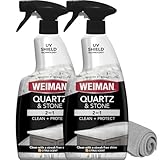
- SPECIALLY FORUMULATED CLEANER FOR QUARTZ: The #1 newly installed kitchen countertop surface. Our pH neutral formula safely removes grease, soil, surface stains, and watermarks. Using multi-purpose cleaners not formulated for quartz can result in streaking, and unsightly residue
- SUPERIOR PROTECTION: Helps protect the resins in quartz and other stones from fading or darkening from sunlight exposure
- FRESH CITRUS SCENT, SPOTLESS SHINE: Cleans, shines & protects quartz countertops & other sealed stone surfaces. Light and fresh citrus scent will leave your countertops glistening and your kitchen smelling amazing!
- CLEAN WITHOUT LEAVING STREAKS AND RESIDUE: Supreme polishing power brings out a whole new level of luster without damaging surface
- BUNDLE OFFER: Includes (2) 24 Oz Bottles of Quartz Cleaner and (1) MicroFiber Cleaning / Buffing Towel
- Metal marks: These may be transfer from cookware or an appliance rather than an absorbed stain. Some Caesarstone guidance permits a carefully applied Bar Keepers Friend powder for rust or metal marks, while MSI permits certain nonabrasive products. Cambria’s broader restrictions mean you should not transfer either method to a Cambria surface.
- Hard-water scale: Confirm that your brand permits vinegar or a limescale remover, follow its dilution and pad instructions, limit contact time, rinse, and dry. Current Silestone guidance says diluted limescale remover should remain on the surface for no more than two minutes. That time limit is Silestone-specific.
- Persistent haze: If the area is cloudy, rough, or unevenly shiny after an approved treatment, stop. It may be finish damage rather than scale.
6. Do preserve the factory finish; don’t seal, wax, polish, or recondition it
Ordinary engineered quartz does not need routine sealing. Its low-porosity or nonabsorbent construction is different from porous natural stone. A penetrating sealer cannot provide the same benefit on engineered quartz that it may provide on quartzite, and a topical product can wear unevenly, leave a film, or create inconsistent gloss.
Cambria, Caesarstone, MSI, and Silestone state that their engineered-quartz products do not require sealing. Several also prohibit polishing, waxes, sealants, and topical treatments. Do not apply a stone sealer simply because the surface looks dull or because a salesperson says it will make the countertop shine.
A dull appearance may be caused by soap residue, hard-water film, patina, an abrasive pad, chemical exposure, or actual finish wear. Clean gently first. If the surface remains cloudy or the sheen is uneven, ask a qualified fabricator about professional assessment or refinishing. Professional repair is different from routine homeowner polishing.
Finish matters. Polished quartz generally wipes clean easily and tends to show fewer ordinary surface markings. Honed, concrete, matte, brushed, and rough finishes show fingerprints, metal transfer, and changes in sheen more readily. Light colors may make coffee, tea, wine, and makeup more visible; dark colors often make water spots and patina more noticeable. These visual differences do not justify aggressive products.
7. Do follow product-specific outdoor and repair guidance; don’t DIY-grind or ignore damage
Outdoor and direct-sun use
Do not assume that a quartz slab installed indoors is suitable for a patio, outdoor kitchen, sunroom, or another location with prolonged direct sunlight. Standard engineered quartz may discolor or yellow because its resin can be sensitive to ultraviolet exposure. Silestone’s care guidance says not to use the product outdoors or in locations exposed to high UV radiation.
Outdoor-rated quartz is a separate, product-specific category. Caesarstone offers an Outdoor collection and addresses it separately in its FAQ. Verify the exact collection, installation requirements, and warranty before choosing any quartz for exterior use. Where direct sun and extreme heat are unavoidable, porcelain or another specifically UV-rated surface may be a better alternative.
Chips, cracks, scratches, and heat rings
- Minor residue or metal transfer: Use the approved cleaning procedure for the brand.
- Small edge chip: Contact the fabricator. A professional may be able to make a color-matched repair.
- Crack, spreading crack, heat ring, or discoloration: Stop experimenting and contact the fabricator or manufacturer.
- Deep scratch or dull patch: Do not sand or polish it yourself.
- Loose, flexing, or unsupported section: Treat it as an installation or structural problem, not a cleaning problem.
Quartz is not chip-proof or fracture-proof. Force, impact, sharp objects, chemicals, and thermal stress can permanently damage the surface. Save the product name, installation date, photographs, and details of what happened before contacting the fabricator; this information may help with diagnosis and any warranty discussion.
Quick wins for a faster PC:
Scan for outdated or missing drivers - takes under a minuteDriver Scan →Repair Windows errors before they cause bigger problemsFix Now →Why DIY refinishing is a safety issue
Do not cut, grind, drill, sand, or polish engineered stone as a casual DIY project. Those operations can permanently alter the factory finish and can generate respirable crystalline-silica dust. The OSHA/NIOSH engineered-stone hazard alert updated in February 2026 addresses the risk associated with fabrication and installation work, while NIOSH’s silica guidance covers dust-control practices. A qualified fabricator has the equipment, procedures, and experience to assess and repair the surface safely.
Rank #4

- No Unnecessary Ingredients: HOPE'S Perfect Quartz is free of sunscreen, silicone, and oil to create a unique residue-free formula that leaves your quartz countertops perfectly clean and spotless
- Sparkling Clean: Say goodbye to the streaks and haze that ordinary cleaners leave behind with our quartz countertop cleaner; removes dirt and surface stains on home, bathroom, and kitchen countertops
- Mild Formula: With a pH-neutral formulation, our cleaner for quartz countertops won't damage the surface of your counter and can be used for the daily care and maintenance of all brands of quartz
- Safe on Food Preparation Surfaces: A fragrance and dye-free kitchen counter cleaner spray, whip out your best dishes without any unwanted scents or colors interfering with your preparation and mealtime activities
- Multi-Surface: This versatile counter spray cleaner allows you to get that pristine look on other sealed surfaces such as granite, marble, onyx, glass cooktops, laminate, tile, chrome, and nickel
What to do after an accidental chemical spill
- Remove the chemical immediately using a disposable towel or cloth, while avoiding unnecessary spreading.
- Rinse the area with plenty of clean water.
- Wipe with mild soap and water only if the brand’s instructions permit it.
- Rinse again and dry.
- Do not try to neutralize the spill with another chemical. A second reaction can worsen the damage.
- Photograph the area and record the product name, ingredients if available, and approximate contact time.
- If discoloration, haze, roughness, or a gloss change appears, contact the manufacturer, retailer, or fabricator before trying an abrasive, solvent, sealer, or polish.
Caesarstone and Silestone both instruct users to rinse potentially damaging products promptly. Silestone also warns that misuse may affect its warranty, so preserving the product information and following the applicable care guide matters.
Brand-specific guidance is the final authority
The general routine in this article is deliberately conservative. It is appropriate when the countertop brand is unknown, but the manufacturer’s current guide overrides general advice for specialty cleaners, finishes, outdoor use, stain treatment, and warranty requirements. Keep these references available:
- Cambria Product Care
- Caesarstone Quartz and Mineral Surfaces Care
- MSI Q Care and Maintenance PDF
- Current Silestone Use and Care PDF
Also, food-contact certification is not the same as an antimicrobial treatment. For example, Cambria says some of its products are NSF 51 certified for food and splash zones; that does not mean every quartz brand is certified or that cleaning is unnecessary.
The Tool Desk
Outbyte PC Repair FREEClear out junk files and repair common Windows errorsFree Scan →Outbyte Driver Updater FREEScan for outdated or missing drivers - takes under a minuteDriver Scan →Frequently Asked Questions
Does engineered quartz need to be sealed?
Usually, no. Ordinary engineered quartz is designed to be low-porosity or nonabsorbent and does not need routine sealing. Do not apply a sealer, wax, or topical shine product unless the specific manufacturer directs it. This does not automatically apply to natural quartzite, which may require a different maintenance routine.
Can I put a hot pan on a quartz countertop?
No. Quartz is heat-resistant, not heat-proof. Put hot pans, baking dishes, air fryers, slow cookers, griddles, and other heat-generating appliances on a trivet or solid hot pad. There is no universal safe temperature for every quartz product.
Can I use vinegar on quartz?
Only if the countertop’s manufacturer specifically permits it. Some Caesarstone guidance permits a 50/50 water-and-vinegar mixture, and current Silestone guidance permits limited limescale treatment. Other brands may restrict acids. Follow the exact dilution, contact time, rinsing, and finish instructions.
Can I use bleach on quartz?
Do not use bleach as a default cleaner. Manufacturer instructions differ: some Caesarstone guidance permits limited diluted bleach use, while Cambria prohibits bleach and Silestone advises avoiding chlorine-based products or prolonged contact. Check the current guide for your exact brand.
Do these 3 things before closing this tab:
1Fix the driver behind crashes, sound loss and screen glitches2Clear out junk files and repair common Windows errors3Scan for outdated or missing drivers - takes under a minuteCan I use Windex or ammonia on quartz?
Do not assume that all glass cleaners are safe. Some Caesarstone guidance permits certain formulas, but high ammonia concentrations or a different formula may dull the surface. Verify the exact product with the countertop manufacturer and spot-test first.
Best Value

- Contains (1) 28 ounce bottle of granite cleaning spray
- Cleans to a sparkle without streaks or stress.
- Surface-safe on granite, marble and sealed stone.
- Cruelty free. Tested by people, not on animals.
- Bottle (minus nozzle) made from 100% recycled plastic (PCR).
Can I use rubbing alcohol or disinfecting wipes?
Only when the specific brand approves the exact product and concentration. MSI’s care document permits a 70% isopropyl alcohol solution for sanitizing, but that permission is not universal. Disinfecting wipes can contain bleach, solvents, acids, oils, or abrasives, so rinse afterward when instructed.
Can I use a Magic Eraser on quartz?
It is best to avoid it. Melamine foam is mechanically abrasive and can dull or alter a quartz countertop’s factory finish, particularly with repeated or forceful use.
How do I remove dried food from quartz?
Re-wet the material with water for several minutes, then wipe gently with a soft cloth and mild soap. Repeat instead of scrubbing harder. Start with a plastic scraper for hardened material. Use a metal blade only if your brand’s current care guide expressly permits it.
Recommended Free Tools
How do I remove hard-water spots from quartz?
Use warm water and mild soap first. If scale remains, check whether your brand permits diluted vinegar or a limescale remover, follow its instructions, rinse thoroughly, and dry. Current Silestone guidance limits diluted limescale-remover contact to no more than two minutes; that limit should not be generalized to every brand.
Can quartz be used outdoors?
Not automatically. Standard indoor quartz may discolor or yellow under prolonged UV exposure. Use only a collection specifically rated for outdoor conditions, and verify its separate care and warranty requirements. Caesarstone, for example, has a separate Outdoor collection.
What should I do about a chip, crack, or heat ring?
Stop experimenting, photograph the damage, and contact the fabricator or manufacturer. A small edge chip may be professionally repairable, but cracks, spreading cracks, heat damage, deep scratches, and unevenly dull areas may require specialized assessment.
Can I polish, sand, or refinish quartz myself?
No. DIY polishing can permanently change the factory finish, and cutting, grinding, drilling, or sanding engineered stone can create hazardous respirable crystalline-silica dust. Use a qualified fabricator for assessment or repair.
What’s actually slowing this PC down?
Pick the symptom - the matching free tool is one click away.
Is quartz the same as quartzite?
No. Engineered quartz is a manufactured mineral-and-resin surface. Quartzite is natural stone and commonly has different porosity and sealing requirements. Do not apply quartzite sealing instructions to engineered quartz or assume a quartz-looking material has quartz’s performance characteristics.
The Bottom Line
Bottom line: Warm water, mild soap, a soft cloth, prompt spill removal, cutting boards, and trivets are the dependable quartz-care routine. Because specialty-cleaner rules differ among Cambria, Caesarstone, MSI, Silestone, and other brands, verify your exact product before using anything stronger. If cleaning does not remove a mark—or if the surface is chipped, cracked, cloudy, rough, discolored, or heat-damaged—stop scrubbing and call the fabricator.
Quick Recap
Product prices and availability are accurate as of the date/time indicated and are subject to change. Any price and availability information displayed on Amazon at the time of purchase will apply.