Quick wins for a faster PC:
Repair Windows errors before they cause bigger problemsFix Now →Scan for outdated or missing drivers - takes under a minuteDriver Scan →The right chicken coop plan is the one that fits your flock, site, climate, predator risks, and building skills—not simply the one with the most attractive drawing. A plan collection titled “38 Great Chicken Coop Plans” cannot be verified from the available sources: they identify credible extension designs and plan collections, but do not establish 38 individual plans or their specifications. Use the sources below as reliable starting points, then check each plan’s dimensions, capacity assumptions, materials, and protection details before building.
Start with flock size and separate indoor and run space
Plan the enclosed coop and the outdoor run as separate areas. Published extension recommendations differ, so treat them as planning guidance rather than universal requirements.
As an Amazon Associate I earn from qualifying purchases.
| Guidance source | Indoor space | Outdoor space | Context |
|---|---|---|---|
| Oregon State University Extension | At least 3 sq. ft. per bird | Not stated | Indoor recommendation assumes birds have access to a run or outdoor area; without outdoor access, the recommendation is 8–10 sq. ft. per bird indoors. |
| Virginia Cooperative Extension / Virginia Tech | 3–4 sq. ft. per laying hen | 10 sq. ft. per laying hen | Published April 28, 2023; the figures are for laying hens. |
For example, five birds using an outdoor run would call for at least 15 sq. ft. of indoor area under Oregon State’s guidance, while Virginia’s table suggests 15–20 sq. ft. indoors plus 50 sq. ft. of run. These are not directly interchangeable standards; the sources use different recommendations and assumptions. Allow more space when feasible, especially if birds will spend substantial time confined, and account for breed and local conditions.
Examples of credible plan starting points
- NC State Extension provides sample plans described as suitable for four or five hens when paired with an attached run.
- Virginia Tech’s housing publication includes structure illustrations, including an 8-by-8-foot layer house described for 15–20 hens.
- Small and Backyard Poultry Extension links to LSU AgCenter construction-plan categories and a University of Wisconsin pasture ark design.
These examples do not by themselves establish the construction details, suitability, or capacity of every design. Read the plan itself and check whether its stated bird count is supported by indoor and run dimensions.
#1 Best Overall

- Spacious for 4-6 Hens: Measuring 82.4"L x 25.8"W x 44.1"H, this large chicken coop with run is spacious enough for 4-6 adult chickens to thrive. It’s also ideal for ducks, rabbits, and other small animals—serving as a versatile, well-ventilated home for all your backyard small livestock
- Easy Mobility with Built-In Wheels: Built with 2 durable wheels and a convenient handle, this mobile chicken coop with wheels glides easily across your yard. Unlike fixed coops, you can relocate it to fresh grass, shade, or shelter whenever needed—giving your flock the best spot year-round
- Predator-Proof Nesting Box: Predator-Proof Security System: Features a predator-proof lock and an extra-large protective guard beneath the nesting box. Blocks raccoons, foxes, and other threats from accessing your flock. Your chickens stay safe, even at night
- All-Weather Protection: This outdoor chicken coop features a fully waterproof roof and reinforced PVC covers to block rain from entering. More durable than standard wooden roofs, it reliably shields your chickens from wet weather—year after year
- Easy to Clean: Large removable sliding trays let you empty waste in seconds. Multiple access doors give you easy reach to every corner—no awkward bending or struggling. Three screened ventilation windows in the sleeping area promote optimal airflow, reducing odors and keeping the coop fresh
Compare plans by how they work day to day
A drawing is useful only if it shows enough detail to build, secure, and maintain the structure. Compare candidate plans against the same practical questions rather than choosing on footprint alone.
- Configuration: Is the coop stationary or mobile? Is a run attached, and is the run roofed?
- Access: Can you reach every nest, roost, waterer, and corner for cleaning and repairs? Can you collect eggs from outside the coop, or must you enter?
- Construction information: Are dimensions, material quantities, hardware, and tool demands specified? Can you follow the drawings with your skill level?
- Site fit: Does the layout accommodate shade, drainage, prevailing winds, weather exposure, and local predator pressure?
- Rules: Have you checked municipal, neighborhood, and permitting restrictions before building or acquiring birds?
Oregon State University Extension says a well-designed coop should be comfortable to access and easy to maintain with weekly cleanings. A plan that leaves inaccessible corners or makes routine egg collection awkward can turn a seemingly simple structure into a daily burden.
Provide ventilation while keeping the coop dry
Ventilation removes moisture and gases while allowing fresh air in. Oregon State University Extension states, “Passive ventilation is adequate for most backyard chickens coops.” Virginia Tech likewise emphasizes ample air movement without drafts; dampness and ammonia buildup are signs that ventilation is insufficient.
Recommended Free Tools
Rank #2
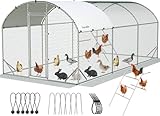
- [Essential Series: Exceptional Utility with Perch] - This model features a stable structure with 8 reinforced support bars and includes a Multi-Level Climbing Ladder (the same professional model as our Advanced Series). The natural wooden crossbars provide a secure, non-slip grip that protects your flock's feet from metal surfaces while satisfying their instinctive climbing and roosting needs.
Do not seal a coop so tightly that moisture accumulates, but avoid openings that expose birds to drafts or let predators enter. Vent placement should reflect the local climate and prevailing winds. Check that ventilation openings can be protected securely and that rain cannot routinely blow or drip into the bedding.
Design the whole perimeter against predators
Protection is a system, not just a sturdy coop door. Review doors, windows, vents, run sides, the run roof, and the ground perimeter. A run open overhead or vulnerable to digging is not fully protected.
- Use appropriately small mesh: University of Florida IFAS explains that hardware cloth has tighter wire spacing than chicken wire and better protects against smaller predators such as snakes and rats. Select mesh for the predators in your area; the source does not establish one universal specification for every site.
- Secure the ground edge: UF/IFAS recommends a buried or outward-turned barrier around stationary structures. Virginia Tech and NC State also advise burying run wire or constructing a perimeter barrier.
- Cover the run: Virginia Tech recommends covering the top against aerial predators. Check that the roof and its fasteners remain secure, not just the side fencing.
- Check doors and openings: NC State emphasizes strong, securely attached wire. Ensure latches and ventilation openings cannot be easily opened or breached by local predators.
- Use a nighttime routine when needed: Virginia Tech advises locking birds up before dark if an outside run is not predator-proof.
These measures are design principles from extension guidance, not a guarantee against every predator. Match mesh, latches, and perimeter construction to local risks.
Rank #3

- 【Specialized and Luxurious Pet House】Chicken Coop Dimensions: 80.7"L x 26"W x 44.5"H, Holds up to 2-4 chickens. 80" chicken coop comes with nesting box, resting box and ramp. Your poultry can lay their eggs in the nesting box. There is sliding door and ramp allows poultry to easily enter the raised housing area. There are timber ridges above the ramp to protects your poultry from slipping back. Come with door you can watch your pets without disturbing.
- 【Durable and Weatherproof Wooden Chicken Coops】Solid rain-resistant fir wood with Environmental painted keep the Poultry Hutch waterproof and not afraid of sun anymore. Green asphalt sloping roof to protect from water penetration.
- 【Coops come with Removable tray & Grinding Fences】There is removable bottom sliding tray for easy cleaning. High quality gridding fences provide a healthy poultry lifestyle. With the pitched roof your poultry can run outside even in rainy days. The fences are vital to the ventilation of poultry, they will also protect your poultry from the outside predators.
- 【Perfect for Indoor and Outdoor Use】This coop is suitable for indoors and outdoors setting. Specially designed with green asphalt roof, the hutch can protect your pets from rain, wind, and snow. The doors feature a metal slide bolt locks to keep your poultry safe and from escaping.
- 【Extra Large Chicken Coop Easy Assemble and Clean】Simple overall structure which is quite easy to assemble, it is better to use electronic drill to assemble. We packed item as good as we can, if there is any damaged part, please contact us first and offer us pictures of damaged part, we will solve the problem as the way you want(discount or replacement).
Make nests, roosts, and cleanout accessible
Allow enough nest space and perch length, and make both reachable for cleaning. Extension recommendations vary slightly:
| Source | Nest guidance | Roost guidance | Context |
|---|---|---|---|
| Oregon State University Extension | About 1 nest box per 4 birds | Not stated | Publication date not shown on the inspected page. |
| University of Florida IFAS Extension | At least 1 nest box per 5 hens; gives a 12 × 12 × 12-inch example box | Not stated | Guidance in publication AN239; publication date not shown on the inspected page. |
| Virginia Cooperative Extension / Virginia Tech | 1 nest per 4–5 females | 8–10 inches of perch per chicken | Published April 28, 2023. |
| NC State Extension | 1 nest per 4–5 hens | At least 9–10 inches of perch per bird | Applies its recommendations to chicken housing guidance. |
Use the figures as source-specific guidance, not a single universal rule. In the plan, check whether the nest boxes can be reached to collect eggs and clean them, and whether you can remove bedding and clean beneath roosts without dismantling the coop.
Independent reader supportYour contribution helps us test, update, and keep practical guides available for everyone.Choose between a stationary coop and a mobile tractor
A fixed structure and a mobile tractor solve different site-management problems. A stationary coop can support a more robust perimeter barrier. A mobile design can move birds across the yard, but mobility does not automatically make it safer.
Rank #4
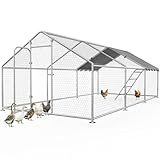
- Heavy Duty Rustproof Steel Construction: The outdoor chicken coop is crafted from galvanised steel tubing with an anti-corrosion coating for unparalleled durability for year-round use. Its weather-resistant metal frame ensures performance, perfect for harsh climates or wet environments
- All-weather waterproof and UV cover: Made of high quality 210D Oxford fabric with reinforced stitching, it protects poultry from rain, snow and harmful UV rays, ideal for free-range or self-cultivation
- Hexagonal Mesh Wall: Fitted with PVC-coated hexagonal mesh, the wall will keep out raccoons, foxes and rodents while securely enclosing poultry. Breathable design promotes air circulation and visibility, creating a safe and ventilated habitat for chickens, ducks, and small livestock
- Easy to install: The chicken coop is made of bolted assembly components for easy construction, the chicken coop provides a safer habitat for small pets such as rabbits, ducks, cats, dogs and goats, they will have plenty of space to play and rest, perfect for family farmers and poultry raising for beginners
- Excellent customer service: We provides warranty.If you have any questions about our product, please leave us a message through Amazon, we will respond within 24 hours with a perfect solution.
| Design | Potential fit | Trade-offs to plan for |
|---|---|---|
| Stationary coop | Sites where a permanent location and stronger ground barrier are practical. | Requires careful site selection, drainage, weather exposure planning, and a secure perimeter. |
| Mobile coop or chicken tractor | Sites where rotating access to forage and distributing bird activity across areas are priorities. | UF/IFAS cautions predators may more easily burrow underneath mobile structures. It also says mobile coops must be stored securely during hurricanes or major weather events. |
The mobile-coop trade-offs are described by University of Florida IFAS Extension. Before choosing a tractor plan, decide how it will be secured at night, protected from digging, moved over the terrain, and stored during severe weather.
Verify the plan and local requirements before building
- Confirm local rules. Check municipal zoning, permits, and neighborhood restrictions. An Ohio State University Extension answer to a coop-plan question identifies local approval as an initial consideration: Backyard Chickens: Where could I find plans for a chicken coop?
- Match capacity to space. Calculate indoor area and run area separately, then compare those totals with the source’s stated bird-count assumptions.
- Check the entire safety envelope. Confirm the plan shows protected openings, secure doors and run sides, an overhead barrier where needed, and a dig-resistant ground edge.
- Review routine access. Make sure cleaning, watering, and egg collection are practical without inaccessible spaces.
- Adapt to your site. Consider weather, wind, shade, drainage, breed, confinement time, and the predators found locally before buying materials.
Extension publications are U.S.-based guidance and do not replace local animal-keeping or building rules. A plan’s dimensions or capacity should not be treated as validated for your site unless its assumptions match your flock and conditions.
Crashes, No Sound, or Screen Glitches?
Random freezes, missing sound and display glitches usually trace back to one bad driver. Find and replace yours safely.Free scan · under a minuteWindows Errors? Fix Them Before They Spread
Repair common Windows errors and clear accumulated junk for a smoother, more stable PC - no reinstall needed.Free scan · no reinstallQuick Recap
Product prices and availability are accurate as of the date/time indicated and are subject to change. Any price and availability information displayed on Amazon at the time of purchase will apply.

