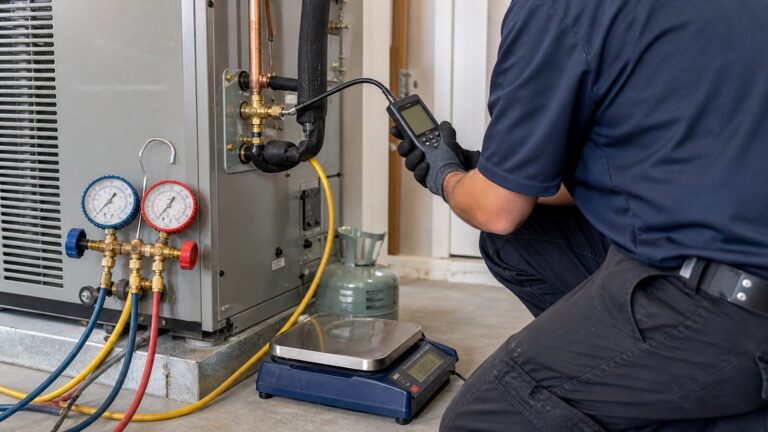
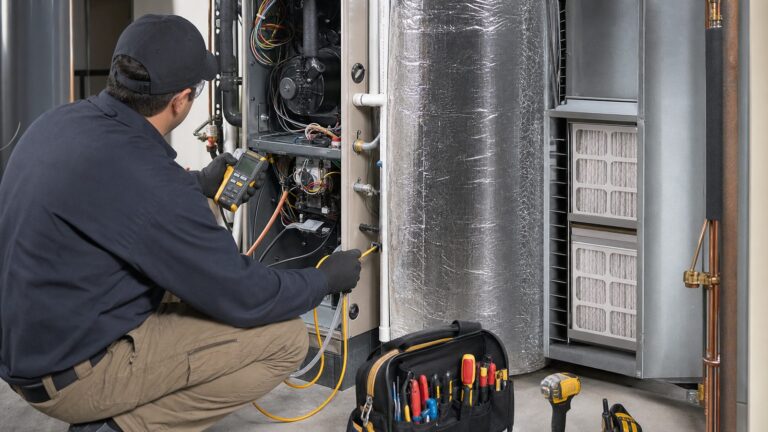
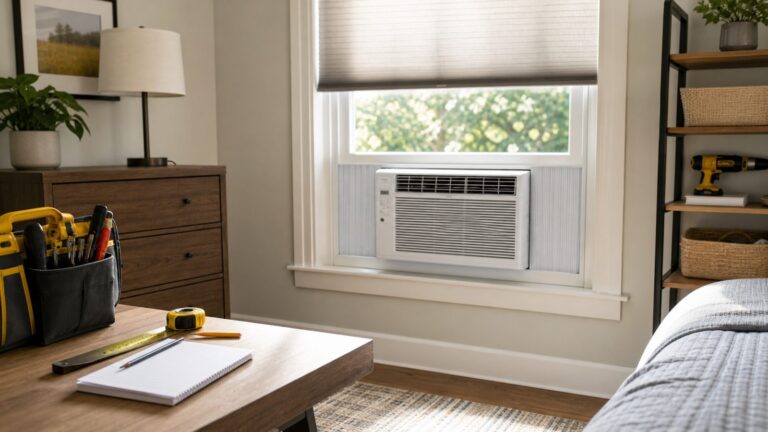
There is no single best air conditioner for every property. The right choice depends first on how much space you need to cool, then on whether you have usable ductwork, whether you also need heating, your climate and humidity, your electrical service, installation restrictions, and your budget.
For most U.S. homes, the practical shortlist is a ducted central system when good ducts already exist, a ductless mini-split when they do not, and a window, through-the-wall, or portable unit when only one room needs cooling or permanent work is not permitted. The equipment must still be correctly sized and installed: an oversized or poorly commissioned high-efficiency system can provide worse comfort than a correctly sized basic system.
As an Amazon Associate I earn from qualifying purchases.
This guide covers 11 useful equipment categories. It does not count Wi-Fi controls, variable-speed compressors, or wall-mounted indoor units as separate fundamental types because those are features or configurations that appear across several system families.
Quick answer: which type is the usual starting point?
| Your situation | Best starting point | Main trade-off |
|---|---|---|
| One room and the lowest initial cost | Window air conditioner | Noise, window obstruction, and air leakage |
| One room with no acceptable window unit | Through-the-wall or portable air conditioner | A wall opening is permanent; portable units generally perform less effectively |
| One room with quiet, permanent cooling | Single-zone ductless mini-split | Professional installation and a visible indoor unit |
| Several rooms without ducts | Multi-split ductless system | More complex refrigerant piping and system design |
| Whole home with usable ducts | Ducted split-system central AC or ducted heat pump | Duct leakage, sizing, and uneven zones can reduce performance |
| Whole home without ducts | Multi-split ductless system, ducted mini-splits, or new ductwork | Indoor-unit placement versus the disruption and cost of adding ducts |
| Hotel, apartment, or multifamily room-by-room cooling | PTAC or PTHP | Noise, sleeve compatibility, and unit-by-unit maintenance |
| Large, highly zoned home or commercial building | VRF, packaged equipment, or a central plant designed for the building | Requires engineering, controls, and experienced commissioning |
| Major renovation with land or drilling access | Geothermal heat pump | High excavation or drilling cost and site-specific design |
| Hot, dry climate with suitable ventilation | Evaporative cooler or conventional AC | Evaporative cooling adds moisture and performs poorly in humid weather |
These are starting points, not automatic prescriptions. The final choice should follow a load calculation, a building and duct assessment, and a quote that identifies the actual equipment combination and installation scope.
#1 Best Overall
- 3-in-1 Portable Air Conditioner: Enjoy cool air (64°F- 90°F) during hot summer days, plus dehumidifier and fan modes for comfortable air circulation when temperatures are milder. Everything you need for year-round comfort in one AC unit
- Comfort Sleep Mode: Sleep mode and programmable 1-24 hour timer maintain your ideal room temperature automatically. Ultra-quiet operation below 50dB won't interrupt sleep, while two adjustable fan speeds let you customize airflow
- Quick Window Installation: Comes ready to install with exhaust hose and adjustable window kit that fits widths from 20.48 to 49 inches. No handyman skills required—set up completely in just minutes and start cooling immediately(for small windows, trimming may be necessary)
- No-hassle Maintenance: Advanced Self-evaporating operation effectively reduces the frequency of manual water draining. The washable filter captures dust effectively and slides out easily for quick cleaning whenever needed—keeping air fresher longer
- Room-to-Room Versatility: Lightweight with smooth-rolling casters, this compact AC moves effortlessly wherever cooling is needed. Perfect for bedrooms, living rooms, garages—any space up to 750 square feet
The 11 types of air conditioners
1. Ducted split-system central air conditioner
A ducted split system has an outdoor condensing unit connected by refrigerant lines to an indoor evaporator coil and an air handler or furnace. An indoor blower moves cooled air through supply and return ducts.
Best for: Whole-home cooling, homes with existing adequately sized ducts, and owners who want concealed equipment and one central thermostat. A zoning system can add separate thermostats or dampers where different parts of the home have different loads.
Advantages:
- Serves many rooms from one system.
- Keeps the compressor and condenser outdoors, reducing indoor mechanical noise.
- Can pair with a gas furnace, electric air handler, or ducted air-source heat pump.
- Can support zoning, advanced filtration, whole-home ventilation, and variable-capacity equipment.
Limitations: Existing ducts may be leaky, undersized, poorly insulated, or badly balanced. Installing new ducts can be disruptive, especially in finished homes. One thermostat may not suit rooms with different sun exposure or occupancy. Oversizing can cause short cycling and inadequate humidity removal.
What’s actually slowing this PC down?
Pick the symptom - the matching free tool is one click away.
The U.S. Department of Energy describes residential central systems as split systems and single-package systems, generally in the residential category below 65,000 Btu/h. See the DOE guidance on residential central air conditioners.
A ducted heat pump looks much like central AC in cooling mode but reverses the refrigeration cycle to heat the home. ENERGY STAR describes a ducted air-source heat pump as essentially a central air conditioner that also works in reverse.
2. Packaged central air conditioner or rooftop unit
A packaged system puts the compressor, condenser, evaporator coil, and blower in one outdoor cabinet. Residential packaged equipment may sit beside a home or on a roof; commercial packaged rooftop units are commonly roof-mounted. The package may provide cooling only, cooling with electric heat, or cooling and heating through a heat pump or fuel-burning section.
Best for: Homes with little indoor mechanical-room space, manufactured homes, some low-rise properties, and commercial buildings designed around rooftop equipment.
The Tool Desk
Outbyte PC Repair FREERepair Windows errors before they cause bigger problemsFix Now →Outbyte Driver Updater FREEFix the driver behind crashes, sound loss and screen glitchesFind Drivers →Advantages:
- All major components are in one cabinet.
- It can eliminate the need for a separate indoor evaporator cabinet.
- It frees indoor floor space.
- It can combine cooling and heating in one factory-built package.
Limitations: The complete system is exposed to outdoor weather. Roof access can complicate inspection and repair. When a major section fails, replacing the package may be more practical than replacing only one component. A packaged unit is not automatically more efficient than a split system; efficiency depends on the model, load, ductwork, and installation.
ENERGY STAR defines a single-package unit as a central air conditioner or heat pump with its major assemblies enclosed in one cabinet. Do not assume a packaged unit is the best choice merely because a home is small. Available mechanical space, roof or slab access, climate, duct layout, and local installer experience matter more.
3. Single-zone ductless mini-split
A single-zone mini-split connects one outdoor compressor and condenser to one indoor air handler. The connection typically requires refrigerant lines, control wiring, electrical power, and a condensate drain or pump. There is no central air-distribution ductwork.
Best for: One room or zone, additions, finished attics, garages, workshops, converted porches, older homes without ducts, and rooms served poorly by an existing central system. It is also useful where heating comes from radiators, baseboards, or electric resistance and the owner wants efficient heat-pump heating.
Recommended Free Tools
Advantages:
- Avoids the cost and loss associated with distribution ducts.
- Provides strong zone-level control.
- Is commonly available as either cooling-only equipment or a heating-and-cooling heat pump.
- Can be installed with less structural disruption than a new duct system.
Limitations: The indoor head is visible, and its filter needs regular cleaning. One head will not reliably cool closed-off adjacent rooms. The outdoor unit needs a suitable location, and the line-set route and condensate drainage must be planned. A mini-split is not duct-free in the absolute sense: it still requires refrigerant lines, power, control wiring, and condensate handling.
ENERGY STAR recommends ductless systems for older homes without ductwork, additions, outbuildings, hot spots, and rooms where extending ducts is difficult. Its ductless heating and cooling guidance also emphasizes sizing based on the actual load rather than square footage alone.
4. Multi-split ductless system
A multi-split uses one outdoor unit to serve several indoor air handlers. Each indoor unit can usually be controlled separately, although the available capacity, connected-unit limits, and heating and cooling modes depend on the manufacturer and system design.
Best for: Homes with several rooms but no practical duct system, additions, mixed-use spaces, and buildings that need room-by-room control.
Free tools Windows power users keep installed
One-click scans. No signup required.
Advantages:
- Uses fewer outdoor units than installing several independent single-zone systems.
- Provides individual zone control.
- Supports wall-mounted, floor-mounted, ceiling-cassette, and sometimes concealed ducted indoor units.
- Can provide heating and cooling when configured as a heat pump.
Limitations: A problem with the outdoor unit can affect every connected zone. Refrigerant piping and branch connections are more complex than in a single-zone installation. Indoor and outdoor units must be matched, and the system must be able to operate efficiently when only one small zone is calling. Some systems cannot heat one zone and cool another simultaneously.
A multi-split is the residential or light-commercial branch of ductless zoning. VRF is the more engineered, larger-scale version, although the boundaries between advanced multi-splits and smaller VRF systems can vary by manufacturer and market.
5. Variable-refrigerant-flow system
A variable-refrigerant-flow, or VRF, system uses one or more outdoor units, variable-capacity compressors, a common refrigerant circuit, and multiple individually controlled indoor fan-coil units. Cooling-only, heat-pump, and heat-recovery configurations are available. A heat-recovery VRF system can provide cooling in one zone and heating in another by moving heat between zones.
Best for: Larger homes with sophisticated zoning, multifamily buildings, hotels, offices, clinics, schools, and retail properties.
Quick wins for a faster PC:
Scan for outdated or missing drivers - takes under a minuteDriver Scan →Clear out junk files and repair common Windows errorsFree Scan →Fix the driver behind crashes, sound loss and screen glitchesFind Drivers →Advantages:
- Individual zone control.
- Variable capacity that can be useful during part-load operation.
- Many indoor-unit styles and placement options.
- Potential heat recovery between zones with the appropriate system.
- Scalability for larger or changing buildings.
Limitations: VRF requires more design, controls, refrigerant-piping, commissioning, and service expertise than a typical single-family central system. Building-code requirements, refrigerant charge, leak detection, pipe lengths, and indoor-unit compatibility need careful review. It is usually excessive for a typical home with a simple cooling load, and replacement parts or service may be less widely available than for conventional equipment.
DOE defines VRF systems as split systems with variable-capacity control, multiple indoor fan-coil units, individual metering and control, and a common communications network. DOE’s VRF overview provides the federal equipment context, while ASHRAE’s HVAC Systems and Equipment handbook discusses VRF applications and system types.
6. Window room air conditioner
A window air conditioner is a self-contained room unit installed in a suitable window. Its indoor and outdoor sections are contained in one cabinet.
Best for: A bedroom, office, or living room; renters; limited-duration cooling; and buildings where permanent HVAC work is not practical or allowed.
PC Slower Than It Used to Be?
A free scan shows the junk files, broken settings and background clutter dragging Windows down - then fixes them in one click.Free scan · Windows 10 & 11Crashes, No Sound, or Screen Glitches?
Random freezes, missing sound and display glitches usually trace back to one bad driver. Find and replace yours safely.Free scan · under a minuteAdvantages:
- Usually has relatively low purchase and installation complexity.
- Needs no refrigerant-line installation.
- Is available in many capacities and price ranges.
- Some newer designs have variable-speed compressors, connected controls, and U-shaped or saddle configurations that reduce noise and preserve more window access.
Limitations: It blocks part of the window, places compressor noise near the room, and can leak outdoor air or water if poorly installed. A window unit may violate a lease, HOA rule, or building policy. It should generally be treated as a room solution, not whole-home cooling.
Rank #2

- Fast, Effective Cooling for Rooms Up to 750 Sq. Ft: This 14,000 BTU portable air conditioner provides rapid spot cooling for spaces like bedrooms, home offices, or apartments up to 750 sq. ft. It helps quickly dissipate indoor heat, keeping you comfortable even on the hottest summer days.
- 3-in-1 Versatility: AC, Fan & Dehumidifier: More than just a cooler, this unit also functions as a dehumidifier and a circulating fan. It reduces excess indoor humidity and improves air circulation, delivering year-round comfort across different seasons and weather conditions.
- User-Friendly Controls & Eco-Conscious Design: The clear LED control panel makes operation easy, with a programmable 24-hour timer and Sleep Mode for convenient, quiet nighttime use. Designed with eco-friendly refrigerant, this energy-efficient AC helps cool your space while minimizing energy consumption.
- Easy to Move with Rolling Casters & Side Handles: Compact and sleek, this unit features smooth-rolling wheels and ergonomic side handles, so you can effortlessly move it from room to room — wherever cooling is needed most.
- Quick No-Drill Window Installation: The package includes a remote control and a complete window installation kit with an adjustable exhaust hose and window panels. Fits most double-hung or sliding windows, requires no drilling, and can be set up in minutes — ideal for renters or temporary cooling needs.
DOE defines a room air conditioner as an encased, single-phase unit designed for mounting in a window or through a wall. ENERGY STAR warns that an oversized room unit can cool the air before removing enough moisture, leaving the room cool but clammy. Its room air conditioner guidance includes sizing, installation, and efficiency advice.
7. Through-the-wall room air conditioner
A through-the-wall room air conditioner is installed in a permanent wall sleeve or wall opening rather than in a window.
Best for: Rooms without suitable windows, casement-window rooms, buildings where a permanent opening is acceptable, and owners who want to preserve use of a window.
Advantages:
- Does not occupy a window.
- Can be more secure and permanent than a temporary window installation.
- Provides independent room cooling.
- Can work well where a standard window unit will not fit.
Limitations: The wall opening requires proper structural support, flashing, insulation, and air sealing. Sleeves and cabinets are not universally interchangeable, so the replacement must match the opening and the manufacturer’s installation requirements. An inadequately sealed opening can cause water intrusion, drafts, and energy loss.
A through-the-wall room AC and a PTAC may look similar but are not automatically interchangeable. ENERGY STAR includes through-the-wall units in its room-air-conditioner category, while PTACs are a separate equipment class.
8. Portable air conditioner
A portable air conditioner is a self-contained unit that sits inside the room and exhausts heat through a window kit or another approved opening. It is useful when a window unit is prohibited or will not fit, but portability comes with performance penalties.
Single-duct models: A single hose exhausts condenser air outdoors, while the unit draws condenser inlet air from the conditioned room. That can create negative pressure and draw warm, humid replacement air through cracks and other openings.
Dual-duct models: One hose draws condenser air from outdoors and another exhausts it outdoors. This generally reduces the negative-pressure problem compared with a single-duct design, although hoses, seals, noise, floor space, and heat transfer still reduce practicality.
DOE’s portable AC test-procedure materials specifically address infiltration caused by single-duct negative pressure. The DOE final test procedure is also important because a portable unit’s newer DOE rating should not be compared directly with a window unit’s older ASHRAE Btu label.
Best practice: If portability is the only viable option, compare models using the same current DOE rating method and consider dual-duct designs where available. Independent testing has found that portable units generally cool less effectively than similarly rated window units, with dual-hose models performing somewhat better than single-hose models in testing. See Consumer Reports’ portable AC testing.
9. Packaged terminal air conditioner or heat pump
A packaged terminal air conditioner, or PTAC, is a through-wall, self-contained room or zone system common in hotels, motels, apartments, assisted-living facilities, hospitals, and offices. A PTHP is the heat-pump version.
Do these 3 things before closing this tab:
1Repair Windows errors before they cause bigger problems2Scan for outdated or missing drivers - takes under a minute3Clear out junk files and repair common Windows errorsBest for: Buildings designed around standardized wall sleeves, individual-room control, retrofit projects with existing PTAC openings, and properties that need heating and cooling at each room or zone.
Advantages:
- Each room or zone can have independent temperature control.
- No central ductwork is required.
- Heating and cooling can be combined in one terminal unit.
- Maintenance can be performed room by room.
Limitations: Indoor and outdoor noise are close to the occupied room. Multiple units increase the maintenance workload, and replacements are constrained by the existing sleeve, dimensions, electrical circuit, and controls. PTACs are not normally the first choice for a detached single-family home.
ASHRAE defines a PTAC as a factory-selected wall sleeve with separate unencased heating and cooling components intended to serve one room or zone through the wall. That definition is why a consumer through-the-wall room AC should not automatically be called a PTAC.
10. Geothermal or ground-source heat pump
A geothermal heat pump exchanges heat with the ground or groundwater rather than directly with outdoor air. Buried horizontal or vertical loops act as the heat source in winter and the heat sink in summer. The indoor equipment still needs a way to distribute heating and cooling, often through ducts.
Best for: New construction or major renovation, owners planning to stay for many years, and sites with adequate land, drilling access, geology, or groundwater conditions.
Advantages:
- Ground temperatures are more stable than outdoor-air temperatures.
- It can provide efficient heating and cooling.
- Outdoor temperature has less effect on performance than it does with an air-source system.
- Outdoor equipment can be quieter and less exposed to weather.
- Some systems can also assist with domestic hot water.
Limitations: Installation can require substantial excavation or drilling, permits, specialized design, and a qualified contractor. Loop design is site-specific; an improperly designed loop can create long-term performance problems. The initial cost can be high, and the system’s financial value depends on electricity prices, climate, building load, loop cost, and how long the owner remains in the property.
DOE’s geothermal heat-pump guide explains the underground collector, heat pump, and heat-distribution subsystems, including horizontal and vertical loop arrangements. Geothermal may have excellent operating efficiency, but it is not automatically the lowest-cost or best solution for every building.
11. Evaporative cooler
An evaporative cooler passes air over wet pads or another wetted surface. Evaporation removes heat, but direct systems add moisture to the air. Because they do not rely on conventional compressor-based refrigeration for direct cooling, some experts classify them as a cooling alternative rather than conventional air conditioning.
Best for: Hot, dry climates, buildings with low outdoor humidity, and owners who value low electricity use where water and ventilation are available.
Advantages:
- Can use substantially less electricity than compressor-based cooling in suitable conditions.
- Adds moisture to very dry air.
- Does not use a conventional refrigeration compressor for direct evaporative cooling.
- Is available in portable, room, and whole-building forms.
Limitations: Performance declines sharply as humidity rises. Direct systems increase indoor humidity and require water, cleaning, pad replacement, and mineral-scale management. They may require open windows or other ventilation, which is undesirable during wildfire smoke, high humidity, or poor outdoor-air-quality events.
DOE describes direct, indirect, and indirect/direct evaporative systems and explains why direct evaporative cooling is limited by the need for consistently low wet-bulb temperatures. See its discussion of residential HVAC energy-saving opportunities.
Mini-split configurations: what wall-mounted actually means
Wall-mounted, floor-mounted, and ceiling-cassette systems are configurations of ductless equipment, not separate refrigeration architectures. ENERGY STAR identifies these indoor-unit arrangements in its contractor resources.
- Wall-mounted: The common high-wall head is easy to retrofit, but it is visible and depends on good air throw from the upper wall.
- Floor console: Useful below windows, in rooms with low walls, or where a high-wall unit is unsuitable.
- Ceiling cassette: Distributes air from the ceiling and can suit open rooms, but requires ceiling space and careful condensate planning.
- Compact ducted: Conceals the indoor unit and serves one or more short duct runs, reducing the visible-head issue but reintroducing some duct design.
- Single-zone: One outdoor unit and one indoor unit.
- Multi-zone: One outdoor unit and multiple indoor units, with capacity and operating limits set by the equipment design.
When a listing says wall-mounted AC, determine whether it means a room unit installed through a wall or a wall-mounted indoor head connected to an outdoor mini-split. Those are different systems with different electrical, condensate, service, and installation requirements.
Rank #3

- Three-in-One Unit: Our 14,000 BTU ASHRAE (10,200 BTU SACC) air conditioner also functions as a dehumidifier & fan. This portable air conditioner has a full function remote control & top mounted control panel with LED display
- Portable AC: Take this personal air conditioner (16.5” x 14.06” x 27.09) in rooms up to 700 sq. ft. Stay cool in the hot summer months and sleep well with this BLACK+DECKER ac unit for bedroom
- Smart AC with Voice Control: This smart air conditioner allows Wi-Fi connectivity and can be controlled using our mobile app available on iOS and Google Play stores, and voice controlled by Amazon Alexa or Google Assistant
- Follow Me Remote: Our portable AC unit comes with a full function remote control that features a FOLLOW ME function, which allows the remote to act as a thermostat for precise temperature control
- Installation Kit: When it comes to fans that blow cold air, this indoor ac unit includes an easy-to-install window kit. A large, vented airflow outlet ushers in cool air
Air conditioner versus heat pump
An air conditioner cools by moving heat from indoors to outdoors. An air-source heat pump does the same thing in cooling mode, then reverses the refrigerant cycle to move heat indoors during heating mode. That means a heat pump can often replace both a central air conditioner and a furnace, or provide heating and cooling without a furnace at all.
Heat pumps can be:
- Ducted: Installed like central AC with an air handler or furnace and distribution ducts.
- Ductless: Packaged as single-zone or multi-zone mini-splits.
- Packaged: Installed as a single outdoor cabinet.
- Terminal: Sold as a PTHP for individual rooms or zones.
- Dual-fuel: Combined with a gas furnace. The heat pump handles heating until the controls transfer operation to the furnace under selected temperature or operating conditions.
- Ground-source: Uses buried loops instead of outdoor air as the heat exchange source.
Do not count air-source heat pump as an entirely separate cooling architecture from every central or ductless category. It is primarily a heating-and-cooling function that can be built into those categories. ENERGY STAR’s air-source heat-pump overview explains the reverse-cycle principle.
For a cold climate, ask for capacity and performance at the local design temperature, not just the nominal heating capacity. ENERGY STAR’s cold-climate criteria include third-party-verified performance at 5°F, including minimum coefficient of performance and capacity-retention requirements. A heat pump designed for mild weather is not automatically equivalent to a cold-climate model.
PC Slower Than It Used to Be?
A free scan shows the junk files, broken settings and background clutter dragging Windows down - then fixes them in one click.Free scan · Windows 10 & 11Outdated Drivers Are Slowing You Down
One free scan finds every outdated or missing driver and matches the right update for your exact hardware.Free scan · exact hardware matchHow to choose an air conditioner step by step
1. Decide which rooms need cooling
Start with the coverage requirement, not a brand or efficiency number. One bedroom has a different solution from a 2,500-square-foot house, and a hotel room has a different solution from a 20-zone office.
- For one room, compare a window unit, through-wall unit, portable unit, or single-zone mini-split.
- For several rooms without ducts, compare a multi-split or multiple single-zone systems.
- For a whole home with usable ducts, compare central AC and ducted heat pumps.
- For a whole home without ducts, compare multi-split, compact-ducted, or the cost of creating a new duct system.
- For large or highly zoned properties, involve an engineer or designer before choosing VRF or a central plant.
2. Inspect existing ductwork
Ducts strongly favor a central system only when they are usable. Ask a contractor to inspect insulation, leakage, supply and return capacity, static pressure, crushed or disconnected sections, and access for repair.
Important questions include:
- Are ducts insulated where they pass through an attic, crawlspace, garage, or other unconditioned area?
- Are return ducts large enough and located appropriately?
- Are all rooms supplied and returned correctly?
- Is excessive static pressure causing noise or restricting airflow?
- Will duct sealing, insulation, balancing, or replacement be included?
- Is the proposed blower compatible with the existing duct system?
DOE guidance on proper HVAC sizing emphasizes calculated loads and airflow rather than rules of thumb. Leaky or undersized ducts can undermine the performance of an expensive central system.
3. Assess climate and humidity
In a hot, humid climate, proper sizing and latent-capacity control matter as much as the advertised cooling capacity. A system may reach the thermostat temperature while leaving the room damp. Variable-capacity operation, appropriate airflow, good return-air design, sealed ducts, and sometimes dedicated dehumidification can help.
Recommended Free Tools
In a hot, dry climate, an evaporative cooler may be practical if water, maintenance, and ventilation are acceptable. Conventional refrigerated AC may still be preferable when windows must remain closed, indoor humidity must be controlled, or smoke and outdoor air quality are concerns.
4. Decide whether you need heating too
If the building has an aging furnace, electric resistance, or no existing heating system, compare the cost of an air conditioner with an air-source heat pump. A heat pump may provide both functions, but the contractor should show heating capacity at relevant outdoor temperatures and explain backup heat, defrost operation, and controls.
5. Check installation restrictions
Before choosing equipment, verify:
- Whether a landlord, HOA, condominium association, or historic-preservation authority must approve the installation.
- Whether a window unit, wall penetration, facade change, or outdoor unit is permitted.
- Where condensate can drain safely.
- Whether the outdoor unit has required clearances and service access.
- Whether the electrical panel, circuit, disconnect, and wiring can support the equipment.
- Whether roof access, a crane, drilling, excavation, or structural support is needed.
- Whether local permits and inspections apply.
Federal equipment rules do not replace state, local, utility, building-code, or property-specific requirements. The current DOE regional-standards information is a useful starting point, but the installer should confirm the rules for the project location.
6. Size the system from a load calculation
For a whole-home system, request a documented Manual J heating and cooling load calculation. Equipment should then be selected using manufacturer performance data and Manual S; ducts should be designed or checked using Manual D where applicable.
Quick wins for a faster PC:
Repair Windows errors before they cause bigger problemsFix Now →Fix the driver behind crashes, sound loss and screen glitchesFind Drivers →A proper process should confirm:
- The building’s heating and cooling loads.
- The design outdoor conditions and indoor humidity assumptions.
- The equipment’s capacity at those conditions.
- The system’s sensible and latent capacity.
- Required airflow and available static pressure.
- Whether the smallest available equipment is still too large for the calculated load.
Oversizing can cause short cycling, poor humidity removal, more starts and stops, reduced comfort, and potentially higher operating cost. DOE discusses these effects of HVAC sizing.
7. Size room air conditioners carefully
For window and through-the-wall room units in rooms with 8-foot ceilings, ENERGY STAR provides these starting points:
| Room area | Nominal capacity |
|---|---|
| 100–150 sq. ft. | 5,000 Btu/h |
| 150–250 sq. ft. | 6,000 Btu/h |
| 250–300 sq. ft. | 7,000 Btu/h |
| 300–350 sq. ft. | 8,000 Btu/h |
| 350–400 sq. ft. | 9,000 Btu/h |
| 400–450 sq. ft. | 10,000 Btu/h |
| 450–550 sq. ft. | 12,000 Btu/h |
| 550–700 sq. ft. | 14,000 Btu/h |
| 700–1,000 sq. ft. | 18,000 Btu/h |
| 1,000–1,200 sq. ft. | 21,000 Btu/h |
| 1,200–1,400 sq. ft. | 23,000 Btu/h |
| 1,400–1,500 sq. ft. | 24,000 Btu/h |
| 1,500–2,000 sq. ft. | 30,000 Btu/h |
| 2,000–2,500 sq. ft. | 34,000 Btu/h |
ENERGY STAR recommends reducing the starting capacity by 10% for heavily shaded rooms, increasing it by 10% for very sunny rooms, adding 600 Btu/h for each regular occupant beyond two people, and adding 4,000 Btu/h for a kitchen. These are room-unit adjustments only, not a replacement for a whole-home Manual J calculation.
8. Compare the right efficiency metric
Efficiency ratings are not interchangeable across equipment categories:
| Equipment | Common metrics | What to remember |
|---|---|---|
| Central split or packaged AC | SEER2, EER2 | Confirm the rating for the complete matched system |
| Air-source heat pump | SEER2, EER2, HSPF2 | Cooling and heating performance are separate questions |
| Geothermal heat pump | EER, COP | Loop design and site conditions affect real performance |
| Window or through-wall room AC | CEER, sometimes EER | Compare units in the same product class |
| Portable AC | DOE-tested capacity and efficiency metrics | Do not compare a current DOE rating directly with an older ASHRAE Btu label |
| VRF and commercial rooftop equipment | EER, IEER, SEER2, or COP, depending on class | Use the metric and test conditions applicable to that equipment |
ENERGY STAR defines SEER2 as seasonal cooling output divided by seasonal electrical consumption and EER2 as cooling rate divided by electrical input under specified conditions. A higher rating can help, but actual bills also depend on climate, run hours, electricity rates, duct losses, thermostat settings, building envelope, and installation quality. A high SEER2 number is not a guarantee of lower bills.
For room ACs, ENERGY STAR says certified products are 19% to 36% more efficient than applicable federal minimum standards, depending on the product class. Check the current room-AC criteria rather than relying on an old product label or a generic claim.
9. Verify the complete equipment match
In a split system, the outdoor unit, indoor coil, furnace or air handler, metering device, and controls may need to be a certified combination. A high-efficiency condenser paired with an incompatible indoor coil may not deliver the advertised rating or capacity.
Ask for:
- Complete model numbers, not only a brand and series name.
- The AHRI-certified matched-system certificate.
- Rated capacity at design conditions.
- SEER2 and EER2 for the actual combination.
- Sensible and latent capacity where humidity matters.
- Blower airflow and static-pressure assumptions.
- Refrigerant type and required safety procedures.
- Parts, compressor, labor, and workmanship warranty terms.
DOE directs buyers to ENERGY STAR and the AHRI Directory of Certified Product Performance for equipment verification.
Free tools Windows power users keep installed
One-click scans. No signup required.
U.S. refrigerant rules and what buyers should verify
Regulatory snapshot dated August 10, 2026: EPA’s current technology-transition table lists a 700-GWP limit for covered stationary residential and light-commercial air-conditioning and heat-pump systems. It also lists no installation compliance date for systems whose specified components were all manufactured or imported before January 1, 2025. Covered VRF systems are listed separately with a January 1, 2027 installation compliance date. See EPA’s current HFC restrictions by sector before purchasing or specifying equipment.
This does not mean every existing R-410A system must be replaced or that R-410A systems are universally illegal to service. Existing equipment can generally be serviced under applicable rules, but new equipment must be selected according to the category, manufacturing or import date, installation date, and rules that apply at the project location.
EPA identifies R-32 and R-454B among lower-GWP options for room air conditioners. These and other newer refrigerants can have different safety classifications, charge limits, labeling, ventilation, tools, and installation requirements. Do not mix refrigerants or components unless the equipment manufacturer specifically permits the combination. A refrigerant is not interchangeable merely because the connection looks similar.
Refrigerant circuit work that could release refrigerant generally requires an EPA Section 608-certified technician. EPA explains the requirement in its Section 608 certification guidance. State, local, manufacturer, and building-code requirements can be more specific, so a contractor should identify them in the proposal.
What a proper air-conditioning quote should include
Do not compare quotes by equipment price alone. A useful proposal should identify the design assumptions, the exact equipment, and the work needed to make it operate correctly.
Rank #4
- Three-in-One Unit: Our 12,000 BTU (8,350 BTU SACC) air conditioner also functions as a dehumidifier & fan. This portable air conditioner has a full function remote control & top mounted control panel with LED display
- Portable AC: Take this personal air conditioner (16.5” x 14.06” x 27.09) in rooms up to 550 sq. ft. Stay cool in the hot summer months and sleep well with this BLACK+DECKER ac unit for bedroom
- Smart AC with Voice Control: This smart air conditioner allows Wi-Fi connectivity and can be controlled using our mobile app available on iOS and Google Play stores, and voice controlled by Amazon Alexa or Google Assistant
- Follow Me Remote: Our portable AC unit comes with a full function remote control that features a FOLLOW ME function, which allows the remote to act as a thermostat for precise temperature control
- Installation Kit: When it comes to fans that blow cold air, this indoor ac unit includes an easy-to-install window kit. A large, vented airflow outlet ushers in cool air
Central split, packaged, and ducted heat-pump systems
- Manual J load calculation or a clear explanation of the sizing method.
- Equipment model numbers and AHRI matched-system documentation.
- Duct inspection, leakage assessment, and any sealing or replacement work.
- Static-pressure measurements and required supply and return airflow.
- Refrigerant-line size, length, elevation, insulation, and access.
- Condensate drain, trap, float switch, secondary protection, and termination.
- Electrical disconnect, breaker, wire size, grounding, and service-capacity requirements.
- Outdoor-unit pad or mounting, clearances, vibration control, and service access.
- Thermostat, zoning, filter, and control compatibility.
- Startup, refrigerant-charge verification, airflow testing, and commissioning documentation.
- Permit, inspection, disposal, warranty registration, and maintenance requirements.
Mini-splits and multi-splits
- Indoor-head locations, air throw, noise, filter access, and appearance.
- Outdoor-unit location, clearances, snow or weather exposure, and service access.
- Line-set lengths, elevation limits, wall-penetration sealing, and insulation.
- Condensate routing, drain slope, pump requirements, and freeze protection where relevant.
- Branch-box or refrigerant-distribution design where applicable.
- Capacity of each zone and the minimum and maximum connected capacity.
- Whether zones can heat and cool independently or must share an operating mode.
- Controls, Wi-Fi, wired-controller, and power requirements.
Window, through-wall, and portable units
- Window dimensions, sleeve dimensions, or casement-window compatibility.
- Structural support, leveling, flashing, insulation, and air sealing.
- Safe condensate drainage and protection against water intrusion.
- Dedicated circuit and electrical-load requirements.
- Noise location and access for filter cleaning.
- Portable hose length, window-kit seal, and the unit’s rating method.
ENERGY STAR notes that poor room-AC installation can create an air leak comparable to a 6-square-inch hole. Use the supplied insulation, level the unit as directed, and seal the installation carefully.
Common situations that change the recommendation
Existing ducts are present but unusable
A contractor may recommend central AC simply because ducts exist. If the ducts are badly leaking, undersized, inaccessible, contaminated, or unable to deliver adequate return air, compare the cost and disruption of duct remediation with a ductless system. The presence of ducts alone is not proof that central AC is the best value.
An addition or finished attic is too hot
A dedicated mini-split may be more practical than enlarging the central system, particularly where the addition has a separate load and no easy duct route. Confirm electrical capacity, outdoor-unit placement, line-set routing, condensate drainage, and whether the new zone needs heating as well as cooling.
One unit is expected to cool the entire house
A window, portable, or through-wall room unit will not reliably cool a multi-room home unless the layout is unusually open and the unit is located correctly. Treat these as room or limited-zone systems rather than inexpensive substitutes for whole-home distribution.
The room is cool but damp
Possible causes include oversized equipment, short cycling, high indoor moisture loads, poorly insulated ducts, excessive fan speed, outdoor-air leakage, or inadequate ventilation design. Simply lowering the thermostat may increase energy use without solving the moisture problem.
The system is efficient on paper but operating costs are high
Check the actual matched-system rating, duct leakage, airflow, refrigerant charge, thermostat settings, electricity rate, building envelope, and cycling behavior. A product label cannot compensate for poor ductwork, an incorrect charge, or an oversized system.
A portable unit has a high Btu number but cools poorly
Check whether the number uses an older ASHRAE method or the current DOE test procedure. Then determine whether it is single-duct or dual-duct. A single-duct unit can draw conditioned room air for condenser cooling, creating negative pressure and bringing warm, humid air into the room.
The Tool Desk
Outbyte PC Repair FREEClear out junk files and repair common Windows errorsFree Scan →Outbyte Driver Updater FREEFix the driver behind crashes, sound loss and screen glitchesFind Drivers →Casement windows are involved
A standard window unit may not fit. Consider a casement-slider room AC, a through-wall unit, a portable unit, or a mini-split if permanent installation is allowed. ENERGY STAR recognizes casement-only and casement-slider room-AC categories in its product criteria.
The property is rented, historic, or governed by an HOA
Confirm permission before buying equipment. Check rules for window units, wall penetrations, facade changes, outdoor-unit placement, electrical circuits, condensate drainage, and historic-preservation requirements. A technically suitable system can still be prohibited by the property rules.
Wildfire smoke or poor outdoor air quality is a concern
Air conditioning and ventilation are different functions. A room AC generally recirculates indoor air but does not automatically provide effective fresh-air ventilation or smoke filtration. An evaporative cooler that requires open windows may be a poor choice during smoke events.
Replacing only the outdoor central unit
Do not assume a new outdoor condenser can be paired with the old indoor coil. The components may not form a certified match, and the resulting system may lose capacity, efficiency, warranty coverage, or refrigerant compatibility. Ask whether the indoor coil, metering device, controls, and line set also need replacement.
Do these 3 things before closing this tab:
1Fix the driver behind crashes, sound loss and screen glitches2Clear out junk files and repair common Windows errors3Scan for outdated or missing drivers - takes under a minuteMaintenance by system type
| System | Owner tasks | Professional attention |
|---|---|---|
| Central or packaged | Replace or clean filters, keep outdoor airflow clear, watch for condensate leaks | Inspect airflow, ducts, electrical connections, coil cleanliness, condensate protection, and refrigerant performance |
| Mini-split or multi-split | Clean indoor filters and keep outdoor unit clear | Clean coils and blower where needed, inspect drains, line-set insulation, controls, and refrigerant circuit |
| Window or through-wall | Clean filter and coil area, check seals and drainage | Inspect mounting, sleeve, flashing, electrical connection, and water intrusion |
| Portable | Clean filter, inspect hose and window seal, drain as directed | Repair electrical or refrigerant faults; replace a poorly sealing kit or damaged hose |
| PTAC or PTHP | Clean filters and keep exterior grille clear | Service coils, fan, drain, controls, electrical components, and sleeve seals |
| Geothermal | Replace filters and monitor indoor equipment | Inspect heat pump, loop performance, pumps, water quality where applicable, and controls |
| Evaporative cooler | Clean reservoir, replace pads, manage scale, and maintain water supply | Inspect pump, float, fan, distribution system, water treatment, and seasonal shutdown |
Never open a refrigerant circuit or attempt to add refrigerant based only on a gauge reading. Refrigerant work and diagnosis should follow the manufacturer’s procedure and applicable certification rules.
Final recommendation matrix
| If this describes the property | Most sensible shortlist | Verify before deciding |
|---|---|---|
| Typical detached home with good ducts | Ducted central AC or ducted heat pump | Manual J load, duct leakage, return airflow, matched equipment |
| Older home with no ducts | Multi-split or several single-zone mini-splits | Indoor-head locations, line routing, condensate, electrical service |
| One problem room or addition | Single-zone mini-split, window unit, or through-wall unit | Permission, noise, drainage, and whether adjacent rooms also need cooling |
| Renter needing temporary cooling | Window unit if allowed; otherwise portable unit | Window fit, circuit capacity, DOE rating method, and installation security |
| Hotel or apartment with room sleeves | PTAC or PTHP | Sleeve, dimensions, electrical service, noise, and replacement availability |
| Large property with many zones | VRF or another engineered commercial system | Design, refrigerant rules, controls, leak detection, commissioning, and service capability |
| Long-term owner planning major site work | Geothermal heat pump | Loop design, drilling or excavation cost, permits, distribution system, and ownership period |
| Hot and consistently dry climate | Evaporative cooler or refrigerated AC | Humidity, water, ventilation, maintenance, smoke exposure, and comfort expectations |
Frequently Asked Questions
What is the best air conditioner for a house without ducts?
A ductless mini-split is usually the first option to evaluate. A single-zone system suits one room, while a multi-split or several single-zone systems can serve multiple rooms. Compare the cost of indoor heads, electrical work, condensate routing, and outdoor-unit locations with the cost of installing new ductwork. A properly designed system matters more than choosing between brands.
Is a mini-split better than central AC?
Neither is universally better. Central AC is often the simpler whole-home choice when existing ducts are adequately sized, sealed, and balanced. A mini-split avoids duct losses and is often more practical for homes without ducts, additions, or separate zones. Indoor appearance, filter maintenance, line routing, zoning needs, and the condition of the existing ducts should decide the comparison.
Are portable air conditioners worth buying?
They can be worthwhile when a renter or unusual window makes a window unit or permanent system impossible. They are usually less effective than similarly rated window units, and single-duct models can draw warm, humid replacement air into the room. If portability is required, compare current DOE ratings and consider a dual-duct model where available.
What’s actually slowing this PC down?
Pick the symptom - the matching free tool is one click away.
What is the difference between a PTAC and a through-the-wall air conditioner?
A consumer through-the-wall room AC is an encased room unit installed in a wall opening or sleeve. A PTAC is a separately defined through-wall room or zone system commonly used in hotels, apartments, and institutional buildings, with a factory-selected sleeve and separate unencased heating and cooling components. They may look similar but are not automatically interchangeable.
How many Btu do I need?
For a window or through-wall room unit, use the room-area table as a starting point and adjust for sun, shade, occupants, and kitchen heat. For a whole-home system, do not use a square-foot rule. Request a documented Manual J load calculation and equipment selection based on manufacturer performance data.
Is a higher SEER2 rating always better?
No. A higher SEER2 rating can reduce cooling energy under the rating conditions, but real savings depend on climate, run hours, electricity prices, duct losses, building load, installation quality, and thermostat settings. Compare the installed price and expected operating conditions, and verify the rating for the complete matched system.
Can a heat pump replace an air conditioner?
An air-source heat pump provides cooling in summer and reverses operation to provide heating, so it can often replace both an air conditioner and a furnace or other heating system. Confirm heating capacity at the local design temperature, backup-heat operation, defrost behavior, and cold-climate performance where applicable.
PC Slower Than It Used to Be?
A free scan shows the junk files, broken settings and background clutter dragging Windows down - then fixes them in one click.Free scan · Windows 10 & 11Crashes, No Sound, or Screen Glitches?
Random freezes, missing sound and display glitches usually trace back to one bad driver. Find and replace yours safely.Free scan · under a minuteCan I install a mini-split myself?
Some equipment is marketed with precharged lines for limited DIY work, but many installations require refrigerant-circuit connections, evacuation, charging, electrical work, permits, and manufacturer-specific commissioning. Refrigerant work that could release refrigerant generally requires an EPA Section 608-certified technician. Follow local code and the equipment manufacturer’s requirements.
What refrigerant should a new U.S. system use?
The answer depends on the equipment category, installation location, manufacturing and import dates, and current EPA requirements. The supplied regulatory snapshot dated August 10, 2026 lists a 700-GWP limit for covered stationary residential and light-commercial systems and treats VRF systems separately. Ask the contractor to identify the refrigerant, equipment listing, safety classification, and compliance basis rather than assuming all R-32, R-454B, or R-410A equipment is interchangeable.
Do I need a permit to install an air conditioner?
Many permanent installations require mechanical, electrical, building, or refrigerant-related permits, but requirements vary by state and local jurisdiction. Window and portable units may be treated differently from mini-splits, central systems, wall penetrations, rooftop units, and geothermal loops. Ask who obtains permits and inspections and include that responsibility in the quote.
How often should an air conditioner be maintained?
Clean or replace accessible filters according to the equipment and indoor conditions, keep outdoor units and grilles clear, and inspect condensate drainage. Central, ductless, PTAC, geothermal, and evaporative systems benefit from periodic professional inspection appropriate to their design. Evaporative coolers also need pad, water, scale, and pump maintenance; refrigerant circuits should be serviced only by qualified personnel.
Recommended Free Tools
The Bottom Line
Choose the distribution method before choosing the efficiency label: room units for one room, ductless systems for zones without ducts, central systems for whole homes with usable ducts, PTACs for standardized room-by-room buildings, VRF for engineered multi-zone properties, geothermal for suitable long-term projects, and evaporative cooling only where the climate supports it.
Then require a load-based design, a matched equipment certificate, correct metric comparisons, a clear installation scope, and documented commissioning. The best air conditioner is the one that fits the building, climate, restrictions, and load—and is installed well enough to deliver what its label promises.
Quick Recap
Product prices and availability are accurate as of the date/time indicated and are subject to change. Any price and availability information displayed on Amazon at the time of purchase will apply.