Quick wins for a faster PC:
Scan for outdated or missing drivers - takes under a minuteDriver Scan →Clear out junk files and repair common Windows errorsFree Scan →Fix the driver behind crashes, sound loss and screen glitchesFind Drivers →Yes—one conventional passive 8-ohm speaker per amplifier channel is normally compatible with an amplifier rated for a 6-ohm, 4-ohm, or 2-ohm minimum load. The amplifier rating is generally a minimum supported impedance, not an impedance the speaker must match exactly. The real risk is wiring multiple speakers in parallel, which lowers the total load.
Yes—one conventional passive 8-ohm speaker per amplifier channel is normally compatible with an amplifier rated for a 6-ohm, 4-ohm, or 2-ohm minimum load. The amplifier rating is generally a minimum supported impedance, not an impedance the speaker must match exactly.
As an Amazon Associate I earn from qualifying purchases.
The important question is how many speakers are connected to each channel and whether they are wired in parallel. Two 8-ohm speakers in parallel present an approximately 4-ohm nominal load; four present approximately 2 ohms. That lower load can exceed an amplifier’s limits, especially when the speakers’ real, frequency-dependent impedance dips below their nominal rating.
Quick compatibility guide
| Amplifier’s published minimum load | One 8-ohm speaker per channel | Two 8-ohm speakers in parallel on one channel | Two pairs of 8-ohm speakers in parallel |
|---|---|---|---|
| 6 ohms minimum | Normally safe | Normally not safe: approximately 4 ohms | Not safe: approximately 2 ohms |
| 4 ohms minimum | Normally safe | Normally within the nominal rating | Normally not safe: approximately 2 ohms |
| 2 ohms minimum | Normally safe | Normally within the nominal rating | At the nominal limit; verify the exact operating mode |
This is a planning guide, not a replacement for the amplifier manual. Minimum-load requirements can change for bridged operation, different channels, simultaneous A/B outputs, multi-channel operation, or an amplifier’s impedance-selection menu.
#1 Best Overall

- Spread your sounds around your home or business with this Monoprice 8-Channel Speaker Selector!
- This speaker selector allows you to connect up to eight stereo speaker zones
- Built-in impedance-matching circuitry ensures that the overall impedance level to the amplifier does not drop below 5 Ohms no matter how many speaker zones are selected or how many speakers are in each zone
- can handle up to 100 watts per channel with the protection circuitry enabled and up to 200 watts per channel with the protection circuit disabled
- Included in the Box: 1x 8-Channel Speaker Selector | 1x User's manual | 1x Card with stickers for identifying channel zones
What the impedance number means
Impedance is the electrical load presented to the amplifier. A speaker marked “8 ohms” has a nominal impedance, but its actual impedance changes with frequency. It may rise or fall considerably while music is playing.
Lower impedance generally requires the amplifier to supply more current. If the amplifier is not designed for the resulting load, it may overheat, clip, shut down into protection, or be damaged. The practical rule is:
The total load presented to each amplifier channel must not be lower than the minimum impedance specified for that channel and operating mode.
Special offer. See more information about Outbyte and uninstall instructions. Please review EULA and Privacy policy.
Consequently, connecting an 8-ohm speaker to an amplifier that can operate down to 4 ohms is not the dangerous kind of mismatch. The speaker may receive less power than the amplifier could deliver into a 4-ohm load, but it does not force the amplifier below its minimum rating.
Connecting one pair of 8-ohm speakers
For a normal stereo installation, connect one speaker to the left channel and one speaker to the right channel:
- Turn the amplifier off and disconnect it from power.
- Connect the left amplifier positive terminal to the left speaker positive terminal.
- Connect the left amplifier negative terminal to the left speaker negative terminal.
- Repeat the same positive-to-positive and negative-to-negative connection for the right channel.
- Use dedicated two-conductor speaker cable suitable for the run and the terminals.
- Check that no loose copper strands can touch the opposite terminal or the amplifier chassis.
- Start playback at a low level and increase the volume gradually.
With this conventional arrangement, each channel sees one nominal 8-ohm speaker—not a 4-ohm load because there are two speakers in the room. The left and right channels are separate loads.
Rank #2
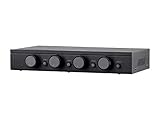
- Connect and safely control multiple speaker pairs with a single amplifier. Automatic impedance protection circuitry.
- 100 watts/channel continuous power handling capacity, 200 watts/channel peak. 5-ohm minimum amplifier impedance with four 4-ohm speakers selected, 6-ohm minimum with 8-ohm speakers.
- Individual zone on/off buttons and volume controls.
- Heavy-duty screw-type connectors supporting 12-18 AWG speaker wire.
- Isolated left/right circuit grounds provide safe connection for amplifiers with floating grounds or bridged configurations. Accurate, noise-free switching.
Maintain polarity. Reversing one speaker’s connections can put the pair out of phase, producing weak bass and an unusually thin or diffuse sound. Do not connect the left and right negative terminals together unless the amplifier documentation specifically permits it. Bridged and floating-output amplifiers can be damaged by assumptions that are safe only with conventional common-ground stereo amplifiers.
How multiple 8-ohm speakers change the load
Parallel wiring connects all positive speaker terminals together and all negative terminals together. For equal nominal impedances, the approximate total load is:
1 / Ztotal = 1 / Z1 + 1 / Z2 + 1 / Z3 ...
| Speakers connected in parallel to one channel | Approximate nominal load |
|---|---|
| One 8-ohm speaker | 8 ohms |
| Two 8-ohm speakers | 4 ohms |
| Three 8-ohm speakers | 2.67 ohms |
| Four 8-ohm speakers | 2 ohms |
These figures are nominal approximations. Real speakers are not fixed resistors, so a system calculated as “2 ohms” may present an even more demanding load at some frequencies. Cable resistance, speaker variation, crossover networks, channel count, and amplifier temperature also affect real-world behavior.
Why A/B speaker outputs can be misleading
On many stereo amplifiers and AV receivers, the A and B terminals are not independent amplifier channels. Activating both sets can electrically place two speaker pairs in parallel on each channel.
For example, two pairs of 8-ohm speakers connected to A and B may create an approximately 4-ohm load per channel—not two separate 8-ohm loads. Some receivers therefore specify a higher minimum impedance when both A and B outputs are active. Check the manual for the exact model before using both outputs.
What changes with each amplifier rating?
Amplifier rated for a 6-ohm minimum
One 8-ohm speaker per channel is normally acceptable because 8 ohms is above the stated 6-ohm minimum. Two 8-ohm speakers in parallel produce an approximately 4-ohm nominal load, which is below that minimum. Do not use that arrangement unless the exact amplifier documentation explicitly allows it.
Rank #3

- Up to 4 Separate Speaker Pairs to Your Stereo System - Dimensions: 7.48- Inches(W) x 1.97- Inches(H) x 4.72- Inches(D)
- Accepts Speaker Wires up to 14-Gauge
- Handles 100Watts per Channel w/ Speaker Systems That Have Minimum Impedance of 8 Ohms
Amplifier rated for a 4-ohm minimum
One 8-ohm speaker per channel is normally acceptable. Two 8-ohm speakers in parallel produce an approximately 4-ohm nominal load and may be within the published rating. Before using the arrangement, verify that the 4-ohm specification applies to continuous operation, the intended channel configuration, simultaneous A/B outputs, and the volume levels you plan to use.
Amplifier rated for a 2-ohm minimum
One 8-ohm speaker and two 8-ohm speakers in parallel are normally within the nominal load limit. Four 8-ohm speakers in parallel approach 2 ohms, but that is an operating-limit situation rather than a comfortable margin. Actual impedance dips, heat buildup, wiring, and the number of active channels matter.
A 2-ohm rating on a car amplifier, for example, should not automatically be applied to bridged operation or to a home-theater receiver. Amplifiers may have separate ratings for stereo, bridged, multi-channel, and high-temperature operation.
Crashes, No Sound, or Screen Glitches?
Random freezes, missing sound and display glitches usually trace back to one bad driver. Find and replace yours safely.Free scan · under a minuteWindows Errors? Fix Them Before They Spread
Repair common Windows errors and clear accumulated junk for a smoother, more stable PC - no reinstall needed.Free scan · no reinstallSeries wiring: safer for the amplifier, but not automatically better
Series wiring connects the positive terminal of one speaker to the negative terminal of the next, with the amplifier connected to the two remaining outer terminals. Two nominal 8-ohm speakers in series present approximately 16 ohms.
A higher impedance is generally an easier electrical load for the amplifier, but series wiring changes the voltage distribution and can change system level and frequency response. The speakers also interact through their crossover networks. Use series wiring only when the system design calls for it; it is not a universal substitute for a correctly rated multi-speaker installation.
Do not confuse lower impedance with more usable speaker power
At a given amplifier voltage, a lower impedance can draw more current and may allow more output power if the amplifier’s power supply and output stage are designed for it. That does not mean an amplifier should be forced to drive a 2-ohm load.
Rank #4

- Connect and safely control multiple speaker pairs with a single amplifier. Automatic impedance protection circuitry.
- 100 watts RMS per channel power capacity. 5-ohm minimum amplifier impedance with four 4-ohm speakers selected, 6-ohm minimum with 8-ohm speakers.
- Supports 12-16 AWG speaker wire. Individual zone on/off buttons.
- Heavy-duty screw-type connectors.
- Isolated left/right circuit grounds provide a safe connection for amplifiers with floating grounds or bridged configurations. Accurate, noise-free switching.
Check the minimum supported load first. Then consider amplifier power, speaker sensitivity, listening level, ventilation, and thermal headroom. A system that is technically rated for a low impedance can still overheat or clip if it is operated continuously at high output in a poorly ventilated location.
What’s actually slowing this PC down?
Pick the symptom - the matching free tool is one click away.
When an impedance-matching selector is appropriate
For one pair of 8-ohm passive speakers, an impedance-matching device is usually unnecessary. Suitable speaker cable and properly compatible terminals are generally all that is needed. Speaker wire does not change the impedance and cannot make an unsafe load safe.
For multiple speaker pairs or multi-room installations, an impedance-matching speaker selector can be useful. An impedance-matching selector or volume control is designed to help maintain a sufficiently high load for the amplifier when several speaker pairs are connected. Selectors and controls may have settings based on the number and impedance of the connected pairs.
Use such a device only as part of a properly designed system. It is not a substitute for checking the amplifier manual, and an ordinary resistor, generic speaker wire, or random 8-ohm speaker should not be presented as a fix for an overloaded amplifier.
Constant-voltage and powered-speaker exceptions
This guidance assumes conventional passive, low-impedance speakers connected to a matching power amplifier or receiver.
Do these 3 things before closing this tab:
1Repair Windows errors before they cause bigger problems2Scan for outdated or missing drivers - takes under a minute3Clear out junk files and repair common Windows errors- Powered speakers: These contain their own amplifiers and normally connect through line-level or other appropriate signal connections—not to a conventional amplifier’s speaker outputs.
- 70V and 100V distributed audio: These systems use different amplifier architecture and transformer taps. A product may support 70V/100V operation and also provide an 8-ohm low-impedance bypass, but those are distinct operating modes.
- Bridged amplifiers: Bridging changes the voltage seen by the load and commonly raises the minimum permitted speaker impedance. Use the bridged-mode specification, not the ordinary stereo specification.
Model-specific installation checklist
- Identify the speaker type. Confirm that the speakers are passive and low impedance—not powered or part of a 70V/100V constant-voltage system.
- Find the amplifier’s minimum impedance. Read the manual for the exact channel, output mode, number of active channels, and A/B setting.
- Count speakers per channel. Do not count only the total number in the room; determine how many are electrically connected to each channel.
- Determine the wiring. Parallel connections lower the load; series connections raise it. A/B outputs may still be parallel internally.
- Calculate the nominal load. Two 8-ohm speakers in parallel are approximately 4 ohms; four are approximately 2 ohms.
- Check for an impedance setting. Some receivers require a menu or rear-panel setting when lower-impedance speakers are used. Use the setting specified by the manufacturer.
- Make safe connections. Power off first, observe polarity, use suitable two-conductor cable, and remove stray wire strands.
- Test gradually. Begin at low volume and watch for audible clipping, excessive heat, repeated protection shutdowns, distortion, or unusual smell.
- Stop if the amplifier struggles. Do not repeatedly reset a protection circuit or continue operating an amplifier that becomes excessively hot. Reduce the load, improve ventilation, change the wiring, or use an amplifier designed for the configuration.
Bottom line for common installations
One 8-ohm passive speaker connected normally to each channel is generally safe with an amplifier whose published minimum load is 6, 4, or 2 ohms. The risk begins when multiple speakers are placed in parallel, when A/B outputs are used simultaneously, or when the amplifier is bridged or otherwise operated outside its ordinary stereo mode.
Best Value
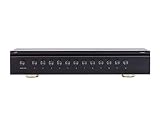
- 12-Zone speaker selector that allows you to connect up to 12 pairs of speakers or 12 listening zones and control each zone with front panel push-buttons.
- Utilizes audiophile-grade impedance-matching transformers to safely distribute maximum power throughout your system.
- Easy to use front panel switch to choose between sources.
- Includes 6 shingle clips and 2 Spacers.
- Turns on when at least 10in of sensor wire detects moisture and has a temperature of +39.2 degree F. Turns off at +44.6 degree F or no moisture is detected.
If the installation has several speaker pairs, use the amplifier’s documented multi-speaker limits and consider an impedance-matching selector or volume-control system. If the manual does not clearly cover the proposed wiring, do not rely on the number printed on the front panel—verify the exact model and operating mode first.
Frequently Asked Questions
Can I connect an 8-ohm speaker to a 6-ohm amplifier?
Yes, normally. A single 8-ohm passive speaker is a higher-impedance load than the amplifier’s 6-ohm minimum. Check the exact amplifier manual because channel, thermal, A/B-output, or bridged-mode requirements can differ.
Can I connect 8-ohm speakers to a 4-ohm amplifier?
Yes, normally. One 8-ohm speaker per channel is above a 4-ohm minimum. Two 8-ohm speakers in parallel are approximately a 4-ohm nominal load and may be acceptable only if the amplifier is rated for that configuration.
Recommended Free Tools
What impedance do two 8-ohm speakers make?
Two 8-ohm speakers in parallel are approximately 4 ohms; four are approximately 2 ohms. Real speaker impedance varies with frequency, so these are planning values rather than guaranteed minimums.
Can I use two pairs of 8-ohm speakers on A and B outputs?
Not necessarily. On many amplifiers, A and B outputs place two speaker pairs in parallel on each channel. Check the manual because the minimum permitted impedance may increase when both output sets are active.
Does thicker speaker wire make a low-impedance load safe?
No. Speaker cable does not change the load impedance and cannot make an amplifier-safe. For multiple speaker pairs, use a documented impedance-matching selector or volume-control system, or use an amplifier designed for the calculated load.
The Bottom Line
One 8-ohm speaker per channel is normally compatible with a 6-ohm, 4-ohm, or 2-ohm minimum-rated amplifier. Verify the manual before wiring multiple 8-ohm speakers in parallel, using A/B outputs, or operating in bridged mode.
Quick Recap
Product prices and availability are accurate as of the date/time indicated and are subject to change. Any price and availability information displayed on Amazon at the time of purchase will apply.

