Water usually pools beside a foundation because roof runoff is being concentrated there, the ground is flat or slopes toward the house, soil has settled, or paving has created a low spot. Start by giving every downspout a safe outlet, then restore a slope away from the foundation. Use a swale or surface drain when the site cannot be graded, and reserve footing drainage for persistent below-grade moisture or water entry.
Do not install a drain simply to move the problem underground. Every drain needs a permitted destination that will not send water back to the house, erode a neighbor’s property, or overload a foundation-drain system.
As an Amazon Associate I earn from qualifying purchases.
Why water collects beside a foundation
Roof runoff is concentrated at the walls
Rain falls over the entire roof but leaves through a small number of gutters and downspouts. If a downspout ends beside the wall, that concentrated flow can saturate the soil next to the foundation. The U.S. Department of Energy’s Building Science Education guidance warns that roof water can move through saturated soil and reach the foundation when it is not drained away.
What’s actually slowing this PC down?
Pick the symptom - the matching free tool is one click away.
A missing, blocked, undersized, or disconnected gutter can have the same effect. Look for overflowing gutters during rain, staining below a gutter joint, or a downspout that empties onto a narrow strip of soil beside the house.
#1 Best Overall

- Low Profile Design. This catch basin can be installed without deep digging. You no need to connect to the downspout. Perfect for underground using. Able to route the water in another direction so the water won’t flood the open patio.
- Pipe Size: Inside Diameter: 2 inches; Outside Diameter: 2.4 inches. Extendable Flexible Pipe from 4.6ft to 16.4ft. The pipe and catch basin are separate, you need to assemble them together.
- Durable Flexible Pipe. The flexible pipe is made of high quality material. Makes it has a long service life under ground. Drains rainwater via this pipe. Reduce damage to foundations from rainwater.
- Flexible Pipe. You can change its shape and length according to your needs. If this length does not meet your needs and you need longer pipe for installation. You can get another 8.2ft pipe(2" ID) from the accessory which sold separately.
- Easy to Assemble and No Leaking. No adapters needed for pipe connections. Just expand the pipe and screw it in the connector.
The finished ground is flat, inward-sloping, or settled
Surface water should fall away from the building. Backfill placed around a new foundation often settles, creating a trough that catches runoff. A slope that looked correct at construction can therefore become a low spot a few seasons later. Poor compaction, erosion, or landscaping that adds soil against the wall can produce the same result.
Hardscape sends water toward the house
Concrete walks, patios, driveways, pool decks, and paver areas do not absorb rainfall. If they slope toward the foundation, or if a low point forms where paving meets the wall, runoff can collect at the most vulnerable edge of the building. A surface that is nearly level may also hold water long enough to seep through joints or cracks.
The site has too little room for a simple slope
Narrow side yards, retaining walls, property lines, steep sites, heavy rainfall, and slow-draining soils can make ordinary grading inadequate. In those situations, a swale, area drain, or French drain may be appropriate, but only if its outlet and capacity are designed for the site.
Pooling may be the visible sign of a below-grade problem
A puddle does not prove that the footing drain or foundation has failed. It does warrant checking the basement, crawlspace, and foundation walls. Persistent dampness, mold or mildew odors, rotting materials, efflorescence, erosion, or new and changing cracks indicate that surface drainage alone may not be the whole problem.
Diagnose the source before choosing a fix
Inspect during or shortly after a substantial rain, not only on a dry day. Trace the water from where it first appears to where it stops. Use this sequence:
Rank #2

- Low-profile Drain System: Dimensions of each channel: 5.9" W x 5.1" H x 39.4" L. Commercial water drainage systems allow safe and efficient drainage for grassed areas, gardens, farms, patio areas, pool sides, office buildings, driveways, or factory interiors. The anti-flotation design prevents floating and doesn’t require staking when setting in concrete.
- Easy & Quick Installation: You can connect these trench drains together for extra length. The interlocking design connects the drains tightly with no potential leak of water. Detachable grate can be manually installed and detached easily, needs no screws or bolts. It also provides a convenient way to clean the drain if it is bunged up.
- Various Outlet Connections: Each trench drain provides a bottom outlet with multiple sizes(3.1 inch/ 3.6 inch), and a side outlet(2.2 inch). You can choose the size you need. No outlet connector is required because it is already built-in; thus, the pipe can be connected directly. Kind Reminder: The 3.1" outlet fits standard 3" pipes. For 3.6" and 2.2" outlets, choose pipes accordingly
- Durability & High Performance: Sturdy HDPE plastic creates a hard and durable structure. The load capacity is A125. The HDPE plastic provides a smooth interior surface, which allows faster water intake.
- Complete Packing List: This trench drain kit comes with six drains with built-in bottom outlets, six plastic grates, and six end caps. Plus, the outlet connector is already built-in. All the accessories that you may need are included.
- Map the puddle. Mark its edges and note whether it forms at a downspout, at a corner, where two paved surfaces meet, or along an entire wall. Record how long it takes to disappear.
- Check the roof-drain system. Confirm that every gutter is continuous, clear, and discharging through a downspout. Watch for overflow at seams and for water spilling behind the gutter.
- Follow each downspout. Identify whether it ends at the foundation, points toward the house, discharges onto a flat area, or connects to an unknown underground line. Check for crushed extensions and buried outlets blocked by soil.
- Check the ground level. Sight along the soil or use a long level to find inward slopes and settled depressions. Look for mulch or fill covering siding, weep holes, or other required clearances.
- Inspect hardscape joints and edges. See whether a patio, walk, or driveway has cracked, settled, or lost its original fall away from the wall.
- Look inside at the same time. Inspect basement and crawlspace corners, sill plates, insulation, and stored materials for dampness or staining. Note whether water enters only after rain or remains when the weather is dry.
- Check for movement and erosion. Exposed soil, washouts, displaced gravel, and new foundation cracks can show where water is traveling or whether the site is changing.
These checks follow moisture-control items identified by the U.S. Environmental Protection Agency, including landscape diversion, soil settlement, roof-drain leaders, and foundation cracks. They are a screening process, not a structural diagnosis.
Redirect water in the order that usually works
1. Make gutters and downspouts discharge safely
Clean leaves and sediment from gutters, repair leaking joints, and verify that the system can carry the roof area during local storms. Add a solid-wall extension or solid conveyance pipe when the existing outlet is too close to the building. The DOE guidance calls for discharge onto sloping ground more than 5 feet from the foundation, or into an underground catchment more than 10 feet away that is separate from the foundation drain system.
Crashes, No Sound, or Screen Glitches?
Random freezes, missing sound and display glitches usually trace back to one bad driver. Find and replace yours safely.Free scan · under a minutePC Slower Than It Used to Be?
A free scan shows the junk files, broken settings and background clutter dragging Windows down - then fixes them in one click.Free scan · Windows 10 & 11The outlet must be somewhere that can accept the flow. A downhill lawn, approved stormwater connection, drywell, or other permitted dispersal area may work; a neighbor’s lot, a retaining-wall base, or a spot that flows back toward the house does not. Protect an outlet on bare or steep soil against erosion with an appropriate splash block, rock apron, or other erosion-control measure.
If you collect roof water in a rain barrel or cistern, provide an overflow route. A full tank without overflow drainage simply moves the discharge problem to the tank base.
2. Restore the surface grade
For permeable ground, the Pacific Northwest National Laboratory’s Building America Solution Center recommends a fall of at least 0.5 inch per foot for 10 feet away from the foundation. That is a 5% slope: a point 10 feet from the wall should be about 5 inches lower than the point at the wall. Apply the check on every side, including behind additions and at corners where grades often reverse.
Rank #3

- 【 Easy to install 】 The Yard Drain Emitter is combined with a 4-inch connector, eliminating the hassle of finding an adapter. This combination is suitable for 4-inch drainage pipes and provides a perfect connection. Please check if your drainage pipe has an inner diameter of 4 inches/outer diameter of 4.5 inches
- 【 Better Quality 】 The overall weight of this combination is 3.2 pounds, with a wall thickness of 0.24 inches providing sufficient support, making your courtyard drainage system more sturdy and durable
- 【 Fix courtyard drainage 】The inclined drainage design seamlessly integrates with the courtyard. The drainage grate can effectively block the entry of organisms, facilitate the smooth discharge of sewage and rainwater, match the color of the grassland, and its pre tilt matches the soil slope
- 【Durable structure】 The grille can be easily disassembled with just two stainless steel screws, making cleaning simple and convenient., made of heavy-duty abs plastic, ensuring long-lasting performance in various weather conditions
- 【Drainage solution】This downspout extension is compatible with French style drainage pipes and is highly suitable for residential and commercial applications. This well made drainage grate can last for a long time. If there are any problems with the drainage device, please contact us and we will correct them
Use clean, compactable soil for a minor correction and shape it so water does not pond at the outer edge. Do not bury siding, vents, drainage openings, or other required clearances while adding soil. A landscape rake is suitable only for small, shallow adjustments; a deep settlement pocket may require removing unsuitable fill and rebuilding the grade in compacted lifts.
Free tools Windows power users keep installed
One-click scans. No signup required.
PNNL’s guide summarizes a 2% slope requirement for impervious surfaces within 10 feet of the foundation in the 2009, 2012, and 2015 International Residential Code editions. That is historical model-code information, not a guarantee of the rule at a particular address. Confirm the currently adopted building and stormwater provisions with the local authority before altering a paved surface or connecting to a public system.
3. Add a swale where there is room
A swale is a shallow, shaped depression that intercepts runoff and carries it across the site. It can be preferable to burying a pipe when the ground can be graded continuously to a safe outlet. PNNL’s localized-flooding guidance describes a swale geometry with a 3-to-1 width-to-height ratio and a longitudinal slope of 2% to 4%; actual dimensions must be matched to runoff volume, soil, vegetation, and available space.
Keep the swale far enough from the foundation that overflow cannot return to the wall. Stabilize the channel with vegetation or other erosion control suited to the flow. A swale that ends at a property line, a basement window well, or a steep unprotected bank is not a complete drainage design.
4. Use an area drain or French drain for a defined low point
An area drain collects water at a grate and carries it through solid pipe. It is useful where runoff gathers at one identifiable low point, such as the bottom of a driveway or a patio corner. Keep leaves and sediment out of the grate and provide access for cleaning.
Recommended Free Tools
Rank #4
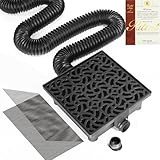
- 🏆【US Patented Design】 Patent No. D1018796.
- 🏆【Material Introduction】Catch basin and "Flexible/ Shapeable Pipe" is made of premium PP To ensure high strength while maintaining high shrinkage, Pipe can extension from 2 .5ft to 8ft. Can be spliced for longer length. Durable, antifreeze explosion proof and no creases, no hole, won't be damaged, andUV resistant to withstand all outdoor elements. Buried underground will not corrode.
- 🏆【NAACOO Unique Design】①Catch basin has double drain holes, improves efficiency. 8Ft Pipe can be cut into two use for drainage on both sides. If you only need one side drain, the other side can be blocked with provided Blockage. ②Catch Basin Special Slope Design - Won't accumulate water and dirt. and Blocked side will not leak water. ③Flexible pipe can be extended and shortened flexibly according to your needs. easily divert rainwater where you want.
- 🏆【Other Advanced Design】①No digging required, Different from traditional catch basin. ②Low profile design can be hidden by covering with mulch. ③Pipe install on catch basin never fall off. ④Debris Catcher Included:GRATE - filter large leaves or some other debris to prevent the block to the pipe, GIFT SCREEN - use for smaller imperities. meet your more needs. ⑤Flexible pipe holds its shape to Adapt more complex environment, and pipe can be spliced for longer length.
- 🏆【Widely Used】High compatibility can be suitable for 2X3 inch, 3x4 inch and 3x3 inch downspout(all standard residential downspouts). This flexible gutter pipe can extension and holds its shape and can be extended from 2.5feet to 8feet. So as to meet any environment needs. prevents foundation damage by diverting rain water around landscaping, Solve difficult irrigating garden and so on.
A French drain generally uses a perforated pipe surrounded by washed drainage rock and wrapped or separated with filter fabric. It collects water along a trench rather than at one grate. Place it on the uphill side of the problem when it is intended to intercept groundwater or sheet flow, and give the pipe a continuous fall toward a daylight outlet, drywell, or other approved destination. Filter fabric and clean stone reduce, but do not eliminate, clogging; the system still needs an outlet that can be inspected or maintained.
Neither drain fixes an inward-sloping surface by itself. If roof water continues to arrive beside the foundation, the drain may fill rapidly, clog with sediment, or discharge more water than the outlet can handle.
5. Consider footing drainage for continuing below-grade moisture
A footing drain is a subsurface system installed outside the footings, typically with perforated drain tile surrounded by washed stone and protected by filter fabric. It is intended to relieve water pressure and collect water below grade, not to cure a small surface puddle. PNNL recommends correcting basic roof-water and surface-grade problems first, then considering drain tile if elevated moisture remains.
Because installing or repairing one normally requires excavation beside the foundation, the work can affect footings, waterproofing, utilities, landscaping, and neighboring property. Collected water still needs a safe discharge point or sump system. Obtain a site-specific assessment before excavation where water enters a basement or crawlspace, the foundation is deep, or the proposed route is close to a footing.
Compare drainage options by the problem they solve
| Option | Best fit | Space and routing | Disruption and maintenance | Approval or design concerns |
|---|---|---|---|---|
| Gutter repair and solid downspout extension | Roof runoff discharged beside the wall | Needs a continuous route to sloping ground or a permitted catchment | Low disruption; gutters and outlets require periodic cleaning and inspection | Do not discharge toward a building, property line, or prohibited connection |
| Surface regrading | Flat, inward, or settled permeable soil | Requires enough setback to create a continuous fall | Usually low to moderate disruption; recheck after settlement and major storms | Maintain siding, vents, windows, and other clearances; verify local grade rules |
| Swale | Runoff crossing a broad area where open space exists | Needs width, a designed longitudinal slope, and a stable outlet | Moderate earthwork; vegetation and erosion controls need maintenance | Overflow and discharge may be regulated, especially near property lines or waterways |
| Area drain | One concentrated surface low point | Needs a grate, solid pipe, and accessible outlet | Moderate installation; grate and pipe need cleaning | Confirm capacity and legal discharge destination |
| French drain | Linear sheet flow or a persistent shallow low spot | Needs trench space, pipe fall, and an outlet or dispersal area | Excavation is disruptive; sediment and root intrusion can reduce performance | Design must account for soil, flow, filter fabric, and local stormwater rules |
| Footing drain or sump system | Persistent below-grade water pressure or water entry | Requires subsurface routing and a reliable discharge or pump system | High disruption and excavation; pumps and outlets require ongoing maintenance | Use professional assessment where footings, waterproofing, utilities, or neighboring property could be affected |
Installation details that prevent common failures
Downspouts
- Use solid pipe for conveying roof water. Perforated pipe is intended to collect water along its length, not to carry a concentrated downspout flow.
- Keep joints tight and support extensions so they do not lift, separate, or drain against the wall.
- Check the outlet during a storm. Water should leave the extension freely rather than back up, spill over the side, or disappear into an unverified buried connection.
- Where an underground catchment is used, keep it separate from the foundation drain system and provide access for inspection or maintenance.
Grading and hardscape
- Remove debris and loose organic material before placing corrective soil.
- Build the intended fall across the full problem area, not just a narrow berm immediately against the wall.
- For patios, walks, and driveways, correct the underlying settlement or add a properly located drain; simply sealing a joint will not stop water that is flowing toward the foundation.
- After the first heavy rain, walk the entire edge and mark any new low spots for correction before they become established channels.
Swales and buried drains
- Identify the outlet before digging. A route that has no legal or hydraulically workable destination should not be installed.
- Keep excavated soil and rock from blocking window wells, vents, cleanouts, or access paths.
- Use erosion control at daylight outlets and at changes in slope.
- Provide cleanouts or accessible grates where maintenance will otherwise require excavation.
Failure modes and how to correct them
The puddle returns after a new downspout extension
The extension may be too short, may drain onto flat ground, or may be pointed back toward the building. Recheck the fall all the way to the outlet and watch the discharge during rain. If the outlet area cannot accept the volume, redesign the conveyance or use an approved catchment rather than adding more pipe at the same location.
Best Value
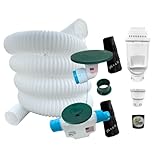
- NO TOOLS NEEDED - Our goal at French Drain Man is to make your underground downspout project as easy as possible. That means you won’t need to dig out any tools. All you need is a shovel to dig your trench.
- EASIEST DOWNSPOUT KIT ON THE MARKET - 3½ pipe is the easiest drainage pipe to install and requires less labor compared to 4 in. pipe. You don’t have to dig as deep of a trench to reach a desired slope and one person can easily handle the pipe and lay it in the trench.
- CONVENIENT ALL IN ONE PACKAGE - No more driving around to multiple stores for different parts that fit. French Drain Man has already done the legwork for you and provide everything you need in one downspout extensions kit.
- KEEPS FOUNDATIONS DRY - Underground downspout extensions transfer roof runoff water far away from the home and protect your foundation, basement and landscape from water damage.
- KIT INCLUDES: 19 ft. Coil of 3½ in. High Octane Extreme Duty Solid Corrugated Pipe in white, Vented Downspout Clean Out Leaf Filter, Pop-Up Emitter & Turf Restrictor Plate with 3 ft x 4 ft of filter fabric, Catch Basin with riser and 3 ft x 4 ft of filter fabric, 1 roll of FDM’s 200 Year Tape – Extra Sticky & Extra Stretchy for making watertight junctions and connections.
A French drain fills with water or stops working
Common causes include no continuous pipe fall, silt entering the trench, crushed or root-filled pipe, an undersized outlet, or roof water being sent into a system intended for shallow collection. Expose an accessible section or cleanout, verify flow toward the outlet, and correct the source water before replacing the trench.
Grading looks correct but the basement remains damp
Water may be entering through a crack, a window well, a plumbing penetration, a failed waterproofing layer, or a footing-drain problem. Check whether the dampness occurs only after rain and whether it is localized or continuous. Continued entry after roof runoff and surface grades are corrected is a reason for a professional assessment rather than deeper landscaping.
Water is redirected onto a neighbor’s property
Moving water across a property line can create erosion, nuisance, or code problems even when the original puddle is gone. Stop the discharge and consult the local stormwater authority or a qualified drainage professional about an on-site or approved off-site solution.
Quick wins for a faster PC:
Repair Windows errors before they cause bigger problemsFix Now →Fix the driver behind crashes, sound loss and screen glitchesFind Drivers →Maintenance after the work
Inspect gutters and downspout outlets at least seasonally and after severe storms. Remove leaves from grates, confirm that extensions have not shifted, and clear sediment from splash areas before it forms a channel back toward the house. Walk swales and exposed outlets for erosion, blocked vegetation, and standing water. Recheck soil grades after freeze-thaw cycles, construction nearby, or any landscaping that adds fill.
Keep a simple record of when puddles appear, how long they last, and whether interior dampness changes. A pattern that worsens despite maintenance is useful information for a contractor or drainage engineer.
When professional help is warranted
Arrange a site-specific evaluation when water enters a basement or crawlspace, pooling continues after gutters and grading are corrected, the proposed drain has no obvious safe outlet, excavation would run alongside footings, or a drainage change could affect a neighbor. The appropriate professional may be a drainage contractor, foundation specialist, civil or geotechnical engineer, or the local building and stormwater office, depending on the problem.
Local rules control many discharge choices, including connections to public systems, drywells, swales near property lines, and work affecting waterways. The DOE and PNNL recommendations are U.S. residential guidance; apply the requirements adopted in your jurisdiction and confirm them before construction.
Quick Recap
Key measurements and source guidance
- Surface grade: PNNL’s Building America Solution Center final-grade guide, last updated September 30, 2020, recommends at least 0.5 inch per foot for 10 feet on permeable surfaces.
- Roof-water discharge: DOE Building Science Education guidance calls for more than 5 feet to sloping final grade or more than 10 feet to a separate underground catchment; the page does not show a publication year.
- Impervious surfaces: PNNL summarizes a 2% slope away from the foundation for impervious surfaces within 10 feet in the 2009, 2012, and 2015 International Residential Code editions. Confirm current local adoption.
- Swales: PNNL’s localized-flooding guide, last updated July 26, 2022, discusses a 3-to-1 width-to-height ratio and a 2% to 4% longitudinal slope for the swale design described there; site-specific runoff and soil conditions still control the final design.
Product prices and availability are accurate as of the date/time indicated and are subject to change. Any price and availability information displayed on Amazon at the time of purchase will apply.

