A cured-in-place pipe (CIPP) liner can fail because of coating damage, poor heat management during cure, resin or installation problems, or a host pipe whose geometry was not suitable for relining. The same visible symptom can have several causes: a pinhole may be a manufacturing defect, transport damage, installation damage, or a cure-related coating failure. CCTV can document what is present, but it usually cannot prove the underlying cause by itself.
Treat leakage through the liner wall, persistent staining, major wrinkles, dry spots, inclusions, pinholes, and delamination as conditions requiring documented follow-up. Compare the observed defect with the project specification, cure records, manufacturer requirements, and the host-pipe geometry before selecting a repair. Do not diagnose an entire installation from one generic symptom.
As an Amazon Associate I earn from qualifying purchases.
What counts as a CIPP liner failure?
A CIPP installation is intended to form a continuous, structurally or hydraulically functional pipe inside the host pipe. NASSCO specification guidance identifies visual defects including foreign inclusions, dry spots, pinholes, major wrinkles, and delamination. Leakage through the liner wall is also treated as a defect. A liner can therefore be unacceptable even when it has not collapsed: water-tightness, flow capacity, durability, and structural performance are separate concerns.
What’s actually slowing this PC down?
Pick the symptom - the matching free tool is one click away.
Failure may be localized or systemic. One gouge, pinhole, or wrinkle can be limited to a short section, while repeated bubbles, regularly spaced pinholes, or similar defects at multiple locations may indicate a manufacturing, handling, resin, or cure problem affecting more of the reach. A post-installation leak or stain warrants investigation rather than automatic acceptance or replacement.
#1 Best Overall

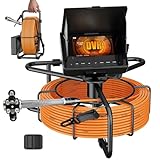
- 【Real 1080P High Definition Waterproof Lens】 Drain camera Equipped with a 1080P full HD camera and high brightness LED lighting, providing sharp and clear real-time images. IP68 waterproof and dustproof design, can penetrate deep into damp and greasy pipelines, without fear of water stains and dirt, allowing cracks and blockages to be visible
- 【100 FT Ultra Long Cable】The snake camera equipped with a 30 meter (approximately 100 feet) high toughness semi-rigid cable. It can easily penetrate into hard to reach areas such as long pipelines and large tanks, and detect blind spots at deep distances. Cable tape distance scale markings help you accurately locate problem points and improve detection efficiency
- 【5-inch Large Screen Real-time Display】 The 5-inch DVR high-definition display screen supports real-time viewing and synchronous recording.The plumbing camera equipped with a built-in 32GB storage card, it can take photos/videos with just one click, save detection evidence, facilitate subsequent analysis, generate reports, or share with customers
- 【Integrated Portable Tool Box】 The inspection camera system adopts that the host combine together with an orange sturdy tool box innovatively, make it easy to store and ready to use. All accessories (such as lenses, hooks and so on.) can be stored in an orderly manner in the box to avoid loss and facilitate easy carrying to any work site, achieving ready to use upon opening the box
- 【Widely Compatible】 Pipe camera made of sturdy shell design, durable and long-lasting. Widely used in various industrial and household scenarios such as pipeline dredging, house inspection, and automobile maintenance. KCapyn pipe snake is an efficient and economical choice for professionals and DIY enthusiasts
Defect categories
| Observed condition | Primary concern | What it can and cannot establish |
|---|---|---|
| Leak through the liner wall or visible infiltration | Water-tightness and possible long-term liner deterioration | Confirms a leakage condition; does not by itself identify whether the cause is a pinhole, seam, delamination, host movement, or cure problem. |
| Pinhole or small bubble that opens | Coating continuity and localized leakage | May be associated with coating defects, transport or installation damage, or heat damage; CCTV cannot normally distinguish those causes alone. |
| Wrinkle, fold, or bulge | Reduced hydraulic area, obstruction, or stress concentration | May reflect host geometry, insufficient fitting, pressure or calibration problems, or curing behavior. |
| Dry spot, resin-starved area, inclusion, or delamination | Loss of material continuity or bond and possible structural weakness | Visible condition requiring evaluation against the design and specification; the visible surface does not reveal full depth. |
| Crack, gouge, or abrasion | Damage to coating or laminate | Indicates a physical defect; extent and effect require location, dimensions, leakage status, and system-specific evaluation. |
Why does a cured-in-place liner fail?
Coating defects and damage create pinholes
Thermoplastic coatings can contain defects introduced during manufacture. NASSCO’s Technical Advisory Council gives regularly spaced pinholes as an example that could be associated with a rough roller surface during manufacturing. Small bubbles or blisters may be scattered or may extend along a section. Where groundwater is present, a bubble that develops into a pinhole can become an infiltration path.
Damage can also occur after manufacture. Folding, dragging, sharp edges, poor lifting practices, contact with debris, or an installation tool can score or puncture the coating. A pattern that repeats at regular intervals may point toward a production process; isolated damage at a bend, access point, or obstruction may be more consistent with handling or installation. Those are investigative hypotheses, not conclusions from appearance alone.
Inadequate heat removal during steam cure
Steam curing is a heat-management process, not simply a matter of reaching a stated steam temperature. NASSCO notes that steam may reach up to about 240°F or more in the conditions discussed in its advisory, while the resin’s exothermic reaction can rise well above 300°F. These figures describe the advisory’s subject and are not universal cure settings.
If exothermic heat is not removed adequately, the thermoplastic coating can be damaged. Adequate air and steam flow are described as general heat-removal measures. A new CIPP installed inside an existing CIPP or a plastic host pipe presents an additional problem: the surrounding material can insulate the system and retard heat transfer. Depending on the approved system, the manufacturer may require a modified catalyst mix, a modified cure procedure or schedule, or water cure. No single field recipe should be substituted for the system’s instructions.
Resin preparation and material control
Resin errors can produce areas that do not cure as intended or that lack the required properties. NASSCO quality-control guidance recommends using the manufacturer’s resin ratios and mixing times, a suitable mixing device, and methods that avoid air entrainment. The mixture should be monitored, and resin showing hardening or crystallization should be rejected.
These controls reduce risk but do not prove the cause of a particular defect. An investigation should seek batch information, resin identification, mix records, ambient conditions, impregnation details, and cure logs when they are available. A dry spot, soft area, or delamination can have more than one possible mechanism, including resin distribution, pressure, temperature history, contamination, or movement during installation.
Rank #2
- 🔍 Crystal Clear AHD 1080P Inspection & Night Vision: This sewer camera boasts an AHD 1080P high-definition camera with 12 adjustable LED lights. The IP68 waterproof stainless steel probe and 145° wide-angle lens provide a crystal clear view inside dark pipes, making it the ideal drain inspection camera for identifying clogs, cracks, and damage with ease.
- 📹 Built-in DVR with 32GB TF Card for Record & Playback: Document every finding effortlessly! This pipe camera with DVR comes with a pre-installed 32GB card. Instantly record video and capture photos of your findings directly on the device. Review evidence on the spot or playback on your PC for detailed analysis, perfect for plumbing inspection reports and insurance claims.
- 🛡️ Rugged, Professional-Grade Cable & Depth Marker: A sewer inspection camera to conquer the toughest blockages. The 30M (100FT) fiberglass cable is anti-corrosion, cold-resistant, and highly tensile. With clear depth markers (Arabic numerals), you can accurately locate pipe problems like clogs or leaks without guesswork. The 23mm camera head navigates standard drain pipes with ease.
- ☀️ 4.3" HD Monitor with Sun Visor & Marathon Battery: Professional plumbing camera is designed for all-day use. The large 4.3" IPS monitor with a built-in sun visor ensures perfect visibility even outdoors. Powered by a high-capacity 8500mAh rechargeable battery, this sewer inspection system supports up to 10 hours of continuous work, outperforming many competitors.
- 💪 2 Protective Heads & Versatile Applications: Comes with TWO different camera protective covers (with wheels) to fit a wider range of pipe diameters and inspection scenarios. This versatile pipe inspection kit is a must-have for homeowners, plumbers, and contractors to diagnose issues in drain pipes, HVAC systems, and wall cavities, saving you thousands on unnecessary repairs.
Handling, calibration, and installation controls
Before installation, quality-control checks should include visible liner damage, wrinkles, folds, alignment, and the specified length and diameter. Calibration tube placement, dimensions, compatibility with the cure mechanism, and pressure should also be checked. A calibration tube that is misplaced, incorrectly sized, or incompatible with the process can affect how the liner is held against the host pipe and how the cure develops.
Installation records are particularly important when a defect is found. Record the liner identification, resin system, mixing and impregnation times, inversion or pull-in details, pressures, temperature readings, cure duration, and cool-down or water-management steps required by the project. Missing records do not prove an installation was defective, but they make cause and responsibility harder to establish.
Host-pipe offsets and geometry
A liner conforms to the host pipe; it does not eliminate every geometric problem. NASSCO states that small and medium offset joints may be smoothed by CIPP, while severe offsets can create liner abnormalities and operation and maintenance concerns. Its advisory, citing ASTM F1216 paragraph 7.1.4, says an offset that reduces cross-sectional area by 40% or more should be repaired before CIPP installation. The same guidance notes that abnormalities can occur as area loss approaches 30–40% or greater.
These percentages are thresholds in that NASSCO guidance, not a universal substitute for the project’s design documents. An offset can produce a wrinkle, a fold, a narrowed opening, or a snag point even when the liner material and cure are otherwise sound. Measure or estimate the area loss from the inspection and compare it with the applicable contract criteria before deciding whether the liner itself failed.
How to diagnose a suspected CIPP defect
Diagnosis should proceed from condition documentation to cause assessment and then to repair selection. The goal is to preserve evidence while determining whether the problem is cosmetic, hydraulic, water-tightness-related, structural, or a combination.
Do these 3 things before closing this tab:
1Repair Windows errors before they cause bigger problems2Fix the driver behind crashes, sound loss and screen glitches3Clear out junk files and repair common Windows errors1. Secure the project information
Gather the approved design, product data, submittals, installation method, cure requirements, inspection acceptance criteria, and repair procedure. Confirm the host-pipe material, diameter, length, access points, service conditions, and whether the liner was installed in an unlined host, an existing CIPP, or a plastic pipe. Verify which standards edition and contract requirements govern the work; standards and owner specifications change over time.
Rank #3
![[ChoosePRO®] HD1080P Sewer Camera 7'' w/1s Twist-Unlock System, DVR-32GB, 0.64'' Thicker Reel, 5000mAh 100FT Marked Cable, Plumbing Pipe Inspection Camera for Drain & Sewer Inspection](https://m.media-amazon.com/images/I/51huA5MyryL._SL160_.jpg)
- 【2026 Upgraded Cable Reel Unlock System】:Unlock & lock in just 1s with a simple twist. No more stuck cables or sore hands—coil or release with ease! Unlike market designs sewer camera that leave you struggling with two tiny, hard-to-turn screws—difficult to adjust and tighten properly—one wrong move could lead to cable jams or even permanent damage. Ours comes with all-around upgrades (stability, compatibility, flexibility, security, durability), overcoming many common Weaknesses on the market.
- 【Faster Identify Issues – HD 1080P Camera with 7" IPS Screen】:The sewer camera has a true HD 1080P lens and a bright 7" IPS screen, helping you identify issues faster with a clear view inside pipes. The 16× zoom lets you see small details like cracks, clogs, and rust. Unlike older 1000TVL pipe camera with dark TFT/LCD screen, it shows clear, bright images that make spotting problems easy. Checking your pipes often helps you find leaks early and reduce costly damage to walls, floors, or ceilings.
- 【Record More Videos-DVR with 32GB Card】:This sewer pipe camera lets you view and record in real time with instant playback—no extra devices needed, it helps you quickly identify pipe issues.The 32GB memory card offers more storage than typical 8GB cards. so you can record more videos with your sewer inspection camera, allowing for thorough and accurate analysis.MORE,Easily transfer videos via SD card or USB-C. Save records, share findings, and review footage on your PC with ease.
- 【So Easy, Anyone Can Use It — 8H+ on a Single Charge】:This sewer camera is easy to use—Unlock and lock the cable reel in just 1 second with a simple twist, making it easy to coil or release the cable. Just plug& play the display, and you’re ready to go — no complex setup required.The cable is marked in feet, so you know exactly how deep the issue is—no guesswork. The built-in 5000mAh battery lasts over 8 hours. Need more time? Plug into a power bank (not included) via USB-C, even while in use.
- 【For Most Pipeline Environments—IP68 Waterproof HD Camera】:① The IP68-rated camera head works in wet, dirty, or flooded pipes.② Six adjustable LED lights (3 levels) let you see clearly in dark, deep pipes—so you can spot cracks or blockages fast.③ Comes with 25mm (0.98 in) and 84mm (3.31 in) sleeves to handle small or large pipes.④ A flexible stainless steel spring tip helps navigate bends and corners without getting stuck.
2. Perform a complete post-installation CCTV survey
Inspect the entire lined reach rather than only the reported spot. Record the inspection date, pipe direction, station or distance from a defined reference, clock position, defect length and width, and whether the condition repeats elsewhere. The record should identify every pinhole, bubble, wrinkle, stain, leak, gouge, crack, bump, bulge, inclusion, dry spot, or delaminated area that can be seen.
Use stable reference points and preserve the original video. A short clip without a location reference may show a defect but cannot reliably support repair quantities, comparison with pre-installation footage, or verification after repair. If a consumer pipe-inspection camera is used for initial documentation, treat it as a screening aid: image quality, lighting, centering, distance measurement, and water management may not meet professional sewer-inspection requirements.
3. Separate visible condition from suspected cause
For each defect, write what the camera establishes and what remains uncertain. For example, “water enters at a 3 mm opening at station 118 m” is an observation. “The opening was caused by overheating” is a hypothesis requiring cure records, material evidence, or further testing. Note whether the defect is isolated, regularly spaced, aligned with a joint or service connection, or concentrated near an access point or bend.
The Tool Desk
Outbyte Driver Updater FREEFix the driver behind crashes, sound loss and screen glitchesFind Drivers →Outbyte PC Repair FREEClear out junk files and repair common Windows errorsFree Scan →4. Check for infiltration and staining
Look for active droplets, a steady stream, damp staining, mineral deposits, or discoloration around the defect. A dry camera image does not prove that a defect is water-tight under groundwater pressure. Conversely, staining may be historical and should be interpreted with groundwater level, recent weather, flow conditions, and the owner’s testing requirements.
NASSCO’s advisory treats leaks and staining a year after installation as concerning because infiltration may enter and long-term liner integrity may be affected. A reported leak at any age deserves a documented response; a one-year delay does not make it acceptable.
5. Correlate the defect with geometry and cure method
Compare the defect location with the pre-lining survey. Check for offset joints, sags, bellies, sharp transitions, protruding laterals, roots, debris, abandoned connections, and changes in diameter. Then compare the location with the cure method and temperature history. Heat-related coating damage is more plausible when the pattern corresponds to a section with restricted flow or insulation, but correlation is not proof.
Rank #4

- 1920P HD Resolution: Sewer camera with 7.9mm probe can inspect hard-to-reach places effortlessly. The 2.0MP HD endoscope can observe clear snapshot images (1920x1440 resolution) and high-quality video (1920x1440 resolution) at close range.
- Easy Connection: This borescope inspection camera can easily and quickly connect with IOS 9.0+ Android 7+ system devices through the interface. Search for 'SUP-ANESOK' in the APP store or scan the QR code to download the APP. With simple operations, you can view real-time images on the screen.
- Semi-Rigid Cable & Waterproof Probe: Snake Camera can bend freely and remain semi-rigid. The 16.4ft semi-rigid cable unrolls and rolls up quickly, which provides a good mix of flexibility and rigidity. The IP67 waterproof design allows the camera to operate underwater up to 3.28 feet for 1 hour.
- Wide Applications: Scope camera suitable for various scenes, such as inside the car or around the engine, inside the pipe inspection, or the house inspection mold, and wiring. The brightness-adjustable light enables you to obtain picture information even in dark environments.
- What You Get: Endoscope Camera *1, Android connector*1,Lightning Port*1,Type-C connector,16.4ft Semi-rigid Cable *1, Accessories: Magnet *1, Hook *1, Mirror *1, Protective Cap *1, Manual *1
6. Decide whether additional testing is justified
CCTV is often the first and most informative inspection, but the project may require leakage testing. NASSCO guidance describes visual inspection as common for large-diameter sewers and notes that water exfiltration or low-pressure air testing is limited to specified conditions and smaller pipe sizes. The retrieved older specification excerpt says air and hydrostatic testing should not be performed for sewers over 36 inches because of worker safety; verify the current contract specification and safety plan before relying on that threshold.
Windows Errors? Fix Them Before They Spread
Repair common Windows errors and clear accumulated junk for a smoother, more stable PC - no reinstall needed.Free scan · no reinstallOutdated Drivers Are Slowing You Down
One free scan finds every outdated or missing driver and matches the right update for your exact hardware.Free scan · exact hardware matchTesting must account for pipe size, cure method, access, groundwater, worker exposure, and the owner’s acceptance criteria. Do not improvise a pressure test on a lined sewer. A qualified contractor or engineer should define the test, isolate the reach, control energy, and document the result.
How symptoms help narrow the investigation
Pinholes and small bubbles
Ask whether the pinholes are isolated or regularly spaced, whether bubbles surround them, whether they occur in a band, and whether groundwater is present. Regular spacing can be consistent with a manufacturing-related surface defect; scattered damage near an access point can be consistent with handling; a broad damaged area in a restricted cure environment can raise a heat-management question. None of these patterns replaces manufacturer review or project records.
Wrinkles and folds
Measure the wrinkle’s height, length, orientation, and effect on the opening. Determine whether it is at an offset, bend, connection, sag, or diameter transition. A wrinkle that reduces flow, catches debris, prevents cleaning equipment from passing, or concentrates stress is more consequential than a shallow cosmetic undulation. Severe host offsets should be evaluated against the 30–40% and 40% area-loss guidance cited above.
Dry spots, inclusions, and delamination
Map the boundaries and look for associated softening, blistering, cracks, or leakage. A visible dry spot may represent inadequate resin wet-out; an inclusion may be trapped debris or foreign material; delamination may indicate separation within the laminate or between layers. Because camera images show the surface, an engineer or manufacturer may require thickness, hardness, sampling, or other specialized evaluation before assigning structural significance.
Recommended Free Tools
Gouges, cracks, bumps, and bulges
Record whether the feature is sharp, open, displaced, or changing under flow. A gouge can be coating-only or can extend into the laminate. A bump may be an inclusion, a service connection feature, or a local fold. A bulge can indicate trapped material, pressure effects, or separation. Compare with construction records and, where safe and allowed, repeat the inspection after flow conditions change.
Best Value

- 【4.3-INCH LCD DISPLAY】HD Endoscope camera with a 4.3-inch color LCD screen that allows you to view high-definition images in real time. Easy to operate, you can use it immediately when it is powered on. No need to use your smartphone to connect to the WIFI and no need to download any driver software. So you do not need to worry about dirtying your expensive phone at work too. Note: The endoscope cannot take pictures and videos
- 【HIGH-QUALITY SNAKE CAMERA】8 adjustable LED lights to ensure a clear image even under dark conditions. The best observation distance: 1.5 in-5 in, making inspections easier. 16.5ft Semi-Rigid cable is both stiff and flexible to better meet your needs
- 【IP67 WATERPROOF】The borescope is rated IP67 waterproof for use in inclement weather and wet environments. The snake camera probe uses an aerospace connector that is water safe to use in pools, plumbing and the rain
- 【SAVE TIME AND MONEY】This is an excellent tool for car maintenance, home inspections, electrical installation, HVAC repairs, and home DIY. The 8mm endoscope camera can easily pass through the spark plug hole to inspect the combustion chamber of the engine. Alternatively, simply drill a hole in the wall to enter the inner wall for viewing, saving the trouble of damaging the wall
- 【WHAT'S IN THE BOX】1 inspection camera with light+1 user‘s manual+1 Type-C charging cable+1 hook+1 magnet+1 side mirror, Our worry-free 180 days warranty and friendly customer service. Warning: Please use a household charger device that meets safety requirements (5V 1A) for charging. Fast charging is not supported to prevent battery overheating
When is a defect a structural problem?
Structural significance depends on the liner design, host-pipe condition, defect depth and extent, groundwater and surcharge loads, and the project’s acceptance criteria. A visible surface defect is not automatically a structural failure, but a defect that could affect structural integrity or strength must be repaired under the submitted repair or replacement procedure, according to NASSCO specification guidance.
Separate three questions in the decision record:
- Water-tightness: Does water pass through the liner wall, and under what observed or tested conditions?
- Hydraulics and operations: Does the defect reduce area, obstruct cleaning equipment, trap debris, or interfere with service connections?
- Structural performance: Is there evidence that the laminate, bond, thickness, or host interaction no longer meets the design?
One defect may affect one category without affecting the others. A small non-leaking wrinkle may be an operational concern; a pinhole may be a water-tightness defect without demonstrating loss of structural capacity; extensive delamination may require a structural evaluation even before leakage appears.
Repair and escalation decisions
Repair selection should be tied to defect type and location, leakage, structural or coating concern, access, pipe diameter, cure method, material compatibility, effect on area, and the contract. The owner, engineer, manufacturer, and qualified contractor should agree on the procedure before work begins.
Free tools Windows power users keep installed
One-click scans. No signup required.
| Situation | Information needed before choosing a remedy | Possible direction |
|---|---|---|
| Localized nonstructural pinhole with confirmed leakage | Exact location, active leakage, coating and laminate condition, access, and approved materials | A localized manufactured seal or other approved water-tight repair may be considered. |
| Leak or staining with uncertain extent | Full-reach CCTV, groundwater conditions, installation records, and manufacturer assessment | Inspect other areas and obtain a system-specific repair recommendation before patching only the visible spot. |
| Short wrinkle or fold that affects operations | Area reduction, equipment clearance, host offset, and design acceptance criteria | Evaluate localized correction, sealing, or replacement under the approved procedure. |
| Extensive bubbles, repeated pinholes, or coating damage | Pattern mapping, cure history, resin records, and material compatibility | Escalate to the manufacturer and engineer; a broader repair or replacement may be needed. |
| Delamination, major dry spot, or defect that may affect strength | Extent, depth, loading, design calculations, and any required testing | Use the submitted structural repair or replacement procedure rather than an informal patch. |
Examples of localized repairs
NASSCO’s advisory gives epoxy grout applied through confined-space entry, a CIPP short liner with hydrophilic seals at both ends, and another manufactured seal as example approaches for leakage-related defects. These are examples, not universal prescriptions. Confirm chemical compatibility, cure conditions, surface preparation, pressure control, access, worker protection, and the manufacturer’s warranty or acceptance requirements.
When to contact the manufacturer immediately
Contact the liner-system manufacturer promptly when there is active leakage, staining after installation, repeated defects, coating blistering, suspected heat damage, incompatibility with an existing CIPP or plastic host, or a defect that may affect structural performance. Provide the CCTV video, defect map, liner and resin identification, cure method, temperature and pressure records, host geometry, and the proposed repair concept. The manufacturer can assess whether the proposed material and cure are compatible with the installed system.
Quality-control practices that reduce failure risk
- Inspect the delivered liner for visible damage, wrinkles, folds, alignment, correct length, and correct diameter before installation.
- Verify resin identity, ratios, batch condition, mixing time, mixing equipment, and procedures that minimize air entrainment.
- Reject resin that has hardened, crystallized, or otherwise fails the manufacturer’s material requirements.
- Confirm calibration tube placement, dimensions, compatibility with the cure mechanism, and pressure.
- Monitor cure temperatures, flow, pressure, duration, and cool-down according to the approved system procedure.
- Pay special attention to heat transfer when relining an existing CIPP or plastic host; obtain the manufacturer’s modified procedure when required.
- Complete and preserve pre-installation and post-installation CCTV, with consistent stationing and defect descriptions.
- Verify that offset joints, protruding connections, debris, and other host-pipe conditions meet the project’s preparation criteria before lining.
A practical field checklist
- Make the area safe. Control flow, traffic, confined-space hazards, gases, and access in accordance with the site safety plan. Do not enter a sewer or perform pressure testing without the required competent personnel and controls.
- Preserve evidence. Save the original CCTV file, inspection log, photographs, drawings, cure chart, and material records. Do not clean, grind, or patch the defect before documenting it unless emergency control is necessary.
- Map the reach. Mark each defect by station, clock position, dimensions, type, leakage status, and relation to joints or connections.
- Compare before and after. Use pre-lining footage to distinguish a host-pipe offset or protrusion from a liner-created feature.
- Classify the consequence. Decide whether the immediate issue is water-tightness, flow and maintenance, structural performance, or several at once.
- Check the governing documents. Read the contract acceptance criteria, applicable standard edition, submitted repair procedure, and manufacturer instructions together.
- Escalate proportionately. Obtain manufacturer and engineer input for leakage, repeated patterns, heat or material concerns, severe offsets, delamination, or any possible structural defect.
- Verify the repair. Reinspect the repaired area and document that leakage, clearance, and other acceptance criteria have been met.
What a CCTV inspection can—and cannot—prove
CCTV is excellent for locating and classifying visible conditions, showing active infiltration, measuring apparent obstruction, and comparing the finished liner with the host pipe. It is also the practical record used to plan localized work and verify the result.
CCTV generally cannot prove resin ratio, cure temperature history, laminate thickness, bond strength, hidden delamination, or the exact origin of a pinhole. A camera may show a blister but not whether it began in manufacture or during cure. It may show a wrinkle but not whether an offset exceeded the project’s allowable area loss before lining. Those questions require records, measurements, testing, and qualified interpretation.
Bottom line for owners and contractors
A failed CIPP liner is diagnosed by correlating the visible defect with leakage, geometry, installation records, cure method, material controls, and project requirements. Pinholes, bubbles, wrinkles, dry spots, inclusions, and delamination should be documented rather than dismissed, and leakage through the liner wall is a defect requiring follow-up. The safest repair is not the fastest patch: it is the remedy that matches the defect, preserves hydraulic and structural performance, is compatible with the installed system, and is accepted by the owner, contract, manufacturer, and qualified repair team.
Quick Recap
Product prices and availability are accurate as of the date/time indicated and are subject to change. Any price and availability information displayed on Amazon at the time of purchase will apply.

