For the usual handheld setup—where the template is secured on top of the workpiece—use a top-bearing pattern router bit, also called a top-bearing template bit or top-bearing straight trim bit. Its upper bearing rides against the template edge while the cutter copies that edge onto the workpiece.
Use a bottom-bearing flush-trim bit when the bearing must follow a reference surface underneath the material, such as a substrate beneath laminate or veneer. Choose a dual-bearing bit when the template may be positioned above or below the workpiece.
The quick decision
| Your setup | Bit to use | Reason |
|---|---|---|
| Handheld router with the template on top | Top-bearing pattern or template bit | The upper bearing follows the template edge. |
| Laminate, veneer, or another layer overhanging a substrate | Bottom-bearing flush-trim bit | The lower bearing rides against the substrate while the cutter removes the overhang. |
| Template or reference surface below the workpiece | Bottom-bearing flush-trim bit | The bearing contacts the lower reference edge. |
| Template may be mounted above or below | Top-and-bottom-bearing flush-trim bit | Either bearing can guide the cut, depending on the setup. |
| Internal recess, hinge mortise, or lettering cut inside an opening | Straight bit with a guide bushing, or a suitable top-bearing pattern bit | A bushing can follow the inside edge of a template opening, but the template must allow for the bushing-to-cutter offset. |
Why the bearing position determines the answer
A bearing-guided router bit copies the edge that its bearing touches. The bit does not automatically know which side of the workpiece is the template side. The physical position of the bearing, the router’s orientation, and the surface used as the reference determine whether the setup works.
As an Amazon Associate I earn from qualifying purchases.
Free tools Windows power users keep installed
One-click scans. No signup required.
With a handheld router and a template fixed above the workpiece, a top-bearing pattern bit places the bearing directly against the visible template edge. The cutter then removes the waste below the template and reproduces its shape.
A bottom-bearing flush-trim bit reverses that relationship. Its bearing is below the cutter and is intended to follow a lower reference surface. This is why it is commonly used for trimming laminate or veneer flush with a substrate.
#1 Best Overall
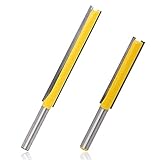
- 1/4 Inch Shank Straight Router Bit Set with 2 Different Cutting Depth: 2" and 3'', Cutting Diameter: 3/8''
- Double flute straight bits, designed for trimming, three-dimensional clearance angle, slotted and wood screw holes.
- Solid hardened steel bodies with anti-kickback design, high hardness and toughness, high abrasion resistance, impact resistance.
- Industrial grade C3 micro grain carbide blade for cutting wood, MDF, particle boards, plywood, panels, softwood, and other synthetic wood.
- Suitable for a router table or desktop woodworking engraving machine like CNC hand-held and table-mounted portable router,can not be used for electric drill & drill machines.
A dual-bearing bit gives you both options. It is useful where templates may be attached to either side of the workpiece, but it does not remove the need to select the correct cutting length, diameter, shank, and feed direction.
When to use a top-bearing pattern router bit
Choose a top-bearing pattern router bit when you are making duplicate parts from a template and the template is secured on top of the stock. Typical examples include copying a furniture component, shaping a curved edge, routing template-defined lettering, and following an external template profile with a handheld router.
The top bearing should contact the template continuously while the cutter removes only the remaining waste. The template needs to be rigid, accurately shaped, and firmly secured; any bump or dent in its edge can be transferred to every part made from it.
For the common handheld arrangement, this is the most direct product category to search for: top-bearing pattern router bit, top-bearing template bit, or pattern routing bit.
When a bottom-bearing flush-trim bit is the better choice
Use a bottom-bearing flush-trim router bit when the reference surface is underneath the material being trimmed. The classic example is trimming a projecting sheet of laminate or veneer flush with the substrate beneath it. The bearing rides on the substrate and the cutter removes the overhanging material.
This bit can also be appropriate when the workpiece or template is arranged below the router in a particular setup. Do not choose it merely because the product is labeled “flush trim”; first identify which surface the bearing must touch.
What’s actually slowing this PC down?
Pick the symptom - the matching free tool is one click away.
Rank #2

- Carbide Tipped 2 Flute: SICWOOD 6pcs straight router bit set with 1/4 shank, Cut Dia 3/4", 5/8", 1/2", 3/8", 5/16", 1/4", cutting height 13/16", used for most of basic functions of jointing, grooving, rabbets.
- Smooth Planed Finish: SICWOOD straight router bit 2- Flute cutters give a smooth planed finish with a medium feed rate, Premium C3 micro-grain tungsten carbide blades for a sharper & longer lasting edge, improving woodworking efficiency.
- Applicable Materials: SICWOOD straight router bit work in abrasive materials such aschipboard, MDF, plywood and hardwood.
- For Equipment: Use on CNC machine, desktop installation and handheld routers.
- SICWOOD SERVICE: If you have any questions about purchasing our straight router bit, please contact us in time for support, we will solve your problem perfectly.
For this application, useful search terms include bottom-bearing flush-trim bit, flush-trim router bit, and laminate trim router bit.
When a dual-bearing bit is worthwhile
A top-and-bottom-bearing flush-trim bit has a bearing at both ends. Depending on the setup, you can use the upper or lower bearing to follow the template or reference surface. This can reduce the need to reposition a template and is useful in a workshop where both orientations are common.
The trade-off is that dual-bearing capability does not make one bit suitable for every job. Check that the cutting length reaches through the stock, that the diameter fits the curves and openings in the template, and that the shank matches your router collet.
Pattern routing with a guide bushing
For an internal shape—such as a hinge mortise, recess, or lettering cut inside a template opening—a guide bushing and straight bit may be more practical than a bearing-guided bit.
The Tool Desk
Outbyte PC Repair FREERepair Windows errors before they cause bigger problemsFix Now →Outbyte Driver Updater FREEFix the driver behind crashes, sound loss and screen glitchesFind Drivers →The bushing follows the template opening while the cutter cuts inside it. However, the bushing is wider than the cutter, so the template opening must account for the offset. If the bushing’s outside diameter is larger than the cutter diameter, the cutter will not reproduce the template opening at the same dimensions unless the template is deliberately sized for that difference.
Rank #3

- Downcut spiral router bit with 1/4 inch shank and 1/4 inch cutting diameter, 1 inch cutting length, 2-1/2 inch for total length
- SOLID CARBIDE AND NANO BLUE COATED: The down-cut spiral router bit is made of solid carbide. And Nano Blue Coating with high hardness and heat resistance enables the tool's cutting edge to retain crucial sharpness and lubricity. This provides longevity and produces cutting results of the highest quality. Clean surface, neat, no glitches. Up to 2.5X longer life compared to uncoated bits.
- CNC Spiral bits used for side milling, end milling, finish machining, etc. End Mill Bits can smoothly downcut groove and slots, mortises, cycles and dados with clean edge and top, better than straight bits.
- The CNC End Mill Router Bits apply to various wood: such as Plywood, OAK, MDF, and any hardwood working and Long service life for sharp. And also for carbon steel, soft alloy steel, tool steel, cast iron, aluminum alloy.
- The spiral router bit suit for CNC router and any plunge routers with 1/4" collet.
A router template guide bushing or guide-bushing set is therefore an alternative for internal template work, not a direct replacement for a top-bearing bit when copying an outside profile.
How to choose the actual bit size
1. Match the cutting length to the stock
The cutting length must reach the template or reference surface through the material. A bit that is too short cannot properly contact the template. A bit that is much longer than necessary can be harder to control and may increase leverage and deflection.
For thick stock, consider a bit that can complete the work in controlled stages rather than assuming the longest available bit is best. Product families are sold in several cutting lengths, so select the length for the actual template-and-workpiece arrangement.
Quick wins for a faster PC:
Scan for outdated or missing drivers - takes under a minuteDriver Scan →Clear out junk files and repair common Windows errorsFree Scan →Fix the driver behind crashes, sound loss and screen glitchesFind Drivers →2. Match the shank to the router
Confirm whether your router accepts a 1/4-inch or 1/2-inch shank. Do not assume that a larger cutter will fit your collet. The shank must be inserted to the manufacturer’s specified depth and tightened correctly; never use a bit with the wrong shank size.
3. Select a diameter that suits the template
A larger-diameter bit can be stable and robust, but it may not fit tight inside curves, narrow openings, or small template details. Smaller bits can reach tighter features, but they generally call for lighter passes and more care to limit deflection, heat, and breakage.
Common pattern-bit diameters include approximately 1/2, 5/8, 3/4, and 1-1/8 inches, although availability varies by manufacturer and region. Choose based on access and the detail required—not simply on the largest diameter available.
Rank #4

- Bits Precisely match the requirement of the American dimension and standard.
- American industry classification MNA Carbide.Provide superior wear resistance and sharp edges for the best finish.
- MNA 15-piece set is a common router bit set for the DIYer woodworker. It has a great variety of the most popular carbide-tipped bits in a Classical Wood Case.
- Fit for all types of wood material, such as MDF, hardwood, softwood, and particle board.
- Universal 1/4” shank is compatible with all major router instrument (either handheld or benchtop router table) such as MNA, Kowood, Bosch, DeWalt, Makita, Milwaukee, Porter & Cable, Skil, Ryobi, Black & Decker.
Prepare the work before routing
- Make the template accurate. Smooth the template edge and remove dents, saw marks, or bumps. The router bearing will follow those imperfections.
- Secure the template and workpiece. Clamps, screws in waste areas, or suitable template-routing tape can be used as appropriate. Nothing should shift when the bearing contacts the edge.
- Rough-cut close to the line. Use a bandsaw, jigsaw, or another suitable tool to remove most of the waste, leaving a modest amount for the router. A pattern bit is a finishing and copying tool, not an efficient substitute for removing a large block of stock.
- Check the bearing. It should turn freely and be clean. A seized bearing can damage the template and produce an inaccurate edge.
- Confirm bit clearance. Check the cutting length, bearing position, diameter, shank, and maximum permitted speed against the manufacturer’s instructions.
Use shallow passes and the correct feed direction
For thick material, deep profiles, or substantial remaining waste, take multiple shallow passes. Removing too much material in one pass increases the load on the bit and makes it more difficult to keep the router stable.
Recommended Free Tools
Keep the router’s base flat on the workpiece and maintain firm, controlled downward pressure. Preventing the router from tipping is especially important when the bit extends significantly below the base or when only a small area of the base is supported.
In conventional handheld routing, feed the router against the bit’s rotation. Feeding with the rotation is climb cutting; the router can pull itself forward, causing loss of control or kickback. Plan the direction around the outside profile so the bit pushes into the work rather than running away from it. Make sure the chosen direction still gives the bearing continuous contact with the template.
Independent reader supportYour contribution helps us test, update, and keep practical guides available for everyone.Handheld versus router-table setups
On a router table, the workpiece is often presented to the bit from a different orientation than in handheld routing. As a result, do not choose “top” or “bottom” solely by looking at the bit in the package. Identify the actual surface that will contact the bearing during the cut.
A bottom-bearing or dual-bearing bit is often useful on a router table, but the correct choice depends on whether the template or reference surface is above or below the workpiece, how the work is supported, and how the piece will be fed. Follow the router-table and bit manufacturer’s instructions for guarding, feed direction, and maximum speed.
Do these 3 things before closing this tab:
1Repair Windows errors before they cause bigger problems2Fix the driver behind crashes, sound loss and screen glitches3Clear out junk files and repair common Windows errorsBest Value

- Specs: Bearing Dia. 1/2", Number of Cutters 2, Overall Dia. 1/2", Overall Length 2-13/16", Shank Dia. 1/4", Carbide Height 1"
- Cuts all composition materials, plywoods, hardwoods, and softwoods
- Use on hand-held or table-mounted routers
- Freud Perma-SHIELD Coating
A practical buying checklist
- Template on top, handheld router: choose a top-bearing pattern router bit.
- Substrate below laminate or veneer: choose a bottom-bearing flush-trim bit.
- Templates on either side: consider a top-and-bottom-bearing flush-trim bit.
- Internal template opening: consider a guide bushing with a straight bit, allowing for the diameter offset.
- Verify the shank size—1/4 inch or 1/2 inch—as well as the router’s collet capacity.
- Choose enough cutting length to reach the reference surface, but avoid unnecessary length.
- Choose a diameter that fits the tightest curve or opening in the template.
- Rough-cut most of the waste before bringing the router to the template.
- Use shallow passes and check the manufacturer’s maximum speed and material guidance.
Safety checks before the cut
- Secure both the template and the workpiece so neither can move.
- Start the router with the bit clear of the material and allow it to reach operating speed before entering the cut.
- Use both hands where the router design permits, especially during startup and when entering a cut.
- Keep hands clear of the cutter path and never reach near a rotating bit.
- Maintain a flat base and stable support throughout the cut.
- Wait until the bit has completely stopped before setting the router down.
- Wear the appropriate eye and hearing protection and follow the router and bit manufacturer’s safety instructions.
Manufacturer guidance should also be checked for compatible materials. Top-bearing trim-bit families may be listed for materials such as hardwood, softwood, plywood, particleboard, and MDF, but the specific bit’s instructions control.
Frequently Asked Questions
Can I use a bottom-bearing flush-trim bit for a template on top?
Not in the usual handheld arrangement unless the bit and workpiece are physically arranged so the bottom bearing can contact the template. For a template secured on top of the workpiece, a top-bearing pattern bit is the straightforward choice.
Is a pattern bit the same as a flush-trim bit?
They are closely related bearing-guided cutters, and product naming can overlap. The important distinction is bearing position: a top-bearing pattern bit follows an upper template, while a bottom-bearing flush-trim bit normally follows a lower reference surface.
Do I need to rough-cut before pattern routing?
Yes, in most cases. Remove most of the waste with a bandsaw, jigsaw, or similar tool and leave a modest amount for the router. This reduces load, heat, and the risk of losing control.
What bit should I use for an internal template cut?
A straight bit with a guide bushing is often appropriate for an internal recess, hinge mortise, or lettering cut. Account for the difference between the bushing’s outside diameter and the cutter diameter when making the template.
Should I buy a 1/4-inch or 1/2-inch shank?
Buy the shank size your router collet accepts. A 1/2-inch shank can be appropriate where the router supports it, but it is not compatible with a 1/4-inch-only collet. Always verify the router and bit specifications.
The Bottom Line
Template on top of the workpiece? Use a top-bearing pattern router bit. Use a bottom-bearing flush-trim bit when the bearing follows a lower substrate or reference surface, and choose a dual-bearing bit when you need either orientation. Whichever bit you select, secure the template, rough-cut the waste, match the cutting length and shank to the job, take shallow passes, and feed against the bit’s rotation.
Quick Recap
Product prices and availability are accurate as of the date/time indicated and are subject to change. Any price and availability information displayed on Amazon at the time of purchase will apply.

