Recommended Free Tools
The harmful trade-off is not “green building” itself. It occurs when an efficiency measure lowers HVAC energy use by reducing outdoor-air delivery, weakening controls, or allowing comfort and indoor-air-quality (IAQ) performance to drift. EPA’s evidence shows that design intent and measured operation can differ, but it also shows that energy and ventilation goals can be met together when systems are designed, commissioned, and operated as one performance problem.
For a building owner, the practical test is straightforward: verify delivered outdoor air against the design and the requirements that apply locally, check IAQ and comfort with more than one indicator, and keep testing after occupancy. A certification label or an efficient piece of equipment is not proof that occupants are receiving adequate ventilation.
As an Amazon Associate I earn from qualifying purchases.
What the harmful trade-off actually is
Heating, cooling, and moving outdoor air consume energy. Bringing in more outdoor air can increase the load on coils, boilers, heat pumps, and fans, especially when outside conditions are hot, humid, or very cold. Designers therefore look for ways to reduce ventilation-related energy use while still controlling contaminants and maintaining acceptable temperatures.
Do these 3 things before closing this tab:
1Scan for outdated or missing drivers - takes under a minute2Repair Windows errors before they cause bigger problems3Fix the driver behind crashes, sound loss and screen glitchesThe problem begins when “reduce the load” becomes “deliver less outdoor air than the design requires.” A variable-air-volume (VAV) system may reduce supply airflow at part load; a control sequence may close an outdoor-air damper farther than intended; a schedule may shut off ventilation before occupants leave; or a sensor, actuator, or balancing damper may be miscalibrated. Each choice can save energy at one moment while creating stale air, odors, elevated contaminant concentrations, drafts, or uneven temperatures.
#1 Best Overall
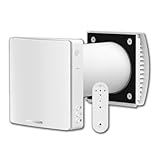
- Ultra High Efficiency ECOasis ERV-rm Series Ductless Energy Recovery Ventilation System with 97% Heat Recovery| Minimal Energy Consumption with an Average Power draw of only 8W | Wall-Mounted with Variable Length Air Channel Duct to Suit Different Wall Thicknesses| Large Volume Air Output with Up to 35 CFM of Treated Airflow| Washable Re-usable Integrated Prefilters along with F7 (MERV13) Filter| Wi-Fi Controlled via Free Smartphone App (along with Standard Controller)| Rainproof Design with Hooded and Angled Outdoor Cover| Super-Silent Operation with a Maximum Sound Output of 32.7 dB(A)| Remove Room Air Pollutants: Filtration of air impurities such as MVOCs (Microbial Volatile Organic Compounds) along with removal of dust and other contaminants that commonly cause coughing fatigue and allergy aggravation| Freshen and Renew Breathing Air: Extraction of stale and stuffy room air while simultaneously introducing fresh outdoor air into the room to improve oxygen levels and overall quality of life| Minimize Strain on the Home Heating or Cooling System: By cooling the incoming hot outside air in summertime and heating the incoming cold outside air in wintertime the system intelligently prevents a change in indoor air temperature by using that outgoing stale indoor air to preheat or precool the incoming outdoor air depending on the season (Recommended to install two 50 Series ERVs to take advantage of this benefit)| Continuously Monitor Air Quality: A built-in CO2 sensor allows automated management of oxygen CO2 levels inside the room to maximize breathability| Power Supply: 110 ~ 240 VAC (50~60 Hz) with Plug-In Power Cord| Dimensions (WDH): 9-3/8" x 19-5/8" x 10-1/8"| Airflow w/ F7 Filter (Lo/Med/Hi/Max): 11.8 / 23.5 / 29.4 / 35.3 CFM | In-Wall Channel Span: 11" ~ 18-1/2"| Method of Control: Onboard Interface Handheld Remote Smartphone App| Product Weight: 11 lbs| Input Power (Lo/Med/Hi): 6 / 7 / 8 W| Water-Resistance Rating: IPX4| Diameter of Air Duct: 6-1/4"|User's Manual
That is a performance failure in a particular design or operating practice, not evidence that green buildings as a category harm occupants. EPA describes green building as a life-cycle approach intended to use energy, water, materials, and land efficiently, and notes potential health benefits from better IAQ and natural lighting. The question is whether the installed building delivers those objectives in operation.
Where HVAC efficiency and ventilation come into tension
Outdoor-air loads
Outdoor air must be conditioned before it reaches occupied rooms. In a hot-humid climate, that means removing both sensible heat and moisture; in a cold climate, it means adding heat and often humidity. Heat-recovery equipment, efficient coils, and well-tuned economizer sequences can reduce this penalty. Simply reducing the outdoor-air fraction avoids the load, but it also changes the ventilation result.
VAV turndown and minimum settings
VAV systems save fan energy by reducing airflow as zone loads fall. The minimum airflow and outdoor-air control must still support the occupied zone. If a terminal-box minimum is set too low, or if central-fan control does not maintain the required outdoor-air quantity at part load, a room can receive less ventilation than the design assumed.
Schedules, occupancy controls, and sensors
Demand-controlled ventilation can respond to occupancy, but it depends on correct sensors, sequences, and minimum safeguards. A schedule that reflects an old tenant pattern can leave a conference room, classroom, or auditorium under-ventilated when use changes. CO2 sensors can inform control, but a sensor that is poorly located, uncalibrated, or used as the only IAQ measure can create false confidence.
Rank #2

- SmartFlow ECM Motors: Dual brushless motors automatically adjust speed for optimal airflow and quiet operation under varying pressure conditions
- Customizable Airflow (30–110 CFM): Multi-speed selector supports balanced, positive, or negative pressure setups
- Energy Recovery & Protection: Hygroscopic transfer core balances heat and moisture for improved comfort and efficiency
- Dual MERV 13 Filters Included: High-efficiency filters clean incoming and outgoing air; optional washable MERV 6 filters available
- Flexible Installation & Controls: Ceiling, wall, or floor mountable with plug-in or hardwired options; compatible with Wi-Fi module, touch screen wall control, and low-voltage timer switch
Envelope, filtration, and comfort interactions
A tighter envelope can reduce heating and cooling loads, yet it also makes intentional ventilation more important because uncontrolled infiltration is no longer the fallback. Higher-efficiency filters may improve particle removal but increase pressure drop and fan energy unless the fan and filter rack are selected for it. Lowering supply-air volume or raising temperature set points can save energy while producing hot or cold complaints that prompt occupants to defeat controls with space heaters, open windows, or unauthorized overrides.
What EPA’s evidence shows
EPA completed its Ventilation Systems and Controls Study in 1999. The modeling examined constant-volume and VAV HVAC systems in Miami, Washington, D.C., and Minneapolis, representing hot-humid, temperate, and cold conditions. It modeled office-building variants as well as a school and an auditorium, and explicitly evaluated compatibility and trade-offs among energy use, IAQ, and thermal comfort.
Because the work was completed in 1999, it is a historical modeling study, not a measurement of today’s green-building stock. Its value is in showing how different control and efficiency choices affect several objectives at once.
Outdated Drivers Are Slowing You Down
One free scan finds every outdated or missing driver and matches the right update for your exact hardware.Free scan · exact hardware matchPC Slower Than It Used to Be?
A free scan shows the junk files, broken settings and background clutter dragging Windows down - then fixes them in one click.Free scan · Windows 10 & 11| Evidence | What was measured or modeled | How to interpret it |
|---|---|---|
| Ventilation-systems model | Constant-volume and VAV systems in three U.S. climates, with offices, a school, and an auditorium | Shows modeled interactions among energy, IAQ, and comfort; it does not establish current nationwide performance. |
| BASE design-versus-measured airflow | About 40% of systems with available design data measured below the design outdoor-airflow value. | Indicates that installed operation can diverge from design; it is not a prevalence estimate for all U.S. buildings or all green buildings. |
| BASE comparison with historical benchmark | About 17% of ventilation measurements were below 20 cubic feet per minute per person, compared with the office recommendation identified as ASHRAE Standard 62-2001. | The 20-cfm-per-person comparison is historical and sample-specific, not a universal current requirement. |
| Testing and balancing | About 44% of surveyed buildings reported that they did not perform HVAC testing and balancing. | A missing verification process can help explain why measured airflow falls short of design. |
These figures come from EPA’s Building Assessment Survey and Evaluation (BASE) analysis of sampled office spaces. The analysis used available HVAC design information, measurable airflow quantities, and carbon-dioxide measurements in HVAC air streams to estimate outdoor-air fraction and quantity. It did not establish that a consumer CO2 monitor can certify ventilation adequacy or healthfulness.
Rank #3

- Heat Recovery Ventilator (HRV) for Single Room Ventilation: Equipped with a high-efficiency ceramic heat exchanger that recovers up to 90% of heat energy from exhaust air, improving indoor air quality and reducing heating energy consumption
- Smart WiFi & Remote Control: Control your ventilation system anytime via the Tuya App or included remote. Adjust fan speed, humidity and mode for smarter air management
- 3 Airflow Modes: Choose between Fresh Air, Exhaust, and Recirculation modes to create a comfortable and healthy indoor environment
- Energy-Efficient EC Motor: Features an 8.5W EC motor with PWM control, providing powerful airflow, ultra-quiet operation under 30dB, and low energy consumption for continuous, efficient ventilation
- Versatile Wall-Mounted Ventilation System: Weiworld 150 mm (6 Inch) heat recovery ventilation system suitable for apartments, offices, barns, sheds, tiny homes, and garages—bringing clean, fresh air wherever you need it
Energy savings and IAQ do not have to be a zero-sum choice
The same EPA study looked for efficiency measures that would enhance, or at least not degrade, indoor environmental quality while meeting outdoor-air requirements. In the historical executive summary, combinations of those measures with strategies to meet ASHRAE Standard 62-1999 outdoor-air requirements reduced modeled total energy costs by 42–43% in the office model and by 22–37% in the education model.
Those percentages are modeled results from the 1999 study, not a promise for a modern project. They do, however, answer a common design assumption: maintaining ventilation does not automatically require abandoning efficiency. Heat recovery, efficient fans and coils, appropriate economizer operation, envelope improvements, zoning, and controls that preserve minimum outdoor air can reduce energy while protecting IAQ. The right combination depends on climate, occupancy, equipment, and the requirements adopted for the project.
Why a high-performing design can underperform in use
Commissioning was incomplete or omitted
Commissioning checks whether equipment, controls, sequences, and documentation work together before occupancy. It should include outdoor-air measurement, damper operation, VAV minimums, sensor calibration, schedules, alarms, and the response of the system at representative loads. If the process stops at a checklist or visual inspection, a design shortfall can remain hidden.
Testing and balancing data are missing
Airflow cannot be verified from equipment nameplates alone. A balancing report should identify measured supply and outdoor-air quantities, the instruments and test conditions used, terminal settings, and unresolved deficiencies. EPA’s BASE summary notes both limited availability of design data and a substantial share of buildings reporting no HVAC testing and balancing. Without a design baseline and measured values, an owner cannot tell whether a control change improved or degraded ventilation.
Rank #4

- 4-Inch Plug-in EC Wall Fan with Reversible Remote: Control dual airflow instantly via remote-exhaust stale air or intake fresh air. No wiring needed: Plug directly into any standard outlet
- Simple Wall-Mount Drilling Installation: Secure to walls with included screws (drill required). Cannot be hung-designed for stable wall-mounting in bedrooms
- Stainless Steel Slanted Rain Hood: Corrosion-resistant angled design deflects rain and humidity. Zero-maintenance outdoor durability
- Washable Ceramic Core with No Replacements: Rinse reusable filter every 3 months-traps fine particles for cleaner indoor air
- Plug-in Operation in Minutes: Includes power cord and plug. Drill wall, mount fan, and plug in. No electrician required
Controls drift after handover
Filters load, dampers stick, belts wear, sensors lose calibration, and tenants change layouts and schedules. A sequence that worked during a vacant-building test may fail when occupancy, weather, or operating hours change. EPA therefore emphasizes recommissioning existing systems, not only commissioning new construction.
A practical performance comparison
When reviewing a green-building HVAC strategy, compare each option on all of the following dimensions rather than ranking it by energy use alone.
| Decision axis | Questions to ask | Evidence to request |
|---|---|---|
| Energy use and operating cost | What loads, schedules, weather assumptions, and control modes produced the estimate? | Model assumptions, utility data, trend logs, and seasonal operating results. |
| Outdoor-air delivery | What quantity is required at design and at part load, and how is it measured? | Design documents, balancing report, damper positions, and measured airflow under representative conditions. |
| IAQ indicators | Which contaminants or sources matter for this occupancy, and what does each measurement actually tell us? | Source-control plan, monitoring protocol, maintenance records, and investigation results. |
| Thermal comfort | Are temperatures, humidity, air movement, and zoning suitable for the people and activities in each space? | Trend data, complaint logs, zone-level readings, and control sequences. |
| Verification over time | Who checks performance after turnover, after tenant changes, and after major maintenance? | Commissioning plan, seasonal test schedule, corrective-action log, and recommissioning budget. |
How to prevent the trade-off in a new project
- Define objectives together. Put energy, outdoor-air delivery, IAQ, comfort, acoustics, and maintainability in the owner’s project requirements. Do not let an energy target stand alone.
- Set the applicable ventilation basis. Identify the building type, occupancy categories, local code, and current standard edition used by the authority having jurisdiction. Requirements vary by jurisdiction and use; do not assume that a historical benchmark applies everywhere.
- Model realistic operating modes. Test peak and part-load conditions, minimum occupancy, high occupancy, economizer operation, warm-up, cool-down, and extreme weather. Confirm that outdoor-air quantities remain adequate when VAV airflow falls.
- Design for measurement. Provide accessible test points, airflow stations or other appropriate measurement provisions, calibrated sensors, and trend logging. A system that cannot be measured cannot be reliably commissioned.
- Commission before occupancy. Test dampers, fans, terminal minimums, schedules, alarms, interlocks, filtration pressure drop, and control responses. Resolve deficiencies rather than recording them as future work.
- Document the baseline. Deliver as-built sequences, set points, balancing results, sensor calibration records, and a plain-language operating plan to the facilities team.
- Recommission after change. Repeat targeted tests after tenant fit-outs, major control updates, equipment replacement, persistent complaints, or a significant change in occupancy.
- Use complaints as data. Map odor, stuffiness, temperature, and humidity complaints to zones, schedules, and trend logs. Do not respond by simply lowering or raising a global set point.
How to investigate an existing building
Rooms feel stuffy or odors persist
- Check whether the affected zones are occupied during the scheduled ventilation period.
- Compare measured outdoor-airflow quantity with the design value and the requirement that applies to the space.
- Inspect outdoor-air dampers, filters, fan status, VAV minimums, and control overrides.
- Look for indoor sources such as stored chemicals, moisture, combustion products, or high-emitting materials; ventilation alone may not solve a source problem.
Energy use is high after a ventilation change
- Confirm that dampers are not stuck open and that economizer logic is using outdoor conditions correctly.
- Check heat-recovery operation, coil control, fan static-pressure reset, and simultaneous heating and cooling.
- Verify that schedules and occupancy assumptions match actual use before reducing outdoor air.
Temperatures are uneven
- Review zone airflow, terminal-box minimums, sensor locations, and balancing results.
- Check whether furniture, partitions, or renovations changed air distribution.
- Investigate humidity and radiant effects instead of treating every complaint as a thermostat problem.
Ventilation requirements are local and time-dependent
There is no single number that establishes adequate ventilation for every U.S. building. Requirements depend on the building type, occupancy, adopted code, and the edition of the applicable standard. ASHRAE’s policy and issues index points to separate commercial and residential ventilation standards, but the legally enforceable requirement is the one adopted by the relevant jurisdiction.
What’s actually slowing this PC down?
Pick the symptom - the matching free tool is one click away.
Before making a compliance claim, confirm the current code and standard edition with the authority having jurisdiction and the project’s code professional. The BASE comparison to 20 cfm per person used the office recommendation identified as ASHRAE Standard 62-2001; it should not be presented as a current universal threshold.
Best Value

- A leading provider of ventilation and air-quality solutions for homes
Use IAQ measurements carefully
Carbon dioxide is useful as one clue about occupancy-related ventilation and air mixing, but it is not a complete IAQ score. A reading can be affected by sensor placement, calibration, occupancy patterns, outdoor background concentration, and local air distribution. It does not by itself measure particles, moisture, volatile compounds, combustion products, or biological hazards, and it cannot certify that a space is healthy.
A responsible assessment combines airflow measurements, control and maintenance records, source investigation, temperature and humidity data, occupant information, and targeted contaminant testing when a specific concern warrants it. EPA’s office IAQ guidance warns that systems may not be designed or operated to provide adequate outdoor air, which is why field verification matters.
What occupants and owners should conclude
Efficient equipment, reduced loads, and green-building practices can support healthier indoor environments, but none of them substitutes for delivered performance. The strongest warning sign is not a certification label; it is a gap between the design outdoor-air quantity and what the system actually supplies, especially when no one has tested, balanced, or recommissioned the system.
Owners can avoid the harmful trade-off by treating ventilation as a measurable operating requirement, preserving it in every control mode, and funding verification throughout the building’s life. That approach turns energy efficiency and IAQ from competing slogans into coordinated, testable outcomes.
Quick Recap
Product prices and availability are accurate as of the date/time indicated and are subject to change. Any price and availability information displayed on Amazon at the time of purchase will apply.

