The Tool Desk
Outbyte Driver Updater FREEFix the driver behind crashes, sound loss and screen glitchesFind Drivers →Outbyte PC Repair FREERepair Windows errors before they cause bigger problemsFix Now →All-Clad’s line names describe different engineering compromises rather than a simple quality ranking. D3 is the balanced stainless default; D5 favors steady heat; Copper Core favors rapid control; G5 delivers fast response with less weight; and the nonstick, ceramic, and enameled cast-iron collections address entirely different cooking needs.
The right choice depends on how much you value responsiveness, heat stability, lifting weight, easy release, storage, and oven or cooktop compatibility.
As an Amazon Associate I earn from qualifying purchases.
Disclosure: If retailer links appear in this guide, they may be affiliate links. That does not change how the cookware is compared or recommended.
The short answer
All-Clad’s lines are not arranged in a simple good-better-best ladder. The collection name usually tells you about the metal construction, exterior finish, cooking surface, or intended use.
#1 Best Overall

- KITCHEN COOKWARE SET: This Cuisinart stainless steel cookware set includes 1.5 qt. & 2.5 qt. saucepans w/glass covers, 3 qt. saucepan w/glass cover & helper handle, 8 qt. stockpot w/glass cover, 8" skillet, 10" skillet and 7.08" steamer insert
- PREMIUM STAINLESS STEEL: Premium stainless steel pots and pans set with aluminum encapsulated base heats quickly and spreads heat evenly, eliminating hot spots for optimal cooking performance
- COOL GRIP HANDLES: Cast stainless steel Cool Grip stick handles are contoured for a secure grip and designed to stay cool on the stovetop, while glass lids equipped with wide, easy-grip handles fit tight to lock in flavor, texture and nutrients
- EXCEPTIONAL HANDLING: Riveted stainless steel handles, including side grips and helper handles, are professionally riveted to ensure a lifetime of perfect balance and a drip-free pour every time for your best cooking results
- DISHWASHER & OVEN SAFE: Easy to clean and conveniently dishwasher safe, this stainless steel cookware set is also oven safe up to 500°F and can be used on stovetop, in oven or under broiler, providing a range of versatile, professional performance
- D3 Stainless is the balanced, everyday bonded-stainless choice.
- D3 Stainless Everyday uses D3 construction but changes the shapes, handles, rims, and lids for convenience.
- D5 uses five bonded layers for steadier, more even heating and comes in Brushed and Polished finishes.
- Copper Core prioritizes rapid heat response and precise control.
- G5 Graphite Core aims for premium responsiveness with less weight.
- Collective mixes several premium constructions rather than using one uniform metal stack.
- NS Pro, HA1, Essentials, and the ceramic lines are nonstick alternatives, not lower tiers of stainless cookware.
- Enameled Cast Iron is a heavy, heat-retaining category designed for different cooking tasks altogether.
For most people buying one stainless pan, D3 is the sensible starting point. Choose D5 for stability, Copper Core for precise burner control, or G5 when low weight matters unusually much. Choose a nonstick line when easy release and cleanup matter more than fond formation, aggressive searing, or very high-heat cooking.
All-Clad lines at a glance
| Line | Construction or surface | What changes in practice | Best suited to |
|---|---|---|---|
| D3 Stainless | Three-ply stainless steel and aluminum | Balanced weight, heat distribution, and responsiveness | General-purpose stainless cooking |
| D3 Stainless Everyday | D3 tri-ply construction with revised ergonomics | More skillet surface, contoured handles, drip-free rims, interchangeable lids | Everyday cooks who care about handling and storage |
| D5 Brushed or Polished | Five-ply stainless steel and aluminum | More stable and even heating; heavier and slower to react than D3 | Steady searing, braising, and cooks who prefer thermal stability |
| Copper Core | Five-ply construction with a copper core | Very rapid heat response and precise control; medium-heavy weight | Sauces, reductions, custards, and frequent heat adjustments |
| G5 Graphite Core | Five-ply stainless steel and graphite | Very fast response with a lighter build | Premium performance for cooks sensitive to heavy pans |
| Collective | A mixture of premium bonded-metal constructions | Different pieces may behave differently because the set is not uniform | Buyers who want a curated mix of materials |
| NS Pro Nonstick | Recycled aluminum with ceramic-plasma-reinforced PTFE | Premium easy release and cleanup | Eggs, fish, and delicate foods |
| HA1 Expert | Hard-anodized aluminum, stainless base, three-layer PTFE | Practical, versatile traditional nonstick | Everyday nonstick cooking |
| Essentials | Heavy-gauge hard-anodized aluminum with three-layer PTFE | Stackable, convenience-oriented design | Basic everyday cooking and compact storage |
| HA1 Ceramic | Hard-anodized aluminum, stainless base, HardCore ceramic surface | Ceramic easy release with induction compatibility and stackable handles | Buyers specifically seeking ceramic nonstick |
| NS Pro Ceramic | Recycled aluminum, EvenPro stainless base, HardCore ceramic surface | Ceramic cooking surface with a base designed to distribute oil toward the center | Smaller-assortment ceramic cookware needs |
| Enameled Cast Iron | Enameled cast iron | Excellent heat retention but heavy and slow to change temperature | Braises, baking, searing, and slow cooking |
Exact sizes, handles, lids, stovetop compatibility, and oven ratings can vary by product. Treat the individual product page as the final authority rather than assuming every item in a collection has identical specifications.
The bonded stainless-steel lines
D3, D5, Copper Core, and G5 are all bonded cookware. That means the pan is built from permanently joined layers of different metals so the cooking surface and exterior can provide durability while the internal material improves heat behavior. The lines differ mainly in the number and type of layers, the resulting weight, and how quickly the pan responds when the burner changes.
Recommended Free Tools
D3 Stainless: the default recommendation
D3 uses three bonded layers with an aluminum core and stainless-steel cooking surfaces. It is All-Clad’s classic tri-ply construction and the most balanced option in the range: moderate weight, comparatively quick response, and even enough heating for everyday stovetop work.
That balance is useful for browning meat, sautéing vegetables, making a pan sauce, deglazing, boiling, and moving a pan from the stovetop to the oven. D3 is not entry-level cookware in the sense of using a fundamentally inferior quality standard. It is the simplest of All-Clad’s major fully bonded stainless constructions, with fewer specialized trade-offs.
If you want one pan that can handle the widest variety of tasks without being exceptionally heavy or exceptionally expensive, the All-Clad D3 Stainless 12-inch fry pan is the most logical place to begin. A 12-inch fry pan is large enough for family-sized portions, though its weight and diameter should still be considered if you have a small cooktop or limited lifting strength.
D3 Stainless Everyday: the D3 variant with more practical ergonomics
D3 Stainless Everyday retains classic D3 tri-ply technology. The important difference is not a new heat-conducting metal stack; it is the design around that stack.
All-Clad highlights approximately 30% more skillet surface area, contoured handles, drip-free pouring rims, and interchangeable lids. Those changes can matter more than a small theoretical difference in thermal performance if you regularly pour sauces, use multiple pans, or store cookware with limited cabinet space.
Think of D3 Stainless Everyday as D3 performance with altered shape and handling, not as a higher performance tier. It is currently listed as an All-Clad.com-exclusive collection, so availability and sizing may differ from the more broadly distributed D3 line.
D5 Brushed versus D5 Polished
D5 uses five layers of stainless steel and aluminum. Compared with D3, it is generally heavier and somewhat less quick to react, but it is designed around stable, highly even heating. That steadiness can be forgiving when a recipe needs consistent heat rather than rapid changes.
Rank #2

- Fully Clad Tri-Ply Stainless Steel Cookware Set. Tri-ply fully clad construction delivers fast, even heating from base to rim, helping reduce hot spots for better searing, steadier simmering, and more consistent cooking results.
- Durable No-Coating Cooking Surface. Designed for buyers who want a long-lasting pots and pans set, the stainless steel cooking surface is free from traditional nonstick coatings, making it a reliable choice for everyday healthy cooking.
- Works on All Cooktops, Including Induction. Compatible with induction, gas, electric, ceramic, and glass stovetops, this cookware set moves easily from daily meals to more advanced cooking needs.
- Oven Safe & Dishwasher Safe Convenience. Move from stovetop to oven with ease, then clean up quickly in the dishwasher—built for busy kitchens without sacrificing durability or performance.
- Stainless Steel Cooking Tips for Better Results. For best results and less sticking, preheat the pan first, add oil, then cook. Flip food only when it releases naturally to help achieve beautiful browning and better searing.
The difference between D5 Brushed and D5 Polished is principally the outside finish:
- D5 Brushed has a matte, brushed, vintage-inspired appearance that tends to disguise some everyday marks.
- D5 Polished has the reflective classic-stainless appearance associated with much of the All-Clad range.
The current collection information does not present Brushed and Polished as materially different core technologies. Choose between them primarily by appearance, availability, and price—not because one finish should cook substantially better.
D5 makes sense when your priority is stability and evenness. It is particularly appealing for cooks who dislike abrupt temperature swings or who do a lot of steady sautéing, braising, and pan cooking. The trade-off is meaningful: a D5 pan can feel tiring when lifted, shaken, or transferred frequently. If you are comparing it with D3, the All-Clad D5 fry pan is a specialized choice for stable heating, not an automatic upgrade for every recipe.
Copper Core: the responsiveness specialist
Copper Core is a five-ply bonded design with copper in the core. Copper conducts heat and changes temperature quickly, while the stainless cooking surface provides a durable, non-reactive working surface.
All-Clad rates Copper Core as medium-heavy with very high heat responsiveness. That makes it especially defensible for sauces, reductions, custards, caramel work, and other preparations where a pan must cool quickly when the burner is lowered or removed. Precise control can also help when a recipe moves repeatedly between searing, simmering, and finishing temperatures.
Do these 3 things before closing this tab:
1Fix the driver behind crashes, sound loss and screen glitches2Repair Windows errors before they cause bigger problems3Scan for outdated or missing drivers - takes under a minuteIts premium is not a universal promise of better food. If most of your cooking consists of fried eggs, roasted proteins, vegetables, pasta sauce, and one-pot meals, D3 may provide nearly all the practical benefit you notice. Consider All-Clad Copper Core cookware when rapid control is a recurring need rather than an occasional aspiration.
G5 Graphite Core: premium response without the usual premium weight
G5 Graphite Core uses five-ply stainless-steel and graphite construction. All-Clad positions the graphite blend as a way to speed heating and cooling while keeping the cookware lighter than other premium bonded-metal lines.
In the comparison guidance, G5 is characterized as light with very high responsiveness. That gives it a distinctive position: it is aimed at buyers who want fast heat changes but do not want the heft normally associated with five-ply cookware.
G5 is not simply better than D3. Its advantage is most relevant when both response and maneuverability matter. A large pan can still be awkward because diameter, food load, and handle design influence handling as much as the collection name. If weight is your main concern, inspect the exact vessel rather than relying only on the G5 label. For that buyer, All-Clad G5 Graphite Core is the most targeted premium option.
Quick wins for a faster PC:
Clear out junk files and repair common Windows errorsFree Scan →Fix the driver behind crashes, sound loss and screen glitchesFind Drivers →Repair Windows errors before they cause bigger problemsFix Now →Collective: a mixed set rather than one metal formula
The Collective Collection combines pieces made from several premium bonded-metal constructions. This can be attractive if you want different pans matched to different jobs—for example, a responsive vessel for sauce work and a more stable one for another task.
The drawback is that Collective makes simple line-to-line comparison difficult. A Collective set is not one uniform construction, so the handling, weight, and heat response of one piece should not automatically be attributed to every other piece in the box. Read the specification for each included pan before paying a set premium.
Why stainless and nonstick should not be ranked together
A nonstick pan is not a cheaper version of stainless steel. It solves a different problem.
Rank #3
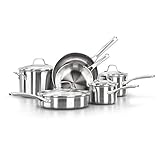
- Impact-bonded aluminum base distributes heat evenly, for exceptional browning, searing, and sauteing
- Stainless steel long handles stay cool on the stovetop
- Convenient measuring marks, pour spouts, and straining covers allow you to cook with efficiency
- Dishwasher-safe for easy cleanup
- Oven-safe up to 450 degrees F, so you can easily go from stovetop to the oven
Stainless cookware is the better tool when you want browning, fond formation, deglazing, aggressive searing, high-temperature flexibility, and a surface that can tolerate ordinary metal cooking tools more readily. It demands more technique: preheating, controlling the burner, and cleaning the surface properly.
PC Slower Than It Used to Be?
A free scan shows the junk files, broken settings and background clutter dragging Windows down - then fixes them in one click.Free scan · Windows 10 & 11Outdated Drivers Are Slowing You Down
One free scan finds every outdated or missing driver and matches the right update for your exact hardware.Free scan · exact hardware matchNonstick cookware is the better tool when you want food to release easily with little added fat and cleanup to be simple. It is especially useful for eggs, fish, pancakes, and other foods that can tear or stick in bare stainless steel. The surface has stricter heat and utensil limitations, and its release performance is a consumable feature rather than something to expect to last indefinitely.
NS Pro Nonstick
NS Pro is All-Clad’s premium current PTFE nonstick line. Its coating is described as high-quality PTFE reinforced by an internal ceramic-plasma layer, and the body uses heavy-gauge recycled aluminum. The collection also includes flared pouring edges.
NS Pro is the most suitable choice when easy release is the primary requirement and you are willing to follow nonstick care rules. All-Clad positions it for delicate foods and claims up to 50% better performance than its previous nonstick surfaces. That is a manufacturer comparison, not independent testing, so it should not be treated as a universal durability or performance measurement.
An All-Clad NS Pro nonstick pan should not replace a stainless pan if your main goal is a dark sear, fond for a pan sauce, or cooking with metal utensils. Keep the heat low to medium, avoid the broiler, and use wood, silicone, or other non-metal utensils.
Free tools Windows power users keep installed
One-click scans. No signup required.
HA1 Expert Nonstick
HA1 Expert combines hard-anodized aluminum, an optimized stainless-steel base on most pieces, and a three-layer PTFE nonstick surface. It is positioned as a practical at-home line that provides even heating and easy cleanup without the premium specialization of Copper Core or NS Pro.
Among All-Clad’s traditional PTFE lines, HA1 is the middle-ground choice. It is more construction-focused than the convenience-first Essentials line, but it is not positioned as the flagship NS Pro surface. The All-Clad HA1 Expert nonstick fry pan is a reasonable everyday choice for someone who wants traditional nonstick performance and does not need stainless-steel searing behavior.
Essentials Nonstick
Essentials uses heavy-gauge hard-anodized aluminum and a three-layer PTFE nonstick surface. Its strongest differentiator is convenience: the pieces are designed to nest, helping save cabinet space, and the collection is aimed at straightforward everyday cooking.
Current product information lists Essentials as compatible with all stovetops except induction, but compatibility can vary by model. Check the exact product listing if you use an induction cooktop or plan to replace a single pan rather than buy a set.
The All-Clad Essentials cookware set makes the most sense when stackability, easy release, and uncomplicated storage are more important than premium bonded-stainless performance.
HA1 Ceramic and NS Pro Ceramic
HA1 Ceramic and NS Pro Ceramic are ceramic nonstick alternatives. Both use All-Clad’s HardCore ceramic technology and recycled aluminum bodies. All-Clad says this technology offers up to twice the scratch resistance of standard aluminum; that is a manufacturer claim, not an independent durability test.
HA1 Ceramic uses a hard-anodized aluminum body, an optimized stainless-steel base, a ceramic interior, and ProStack handles. It is induction-compatible, with an oven rating of up to 450°F for the pan and up to 350°F for glass lids.
Rank #4

- COOKWARE SET: The Cuisinart 12-Piece Cookware Set includes a 1.5-quart saucepan with lid, 3-quart saucepan with lid, 3.5-quart sauté pan with helper handle and lid, 8-quart stockpot with lid, 8" skillet, 10" skillet, and 20cm steamer insert with lid.
- DURABLE DESIGN: Professional triple ply construction features a core of pure aluminum and brushed stainless finish. Heat Surround technology allows for even heat distribution along the bottom and sidewalls of the cookware.
- COOKING AND CLEANING: Making for easy cleaning, polished cooking surface does not discolor, react with food, or alter flavors. Tight-fitting stainless steel lids seal in food's natural juices and nutrients for more flavorful results.
- OVEN SAFE: This stainless steel cookware set is safe up to 500°F with rims tapered for a drip-free pouring experience. Suitable for use with induction cook tops as well.
- COOL GRIP HANDLES: The Cuisinart stainless steel cookware set features Cool Grip handles secured with stainless steel rivets, self-basting, and tight-fitting lids.
NS Pro Ceramic uses an EvenPro stainless base intended to distribute oil toward the center. Its currently listed assortment is smaller than HA1 Ceramic’s, so availability and exact sizes should be checked before planning a full set around it.
What’s actually slowing this PC down?
Pick the symptom - the matching free tool is one click away.
Ceramic is a preference-based alternative to PTFE, not a blanket performance upgrade. It can be appealing if you specifically want ceramic easy-release cookware for eggs, pancakes, fish, or vegetables. The All-Clad HA1 Ceramic cookware line is the more practical full-set option of the two based on its broader listed assortment and everyday-oriented design.
Enameled Cast Iron: a different tool entirely
All-Clad’s Enameled Cast Iron collection should not be compared directly with D3 or Copper Core as if they were competing versions of the same pan. Enameled cast iron is substantially heavier and changes temperature more slowly, but its thermal mass is useful when you want heat retention.
It is suited to searing, baking, braising, and slow cooking. A Dutch oven or similar vessel can hold steady heat for a long braise in a way that a lighter, faster-reacting pan does not. On the other hand, it is not the right choice when you frequently need to cool a pan quickly, lift it with one hand, or make rapid burner adjustments. For braises and slow cooking, All-Clad Enameled Cast Iron is the relevant category—not a stainless-line upgrade.
Which All-Clad line should you choose?
| Your priority | Best starting point | Why | Main compromise |
|---|---|---|---|
| One versatile stainless pan | D3 Stainless | Balanced weight, response, distribution, and broad availability | Not the lightest or most responsive premium line |
| More usable skillet space and easier pouring | D3 Stainless Everyday | Revised geometry, contoured handles, drip-free rims, interchangeable lids | Availability and sizes differ from standard D3 |
| Stable, even heating | D5 | Five-ply construction favors thermal steadiness | Heavier and slower to respond than D3 |
| Fastest controlled response | Copper Core | Copper core reacts quickly to burner changes | Premium price and medium-heavy weight |
| Fast response with less lifting weight | G5 Graphite Core | Light build paired with very high responsiveness | Exact pan shape and size still determine handling |
| Delicate foods and easy cleanup | NS Pro Nonstick | Premium PTFE release surface | Requires lower heat and nonstick-safe utensils |
| Everyday traditional nonstick | HA1 Expert | Hard-anodized body and three-layer PTFE surface | Not intended for stainless-style fond and aggressive searing |
| Stacking and basic convenience | Essentials | Nesting design and straightforward nonstick cooking | Current information lists it as non-induction; verify each model |
| Ceramic nonstick | HA1 Ceramic | HardCore ceramic surface, induction compatibility, ProStack handles | Ceramic is not automatically more durable or versatile than PTFE |
| Braising and slow cooking | Enameled Cast Iron | Heavy construction retains heat | Very heavy and slow to change temperature |
What matters more than the line name?
Pan shape and diameter
A wide fry pan gives food room to brown, while a smaller pan heats a smaller load more quickly and is easier to maneuver. A 12-inch pan is useful for family portions, but it can be heavy once filled. For many buyers, the difference between a 10-inch and 12-inch pan will be more noticeable than the difference between two adjacent All-Clad lines.
Weight and handle design
All-Clad’s published comparisons characterize D3 as medium weight, D5 as medium-heavy, Copper Core as medium-heavy, and G5 as light. Those are useful line-level guides, but the vessel’s diameter, lid, handle, and food load still determine whether it feels comfortable. If you have limited wrist strength, prioritize a manageable size and handle over a more prestigious construction.
Whether you are buying a set
Sets can lower the apparent per-piece cost, but they may include sizes you rarely use or omit the exact skillet or saucepan you need most. Collective sets require extra scrutiny because their pieces may not share one construction. Before buying, list the specific vessels you use—usually a fry pan, saucepan, sauté pan, and stockpot—and compare that list with the box contents.
If you are comparing sizes, prices, and availability across collections, compare All-Clad cookware prices by exact model rather than by line name alone. A sale on one finish or size can erase much of the apparent price difference between neighboring collections.
Cooktop compatibility
Current All-Clad support information lists D3, D5, Copper Core, G5, HA1, and several other collections as induction-capable. Essentials is listed as compatible with all stovetops except induction. These are collection-level guides, not permission to skip the product specification: exact compatibility can vary by model and product generation.
Free tools Windows power users keep installed
One-click scans. No signup required.
Oven ratings, broilers, and lids
All-Clad’s current support guidance lists bonded stainless D3, D5, G5, and Copper Core cookware as oven-safe up to 600°F. Essentials, HA1, and other nonstick collections are listed up to 500°F and should not be used under the broiler. Stainless-steel lids are listed to 600°F, while glass lids are limited to 350°F.
These limits apply to the specific cookware configuration, not just the metal body. A pan may have a higher oven rating than its glass lid or handle arrangement. Remove a glass lid before exceeding its rating, and check the individual product instructions before putting any piece under high heat.
Best Value

- Fully Clad Tri-Ply Stainless Steel Cookware Set. Tri-ply fully clad construction delivers fast, even heating from base to rim, helping reduce hot spots for better searing, steadier simmering, and more consistent cooking results.
- Durable No-Coating Cooking Surface. Designed for buyers who want a long-lasting pots and pans set, the stainless steel cooking surface is free from traditional nonstick coatings, making it a reliable choice for everyday healthy cooking.
- Works on All Cooktops, Including Induction. Compatible with induction, gas, electric, ceramic, and glass stovetops, this cookware set moves easily from daily meals to more advanced cooking needs.
- Oven Safe & Dishwasher Safe Convenience. Move from stovetop to oven with ease, then clean up quickly in the dishwasher—built for busy kitchens without sacrificing durability or performance.
- Stainless Steel Cooking Tips for Better Results. For best results and less sticking, preheat the pan first, add oil, then cook. Flip food only when it releases naturally to help achieve beautiful browning and better searing.
Heat and care rules that affect the result
For stainless cookware
- Use low to medium heat for most frying, sautéing, braising, and simmering. All-Clad cookware retains heat, so a high setting can overshoot the temperature more easily than expected.
- High heat is mainly useful for bringing water to a boil, not as the default setting for every cooking task.
- Let the pan preheat and use enough cooking fat for the food and recipe. If food sticks, increasing the burner immediately is often the wrong response.
- Clean the cooking surface according to the product instructions. Discoloration is usually a maintenance issue rather than evidence that a particular line has failed.
For PTFE and ceramic nonstick
- Stay within low to medium heat for routine cooking.
- Do not use metal utensils if you want to preserve the surface.
- Do not use nonstick cookware under the broiler.
- Gentle handwashing is preferable where practical, even when a product is described as dishwasher-safe.
- Do not judge nonstick cookware by stainless-steel standards: it is designed for release and convenience, not for building a fond with aggressive heat.
All-Clad’s limited lifetime warranty covers manufacturing defects, but ordinary wear is excluded. Reduced nonstick release, scratches, and discoloration are not reasons to assume that a coating will be replaced under warranty. Nonstick cookware should be selected with the expectation that its release performance will eventually decline with use, even when it is treated carefully.
Keeping stainless cookware presentable
For a polished or brushed stainless exterior, a purpose-made cleaner can help with marks and discoloration. The All-Clad stainless steel cleaner is appropriate for polished or brushed stainless exteriors only. Do not use it on hard-anodized aluminum, copper, or nonstick cookware.
Do these 3 things before closing this tab:
1Clear out junk files and repair common Windows errors2Fix the driver behind crashes, sound loss and screen glitches3Repair Windows errors before they cause bigger problemsIf you stack pans, use pan protectors or a suitable cookware organizer to reduce rubbing between finished surfaces. Storage accessories are most useful when they solve a real cabinet problem; they are not substitutes for checking whether a particular collection is actually designed to nest.
Bottom line: choose the trade-off, not the badge
Choose D3 Stainless for the broadest all-purpose stainless recommendation. Choose D3 Stainless Everyday when its handling details and lid system are more valuable than maximum availability. Choose D5 for steady, even heat; Copper Core for rapid, precise response; and G5 Graphite Core for premium response with a lighter feel.
Choose NS Pro, HA1 Expert, Essentials, HA1 Ceramic, or NS Pro Ceramic only after deciding that easy release and simpler cleanup are more important than stainless-steel searing behavior. Choose Enameled Cast Iron for heat retention and slow cooking.
The best All-Clad line is therefore the one whose weight, responsiveness, cooking surface, shape, compatibility, and care requirements match the way you actually cook. The collection name is a useful shortcut—but it is not the whole decision.
The Tool Desk
Outbyte Driver Updater FREEScan for outdated or missing drivers - takes under a minuteDriver Scan →Outbyte PC Repair FREEClear out junk files and repair common Windows errorsFree Scan →Frequently Asked Questions
Is All-Clad D5 better than D3?
D5 is not automatically better than D3. D5 uses five layers and prioritizes stable, even heating, but it is heavier and slower to respond. D3 is lighter, quicker to react, broadly available, and usually the better all-purpose choice.
Which All-Clad lines work on induction?
D3, D5, Copper Core, G5, and HA1 are listed in All-Clad’s current support guidance as induction-capable, while Essentials is listed as compatible with all stovetops except induction. Check the exact product page because compatibility can vary by model.
Can All-Clad cookware go in the oven?
Current guidance lists bonded stainless D3, D5, G5, and Copper Core up to 600°F. Essentials, HA1, and other nonstick lines are listed up to 500°F and should not go under the broiler. Stainless lids are listed to 600°F and glass lids to 350°F. Always verify the exact product instructions.
Is All-Clad ceramic nonstick better than PTFE nonstick?
Ceramic is an alternative to PTFE, not a universal upgrade. Both are designed for easy release, while stainless is better for fond formation, aggressive searing, and deglazing. Choose ceramic if you specifically prefer its cooking surface and care requirements.
Does All-Clad’s warranty cover worn nonstick coating?
The limited lifetime warranty covers manufacturing defects, not ordinary wear such as reduced nonstick release, scratches, or discoloration. A nonstick coating should not be expected to last indefinitely.
The Bottom Line
Best default: D3 Stainless. Move to D5 for stability, Copper Core or G5 for responsiveness, and a nonstick or ceramic line when easy release is the priority. Do not treat the lines as a single quality ladder: they are different solutions to different cooking and handling needs.
Quick Recap
Product prices and availability are accurate as of the date/time indicated and are subject to change. Any price and availability information displayed on Amazon at the time of purchase will apply.

