What’s actually slowing this PC down?
Pick the symptom - the matching free tool is one click away.
Microcontrollers (MCUs) provide the local control, sensing, timing, safety and communications logic inside modern appliances. A PSoC extends that idea by combining an MCU with configurable analog and digital hardware, making it easier to integrate touch controls, sensor interfaces and custom control functions.
Neither device makes an appliance “smart” on its own. Smart behavior comes from the complete system: sensors, actuators, power electronics, firmware, connectivity, security, cloud services and user-facing software. The key architectural rule is that essential appliance operation should remain local and safe even when the internet or a cloud service is unavailable.
As an Amazon Associate I earn from qualifying purchases.
What an MCU does inside an appliance
An MCU is a compact computer designed for dedicated control rather than general-purpose computing. It normally combines a processor core, flash program memory, SRAM, digital input/output, timers, PWM generators, analog-to-digital converters and serial interfaces such as I2C, SPI, UART, USB or CAN. Some devices also include radio connectivity, cryptographic hardware, display controllers or specialized motor-control peripherals.
Firmware running on the MCU continuously reads sensors, applies control rules or algorithms, drives electrical and mechanical components, monitors faults and responds to the user. Unlike a laptop or phone, an appliance MCU is optimized for predictable timing, low power, low cost, long service life and direct connection to hardware.
#1 Best Overall
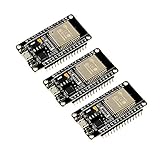
- 2.4GHz Dual Mode WiFi + Bluetooth Development Board
- Support LWIP protocol, Freertos
- SupportThree Modes: AP, STA, and AP+STA
- Ultra-Low power consumption, Compatible with Arduino IDE
- ESP32 is a safe, reliable, and scalable to a variety of applications
| Appliance requirement | Typical MCU responsibility |
|---|---|
| Maintain refrigerator temperature | Read thermistors and control the compressor, fans and defrost cycle |
| Control washing-machine drum speed | Generate PWM signals and run motor-control algorithms |
| Prevent overheating | Monitor temperature and current and trigger a safe shutdown |
| Detect a coffee-machine water tank | Process level, capacitive or other sensor signals |
| Respond to a touch button | Scan the interface and interpret user input |
| Send status to an app | Manage a radio or communicate with a separate connectivity module |
In practical terms, the appliance control loop is:
Sense → process → decide → actuate → verify → communicate.
That loop usually needs to function without the cloud. A washing machine must still control its motor and door lock during an internet outage; a refrigerator must still regulate temperature if its app or vendor server is unavailable.
Infineon’s home-appliance architecture overview presents appliance designs as a combination of motor control, human-machine interface (HMI), connectivity, application processing, security and, in some products, edge AI. This is an architecture model, not a claim that every appliance contains all of those functions.
What makes a PSoC different?
PSoC is not a generic synonym for every MCU. It is a configurable MCU architecture and product family associated with Infineon and its Cypress heritage. Its defining feature is the combination of a conventional processor with programmable analog blocks, configurable digital logic, programmable interconnect, timers, communication peripherals and touch-sensing capabilities.
Depending on the exact part number, a PSoC can integrate functions such as:
- Analog-to-digital converters, digital-to-analog converters, op-amps and comparators.
- Timers, counters, PWM generators and configurable digital logic.
- Capacitive-touch sensing and other customized sensor interfaces.
- USB, I2S, PDM-PCM, CAN-FD and standard serial communications.
- Security hardware, protected memory and secure-update functions.
- Multiple processor domains or wireless-host capabilities.
For example, PSoC 6 documentation describes devices with Arm Cortex-M4 and Cortex-M0+ processing, configurable analog and digital peripherals, CAPSENSE touch hardware, ADCs, DACs, op-amps, comparators, PWM and multiple communication interfaces. The available cores, memory, peripherals, GPIO count and security features vary by device and package, so a family name is not enough for a production design.
This configurability can reduce the need for a separate touch controller, analog front end, glue-logic device or small sensing MCU. It can also let a manufacturer customize an appliance platform in firmware or configurable hardware rather than redesigning the entire board.
Recommended Free Tools
Integration is not automatically better. A PSoC may increase software complexity, require vendor-specific tools and make the design more dependent on one silicon ecosystem. The right choice depends on the appliance’s timing, sensing, safety, security, cost and lifecycle requirements.
How MCUs make appliances smarter
1. They turn sensor readings into useful information
Sensors provide the raw data from which appliance intelligence is derived. Relevant measurements include temperature, humidity, pressure, water level, current, voltage, motor position, speed, vibration, imbalance, door position, weight, proximity, touch, air quality and acoustic signals.
The MCU converts analog signals into digital values, filters noise, identifies events and combines readings from multiple sensors. A washing machine can use load, vibration and motor-current data to adjust a cycle. A refrigerator can coordinate temperature, compressor speed, airflow and defrost behavior. A coffee machine can combine water level, temperature and flow information to improve brewing consistency.
PSoCs are especially useful when the sensor interface itself needs customization. Infineon’s 2025 Home Appliances Selection Guide positions PSoC 4000T devices for applications including capacitive, inductive and liquid-level sensing. Actual performance depends on the selected device, sensor construction, PCB layout, calibration and operating environment.
Quick wins for a faster PC:
Scan for outdated or missing drivers - takes under a minuteDriver Scan →Clear out junk files and repair common Windows errorsFree Scan →Fix the driver behind crashes, sound loss and screen glitchesFind Drivers →2. They provide deterministic real-time control
Appliances often need predictable responses at millisecond or microsecond timescales. Examples include motor commutation, pump and fan control, compressor-inverter operation, heater regulation, current limiting, over-temperature shutdown and door-lock interlocks.
Rank #2

- 2.4GHz Dual Mode WiFi + Bluetooth Development Board
- Support LWIP protocol, Freertos;ESP32 is a safe, reliable, and scalable to a variety of applications
- SupportThree Modes: AP, STA, and AP+STA
- Ultra-Low power consumption, Compatible with Arduino IDE
- 1PCS 30Pin ESP32 Development Board 2.4GHz WiFi Dual Cores Microcontroller Integrated with Antenna RF Low Noise Amplifiers Filters
Wireless traffic, a display task or a cloud service must not be allowed to disrupt a safety function or motor-control loop. This is why a connected appliance normally retains a local real-time controller even when it also contains a high-level processor.
Infineon’s refrigerator-control material describes PSoC Control C3 as a real-time-control MCU family for applications such as motor control and power-factor correction. That capability applies to selected devices and should not be generalized to every PSoC product.
3. They enable more precise energy control
MCUs improve efficiency through control precision rather than simply through greater processing power. They can support variable-speed compressors, adaptive washing and drying cycles, accurate heater duty-cycle control, optimized fan speeds, reduced standby activity, sleep modes and power-factor correction.
Better control can reduce wasted energy, noise and mechanical stress. However, the MCU is only one part of the result. Motor and compressor design, power semiconductors, inverter topology, insulation, thermal management and firmware quality may have an equal or greater effect on total appliance efficiency.
Infineon identifies potential benefits such as lower standby power, quieter operation and improved motor efficiency in its appliance portfolio material. These are system-level possibilities, not guaranteed results from selecting a particular MCU.
4. They manage the user interface
MCUs control buttons, rotary inputs, capacitive touch, sliders, displays, LEDs, buzzers, proximity sensors and, where suitable processing hardware exists, voice interactions.
PSoCs can be attractive for this work because touch sensing and configurable analog and digital functions can coexist with application control. This is useful when controls must work through glass or plastic and withstand moisture, steam, grease and repeated cleaning.
Do these 3 things before closing this tab:
1Fix the driver behind crashes, sound loss and screen glitches2Clear out junk files and repair common Windows errors3Scan for outdated or missing drivers - takes under a minuteTouch is not automatically superior to physical controls. Wet fingers, gloves, condensation, thick overlays, electromagnetic interference and poor tactile feedback can make capacitive interfaces difficult to use. For some ovens, washing machines and safety-related functions, physical controls or a hybrid interface remain the better engineering choice.
5. They support connectivity and remote features
An MCU may host a Bluetooth Low Energy stack, control a Wi-Fi or Bluetooth module, communicate with a Linux-based application processor, manage commissioning and provisioning, package status data or install authenticated firmware updates.
Common architectures include:
- MCU plus external wireless module: flexible and often easier to certify, but it adds components, board area, software interfaces and power-management work.
- Connected MCU: potentially simpler and smaller, but the processor, radio, memory and security architecture must meet all requirements together.
- MCU plus application processor: suitable for rich displays, voice, video or complex local applications, but it increases cost, power consumption, boot complexity and security obligations.
PSoC 6 documentation describes both wireless-host and coprocessor roles. In the latter arrangement, the MCU can handle low-latency sensing and always-on functions while a Linux-based processor manages higher-level applications.
Connectivity technologies have different roles. Bluetooth may simplify commissioning; Wi-Fi commonly provides home-network and cloud access; Thread can support low-power mesh networking; and Matter provides an application-layer approach to smart-home interoperability. Matter does not replace appliance-specific firmware, radio hardware, cloud services or local safety logic.
Free tools Windows power users keep installed
One-click scans. No signup required.
6. They can run edge intelligence
Local processing can detect unusual vibration, recognize a narrow set of voice commands, estimate a laundry load, classify air-quality conditions, identify abnormal motor behavior or predict component failure. Edge processing can reduce latency, keep an appliance useful during an internet outage and reduce the need to transmit raw data.
Rank #3

- Powerful ESP-32 Board: Unlock the world of Internet of Things (IoT) and advanced electronics with the heart of this kit: the ESP-32 board. It features a powerful dual-core processor, integrated Wi-Fi and Bluetooth 4.2, making it perfect for building connected, smart devices that communicate with your phone or the cloud. It's fully compatible with the Arduino IDE for easy programming.
- Super Starter Kit: This kit contains over 35 different modules and electronic components, including sensors, displays, motors, and input devices. From LEDs and buttons to an OLED screen, servo motor, and keypad, you have everything needed to explore a vast range of projects in one box.
- Step by Step Online Tutorial: Jump right in with our detailed, beginner-friendly tutorial. Access 30+ projects with complete code, clear circuit diagrams, and step-by-step instructions. Learn the fundamentals of electronics, coding, and how to utilize the ESP-32's unique capabilities without any prior experience.
- Hands-on Learning for All Skill Levels: Perfect for students, makers, engineers, and hobbyists. Start with basic circuits and coding, then progress to intermediate and advanced IoT applications. Build practical projects like weather stations, smart home controllers, remote-controlled devices, and interactive gadgets. The skills you learn are the foundation for real-world innovation.
- Quality & Great Support: Elegoo is committed to quality. We provide a clear, detailed tutorial guide, refined code, and a well-organized component kit. All modules are carefully selected for reliability and ease of use. Our dedicated technical support team and active online community are ready to help you succeed in your learning journey.
It also introduces trade-offs: limited memory and compute, model-update requirements, power consumption, validation effort and the risk of incorrect classifications. Many functions described as AI may instead be thresholds, rules, statistical estimation or a small classifier.
The exact silicon matters. PSoC Edge E84 documentation describes an AI-capable MCU platform with a neural-network companion processor, DSP, always-on sensing and voice-related functions. Those capabilities should not be applied to ordinary PSoC 4 or PSoC 6 devices without checking their specifications.
7. They protect and update the appliance
A connected appliance may expose device credentials, household usage patterns, local-network access and firmware-update mechanisms. Security therefore has to cover the entire product lifecycle.
Relevant functions can include secure boot, a hardware root of trust, authenticated firmware, protected key storage, device identity, secure provisioning, encrypted communications, signed over-the-air updates, debug-port restrictions and rollback protection.
Selected PSoC 6 devices include security features such as hardware-based roots of trust, cryptographic acceleration, secured onboarding, protected key storage and authenticated updates. Features differ among subfamilies and part numbers.
Some products may add a discrete security element. Infineon describes OPTIGA Trust M MTR as a Matter-certified security solution that can work with an MCU or SoC. The value of such a device includes identity, provisioning and key protection; its cost must be assessed alongside certification and lifecycle requirements.
A long-lived appliance also needs answers to practical questions: What happens when certificates expire? How long will security patches continue? Can a failed update recover locally? Can ownership be transferred securely? What happens if the vendor’s cloud service disappears?
The Tool Desk
Outbyte PC Repair FREERepair Windows errors before they cause bigger problemsFix Now →Outbyte Driver Updater FREEFix the driver behind crashes, sound loss and screen glitchesFind Drivers →How the architecture fits together
Sensors
  ├─ temperature, pressure and level
  ├─ current, voltage, vibration and position
  └─ touch, proximity and audio
          │
          ▼
MCU or PSoC
  ├─ signal conditioning and filtering
  ├─ control algorithms and diagnostics
  ├─ safety monitoring
  ├─ motor, heater, valve and fan commands
  ├─ HMI management
  └─ local decision-making
          │
          ├──────────► Power stage and actuators
          ├──────────► Display and controls
          ├──────────► Wi-Fi, Bluetooth, Thread or Matter
          ▼
       App, cloud or smart-home hub
The cloud can add remote monitoring, analytics, notifications and account-based features. It should not be the appliance’s only control loop. Essential operation, fault handling and safety interlocks should remain local by design.
Examples across appliance categories
Refrigerators and freezers
MCUs coordinate compressor speed, evaporator and condenser fans, defrost cycles, temperature sensors, door detection, ice makers, water valves, lighting, displays and alarms. A design may divide real-time motor control from application and connectivity functions, or combine selected functions in a higher-performance MCU.
Infineon’s refrigerator architecture identifies PSoC Control C3 for real-time control, PSoC 6 for configurable IoT control and PSoC Edge for edge AI and machine learning. A smarter controller alone does not guarantee lower energy use; insulation, refrigeration design, compressor efficiency and power electronics remain crucial.
Washing machines and dryers
MCUs manage drum speed and direction, load estimation, imbalance detection, water level, temperature, detergent dosing, door locks, spin optimization and fault diagnosis. Dryers additionally need temperature and humidity management.
PC Slower Than It Used to Be?
A free scan shows the junk files, broken settings and background clutter dragging Windows down - then fixes them in one click.Free scan · Windows 10 & 11Outdated Drivers Are Slowing You Down
One free scan finds every outdated or missing driver and matches the right update for your exact hardware.Free scan · exact hardware matchA PSoC may consolidate touch controls, sensor acquisition and custom logic, while a dedicated motor-control MCU or power-control subsystem handles demanding real-time functions.
Rank #4

- High-performance foundation line, ARM Cortex-M4 core with DSP and FPU, 512 Kbytes Flash, 180 MHz CPU, ART Accelerator, Dual QSPI
- On-board ST-LINK/V2-1 debugger/programmer with SWD connector
- Can be powered from USB
- Three LEDs, Two Push-buttons
- Support of wide choice of Integrated Development Environments (IDEs) including IAR, ARM Keil, GCC-based IDEs
Ovens and microwave ovens
Typical functions include temperature regulation, heater or magnetron control, door and safety interlocks, fan operation, humidity or food sensing, display management, cooking programs and firmware updates.
Infineon’s microwave-appliance material describes connectivity, remote monitoring, cloud features, secure boot and authenticated updates as parts of a connected architecture. Remote control must never be treated as a way to bypass physical interlocks or local safety logic.
Coffee machines
MCUs coordinate water-level sensing, temperature control, pumps, valves, grinders, brewing flow, milk systems, touch controls and descaling reminders. PSoC devices may be useful for capacitive or other sensing and compact HMI designs.
Fluid exposure, scale, electrical isolation and regulatory requirements still need separate validation. A configurable sensor interface cannot compensate indefinitely for contamination, drift or a damaged sensor.
HVAC systems, air purifiers and fans
MCUs manage fan speed, compressors or pumps, temperature, humidity, air-quality sensors, filter-life estimation, schedules, presence detection and remote control. Edge processing may support local air-quality classification or occupancy response, while lower-cost products may use simple thresholds.
MCU versus PSoC: the practical choice
| Criterion | Conventional MCU | PSoC |
|---|---|---|
| Basic appliance control | Usually sufficient | Also suitable |
| Capacitive touch | May require an external controller or dedicated peripheral | Often a core strength |
| Custom analog sensing | Depends on integrated analog resources | Generally more configurable |
| Custom digital logic | May require external logic | Programmable blocks can reduce components |
| Motor control | Depends on ADC, timers, PWM and control resources | Available on selected families |
| AI and edge processing | Depends on CPU, memory and accelerators | Dedicated PSoC Edge families target more advanced workloads |
| Cost | Can be lower for simple tasks | Integration may lower system cost but increase chip cost |
| Toolchain | Often familiar and widely portable | May require vendor-specific configurable-peripheral tools |
The correct conclusion is not that PSoC is better than a conventional MCU. The better rule is: choose the least complex architecture that meets the appliance’s sensing, timing, safety, connectivity, security and lifecycle requirements.
Independent reader supportYour contribution helps us test, update, and keep practical guides available for everyone.What appliance designers should evaluate
Real-time determinism
- Which functions must respond immediately?
- Can wireless activity interrupt a motor-control or safety task?
- Are hardware fault inputs and independent shutdown paths available?
- Are the ADC, PWM and timer resources appropriate?
Analog performance
Check ADC resolution and sampling rate, channel count, input range, noise, references, op-amps, comparators, sensor excitation, calibration and isolation. A high-resolution ADC does not automatically produce better measurements; PCB layout, reference stability, filtering and sensor quality may matter more.
What’s actually slowing this PC down?
Pick the symptom - the matching free tool is one click away.
HMI requirements
Evaluate touch-through-glass or touch-on-metal operation, wet-hand performance, glove compatibility, display interfaces, proximity sensing, physical-button fallback, condensation and cleaning chemicals.
Memory and software headroom
Budget for application firmware, radio stacks, graphics, file systems, diagnostic logs, machine-learning models, bootloaders and dual-image OTA updates. PSoC 6 variants differ substantially in memory, cores, security configuration and connectivity, as shown in the PSoC 6 application documentation.
Security and lifecycle
Ask how factory keys are provisioned, who signs firmware, how credentials are revoked, how failed updates recover, how long patches will be supplied and how a used appliance is securely transferred to a new owner. Security is a product-lifecycle plan, not merely a cryptography feature list.
Safety and isolation
Home appliances connect low-voltage electronics to mains-powered motors, heaters and compressors. Designs may require galvanic isolation, appropriate creepage and clearance, surge and ESD protection, watchdogs, brownout handling, thermal cutoffs, fail-safe defaults and independent hardware shutdown paths. An MCU’s AI or security capabilities do not substitute for appliance-safety engineering.
Quick wins for a faster PC:
Fix the driver behind crashes, sound loss and screen glitchesFind Drivers →Clear out junk files and repair common Windows errorsFree Scan →Scan for outdated or missing drivers - takes under a minuteDriver Scan →Supply and maintainability
Evaluate expected availability, package longevity, second-source options, tool support, migration difficulty, factory programming, regulatory changes and security maintenance. A chip that is inexpensive at the bill-of-materials level may be costly if it lacks memory headroom or cannot support secure updates later.
Best Value

- with pre-soldered header Raspberry Pi Pico. RP2040 microcontroller chip designed by Raspberry Pi in the United Kingdom
- Dual-core Arm Cortex M0+ processor, flexible clock running up to 133 MHz. 264KB of SRAM, and 2MB of on-board Flash memory.
- Castellated module allows soldering direct to carrier boards. USB 1.1 with device and host support. Low-power sleep and dormant modes. Drag-and-drop programming using mass storage over USB. 26 × multi-function GPIO pins.
- 2 × SPI, 2 × I2C, 2 × UART, 3 × 12-bit ADC, 16 × controllable PWM channels.Accurate clock and timer on-chip.Temperature sensor.
- Accelerated floating-point libraries on-chip.8 × Programmable I/O (PIO) state machines for custom peripheral support
Failure modes and trade-offs
Cloud dependency
Remote features can fail when the home internet, vendor server, user account, certificate or app stops working. Separate the product’s capabilities into local, local-network and cloud-dependent functions. The first category should include essential operation and safety.
Over-integration
Combining sensing, touch, control and connectivity in one PSoC can reduce component count, but it can also enlarge the impact of a chip failure, complicate debugging, increase vendor dependence and make EMC validation more demanding.
Workload interference
A wireless fault should not stop a motor-control loop. A display crash should not disable safety monitoring. A failed update should not permanently brick the appliance. Hardware watchdogs, task isolation, independent safety paths and explicit recovery states are important design measures.
Sensor drift and contamination
Steam, grease, detergent, scale, vibration, electromagnetic interference, heat cycling and condensation can degrade measurements. Algorithms need plausibility checks, calibration strategies and fault states; they cannot indefinitely compensate for a blocked pressure tube, damaged thermistor or contaminated touch surface.
Wireless interference
Motors, inverters, relays and switching supplies can produce electromagnetic interference that affects radios and touch sensing. Wireless reliability is therefore a complete RF, PCB, enclosure and firmware problem, not simply a matter of choosing a Wi-Fi-capable MCU.
AI overclaiming
When an appliance is described as AI-enabled, ask what is actually inferred, where the model runs, what data it uses, how often it is updated and what happens when it is wrong. For many control tasks, conventional signal processing and rules are cheaper, easier to validate and more predictable.
When a multi-chip design is better
A conventional MCU with external peripherals can be preferable when unit cost is tightly constrained, sensing is simple, an existing validated module is required or portability across vendors matters.
Free tools Windows power users keep installed
One-click scans. No signup required.
An MCU plus wireless module can isolate radio certification and connectivity changes from the main control firmware, although it adds cost, power, interfaces and OTA complexity.
An application processor plus real-time MCU is appropriate when the appliance needs a rich touchscreen, video, voice, local apps or a full operating system. The real-time MCU can continue to manage sensing, motors, always-on functions and safety-adjacent tasks.
A dedicated motor-control MCU plus application processor is useful when motor timing is demanding and connectivity or UI software is complex. Its disadvantages are a higher bill of materials, more firmware interfaces and more involved manufacturing and update processes.
Bottom line
MCUs make appliances controllable, responsive and measurable. They read sensors, run local control loops, operate motors and heaters, detect faults, manage interfaces and support secure communications. PSoCs extend that capability by combining an MCU with configurable analog and digital hardware, making them useful where touch interfaces, custom sensing and integrated control are important.
The Tool Desk
Outbyte Driver Updater FREEScan for outdated or missing drivers - takes under a minuteDriver Scan →Outbyte PC Repair FREERepair Windows errors before they cause bigger problemsFix Now →The appliance becomes genuinely smart only when those capabilities are combined with reliable sensors, safe actuators, suitable power electronics, secure connectivity and software that can be maintained for the product’s full life. The best design is not the one with the most processing power or the longest feature list; it is the one that delivers useful intelligence without sacrificing deterministic control, safety, serviceability or resilience when the network disappears.
Quick Recap
Product prices and availability are accurate as of the date/time indicated and are subject to change. Any price and availability information displayed on Amazon at the time of purchase will apply.

