Short answer: You do not automatically need a Tesla Wall Connector. Choose the Mobile Connector for portability or modest daily driving, the Wall Connector for a permanent Tesla-only installation, and the Universal Wall Connector if your household has—or may add—a non-Tesla EV.
The right choice depends on daily mileage, how long the vehicle is parked, your electrical panel, installation distance, and whether you need a hardwired charger or a portable connection. In the United States, Tesla’s listed home-charging products range from a 120-volt portable EVSE to a hardwired 48-amp unit capable of up to 11.5 kW.
As an Amazon Associate I earn from qualifying purchases.
Tesla home chargers at a glance
| Product | Price observed | Connector | Maximum advertised charging | Best for |
|---|---|---|---|---|
| Mobile Connector | $300, as listed by Tesla in August 2026 | Tesla NACS | About 2–3 miles of range per hour on 120 V; up to 30 miles per hour on an approved 240 V connection | Portability, low mileage, backup charging, or an existing suitable outlet |
| Wall Connector | $535 on Tesla’s Shop page in August 2026 | Tesla NACS | Up to 48 amps, 11.5 kW, or about 44 miles per hour | A permanent Tesla-only installation |
| Universal Wall Connector | $570 on Tesla’s Shop page; Tesla’s comparison page displayed $600 | Integrated NACS and J1772 | Up to 48 amps, 11.5 kW, or about 44 miles per hour | Households with Tesla and non-Tesla EVs |
Prices and product availability can change, so verify the checkout price before ordering. Tesla’s official comparison is available on its home-charging page.
These devices are technically EVSEs, or electric-vehicle supply equipment. They safely deliver and manage AC electricity; the Tesla contains the onboard charger that converts AC power for the battery. A 48-amp EVSE therefore does not guarantee that every Tesla will charge at 48 amps.
#1 Best Overall

- Dual Voltage Level 1 & 2: Charge at 120V/12A (1.44kW, 2-5 miles/hr) with the included NEMA 5-15 adapter or at 240V/16A (3.84kW, 9-12 miles/hr) with the NEMA 6-20 plug. One SEGUMA portable tesla charger gives you two charging options for everyday home charging, backup charging, and travel
- EV Charger for Tesla Vehicle-Seguma 16A mobile ev charger for tesla is specifically designed for Tesla vehicles, engineered with standardized North American Charging Standard (NACS) connector, works flawlessly with Tesla Model-Y/X/3/S/Cybe truck
- Wireless Charging Door Control-The portable mobile car charger for tesla has a button on the connector that wirelessly opens the charging port door, eliminating the need for physical keys or buttons and making charging more convenient
- Intelligent Charging-The Seguma level 1 charger offers protection against leaks, grounding, voltage issues, overcharging, and overheating. It automatically shuts off when your Tesla is fully charged. Tip: Install a home circuit breaker for extra safety
- Extended 25FT Cable-The 25-foot cable allows easy tesla charging at home or public stations. The included portable storage bag lets you take the tesla home charger anywhere, making it ideal for travel, road trips, or visits. Perfect accessory for Model Y
Do you actually need a Wall Connector?
For many owners, no. A Mobile Connector on a conventional 120-volt outlet can be sufficient when the vehicle travels only a few miles each day and remains parked overnight. An approved 240-volt outlet can make the same portable unit substantially faster.
| Your situation | Practical choice |
|---|---|
| Low daily mileage and a convenient garage outlet | Mobile Connector on 120 V may be enough |
| Moderate mileage and an electrician-approved 240-volt outlet already exists | Mobile Connector with the correct Tesla adapter |
| Maximum practical overnight AC charging and a permanent parking space | Hardwired Wall Connector |
| Tesla plus a non-Tesla EV | Universal Wall Connector, or a J1772 charger with an appropriate Tesla adapter |
| Two EVs | Two Wall Connectors using Tesla Group Power Management, or another managed multi-EV setup |
| Limited panel capacity | Electrician assessment before selecting a high-current installation |
| Frequent travel or charging away from home | Keep a Mobile Connector even if a Wall Connector is installed |
Think in terms of energy added rather than the phrase “full charge.” A vehicle’s required charging time depends on its starting state of charge, battery size, daily driving, temperature, charging losses, and onboard-charger limit.
Level 1, Level 2, and DC fast charging
Level 1 normally means 120-volt charging through the Mobile Connector. Tesla lists approximately 2–3 miles of range per hour. It is slow, but 10 hours can still add useful energy for a low-mileage driver.
Recommended Free Tools
Level 2 normally means 208–240-volt AC charging. It includes a Mobile Connector using an approved 240-volt adapter and the hardwired Wall Connector products. Tesla lists up to 30 miles of range per hour for a 240-volt Mobile Connector setup and up to 44 miles per hour for the Wall Connector products under maximum conditions.
A Wall Connector is not a DC fast charger. It is faster than a household outlet, while a Tesla Supercharger sends DC power directly to the battery at much higher power.
Tesla Mobile Connector explained
The Mobile Connector is Tesla’s portable option. With the NEMA 5-15 adapter, it can use a standard 120-volt outlet. With the appropriate Tesla adapter and an electrician-approved receptacle, it can also use certain 240-volt outlets.
- 120 V: approximately 2–3 miles of range per hour, according to Tesla.
- Approved 240 V: up to approximately 30 miles of range per hour, depending on the vehicle and connection.
- Portability: useful as a travel charger, backup, or renter-friendly option.
- Controls: charging is primarily managed through the vehicle touchscreen and Tesla app.
Do not assume that any outlet with the right voltage is suitable. Do not connect an EV to an arbitrary dryer, welder, generator, extension cord, shared circuit, or damaged outdoor receptacle. A qualified electrician should verify the receptacle type, grounding, conductor condition, breaker, weather protection, circuit sharing, and suitability for a continuous EV load.
Free tools Windows power users keep installed
One-click scans. No signup required.
Tesla Wall Connector explained
The Wall Connector is a permanently installed, hardwired Tesla NACS charger. Tesla lists output of up to 48 amps and 11.5 kW when the electrical installation and vehicle allow it, with up to approximately 44 miles of range per hour.
It is designed for indoor or outdoor installation and includes Wi-Fi connectivity for features such as firmware updates, remote diagnostics, charging statistics, scheduling, and access management. Tesla also supports power management for installations with limited capacity and multiple Wall Connectors.
The standard Wall Connector is intended for Tesla vehicles. It is a good fit when the household parks one or more Teslas in a fixed location and wants a clean permanent installation. It is less suitable if a J1772-equipped EV is likely to be added.
Universal Wall Connector explained
The Universal Wall Connector combines an integrated Tesla NACS connector with a J1772 connector for most North American EVs. A Tesla can use its NACS connection, while a compatible non-Tesla EV can use the J1772 connector without a separate loose adapter.
What’s actually slowing this PC down?
Pick the symptom - the matching free tool is one click away.
- Up to 48 amps and 11.5 kW, subject to the circuit and vehicle.
- Up to approximately 44 miles of range per hour under maximum conditions.
- Wi-Fi connectivity, Tesla app management, firmware updates, and diagnostics.
- An auto-sensing handle intended to open a Tesla charge port.
Tesla’s Shop page stated that purchase eligibility was limited to Tesla vehicle owners when checked. The Shop displayed $570, while Tesla’s support comparison displayed $600; verify the current price and eligibility before purchasing.
“Universal” does not mean every EV receives the same speed or every feature. Confirm the specific vehicle’s connector, AC charging limit, app support, and utility-program eligibility.
Rank #2
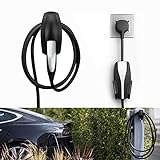
- COMPATIBLE WITH TESLA MODEL 3/MODEL Y/MODEL X/MODEL S CHARGER: Seven Sparta Charging Cable holder is a perfect holder to hang your charging cable from in the garage.
- KEEP YOUR CHARGING CABLE NEATLY AND SECURE: The cable organizer is much better than a normal hook. It does a good job of keeping the cable off of the ground, and protect your cable from falling down accidentally.
- SAFE ABS MATERIAL: The charger cable organizer is made from high quality ABS plastic, pass fireproofing grade testing. The bearing capacity can reach above 30KG at least. Prior to purchasing, we recommend confirming the product's size and material.
- EASY & SECURE INSTALLATION: The charging cable holder takes just minutes to install. The charger head fits snugly into the slot, with a notch to prevent it from sliding out.
NACS, J1772, and adapters
NACS is Tesla’s charging connector. Tesla’s Mobile Connector and dedicated Wall Connector use it. J1772 is the common North American AC connector used by many non-Tesla EVs.
A Tesla can generally use a J1772 home charger with the appropriate Tesla J1772 adapter. A J1772-equipped EV can use the Universal Wall Connector directly. Connector compatibility does not guarantee identical charging speed, scheduled-charging controls, authentication, utility integration, or app features.
Windows Errors? Fix Them Before They Spread
Repair common Windows errors and clear accumulated junk for a smoother, more stable PC - no reinstall needed.Free scan · no reinstallCrashes, No Sound, or Screen Glitches?
Random freezes, missing sound and display glitches usually trace back to one bad driver. Find and replace yours safely.Free scan · under a minuteHow fast will a Tesla charge at home?
Tesla’s “miles of range per hour” figures are estimates, not universal guarantees. Actual results vary with vehicle efficiency, battery temperature, state of charge, voltage, charging losses, current settings, and the vehicle’s onboard AC charger.
| Setup | Tesla-listed estimate |
|---|---|
| Mobile Connector on 120 V | Approximately 2–3 miles of range per hour |
| Mobile Connector on approved 240 V | Up to approximately 30 miles per hour |
| Wall Connector or Universal Wall Connector at maximum configuration | Up to approximately 44 miles per hour |
A useful planning formula is:
Approximate charging time = energy added in kWh ÷ delivered charging power in kW
Delivered power is not always the breaker’s theoretical capacity. Continuous-load rules, the programmed current, voltage variation, vehicle limits, temperature, and charging losses all matter. Cold batteries, high state of charge, and preconditioning can also reduce the observed rate.
Electrical requirements and circuit sizing
The charger’s output must match the circuit, conductor, panel, and programmed configuration. Tesla’s Universal Wall Connector installation manual gives these example pairings:
Quick wins for a faster PC:
Scan for outdated or missing drivers - takes under a minuteDriver Scan →Repair Windows errors before they cause bigger problemsFix Now →| Breaker | Maximum output | Approximate power at 240 V |
|---|---|---|
| 60 A | 48 A | 11.5 kW |
| 50 A | 40 A | 9.6 kW |
| 40 A | 32 A | 7.6 kW |
| 30 A | 24 A | 5.7 kW |
| 20 A | 16 A | 3.8 kW |
| 15 A | 12 A | 2.8 kW |
In Tesla’s listed configuration, a 48-amp continuous EV load is paired with a 60-amp circuit. That table is not a substitute for local electrical code. Your electrician must apply the National Electrical Code, local amendments, equipment instructions, conductor requirements, panel calculations, and permit rules.
Tesla’s J1772 Wall Connector manual specifies at least 6 AWG, 90°C-rated copper conductors for maximum-power installation under the stated conditions. Do not treat that as a universal wire-size instruction: run length, wiring method, temperature, conductor material, and local code affect the design.
Do not solve a capacity problem by simply installing a larger breaker. Breaker rating, conductor size, panel capacity, equipment configuration, and continuous-load calculations must agree.
Hardwired charger or 240-volt outlet?
| Hardwired Wall Connector | 240-volt receptacle with Mobile Connector |
|---|---|
| Higher maximum-current potential | Portable and removable |
| Clean permanent installation | May cost less when a suitable circuit already exists |
| No plug connection to heat or wear | Useful for renters or travel |
| Well suited to outdoor or long-term use | Usually lower maximum output than a 48-amp Wall Connector |
| Requires an electrician to disconnect and relocate | Receptacle condition and continuous-load suitability are critical |
An existing receptacle is not automatically safe because its voltage appears correct. Verify its type, breaker, wire gauge, grounding, condition, circuit sharing, physical location, adapter compatibility, and suitability for continuous EV charging.
How much does Tesla home charging cost?
Separate the project into hardware, electrical work, electricity, and incentives.
- Hardware: Tesla listed the Mobile Connector at $300, the Wall Connector at $535, and the Universal Wall Connector at $570 on the Shop page when observed in August 2026. The Universal comparison page displayed $600.
- Installation: Tesla estimates $0–$1,500 for a Mobile Connector setup and $750–$1,500 for Wall Connector or Universal Wall Connector installation. These are estimates, not guaranteed local quotes.
- Additional electrical work: Long cable runs, conduit, trenching, subpanels, pedestals, concealed wiring, panel upgrades, and service upgrades can materially increase the bill.
- Electricity: Your utility rate, time-of-use schedule, charging losses, and daily driving determine operating cost.
- Incentives: Check your utility, state energy office, and local managed-charging programs for current eligibility.
Tesla says standard installation quotes may include labor and materials, an electrical permit, inspection, and an installation warranty. Ask each contractor to itemize those items rather than comparing hardware prices alone.
Installation checklist
- Identify the vehicle’s parking position.
- Measure the approximate route from the electrical panel to the charger.
- Ask an electrician to assess panel and service capacity.
- Determine whether the installation is indoor, outdoor, surface-mounted, or requires trenching.
- Choose between a hardwired EVSE and an approved 240-volt receptacle.
- Get a quote from a licensed electrician or Tesla Certified Installer.
- Confirm permit and inspection requirements.
- Ask for the breaker size, programmed maximum current, cable route, warranty, and expected completion date.
- Check utility rebates and managed-charging programs before buying equipment.
- Keep the invoice, permit, inspection documents, and equipment receipt.
Limited panels, two EVs, and difficult installations
Limited electrical capacity
A 48-amp EV load may be impractical in a small or heavily loaded service. Options can include a lower-current circuit, scheduled charging, dynamic load management, a smaller EVSE, an energy-management system, or a panel or service upgrade. Your electrician should determine which approach complies with code.
Rank #3

- UP TO 9X FASTER CHARGING SPEED: The IYILO electric vehicle charging station delivers up to 46 miles of range per hour at 48A (11.5kW) via hardwired installation (60A breaker & licensed electrician required). Current is adjustable in 1A increments from 6A to 48A. Charges up to 9 times faster than a standard Level 1 charger
- AUTOMATIC CONNECTOR OVERHEAT PROTECTION: Worried about overheating during daily charging? The IYILO Level 2 EV Charger features an advanced NTC temperature sensor built directly into the NACS (Tesla-style) connector, enabling real-time temperature monitoring with live data displayed in the app. If the connector temperature exceeds 221°F (105°C), the system will automatically reduce charging power or completely shut off charging to prevent damage to your EV and ensure safe home charging.
- UTILITY CHARGING PROGRAM SUPPORT: IYILO is currently joining local utility EV charging programs and has been listed on several official portals, including but not limited to ComEd, PSEG (NJ), PSEG-LI, Seattle City Light, Salt River Project, Portland General Electric, Oregon DOT, and Georgia Power ect. Through these programs, you can take advantage of local policy support and incentives. Moving forward, we will continue expanding our partnerships with major utilities and public agencies.
- INTELLIGENT APP & SMART CHARGING CONTROL: The IYILO App features a smart, intuitive interface to set Time-of-Use (TOU) rates, track energy usage and cost, and manage multiple user accounts. It supports multiple charging modes, such as Scheduled charging and RFID card, while also offering OTA remote upgrades, ensuring optimal performance and longer lifespan. Note: Supports 2.4GHz WiFi only; 5GHz not supported
- COMPATIBLE WITH ALL NACS (J3400) EVS & PHEVS: The IYILO Level 2 EV Charger is designed with a native NACS connector and a 25ft heavy-duty charging cable, delivering seamless compatibility with all NACS-equipped electric vehicles and plug-in hybrid vehicles across North America. Engineered for Tesla-style charging standards, it ensures reliable daily home charging performance. Note: For J1772-equipped EVs, a compatible J1772 adapter is required (adapter not included)
Two EVs
Tesla recommends two Wall Connectors configured with Group Power Management for charging two EVs at the same time. The chargers share available power, so both vehicles may not receive maximum output simultaneously. This can still deliver sufficient overnight energy while avoiding an unnecessarily large service upgrade.
The Tool Desk
Outbyte PC Repair FREEClear out junk files and repair common Windows errorsFree Scan →Outbyte Driver Updater FREEScan for outdated or missing drivers - takes under a minuteDriver Scan →Detached garages and long runs
Detached buildings may require longer conductors, conduit, trenching, a subpanel, a pedestal, weatherproofing, or a service upgrade. Include those possibilities in the initial quote rather than assuming the charger price represents the project cost.
Outdoor installation
Tesla lists the Wall Connector and Universal Wall Connector for indoor or outdoor use. The installer should protect equipment from physical damage, route cable to avoid trip hazards, meet weatherproofing and code requirements, and provide appropriate connector storage.
Condos, apartments, and rentals
Obtain landlord or HOA permission before planning a hardwired installation. Confirm parking rights, shared electrical capacity, metering, billing, load management, insurance requirements, and whether you can remove the equipment later. A private-home installation assumption does not automatically apply to a shared property.
Setting up charging after installation
Tesla’s exact app labels can change. The stable setup process is:
Do these 3 things before closing this tab:
1Repair Windows errors before they cause bigger problems2Fix the driver behind crashes, sound loss and screen glitches3Clear out junk files and repair common Windows errors- Plug the vehicle into the installed EVSE.
- Confirm that the vehicle recognizes the connection.
- Set the desired charge limit in the vehicle or Tesla app.
- Configure scheduled charging if your utility offers cheaper off-peak rates.
- Set a departure time or preconditioning schedule where supported.
- Confirm that the charger’s current setting matches the installed circuit.
- Test charging at the intended maximum current.
- Check charging status, energy use, and fault notifications.
- Complete separate enrollment if using a utility-managed charging program.
Wi-Fi can support firmware updates, diagnostics, statistics, remote controls, and utility integrations. Charging should not be described as dependent on an internet connection in every circumstance, and available controls vary by vehicle, charger firmware, app version, and utility program.
Solar, Powerwall, and Powershare
Tesla residential energy-product owners may be able to manage home charging alongside solar or Powerwall systems in the Tesla app. Tesla’s Charge on Solar feature is ordinary managed charging that uses available solar energy; it should not be confused with backup power or bidirectional vehicle operation.
Tesla’s Powershare materials describe bidirectional charging and supported configurations involving compatible vehicles, Universal Wall Connector hardware, Tesla energy equipment, wiring, and software. Powershare is an advanced, compatibility-dependent project—not a standard capability of every Tesla or every home-charging installation. Confirm the exact supported system configuration before designing around backup power.
Incentives and tax credits
The IRS states that the residential Alternative Fuel Vehicle Refueling Property Credit applied to eligible property placed in service from January 1, 2023, through June 30, 2026. It could provide 30% of eligible costs, up to $1,000 per charging port, subject to requirements including an eligible low-income or non-urban census tract and installation at the taxpayer’s primary residence.
Because the current date is September 2026, a new installation should not be marketed as automatically eligible. Check the current IRS guidance and local programs before relying on an incentive. Utility rebates may have separate requirements for the charger model, installation date, Wi-Fi, enrollment, telemetry, or vehicle.
Alternatives to Tesla’s charger
| Alternative | Notable characteristics | Best fit |
|---|---|---|
| ChargePoint Home Flex | Available with J1772 or NACS connectors; hardwired, NEMA 6-50, and NEMA 14-50 installation options; advertised up to 37 miles per hour | Buyers wanting adjustable current, flexible installation, or a non-Tesla brand |
| Wallbox Pulsar Plus | Level 2 charger delivering up to 40 amps and 9.6 kW, with Wallbox software and energy-management features | Buyers seeking a compact charger and Wallbox ecosystem |
These alternatives may offer different connector versions, software, warranties, and utility-program eligibility. They do not necessarily provide one integrated unit with both NACS and J1772 connectors, and the advertised output is not a guaranteed vehicle charging rate.
Troubleshooting Tesla home charging
- Check whether the vehicle has reached its charge limit.
- Check the vehicle and Tesla app for scheduled-charging delays.
- Confirm that the connector is fully seated.
- Look for overheating warnings or a hot receptacle.
- Check the breaker and EVSE status lights.
- Confirm that the current setting has not been reduced.
- Check Wi-Fi only when the problem involves app access, firmware, or remote management.
- Stop using any hot, loose, damaged, or discolored receptacle.
- Contact the installer for electrical faults.
- Contact Tesla support for Wall Connector hardware or firmware faults.
Never repeatedly reset a tripping breaker or bypass a safety warning. Persistent trips, heat, burning smells, buzzing, discoloration, or damaged wiring require the circuit to be taken out of service and inspected.
Quick Recap
Product prices and availability are accurate as of the date/time indicated and are subject to change. Any price and availability information displayed on Amazon at the time of purchase will apply.

