What’s actually slowing this PC down?
Pick the symptom - the matching free tool is one click away.
No—you do not automatically need rear speakers. A good standalone soundbar can make dialogue clearer, sound fuller, and the front soundstage wider than built-in TV speakers. But if you want effects to move convincingly around and behind you, physical rear speakers remain the most dependable solution.
The right choice depends on your content, seating position, room layout, tolerance for extra equipment, and whether you want a simple TV upgrade or a more complete home-theater system.
As an Amazon Associate I earn from qualifying purchases.
What rear speakers actually add
Rear speakers are not simply extra loudspeakers that make the system louder. In a compatible surround mix, they reproduce separate channels positioned behind or beside the listener.
Windows Errors? Fix Them Before They Spread
Repair common Windows errors and clear accumulated junk for a smoother, more stable PC - no reinstall needed.Free scan · no reinstallCrashes, No Sound, or Screen Glitches?
Random freezes, missing sound and display glitches usually trace back to one bad driver. Find and replace yours safely.Free scan · under a minute- Directional effects: sounds can travel from the front to the sides or rear.
- Ambient detail: rain, crowd noise, wind, echoes, and room tone can surround the seating area.
- Film effects: vehicles, projectiles, aircraft, and explosions can have a clearer sense of movement.
- Gaming cues: footsteps, environmental sounds, and approaching action can be easier to locate.
- Greater envelopment: the sound field can feel surrounding even when listening at moderate volume.
A soundbar can simulate some of these effects using side-firing drivers, beam-forming, reflected sound, or virtual-surround processing. Those techniques can work well, but they do not place a physical sound source behind the listener. Discrete satellite speakers are generally the more consistent option for surround and height reproduction, particularly from a fixed viewing position. RTINGS’ soundbar testing and buying guidance distinguishes the convenience of soundbars from the immersive benefits of discrete satellites.
#1 Best Overall

- 5.1.2ch Surround Sound System: A 5.1.2-channel system featuring up-firing speakers, surround sound, and a powerful subwoofer creates lifelike, multidimensional audio. Feel the Sky Around You—raindrops falling from above, helicopters circling overhead, thunder rumbling in all directions. Sound isn’t just around you, it engulfs you, as if the ceiling disappeared. This is Dolby Atmos: not just heard, but felt.
- Up-Firing Drivers with Neodymium Core: The up-firing channels use neodymium internal magnets and 18-core large voice coils to enhance height precision and vertical throw. This aerospace-grade configuration ensures better high-frequency dynamics, delivering focused and elevated sound images that unlock the true potential of Dolby Atmos.
- 360° SurroundX Audio: SurroundX technology combines two rear surround speakers and dual up-firing Atmos drivers to build a true 360° sound field. Powered by intelligent spatial algorithms, the system precisely positions audio around and above you—enhancing Dolby Atmos with a more natural, three-dimensional soundstage. Note: Not compatible with DTS.
- Lossless Audio Transmission: Unlock full Dolby Atmos performance with HDMI eARC, supporting up to 37Mbps bandwidth for lossless 5.1.2-channel audio. Compared to regular ARC, eARC delivers richer detail and better surround effects with no compression. With CEC, your TV and soundbar work as one—power, volume, and input sync automatically for effortless control.
- Advanced App Control: Customize every detail of your audio experience with the Ultimea App. Fine-tune your surround sound with 13-step level adjustment (-6 to +6), optimize with a 10-band graphic EQ, and choose from 121 preset sound settings. Enjoy seamless OTA updates that unlock new features and keep your system performing at its peak.
What a standalone soundbar does well
For many households, the main problem is not the lack of rear effects. It is that the television sounds thin, quiet, or difficult to understand. A standalone bar can address that without filling the room with equipment.
Depending on the model, a bar may include a dedicated center channel for dialogue, separate left and right channels, side-firing drivers, up-firing drivers, dialogue enhancement, room correction, and support for Dolby Atmos or DTS:X. Some also provide Wi-Fi, Bluetooth, AirPlay, or app-based streaming.
This makes a bar alone a sensible choice when you mainly watch news, sitcoms, sports, YouTube, older programs, or ordinary streaming content. It is also usually easier to install and less expensive than a comparable traditional speaker system. The trade-off is that the soundstage is concentrated at the front of the room, even when processing makes it seem wider or taller.
Dolby Atmos does not guarantee rear sound
Dolby Atmos is an audio format and object-based mixing system—not a promise that a product includes physical rear speakers.
An Atmos soundbar can accept Atmos content and attempt to render surround and height cues through drivers in the bar, psychoacoustic processing, or reflections from the walls and ceiling. The result depends heavily on the bar, seating position, ceiling, walls, and room acoustics.
It helps to separate three claims:
- Atmos-compatible: the device can accept or decode an Atmos signal.
- Atmos-capable in your room: the connection, ceiling, seating, and placement allow the relevant effects to work.
- Fuller Atmos reproduction: physical surround and height speakers provide more direct sound sources around the listener.
An “Atmos” badge therefore does not mean a standalone bar will sound the same as a system with speakers behind and above the seating position.
The source must contain surround information
Rear speakers cannot recover discrete rear effects that were never present in the source. A Dolby Digital 5.1, Dolby Digital Plus 5.1 or Atmos soundtrack can provide separate surround information. Compatible disc players may provide Dolby TrueHD or Atmos, while supported games can output multichannel audio. DTS and DTS:X are also possibilities where the equipment supports them.
Rank #2

- New Dimensional Sound - Come home to the cinematic sound you’ve always wanted, and experience every heart-thumping, thrill-inducing, moment. With 4 channels backed by a booming wireless subwoofer and wireless rear speakers, this LG Soundbar delivers a big audio punch without taking up too much of your space—or budget. Dolby Digital and DTS Digital compatibility means you still get enhanced sound quality for all your shows, movies, music and more.
- Dolby Audio - Experience an unparalleled immersive journey with Dolby Audio. This LG Soundbar delivers an unforgettable listening experience with your favorite entertainment. Never miss a single detail, no matter where you're watching.
- Rear Speakers - Now there’s a surround sound system for rooms of all shapes and sizes. Our new rear surround speakers have wireless connectivity—that means no special receiver needed to deliver an immersive audio experience.
- WOW Orchestra - Create the perfect harmony using the audio from your LG TV and LG Soundbar to produce the ultimate listening experience. Feel every detail of sound. Use the LG TV and LG Soundbar speakers at the same time while using one remote to adjust the settings interchangeably.
- WOW Interface - Now, convenience is in your hand. Control your soundbar and your LG TV with one remote. Adjust the volume and audio settings, check the connection status and even select a sound mode on the screen, all from the TV remote.
By contrast, a stereo YouTube video, stereo music stream, older television program, or stereo broadcast does not automatically become authentic 5.1 simply because two additional speakers are connected. The system may upmix or virtualize the signal, and the rear speakers may play sound, but that is different from receiving discrete rear-channel content. Samsung’s surround guidance explains this distinction and notes that a 2.0 source remains 2.0 unless an upmixing or virtual mode is applied.
Rear speakers versus a subwoofer
These upgrades solve different problems:
| Upgrade | What it contributes | Most useful for |
|---|---|---|
| Soundbar | Clearer dialogue, fuller sound, and a wider front stage | General TV viewing |
| Subwoofer | Low-frequency impact and cinematic weight | Explosions, music, engines, and action films |
| Rear speakers | Directional envelopment and sounds from behind | Films, horror, science fiction, and gaming |
If dialogue is the issue, begin with the bar and its placement or dialogue mode. If the system sounds thin, a subwoofer may produce the most obvious improvement. If you specifically want to hear activity around and behind you, rear speakers are the relevant upgrade.
For many buyers, a sensible sequence is: soundbar first, subwoofer second, and rear speakers third. That is not a rule. A movie or gaming enthusiast with a suitable room may reasonably prioritize a complete bar-and-rears package from the beginning.
Who should buy rear speakers?
Rear speakers are usually worth considering when most of the following are true:
- You regularly watch films with 5.1, Atmos, or DTS soundtracks.
- Gaming immersion is important to you.
- You sit in one main, reasonably centered position.
- There is usable space behind or beside the seating.
- You want clearly directional effects rather than only a broad front stage.
- Power outlets, stands, or wall-mounting are practical.
- You are willing to configure, calibrate, and occasionally troubleshoot the system.
Who should skip them?
Keep the bar alone when your priority is clearer dialogue, simpler installation, lower cost, or less visible equipment. Skipping the rears also makes sense when the room has no sensible position behind the sofa, seating is widely spread or asymmetrical, outlets are unavailable, or most of your content is stereo.
More speakers are not automatically better. Poorly positioned surrounds, an unsuitable room, or a system that is constantly disconnected can be less satisfying than a well-placed standalone bar.
Room layout and placement checklist
Rear speakers need a listening position they can serve consistently. In general:
Rank #3
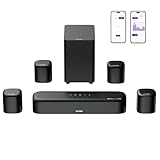
- 7.1ch Dolby Atmos Surround Sound System for TV: This 7.1ch sound bar features 3 main channels for crisp dialogue and 4 surround speakers. Power the rear right surround speaker to pair it wirelessly with sound bar. The setup delivers an immersive surround sound audio experience, making you feel fully engaged in the action. Note: Recommended for space of 108 to 270 ft².
- 4 Surround Speakers for Home Theater Sound System: The Aura A60 Pro soundbar for tv comes with 2 wired front surround speakers and 2 wired rear surround speakers, positioned to create a wide, room-filling soundstage. The rear speakers connect wirelessly with the soundbar, minimizing cable clutter and optimizing space efficiency.
- Dolby Atmos Delivers an Immersive 3D Soundscape: This 7.1ch dolby atmos soundbar enhances your listening experience with multidimensional audio that surrounds you from every direction, upgrading your home theater with powerful, dynamic sound that brings each scene to life.
- 5.25-inch Wired Subwoofer with BassMX Technology: The Aura A60 Pro sound bar comes with a 5.25" wired subwoofer powered by BassMX technology to boost low-frequency performance. An optimized magnetic structure and diaphragm produce deep, powerful bass. Enjoy enhanced low-end sound and experience the impact of every beat.
- Precision Audio Tuning Redefined: Customize your audio experience with the Ultimea App, designed for precise sound control. It provides 121 professionally tuned EQ presets across styles such as Bass, Pop, Classical, and Rock, along with 10-band control and 6 tailored EQ modes including Movie, Music, Voice, Sport, Game, and Night. Using the advanced “Customize” option, you can adjust audio details to suit your personal taste, ensuring every sound is tuned exactly how you prefer.
- Place the left and right surrounds behind or slightly to the sides of the usual listening position.
- Keep them at roughly ear level or somewhat higher, following the manufacturer’s instructions.
- Use similar distances and angles for both sides whenever possible.
- Keep the drivers unobstructed; avoid cabinets and thick furniture.
- Use stable stands or suitable wall mounts.
- Aim and orient both speakers consistently.
Sonos recommends placing surrounds behind and to the left and right of the usual listening position, with both speakers oriented consistently.
A sofa against the back wall creates a compromise. A speaker directly behind the listener may be too close, while side placement slightly above ear level may produce a more even field. There is no universal mandatory distance; follow the system’s calibration guidance and prioritize matching the two sides.
Open-plan rooms, high or angled ceilings, absorptive ceilings, open sides, large windows, and multiple seating rows can make reflected surround and up-firing height effects less predictable. Physical rears may still help, but they also need careful placement and level calibration.
“Wireless” does not mean cable-free
Wireless rear speakers commonly receive audio wirelessly, but they still need electricity. Many systems also use a wireless receiver module, with speaker wires running from that module to the two rear speakers. Samsung documents this arrangement for many of its rear kits. Its SWA-9500S is an example of a different arrangement, although each speaker still requires power.
Before buying, check:
- Whether both rear positions have AC outlets.
- Whether a receiver box is required.
- Whether speaker wire connects the rear speakers to that box.
- Whether the system depends on Wi-Fi or a separate wireless link.
- Whether stands, wall mounts, or extension cords are needed.
Wireless systems can experience dropouts because of interference, congested Wi-Fi, poor router placement, firmware mismatches, distance from the bar, or power interruptions. If that happens, confirm exact compatibility, power-cycle the bar and rear receiver, update firmware, improve network or module placement, and follow the manufacturer’s model-specific pairing procedure.
The Tool Desk
Outbyte Driver Updater FREEFix the driver behind crashes, sound loss and screen glitchesFind Drivers →Outbyte PC Repair FREEClear out junk files and repair common Windows errorsFree Scan →Compatibility and TV connections
Rear kits are rarely universal. Samsung says its rear kit must match the soundbar model and provides compatibility information. Sonos also requires compatible surround speakers and generally requires the two surrounds to be the same model, subject to its listed combinations. Do not assume that a wireless speaker from the same brand will work with every bar.
For the connection between TV and soundbar, HDMI ARC or eARC is generally the most flexible option when both devices support it. Optical connections can limit advanced formats or available settings, depending on the TV and soundbar.
Rank #4

- Fire TV Soundbar Plus with subwoofer and surround speakers – Get the full cinematic experience with 5.1 surround sound. Featuring crisp dialogue, Dolby Atmos, and DTS:X.
- The ultimate home theater – Add a subwoofer and two surround speakers for an audio experience that feels just like being at the big screen.
- Crystal clear dialogue – A dedicated center dialogue channel sharpens conversations so you can catch every moment of your favorite shows.
- Sound in another dimension – Dolby Atmos features 3D sound that moves around you and clear dialogue. DTS:X delivers multi-dimensional audio for lifelike sound.
- Easy setup – After you plug in your subwoofer and speakers to power, they connect to your soundbar for total surround sound.
Check the TV and source-device settings for:
- HDMI ARC or eARC support.
- Bitstream or passthrough output.
- Dolby Digital and Atmos availability.
- Whether a streaming device is connected directly to the TV or soundbar.
- Whether the TV is converting multichannel audio to stereo.
An app showing an Atmos badge does not guarantee Atmos will reach the soundbar. The app, title, subscription, source device, TV settings, connection, and soundbar must all support the required signal.
Standalone bar or expandable system?
A premium standalone bar may offer better dialogue, wider front imaging, music playback, bass integration, construction, or room correction than a cheaper package. A less expensive bar with physical rears may nevertheless produce more obvious surround effects in films and games.
Free tools Windows power users keep installed
One-click scans. No signup required.
Compare systems by use case rather than channel count or advertised wattage. Independent soundbar testing from RTINGS separates all-in-one and discrete-surround designs and evaluates performance and connectivity alongside configuration.
If you want to start simply, choose an expandable system only after checking the manufacturer’s compatibility list, upgrade pricing, required hardware, and return policy. Examples of ecosystems with documented expansion options include Bose, Sonos, and selected Samsung and JBL systems—but compatibility is model-specific. Bose says its Smart Soundbar can be used alone and expanded with optional bass and surround speakers, while Sonos documents both compatible surround combinations and limitations when speakers are configured as surrounds. See Bose’s Smart Soundbar information and Sonos’ surround guidelines.
Calculate the complete system cost, including the bar, subwoofer, rear kit, stands, mounts, cables, and any necessary power or network changes. Buying a cheaper bar now can become expensive if the eventual rear kit costs more than expected.
Special cases
Apartments
Rear speakers can increase immersion without requiring a major increase in volume. A subwoofer’s low frequencies may travel through shared walls more readily than midrange surround effects, so some apartment dwellers may prefer rears without a large subwoofer. Night and dialogue modes can also help.
Quick wins for a faster PC:
Fix the driver behind crashes, sound loss and screen glitchesFind Drivers →Clear out junk files and repair common Windows errorsFree Scan →Scan for outdated or missing drivers - takes under a minuteDriver Scan →Music
Rear speakers are not automatically an improvement for music. Their usefulness depends on whether the service and system support spatial or multichannel music and how the system handles surround playback. Sonos, for example, documents feature limitations—including AirPlay, Bluetooth, line-in, and subwoofer output limitations for certain surround configurations.
Gaming
Games can benefit substantially from rears when the console outputs multichannel audio correctly, the game includes a surround mix, the listener remains in a consistent position, and system latency is low. If the TV or console downmixes output to stereo, the benefit will be limited.
Quick Recap
Decision tree
- Mainly want better dialogue? Buy the bar alone and optimize its placement and settings.
- Want more bass and cinematic weight? Add a compatible subwoofer.
- Want effects clearly coming from behind? Add physical rear speakers.
- Have no suitable rear placement or outlets? Choose a better standalone bar rather than forcing an inconvenient setup.
- Undecided? Choose an expandable bar, but verify the exact rear-kit compatibility and calculate the complete future cost first.
Product prices and availability are accurate as of the date/time indicated and are subject to change. Any price and availability information displayed on Amazon at the time of purchase will apply.

