Neither solar farms nor rooftop solar is the universal winner. Large ground-mounted photovoltaic (PV) projects usually achieve a much lower cost per watt because they spread development, equipment, financing, and operations across utility-scale capacity. Rooftop PV avoids a dedicated field by using an existing building, can serve that building directly, and may reduce a customer’s purchases from the grid. The better choice depends on the cost measure, site, grid connection, ownership, financing, and who is able to participate.
What “solar farms versus rooftop solar” actually compares
A solar farm in this comparison is a large, ground-mounted PV project that sells electricity through a utility or wholesale market. Rooftop solar is a smaller PV system attached to a home or other building, usually to offset on-site consumption and sometimes to export surplus electricity. Community-solar subscriptions sit between those models: the panels are off-site, but participating customers receive credits or another contractual benefit where local rules allow it.
As an Amazon Associate I earn from qualifying purchases.
These systems are not interchangeable products. A utility project may be measured by installed dollars per watt, levelized cost of energy (LCOE), wholesale revenue, or system value. A homeowner is more likely to care about the financed monthly payment, bill savings, export credit, roof replacement, insurance, and the value of backup storage. A low cost per watt does not automatically produce the lowest household bill, and a rooftop system’s direct bill benefit is not the same as wholesale market value.
Are rooftop systems cheaper than a solar farm?
On a like-for-like benchmark of PV plus battery storage, rooftop solar costs substantially more per watt. The U.S. Department of Energy’s 2025 first-quarter market-price benchmarks are modeled representative systems, expressed in 2024 dollars:
#1 Best Overall
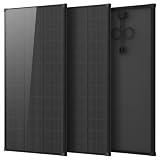
- 【25.6% High-Efficiency & Ultra-Stable Output】AeternaSol 200W solar panel, a premium n type solar panel with 18 BB Full-Welding Silver-Containing Busbars, boasting N-Type A+ Grade Cell, achieves a 25.6% high conversion efficiency. This 200 watt solar panel’s A+ grade monocrystalline silicon effectively reduces microcrack risks, while the 18BB busbars further cut down power loss—ensuring ultra-low degradation and prolonged service life. Note: The 200W rated power is measured under Standard Test Conditions (STC): 1000W/m² irradiance, 25°C, and 1.5 air mass. Real‑world output will vary due to panel angle, operating temperature, shading, wiring loss and connected‑device efficiency.
- 【IP68 Waterproof】Equipped with an exclusive IP68 Waterproof, our solar panels feature advanced potting technology that creates an impermeable seal to prevent water or steam from reaching internal wires. This design minimizes short-circuit risks to the greatest extent, effectively inhibits rust and corrosion, and ensures the solar panel maintains optimal performance even in harsh weather. The junction box’s excellent thermal conductivity enhances heat dissipation, further extending the lifespan of the entire 200 watt solar panel, which is essential for long-term use of solar panels for rv and outdoor applications.
- 【11 AWG 100% Oxygen-Free Copper Wire】Our 200w solar panel comes with 11 AWG 100% Oxygen-Free Copper Wire, which outperforms common copper-clad aluminum cables in conductivity and durability. This extra-thick oxygen-free copper wire can withstand up to 25A current, ensuring efficient power transmission—perfect for rv solar panel and solar panels for camping setups. Beyond the standard insulation layer, the wire is sheathed in a UV-resistant jacket, which significantly extends its lifespan compared to conventional alternatives, providing long-lasting reliability for solar panels for rv and other outdoor uses.
- 【Durable MC4 Connector for Stable Connection】The 200 watt solar panel is fitted with a durable MC4 connector, featuring galvanized copper pins encased in a larger PPO shell that outperforms aluminum-pin connectors with a higher current rating. This robust connector ensures stable power connection for the solar panel charger and compatible devices, while its sturdy PPO shell offers superior compatibility with other connectors on the market. Whether you’re expanding your solar system or replacing parts, this connector makes the 200w solar panel a flexible choice for any setup, including solar panel charger configurations.
- 【Sturdy Aluminum Alloy Frame】Crafted with a more durable aluminum alloy frame, our solar panel is sturdier than steel frames—retaining a sleek shine for years while resisting rust and corrosion. Additional frame sealant prevents air from corroding the monocrystalline cells, protecting the 200w solar panel (200 watt solar panel) from environmental damage, which is crucial for panel solar portatil and solar panels for camping that face frequent outdoor exposure. Pre-drilled holes on the frame ensure effortless installation, making this panel solar portatil easy to set up on RVs, campsites, or rooftops.
| Representative system | PV and storage configuration | Market-price benchmark (MMP) | Minimum-sustainable-price benchmark (MSP) | What the figure means |
|---|---|---|---|---|
| Utility-scale | 100 MWdc PV with 240 MWh of storage | $1.81/Wdc | $1.71/Wdc | Modeled installed market price for a very large project |
| Residential rooftop | 8 kWdc PV with 13.5 kWh of storage | $4.59/Wdc | $4.33/Wdc | Modeled installed market price for a small home system |
The gap is a scale comparison, not a promise that every solar farm will cost less than every roof-mounted system. The utility case is 100 megawatts of PV; the residential case is 8 kilowatts. Utility projects buy equipment and construction services at a different scale, use specialized financing and interconnection, and spread fixed development costs over much more generation. DOE’s modeled benchmarks exclude subsidies payable to the system owner and include the components and operations and maintenance (O&M) described in the benchmark.
What is included in the DOE benchmarks
For the representative home, DOE models cleaning and inspection as homeowner work and includes the homeowner’s time cost, along with modeled property-tax and insurance effects. The utility model includes module cleaning, inspection, repairs, replacements, land lease, property tax, insurance, and management. Those assumptions make the numbers useful for a consistent benchmark but not a quote for a particular address or project.
A separate empirical utility-scale reference
Lawrence Berkeley National Laboratory’s 2024 utility-scale report measured plants completed in 2023 rather than modeling the same storage-inclusive systems used by DOE. In a 76-plant sample totaling 7.1 GWac, average installed cost was $1.43/Wac, equivalent to $1.08/Wdc in the report’s conversion, down 8% from 2022. The report’s 2023 new-project LCOE averaged $46/MWh before federal incentives and $31/MWh after incentives. Installed cost, LCOE, and DOE’s PV-plus-storage MMP are different measures and should not be combined into a single “solar price.”
Crashes, No Sound, or Screen Glitches?
Random freezes, missing sound and display glitches usually trace back to one bad driver. Find and replace yours safely.Free scan · under a minuteWindows Errors? Fix Them Before They Spread
Repair common Windows errors and clear accumulated junk for a smoother, more stable PC - no reinstall needed.Free scan · no reinstallWhy a lower installed cost does not settle a customer decision
A project’s location, labor and equipment prices, storage size, incentives, financing, roof condition, utility tariff, export compensation, and interconnection can change the result. A homeowner comparing an installation should request a local production estimate, a financing schedule, the applicable export rate, and the cost of any roof work. A utility or developer must also price land control, transmission or distribution upgrades, permitting, environmental studies, and schedule risk.
Rank #2

- 【High Conversion Rate】This 20W solar panel with monocrystalline A+ solar cell has an excellent cell efficiency of 21%-30%. Designed to charge and maintain 12V rechargeable batteries like LiFePO₄, Lithium Ion, AGM, SLA, GEL, EFB, MF, etc. Keep batteries in charged for trailer, tractor, truck, boat, motorcycle, RV, car, lawn mower, water pump, gate opener, electric fence, etc
- 【Built to Last】 Low-iron tempered glass surface and corrosion-resistant aluminum frame, make this solar panel 100% waterproof and rustproof, and provide the prolonged lifespan up to 25 years. This 12V solar panel can withstand all weather conditions such as sandstorm, strong wind, thunderstorm, blizzard, hail, etc. It can withstand up to 2400Pa wind pressure and 5400Pa snow load
- 【Smart MPPT Controller】The charging efficiency of this upgraded 10A controller is 30% higher than other controllers on the market. Its intelligent three-stage charging design effectively prevents the battery from overcharging, over-voltage and short circuit. It takes no power from the battery. You will clearly know the charging status of the battery through the two indicator lights on the controller
- 【360° Adjustable Bracket & Plug-and-Play Installation】Comes with a fully 360° angle adjustable mounting bracket, which allows you to adjust the solar panel to the optimal sun-facing angle for maximum solar energy absorption and higher charging efficiency. Pre-drilled mounting holes and matched screws greatly simplify the installation process, no complicated tools or professional skills are required. All cable connections support plug-and-play, enabling quick and effortless installation and disassembly for both indoor and outdoor scenarios.
- 【Complete Accessories & Reliable After-Sales Service】Our SOLPERK Solar Panel kit includes 1*20W solar panel, 1*smart MPPT charge controller, 1*adjustable mounting bracket, 1*alligator clip, 1*O-ring and a full set of mounting accessories to meet your diverse installation and use needs. We offer 1-year professional after-sales service and lifetime technical support, with 7×24-hour online customer service to respond to your questions and solve problems within 24 hours, bringing you a worry-free shopping and using experience.
How land use differs
Ground-mounted projects need dedicated sites
DOE’s representative 100 MWdc utility configuration describes 155 hectares for the PV array. That is a description of one benchmark design, not a universal acreage rule: tracker layout, terrain, setbacks, roads, drainage, fencing, substation equipment, and storage can change a project’s total site boundary.
DOE also cites Solar Futures Study scenarios of about 5.7 million acres of ground-mounted solar by 2035, equal to 0.3% of the contiguous United States, and as much as 10 million acres by 2050, equal to 0.5%. These are scenario projections for possible future deployment, not a current measured national footprint. They should not be compared directly with the 155-hectare array figure because the system boundaries and purpose of each number differ.
Rooftops use existing structures, but suitable roofs are limited
Rooftop arrays do not require a new solar field, but they are constrained by roof area, structural capacity, age, orientation, shading, electrical equipment, fire-access requirements, and the owner’s willingness to install. DOE, citing a 2016 National Renewable Energy Laboratory analysis, reports more than 8 billion square meters of potentially suitable U.S. rooftop area and more than 1 terawatt of technical capacity. That is an upper-limit technical estimate, not deployable capacity, an adoption forecast, or an economic-potential figure. The analysis does not account for availability or cost. DOE also reports that 42% of the residential rooftop area in that analysis was associated with low- and moderate-income households; that describes potential roof area, not actual installations or equitable access.
What’s actually slowing this PC down?
Pick the symptom - the matching free tool is one click away.
Reducing land conflicts
Solar siting is not simply a choice between panels and farmland. Developers and communities must consider agricultural use, wildlife, wetlands, views, cultural resources, water, drainage, roads, zoning, and host priorities. DOE identifies agrivoltaics, which co-locates some agricultural activities with solar, and floating PV on suitable water bodies as approaches that can reduce particular land-use conflicts. Neither is a universal fix: crop requirements, access, water conditions, anchoring, maintenance, permitting, and economics determine whether a site works.
Rank #3

- [Industry-Leading 25% Efficiency] 16BB N-Type cells deliver more power from the same sunlight, supporting RV trips, camping, blackout backup, and off-grid use in limited or cloudy conditions.
- [Lightweight & Magnetic Design] Weighing 13.89 lb and folding to 23.72 x 22.99 x 1.97 in, this 200W panel stores at backpack size with a magnetic closure for SUVs, RVs, and campsites.
- [Direct Device Charging] Charge 3 devices with USB-C PD 45W and dual USB-A ports for phones, tablets, laptops, GPS, and cameras.
- [Compatible with Most Power Stations] Compatible with Jackery Explorer 1000 v2, EcoFlow DELTA 3/DELTA 3 Max/RIVER 3 Max, Anker SOLIX S2000, and other models that meet the requirements. MC4 output only; the 4-in-1 adapter is sold separately.
- [UL 61730 Certified] Tested to UL 61730 and listed with CE, RoHS, FCC, CA65, PSE, and ISO 9001 claims. Four kickstands, an accessory pouch, reinforced grommets, and 40°/50°/60° angles help position the panel on RVs, tents, or windy campsites.
Grid connection and the value of location
A solar farm can produce inexpensive energy at the array but still face a costly or delayed interconnection if transmission capacity is scarce. Its value also depends on when and where electricity is delivered, congestion, curtailment, capacity requirements, and the market rules in the region. A rooftop system avoids some long-distance delivery because generation is next to the building load, but it still needs safe electrical interconnection, an appropriate service panel, and a tariff that determines the value of exports.
Berkeley Lab estimated the 2023 average U.S. utility-scale solar energy and capacity value at $45/MWh. The estimate ranged from $27/MWh in CAISO to $67/MWh in ERCOT. This is wholesale market value; it is not the retail value a rooftop owner necessarily receives. A customer’s avoided bill rate, time-of-use schedule, demand charges, fixed charges, and export-credit rules can produce a different result.
Who benefits from each model?
Benefits follow ownership, contracts, tariffs, and local decisions. They do not automatically flow evenly to everyone who sees a project or lives near it.
Free tools Windows power users keep installed
One-click scans. No signup required.
| Participant | Potential benefit | What determines whether it is received |
|---|---|---|
| Rooftop owner or customer | On-site generation, lower purchased electricity, possible export credits, and resilience if storage is configured for backup | System price, financing, production, roof condition, tariff, usage pattern, export compensation, ownership, and policy |
| Renter or household without a suitable roof | Possible participation through a community-solar subscription or other shared-solar program | Local program availability, eligibility, contract terms, credit structure, and subscription cost |
| Landowner hosting a solar farm | Lease payments or sale proceeds | Whether the developer leases or buys the land and the negotiated project terms |
| Host community and local government | Potential local economic activity, tax revenue, jobs, or negotiated community benefits, alongside land-use and environmental effects | Project agreements, tax rules, permitting decisions, construction, operations, and how costs and benefits are distributed |
| Utility, wholesale customers, and the public | Energy and capacity value, reduced emissions, and public-health benefits | Market conditions, dispatch, avoided generation, regional grid needs, and the project’s actual operation |
Rooftop owners do not all receive the same savings
A homeowner who owns the system may receive the generation value after paying for installation, financing, maintenance, insurance, and any roof work. Under a lease or power-purchase agreement, a third party may own the equipment and receive tax benefits or energy payments while the customer receives a contracted price or bill credit. The available evidence does not support one nationwide household-savings amount.
Rank #4

- ⚡ Ultra-Lightweight & Ultra-Portable: 100W Foldable Solar Panel Weighing only 4.1lbs (1.85kg) with a sleek 0.59-inch profile, this solar charger is engineered for ultimate portability. It folds down to a compact 12.99 x 10.43 x 2.17" (330x265x55mm) and includes a premium carry bag, making it effortless to transport during camping, hiking, or road trips. The generous unfolded size of 45.47 x 26.18" ensures maximum power capture while remaining easy to handle.
- 🔌 Universal 3-in-1 Output & Versatile Adapters: Equipped with PD 3.0 45W USB-C, 18W USB-A, and 100W DC outputs, this solar panel powers all your devices simultaneously. The included 4-in-1 charging cable (DC5521, DC7909, Anderson, XT60) provides universal compatibility for most portable power stations, power banks, and smartphones. It is the ultimate solution for off-grid living and emergency power outages.
- ☀️ High-Efficiency Monocrystalline Technology: Built with premium monocrystalline silicon cells and durable E-Film lamination, this panel delivers an impressive 23%+ energy conversion efficiency. This advanced technology ensures faster charging even in low-light conditions, providing reliable performance on overcast days or in harsh outdoor environments.
- 🛡️ IP67 Waterproo f & Dustproof for All-Weather Use: Engineered to meet the IP67 waterproof and dustproof standard, this solar panel is built to withstand the elements. It is fully protected against rain, dust, sand, and extreme temperatures, ensuring uninterrupted power generation during your adventures by the lake, in the desert, or during sudden downpours.
- 🏕️ Rugged & Reliable for Outdoor Emergencies: Designed to thrive in the great outdoors, this foldable solar panel is perfect for camping, fishing, RV travels, and unexpected power outages. Its durable E-FLIM lamination construction guarantees long-term durability, making it an essential and cost-effective power backup solution for your outdoor lifestyle and emergency preparedness kit.
Who benefits from a solar farm?
A ground-mounted project can pay a participating landowner under a lease or purchase agreement. Local governments may receive property-tax or other tax revenue where state and local rules provide it, and a host community may negotiate additional benefits. Those outcomes are project-specific; a projected aggregate value is not automatically a cash payment to every resident. Nearby residents may also experience construction traffic, visual change, noise, altered land use, ecological effects, or competing agricultural priorities. A fair evaluation asks who bears each burden and who receives each payment.
Public benefits are real but not individual checks
Berkeley Lab estimated 2023 U.S. solar health benefits at $24/MWh and avoided global climate damages at $101/MWh. Combining wholesale-market, public-health, and climate-damage value, the analysis estimated that total benefits exceeded generation costs and incentives by $13.7 billion in 2023. This is a national analytical estimate. It is not a payment to a particular host, rooftop customer, or subscriber.
Independent reader supportYour contribution helps us test, update, and keep practical guides available for everyone.Can renters benefit from solar?
Renters commonly cannot make structural changes to a roof they do not own, and a building may have too little usable roof area, too much shade, or an electrical arrangement that prevents an individual installation. Community solar provides an off-site route for some customers: a subscriber supports or is assigned output from a shared project and receives credits or another benefit under local program rules. NREL identifies renters, people with shaded or small roofs, non-owners, and households that prefer not to finance equipment as potential community-solar participants.
Recommended Free Tools
Availability and terms vary by state, utility, and project. Before subscribing, check whether the program has an enrollment fee, minimum term, cancellation charge, credit-transfer rules when moving, income eligibility, and a clearly stated relationship between subscription payments and bill credits. A community-solar option is access to a contract, not a guarantee of savings.
Best Value

- 【Grade A+ Cells, Up to 25.6% Efficiency】200 watt solar panel utilizes advanced N-Type A+ Grade solar cells and utilizes advanced 18 BB Silver-Containing Full Welding Busbars technology(which improves the photoelectric conversion efficiency and ensures a longer service life compared to traditional 10BB/12BB solar cells) with an increased cell efficiency of 25.6% EL tested,outperforming traditional panels.
- 【No energy drains at night】By incorporating reverse current blocking diode technology, photovoltaic systems achieve “lossless” operation during night-time hours, thereby enhancing energy utilisation efficiency while simultaneously improving safety and durability.
- 【IP68 waterproof certification】Exclusive Filled with Polyurethane polymer Junction Box.it prevents water or steam from reaching the wires inside,Rated IP68 for dust and water resistance, 200W solar panel is designed to endure dirt, splashes, and rain effortlessly. Its anti-corrosion aluminum alloy frame ensures decades of reliable outdoor performance. Engineered for extreme conditions, it withstands 2400 Pa wind pressure and 5400 Pa snow loads.
- 【Enhanced MC4 Connector】Crafted from premium galvanised copper for superior conductivity, effectively reducing resistance and heat generation while boosting transmission efficiency. PPO engineering plastic, it offers exceptional heat resistance and anti-ageing properties. Oversized design enhances structural integrity and delivers superior protection ratings, ensuring reliability in demanding outdoor conditions.Standard MC4 interface for plug-and-play functionality and effortless installation.
- 【11 AWG 100% Oxygen-Free Copper Wire】 Crafted from high-purity oxygen-free copper (OFC) with conductivity reaching 99.99%, offers lower resistance and more efficient transmission, and capable of handling currents up to 25 amps. Beyond standard insulation, it features an additional UV-resistant sheath that effectively withstands prolonged sunlight exposure, high-temperature ageing, and moisture corrosion.
A construction and procurement checklist
Whether you are planning a home installation, a commercial roof, or a utility project, evaluate the proposal in separate steps rather than relying on a single cost-per-watt number.
- Define the system and boundary. Record PV capacity in kWdc or MWdc, inverter rating, storage capacity, interconnection point, and whether the quoted price includes development, site work, transmission upgrades, taxes, O&M, and decommissioning.
- Check the physical site. For a roof, inspect structure, membrane age, load paths, orientation, shading, roof access, fire setbacks, and electrical service. For ground mounting, map boundaries, slopes, drainage, soils, roads, wetlands, wildlife, agricultural operations, and nearby residences.
- Confirm the grid path. Obtain the utility’s interconnection requirements, study status, upgrade estimate, export limit, queue position, and expected in-service date. A panel layout without a deliverable interconnection is not a power project.
- Model the right financial metric. Separate installed cost per watt, LCOE, financed payment, customer bill impact, lifetime cost, lease income, tax revenue, and wholesale value. State whether incentives are included and identify who receives them.
- Assign ownership and obligations. Put equipment ownership, maintenance, insurance, property taxes, roof repairs, vegetation management, battery replacement, performance guarantees, and end-of-life removal in writing.
- Test access and distribution. Identify which households can participate, whether renters and low- and moderate-income customers are included, and whether community benefits are enforceable rather than aspirational.
- Plan for change. Review what happens if electricity rates change, a customer moves, the roof is replaced, the project is sold, an interconnection study changes, or a lease reaches its end.
Trade-offs that should appear in a site decision
Choose a rooftop-first approach when the building is suitable
- The roof has adequate remaining life, structure, solar access, and electrical capacity.
- On-site consumption is substantial and the tariff gives useful value to self-consumption or exports.
- The owner wants control over equipment and is prepared to manage maintenance and roof coordination.
- A new ground-mounted site or transmission upgrade would create disproportionate permitting or community conflict.
Consider utility-scale or shared solar when scale and access dominate
- There is a suitable site with a credible interconnection and transmission path.
- Scale can lower unit costs and support professional operations, storage, and financing.
- Many customers lack suitable roofs or cannot finance individual systems.
- Landowners and host communities have negotiated clear payments, protections, restoration duties, and benefit-sharing terms.
Questions that prevent misleading comparisons
- Are both figures in the same currency year and measured at the same system boundary?
- Does one include storage, interconnection, land, financing, or incentives that the other excludes?
- Is the claimed savings figure a retail bill estimate, a wholesale value, or a modeled social benefit?
- Who owns the equipment and receives tax credits, lease payments, export credits, or renewable-energy attributes?
- Is a land figure a project footprint, a parcel under control, or a national scenario projection?
The practical verdict
Utility-scale solar is generally the lower-cost form on a per-watt benchmark because it operates at a much larger scale, but it requires dedicated land, a viable interconnection, and agreements that determine how local benefits and burdens are shared. Rooftop solar uses existing building surfaces and can place generation directly behind a customer’s meter, yet its smaller scale, roof constraints, customer acquisition, financing, and maintenance make it more expensive per watt in DOE’s representative comparison. Community solar can extend participation to renters and households without suitable roofs, subject to local programs and contract terms.
For a real project, compare the same cost boundary, verify the site and grid connection, and trace every benefit to the person or institution that actually receives it. That approach answers the useful question—who gets what, at what cost, and under which conditions—without treating either deployment form as automatically superior.
Quick Recap
Product prices and availability are accurate as of the date/time indicated and are subject to change. Any price and availability information displayed on Amazon at the time of purchase will apply.

