No single person invented the incandescent lightbulb. Humphry Davy demonstrated early electric lighting; Warren de la Rue and Frederick de Moleyns developed early bulb-like and patented designs; Henry Woodward and Mathew Evans patented a carbon lamp; and Joseph Swan and Thomas Edison developed practical incandescent lamps in the late 1870s.
Edison is remembered because he helped make incandescent lighting durable, manufacturable and commercially deployable as part of a complete electrical system. Swan deserves comparable credit for the practical lamp itself.
As an Amazon Associate I earn from qualifying purchases.
The short answer
| Question | Best answer |
|---|---|
| Who produced an early electric light? | Humphry Davy and other early experimenters |
| Who developed an early vacuum incandescent design? | Warren de la Rue |
| Who received an early incandescent-lamp patent? | Frederick de Moleyns, in 1841 |
| Who patented an early carbon-based lamp? | Henry Woodward and Mathew Evans, in 1874 |
| Who developed practical commercial lamps? | Joseph Swan and Thomas Edison |
| Who helped create a widely deployable lighting system? | Thomas Edison and his collaborators |
The answer changes depending on what “invented” means. The first electric light, the first incandescent experiment, the first patent, the first durable bulb and the first commercially scalable lighting network were different milestones.
What’s actually slowing this PC down?
Pick the symptom - the matching free tool is one click away.
What is an incandescent lightbulb?
An incandescent lamp produces light by passing electricity through a filament until the filament becomes hot enough to glow. The filament must be enclosed in a glass bulb, usually with much of the air removed, because oxygen would make the hot material burn away quickly.
#1 Best Overall
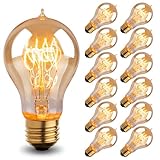
- 💡【Vintage Style Edison Bulbs】:These vintage bulbs are amber in color and have the look of a standard Edison bulb, full of vintage vibes. They emit soft yellow light and look very comfortable, perfect for warm scenes such as bedrooms, living rooms, and family gatherings. If you like retro and old-fashioned lighting fixtures, these old fashioned bulbs will be perfect for you.
- 💡【Easy to Install & OTHERS Features】:These A19 bulbs are paired with an E26 base, making them suitable for most lighting fixtures and easy to install. (Product Parameters: Brightness:240lm(Dimmable), Color Rendering Index:80, Color:Amber Glass-2100k, Wattage:60W, Shape:A19)
- 💡【Safe Packaging】:We have upgraded the packaging of these incandescent edison bulbs. Adding two pieces of pearl cotton in the box can better protect these 60w edison bulbs. And in case of damage during transportation, we will definitely compensate in full, so you can purchase with confidence.
- 💡【APPLICATION SCENARIO】These old style light bulbs are suitable for home or commercial decoration, indoor or outdoor, such as pendant lighting, wall sconces, use at kitchen, living room, bedroom, restaurant to create warm and intimate lighting.
- 💡【After-Sale Service】:We will provide you with high-quality service,you can buy at ease. And If you have any questions please feel free to contact us.(eg:Can't use it,package breakage,etc.)We will definitely give you a satisfactory solution,and solve the problem for you as soon as possible. Thank you very much for your valuable comments!We will do our best to provide customers with the most satisfactory shopping experience.Welcome to visit again.
This is different from other forms of electric lighting:
- Arc lamps create light through an electrical arc between electrodes.
- Gas-discharge lamps use an electrical discharge through a gas.
- LEDs produce light through electroluminescence in a semiconductor.
This distinction matters because some early histories call Davy the inventor of the “electric light.” His best-known demonstrations were important arc-light experiments, not practical household incandescent bulbs. The Science Museum explains the distinction between these lighting technologies.
Before Edison: why the bulb took decades
Creating a glowing filament was relatively easy compared with making one that lasted. Early researchers had to solve several problems at once:
- Finding a filament that could become white-hot without breaking apart.
- Removing enough air to prevent rapid oxidation.
- Producing a vacuum reliably inside a glass enclosure.
- Choosing materials that were effective but affordable.
- Designing an electrical supply that could serve more than one lamp.
Platinum could withstand high temperatures, but it was expensive. Carbon offered a more promising alternative, although carbon filaments were difficult to manufacture consistently. Arc lamps, meanwhile, could be extremely bright and were better suited to streets and large spaces than ordinary rooms.
The early pioneers
Humphry Davy and the first electric lighting demonstrations
In the early 1800s, Humphry Davy demonstrated that electricity could produce intense visible light. His experiments helped establish the principle of electrical illumination, but his apparatus was not an economical, sealed-glass household bulb.
It is therefore more accurate to say that Davy demonstrated early electric lighting than to say he invented the modern lightbulb. The U.S. Supreme Court’s historical discussion of incandescent-lamp patents records the long sequence of experiments that followed.
Rank #2
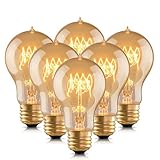
- 💡【Vintage Style Edison Bulbs】:These vintage bulbs are amber in color and have the look of a standard Edison bulb, full of vintage vibes. They emit soft yellow light and look very comfortable, perfect for warm scenes such as bedrooms, living rooms, and family gatherings. If you like retro and old-fashioned lighting fixtures, these old fashioned bulbs will be perfect for you.
- 💡【Easy to Install & OTHERS Features】:These A19 bulbs are paired with an E26 base, making them suitable for most lighting fixtures and easy to install. (Product Parameters: Brightness:240lm(Dimmable), Color Rendering Index:80, Color:Amber Glass-2100k, Wattage:60W, Shape:A19)
- 💡【Safe Packaging】:We have upgraded the packaging of these incandescent edison bulbs. Adding two pieces of pearl cotton in the box can better protect these 60w edison bulbs. And in case of damage during transportation, we will definitely compensate in full, so you can purchase with confidence.
- 💡【APPLICATION SCENARIO】These old style light bulbs are suitable for home or commercial decoration, indoor or outdoor, such as pendant lighting, wall sconces, use at kitchen, living room, bedroom, restaurant to create warm and intimate lighting.
- 💡【After-Sale Service】:We will provide you with high-quality service,you can buy at ease. And If you have any questions please feel free to contact us.(eg:Can't use it,package breakage,etc.)We will definitely give you a satisfactory solution,and solve the problem for you as soon as possible. If you have any questions, please feel free to contact us first. Thank you for your understanding.
Warren de la Rue’s vacuum lamp
Around 1840, Warren de la Rue used a coiled platinum filament inside a vacuum enclosure. This was an important bulb-like incandescent design because it combined a heated conductor with an attempt to limit the damaging effects of air.
Quick wins for a faster PC:
Clear out junk files and repair common Windows errorsFree Scan →Fix the driver behind crashes, sound loss and screen glitchesFind Drivers →Its major weakness was cost: platinum was too expensive for widespread domestic lighting. The design showed that the principle could work, but not yet that it could become a mass-market product.
Frederick de Moleyns and an early patent
Frederick de Moleyns received a patent in 1841 for an incandescent electric lamp using a heated conductor inside a glass enclosure. He is often credited with an early, and sometimes the first, incandescent-lamp patent.
That wording should remain qualified. Patent priority is a legal milestone, not necessarily proof that a lamp was the first experiment, the first reliable prototype or the first commercially successful product.
Woodward, Evans and the carbon lamp
In 1874, Henry Woodward and Mathew Evans patented a carbon-based electric lamp in Canada. Their design used carbon rods inside a glass cylinder containing nitrogen.
Their work is significant because it predates Edison’s famous 1879 lamp and demonstrates that Edison was not the first person to patent a carbon electric lamp. Edison later acquired rights associated with their work, but his eventual design and wider system were not simply identical to the earlier lamp.
Rank #3

- 💡 True 100 Watt Power Provides strong, full brightness without compromise—ideal for spaces that need reliable, high-output lighting.
- 💡 Warm White Glow (2700K) Creates a cozy, inviting atmosphere perfect for relaxing, dining, or entertaining.
- 💡 High Brightness (1300 Lumens) Delivers consistent, wide-reaching illumination suitable for a variety of indoor settings.
- 💡 Dimmable for Custom Ambiance Easily adjust brightness levels with compatible dimmer switches to suit any mood or activity.
- 💡 Standard A19 Shape & E26 Base Fits most common household fixtures—quick and easy installation.
Four questions should be kept separate when comparing inventions:
- Who filed or received legal protection first?
- Whose device worked reliably?
- Whose design could be manufactured at scale?
- Who connected the lamp to a viable electrical service?
Woodward and Evans made an important contribution to the first two stages of the story, but their lamp did not become a successful mass-market lighting system.
Joseph Swan’s independent contribution
British inventor Joseph Swan began experimenting with electric incandescent lighting decades before Edison’s celebrated public breakthrough. His work included carbonized materials, evacuated glass bulbs and methods for improving filament durability.
Free tools Windows power users keep installed
One-click scans. No signup required.
Swan developed successful carbon-filament lamps in Britain, including lamps using “parchmentized thread” made from cotton. The Science Museum identifies Swan and Edison as central figures in the development of commercially viable lamps.
Swan was not merely a footnote to Edison’s achievement. He independently developed a practical carbon-filament lamp, and his British patent interests overlapped with Edison’s commercial activities. Their companies eventually combined in Britain as Edison and Swan United, commonly known as Ediswan.
What Edison actually accomplished
Edison’s major achievement was an integrated practical solution rather than the original idea of making electricity produce light.
Rank #4

- 【Widely used】incandescent light bulbs 60 watt for kitchen appliances, refrigerators, freezers and ovens, ceiling fans, living rooms, bedrooms, bathrooms, porches and patios; Perfect for lamps, sconces, vanity, pendant and string lights
- 【Specifications and Parameters】 Diameter: 2.36” , Length: 3.9” , Shape: Type A19, Base: E26 Standard Medium Screw Base (26mm Diameter)
- 【2780K Soft Warm White Lighting】 Compared to standard LED bulbs, our 60 watt incandescent bulbs emit a softer, warmer light with a vintage feel. They are not glaring and effectively protect your eyes during prolonged use.
- 【NOTE!】Before placing an order, please double-check that your equipment is the same as the model listed,thanks!
- 【Friendly after-sales service】Provide fast return and exchange and 1-year warranty service, so that you can really experience our products and services with zero risk, wish you a happy life!
A workable filament
Edison and his Menlo Park team tested many materials, including carbonized organic substances. The aim was a filament that could glow for a useful length of time and be manufactured consistently.
High electrical resistance
A relatively high-resistance filament allowed the lamp to operate with characteristics suited to a broader distribution system. This mattered because Edison was designing lighting for multiple customers, not just demonstrating a laboratory curiosity.
Improved vacuum technology
A better vacuum reduced oxidation and slowed the filament’s deterioration. The filament still became extremely hot, but it did not burn away immediately.
A complete electrical system
Edison worked on the wider infrastructure needed to make electric light useful: generators, wiring, switches, sockets, meters and distribution methods. This system-level work helped turn an isolated glowing filament into a service that could be installed, controlled, measured and sold.
The Library of Congress describes Edison’s 1879 lamp as long-lasting enough for widespread practical use and emphasizes the collaborative nature of the work.
When did Edison’s lamp become practical?
Edison’s team produced a successful long-burning lamp in 1879. The National Archives records that Edison received his major U.S. incandescent-lamp patent on January 27, 1880, based on work and an application from the preceding period.
Best Value

- Flicker-Free Dimmable Tungsten Filament: High-quality tungsten filament delivers 100% flicker-free, eye-friendly light, and is fully dimmable to adjust brightness for any mood or occasion
- Soft Warm White Frosted Glass: 2700K warm white glow creates a cozy, inviting atmosphere. Frosted glass diffuses light evenly, eliminating harsh glares and hot spots for comfortable illumination
- High Brightness Output: Delivers 1020 lumens of bright, warm light at 3000K color temperature, providing ample illumination for various indoor spaces
- Standard E26 Base Compatibility: Features a standard E26 medium screw base that fits most household light fixtures including lamps, ceiling fixtures, and chandeliers
- Vintage Frosted Glass Design: Classic incandescent filament bulb with vintage frosted glass construction adds a timeless aesthetic to your home lighting while providing reliable 60-watt performance. Comes in a convenient 4-pack
“Practical” does not mean that the bulb immediately became cheap, universal or perfect. It means that its filament, operating life, vacuum, electrical characteristics and manufacturing prospects had advanced far enough to support a viable lighting business.
The key milestone was therefore not one miraculous evening in 1879. It was the point at which years of experimentation could support a repeatable product and a functioning electrical network.
Why is Edison remembered as the inventor?
Edison became the dominant public figure associated with the bulb because he combined several achievements:
Recommended Free Tools
- He developed and publicized a durable carbon-filament lamp.
- He secured influential patents.
- He demonstrated the technology publicly.
- He organized a large laboratory and commercial enterprise.
- He helped develop generators, wiring and distribution.
- He helped make electric lighting a consumer technology.
The popular statement “Edison invented the lightbulb” compresses invention, improvement, patenting, commercialization and adoption into one name. It is understandable as shorthand, but it is historically incomplete.
How the main claims compare
A fair historical judgment depends on the criterion:
- First electric lighting: Humphry Davy is a major candidate, with the qualification that his work concerned early electric and arc lighting rather than a domestic incandescent bulb.
- First bulb-like incandescent design: Warren de la Rue is an important candidate for an early vacuum-enclosed filament lamp.
- Early patented incandescent lamp: Frederick de Moleyns is often credited with a 1841 patent.
- Early carbon-based patented lamp: Henry Woodward and Mathew Evans, in 1874.
- Practical incandescent lamp: Joseph Swan and Thomas Edison are the strongest answer.
- Commercially scalable lighting system: Edison deserves especially strong credit for combining the lamp with generation and distribution.
These categories explain why apparently conflicting histories can each contain part of the truth.
The final verdict
If the question is “Who first made electricity produce visible light?”, early experimenters such as Davy deserve credit. If it is “Who developed an early incandescent lamp or patent?”, de la Rue and de Moleyns are important names, followed by Woodward and Evans’s carbon-lamp patent.
Crashes, No Sound, or Screen Glitches?
Random freezes, missing sound and display glitches usually trace back to one bad driver. Find and replace yours safely.Free scan · under a minutePC Slower Than It Used to Be?
A free scan shows the junk files, broken settings and background clutter dragging Windows down - then fixes them in one click.Free scan · Windows 10 & 11If the question is “Who made the practical household incandescent bulb?”, the fairest answer is Joseph Swan and Thomas Edison. Edison did not invent incandescent lighting from nothing, but he and his collaborators made a durable lamp part of a complete, commercially deployable electrical system. Swan independently made a major contribution to the practical lamp itself.
The incandescent lightbulb was therefore not the isolated invention of one person. It was the result of decades of experiments, patents, laboratory work, manufacturing skill and electrical infrastructure.
Quick Recap
Product prices and availability are accurate as of the date/time indicated and are subject to change. Any price and availability information displayed on Amazon at the time of purchase will apply.

