A Seiko quartz watch will normally keep more stable time with less day-to-day adjustment, while a Seiko automatic watch offers spring-powered mechanical operation without a routine battery change. The right choice depends on whether you value maximum convenience and precision or the involvement and service requirements of a mechanical movement.
Automatic and quartz: the practical difference
“Automatic” and “quartz” describe the movement inside the case, not a particular case style, complication or price level. A Seiko automatic movement stores energy in a mainspring. A rotor responds to wrist motion and winds that spring; the spring then releases energy through gears, an escapement and a mechanical regulator. A quartz movement uses a battery to power an electronic circuit and a quartz oscillator. The circuit divides the oscillator’s vibration into regular electrical pulses that drive the hands.
As an Amazon Associate I earn from qualifying purchases.
Those mechanisms create different ownership patterns. A mechanical movement’s rate is expressed as a gain or loss per day and can change with winding state, position, temperature, arm movement and magnetism. Quartz specifications are usually stated over a month or a year, so the expected correction is generally smaller and easier to predict. The trade-off is that a battery-powered quartz watch eventually needs a battery replacement, whereas an automatic watch needs mechanical cleaning, lubrication and adjustment.
What’s actually slowing this PC down?
Pick the symptom - the matching free tool is one click away.
Side-by-side comparison
| Reader priority | Seiko automatic | Seiko quartz |
|---|---|---|
| Timekeeping specification | Daily rate; the rate changes with wear, winding, position, temperature and other conditions. Seiko advises judging performance over about a week for the 4R35/4R36 family. | Caliber-specific monthly or annual accuracy. A Seiko manual lists approximately ±15 seconds per month and approximately ±10 seconds per year for particular calibers; those figures are not universal to every Seiko quartz watch. |
| What keeps it running | Energy in a mainspring, replenished by wrist motion or hand-winding. | Battery power for the electronic oscillator and circuit. |
| If left unworn | It stops when the mainspring runs down. The exact running time depends on the caliber and its power reserve. | It continues to run until the battery is depleted, whether or not it is worn. |
| Routine upkeep | Regular wear or winding, plus periodic mechanical inspection, cleaning, lubrication and adjustment according to the caliber’s guidance. | Battery replacement for battery-powered models; prompt replacement is advised after depletion to reduce leakage risk. |
| Typical service guidance in the cited Seiko material | About two to three years between recommended overhauls for the covered 4R35/4R36 family; a UK support FAQ gives about three years generally, with climate and owner care affecting the interval. | Battery life of about two or three years for the specific calibers listed in one Seiko Australia manual. Other calibers can differ. |
| Best fit | Someone who enjoys mechanical construction, accepts occasional rate correction and is prepared for periodic servicing. | Someone who wants dependable, low-intervention timekeeping and does not mind scheduled battery service. |
How accuracy is measured
Automatic watches use a daily rate
For a mechanical watch, “+10 seconds per day” means the watch gained about ten seconds in a day under the stated conditions; “−10 seconds per day” means it lost about ten seconds. It is an observed rate, not a promise that every day will show exactly the same result.
#1 Best Overall
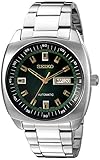
- Case diameter: 43.5mm
- Gold tone second hand
- Water Resistant To 165 Feet
- Power reserve: approximately 41 hours
- 21,600 vibrations per hour
Seiko’s 4R35/4R36 instructions explain that mechanical accuracy is evaluated through daily rates over roughly a week rather than by a single 24-hour reading. A watch may gain time in one position and lose it in another. The amount of wrist movement, how long the watch has been worn, whether the mainspring is fully wound and the surrounding conditions all influence the result. A one-day check can therefore exaggerate a temporary change.
Temperature and magnetism can change a mechanical rate
The cited Seiko mechanical guidance says that mechanical watches tend to lose time at high temperatures and gain time at low temperatures. Strong external magnetism can also alter the rate. Everyday sources can include speakers, magnetic clasps, some bags and electronic equipment. If the watch remains significantly fast or slow after it has been kept away from magnetic sources, a retailer may need to demagnetize it and check the movement.
Position matters because gravity affects the balance and hairspring differently when the watch is dial-up, crown-up or in another orientation. That is why a rate measured overnight on a bedside table may not match the rate while the watch is being worn. The exact tolerance and testing procedure belong to the watch’s own caliber instructions.
Windows Errors? Fix Them Before They Spread
Repair common Windows errors and clear accumulated junk for a smoother, more stable PC - no reinstall needed.Free scan · no reinstallOutdated Drivers Are Slowing You Down
One free scan finds every outdated or missing driver and matches the right update for your exact hardware.Free scan · exact hardware matchQuartz watches use longer reporting periods
Quartz watches are normally described by monthly or annual accuracy because their short-term variation is small. One Seiko Australia manual gives examples of approximately ±15 seconds per month and approximately ±10 seconds per year for the particular calibers it covers. The same document states that the figures assume wrist wear in a normal temperature range of 5°C to 35°C.
Those values must not be copied to an unrelated Seiko quartz model. Accuracy depends on the caliber, and the manual itself warns that watch type affects the specification. Identify the caliber engraved on the case back or listed in the paperwork, then use that caliber’s manual. A chronograph or another power-hungry function can also affect how long the battery lasts, even when the timekeeping specification is unchanged.
What the published figures mean in daily use
Mechanical example
Suppose a mechanical watch shows a mixture of gains and losses during a week. The useful question is the average daily rate across that period, not whether Tuesday alone was three seconds fast. Record the reference time at the same hour each day, keep notes about whether the watch was worn or resting, and average the results. If the average is outside the tolerance in the watch’s manual, arrange an inspection rather than trying to regulate it based on one reading.
Quartz example
A specification of approximately ±15 seconds per month describes the expected range for that listed caliber under its stated conditions. It does not mean the watch will gain exactly 15 seconds every month, nor does it establish the performance of all Seiko quartz movements. An annual specification such as approximately ±10 seconds per year is a separate caliber-specific figure, not a conversion that can be applied to a different model.
Quartz can still be affected by temperature, shock, a weakening battery or a fault in the circuit. If the rate changes suddenly, check the battery condition and the model’s instructions before assuming the movement has failed.
Automatic maintenance, from winding to overhaul
Keep the mainspring charged
An automatic watch winds itself only when the rotor receives enough motion. Desk work, limited wrist movement or several days in a drawer can leave the spring insufficiently wound. The 4R35/4R36 instructions say to wind a stopped watch by turning the crown about 20 turns by hand before starting it. That number applies to the covered family; do not assume every Seiko automatic caliber uses the same starting procedure.
Seiko support guidance for the referenced models recommends regular wear or winding because the winding condition affects the rate. Follow the exact caliber manual for crown direction, winding instructions and power-reserve information. Do not force the crown when it is difficult to turn, and do not operate it while the watch is wet unless the manual specifically permits that operation.
Plan for mechanical servicing
The 4R35/4R36 manual recommends periodic inspection and adjustment involving disassembly and cleaning about every two to three years. Seiko explains that worn parts or aged oil can affect timekeeping or cause the watch to stop. Deteriorated gaskets can also reduce water resistance even when the movement itself is still running.
The Tool Desk
Outbyte Driver Updater FREEFix the driver behind crashes, sound loss and screen glitchesFind Drivers →Outbyte PC Repair FREEClear out junk files and repair common Windows errorsFree Scan →Seiko’s UK service FAQ gives an approximate three-year recommendation for servicing at an Authorized Seiko Service Center and notes that climate and the owner’s care influence the interval. A Seiko India support article gives a three-year recommendation for the models it covers. These are manufacturer guidelines with different regional and model scopes, not a guarantee that every automatic watch requires service on the same date.
Rank #2

- STUNNING BLUE DIAL: this automatic men's watch features a deep blue, pressed pattern and gloss finish surrounded by a stainless steel watch case
- AUTOMATIC: these self-winding, automatic men's watches are powered by your movement, with a power reserve of 41 hours
- STAINLESS STEEL: features a durable stainless steel watch case and bracelet with see through caseback
- WATER-RESISTANT: these men's wrist watches are water-resistant down to 50 meters
- 4R35 CALIBER: equipped with the reliable caliber 4R35 automatic movement, this accurate men's watch keeps precise time
Signs that an automatic needs attention
- The average rate over a week is outside the tolerance stated for the caliber.
- The watch stops despite regular wear or careful hand-winding.
- The rate changes sharply after exposure to a suspected magnetic field.
- The crown feels rough, slips or will not wind normally.
- Moisture appears under the crystal or around the dial.
- The watch is approaching the service interval specified for its movement.
A service normally includes movement inspection, cleaning, lubrication, adjustment and replacement of worn parts or gaskets as needed. Ask the service center what work is included and whether water-resistance testing is performed after the case is closed.
Quartz maintenance and battery replacement
Battery life is caliber-specific
The Seiko Australia manual cited for particular quartz calibers estimates about two or three years of battery life. That is an estimate for those listed calibers, not a universal Seiko interval. A chronograph, alarm or other additional function can increase drain. A battery installed at the time of purchase may be a monitor battery used to check the watch before sale; it is not necessarily guaranteed to last the nominal period.
Replace a depleted battery promptly
Seiko advises replacing an exhausted battery promptly because a spent cell can leak and damage the movement. Use an Authorized Seiko Service Center or an appointed dealer and request a genuine Seiko battery appropriate to the caliber. Professional replacement also gives the technician an opportunity to inspect the gasket and test water resistance where applicable.
If the second hand begins jumping in larger intervals, consult the manual before assuming the watch is defective; some calibers use an end-of-life indication. Do not leave a watch with a dead battery in a drawer for an extended period, especially in a hot or humid environment.
Independent reader supportYour contribution helps us test, update, and keep practical guides available for everyone.Care that applies to either movement
Mechanical and quartz watches share the same case, crystal, crown and gaskets, so exterior care matters regardless of the movement.
- Wipe moisture, sweat and dirt with a soft cloth.
- After seawater exposure, rinse with clean water and dry carefully, but only within the watch’s stated water-resistance limits.
- Do not wash a watch marked non-water-resistant or one rated only for ordinary daily use.
- Keep the crown pushed in or screwed down as the model requires; do not extend it while cleaning.
- Have seals checked when the case is opened for a battery change or mechanical service.
- Avoid relying on a water-resistance marking after years of wear without a fresh gasket and pressure check.
Water resistance is a case rating, not a guarantee that the watch can withstand every activity. Follow the wording on the case back and the model’s manual rather than treating all Seiko watches alike.
Which should you choose?
Choose automatic if the mechanical experience matters most
An automatic suits you if you enjoy seeing a mechanical movement at work, prefer not to schedule battery replacements and are comfortable with a rate that changes with conditions. It is also a good fit when the act of wearing, winding and occasionally setting the watch is part of the appeal. You must, however, accept that it can stop after being left unworn and that a periodic overhaul is part of responsible ownership.
Choose quartz if precision and convenience come first
Quartz is the sensible choice when you need the time to remain close to a reference without daily correction. It keeps running in a drawer and generally demands less involvement between battery changes. The compromise is a recurring battery service, and the battery-life and accuracy figures must be checked for the exact caliber rather than inferred from another Seiko model.
For occasional wear, compare the failure modes
An automatic left unused may simply stop and need winding and setting before wear. A quartz watch left unused may continue operating until its battery expires, at which point prompt replacement is important. If you store either watch for a long period, keep it dry, avoid magnetic sources and inspect it before exposing it to water.
How to identify the correct instructions
- Read the caliber number on the case back, warranty card or movement documentation.
- Find the manual for that exact caliber and note its accuracy tolerance, winding method, power reserve or battery type.
- Record whether the watch is automatic, hand-wound mechanical, solar quartz or battery quartz; “quartz” alone does not identify every power system.
- Write down the water-resistance marking and any restrictions on crown operation or washing.
- Use the manual’s service and battery guidance as the primary schedule, then account for climate, wear, shock and water exposure.
This process prevents a common mistake: applying the 4R35/4R36 mechanical instructions or the Australia manual’s quartz figures to a different movement simply because the dial carries the same brand name.
Troubleshooting a watch that is gaining, losing or stopping
If an automatic is inaccurate
- Fully wind it according to the caliber’s instructions, then wear it normally.
- Measure the rate at the same time each day for about a week.
- Note whether it was worn, resting and in which position overnight.
- Keep it away from strong magnetic sources and repeat the observation if the rate changed suddenly.
- If the weekly average remains outside the manual’s tolerance, take it to an authorized service channel for regulation, demagnetization or overhaul.
If an automatic stops
First determine whether the mainspring has simply run down. Hand-wind it using the specified procedure and observe whether it restarts and continues running. If it stops again soon, winds abnormally or shows moisture, stop experimenting and arrange service; repeated winding cannot correct worn parts, dried lubricant or water damage.
Free tools Windows power users keep installed
One-click scans. No signup required.
If a quartz watch is inaccurate or stopped
- Check whether the battery is near or beyond the estimated life for the caliber.
- Look for the model’s end-of-life indication, if one is listed in the manual.
- Have the battery replaced promptly by an authorized center or appointed dealer.
- Request inspection for leakage, gasket condition and water resistance when the case is opened.
- If the new battery does not restore normal operation, the service center should test the circuit and movement rather than installing repeated batteries.
Bottom line for accuracy and maintenance
For the lowest intervention and the most stable published timekeeping, a correctly specified Seiko quartz model is usually the safer choice. For a spring-powered watch that avoids routine battery changes and rewards regular wear, a Seiko automatic is the better match. In both cases, the caliber number is decisive: use its own accuracy tolerance, winding or battery instructions and service guidance instead of treating a general Seiko figure as universal.
Quick Recap
Product prices and availability are accurate as of the date/time indicated and are subject to change. Any price and availability information displayed on Amazon at the time of purchase will apply.

