Recommended Free Tools
Radiant heat transfer is energy carried by electromagnetic radiation emitted because matter has a temperature. Unlike conduction and convection, it does not require air, water, a solid, or any other material between the surfaces. Heat from a fireplace crossing a room and sunlight crossing space are familiar examples. The U.S. Department of Energy puts the central point plainly: “Radiant heat transfer does not need a medium, such as air or metal, to take place.” DOE Fundamentals Handbook, Volume 2
For an ideal blackbody, emitted power follows P = σAT⁴: area and the fourth power of absolute temperature determine the total emission. Real construction materials require emissivity, surface condition, wavelength, direction, and geometric view factors. A thermal camera can reveal infrared patterns or estimate apparent surface temperature, but an image alone is not a measurement of net heat-transfer rate.
As an Amazon Associate I earn from qualifying purchases.
What is radiant heat transfer?
Every object above absolute zero emits electromagnetic radiation. At ordinary building temperatures, much of that emission is in the infrared portion of the spectrum, although very hot objects also emit visible light. When radiation leaving one surface is absorbed by another, energy has been transferred. The receiving surface may reflect or transmit some wavelengths, so emission and absorption are properties of the surfaces and the wavelengths involved.
Do these 3 things before closing this tab:
1Repair Windows errors before they cause bigger problems2Scan for outdated or missing drivers - takes under a minute3Clear out junk files and repair common Windows errorsRadiation can cross a vacuum. No air molecules are needed, which is why energy from the Sun reaches Earth and why a person can feel a fireplace from across a room without touching it. In a building, radiation crosses the gaps between a person and a wall, between roof surfaces and the sky, and between panes in a window. The radiation exchange can occur at the same time as conduction through the wall and convection in the air.
#1 Best Overall
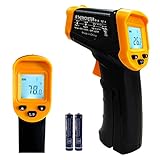
- Temperature measurement range:-50℃-500℃ (-58℉-932℉)Display resolution: 0.1 ℃ or 0.1 ℉
- ℃/℉ conversion selection function
- LCD backlight (convenient for use at night).When backlight is on,any operations will activate the backlight.
- [Data hold]When pull the trigger, LCD display reading with SCAN icon. Release the trigger, display reading with HOLD icon. Built-in 8 sec auto power off function.
- [Emissivity:0.95 preset]Most organic materials and painted or oxidized surfaces have an emissivity of 0.95 (pre-set in the unit). Inaccurate readings will result from measuring shiny or polished metal surfaces. To compensate, cover the target surface with masking tape or flat black paint. Measure the tape or painted surface when the tape or painted reach the same temperature as the material underneath.
The direction of net transfer in a simple two-surface situation is from the hotter surface to the colder one. The colder surface still emits radiation; it does not become a non-radiating object. Net transfer is the hotter surface’s outgoing exchange minus the colder surface’s return exchange.
How does radiation differ from conduction and convection?
| Mode | What carries energy | Does a material medium have to connect the surfaces? | Construction example |
|---|---|---|---|
| Radiation | Electromagnetic waves emitted by matter because of temperature | No; it can cross a vacuum | Heat exchange between a roof and the sky, or across an air gap between window panes |
| Conduction | Microscopic energy transfer through a material | Yes, through a solid, liquid, or gas | Heat moving through a concrete slab, stud, or insulation layer |
| Convection | Energy carried by moving fluid, including air | Yes; the fluid must be present and able to move | Warm air circulating in a room or rising through a ventilated cavity |
These modes are not mutually exclusive. A wall assembly can conduct heat through its layers, convect within a cavity, and exchange radiation between the cavity surfaces. The U.S. Department of Energy’s building-science training describes the modes as concurrent parts of real heat transfer rather than isolated alternatives. DOE Building Science Education: Heat Transfer
How does the Stefan–Boltzmann law work?
Blackbody emission
An ideal blackbody absorbs all incident radiation and emits the maximum possible total power for its temperature. Its total emitted power is:
The Tool Desk
Outbyte PC Repair FREERepair Windows errors before they cause bigger problemsFix Now →Outbyte Driver Updater FREEFix the driver behind crashes, sound loss and screen glitchesFind Drivers →P = σAT⁴
Pis total emitted radiant power in watts.σis the Stefan–Boltzmann constant,5.67 × 10⁻⁸ W/(m²·K⁴)as used in the 2017 NIST model.Ais emitting area in square metres.Tis absolute temperature in kelvins.
The fourth-power term is the important feature. Doubling absolute temperature increases idealized emission by 16 times, not two times. A modest rise in surface temperature can therefore produce a large increase in radiative loss.
Why temperatures must be in kelvins
Do not insert Celsius or Fahrenheit directly into T⁴. Convert first: T(K) = T(°C) + 273.15; for Fahrenheit, convert to Celsius and then add 273.15. A surface at 20°C is 293.15 K, not 20 K. Using a relative temperature scale in the fourth-power law can make a physically reasonable calculation wrong by orders of magnitude.
Rank #2

- 【Highly Accurate & Adjusts to Any Surface】Designed with the latest thermopile sensor technology, the infrared laser thermometer gun is accurate to +/-1.5%; Improve this pizza oven thermometer gun measurements by adjusting the emissivity from 0.1–1.0 to match the surface material being measured
- 【Ultra-Fast Response】With its distance-to-spot ratio of 12:1 and a response time <500Ms, the infrared temp gun thermometer can quickly provide temperature readings of any target, even at great distances
- 【Wide Temperature Range for Multiple Uses】This infrared thermometer gun for cooking utilizes infrared technology to measure temperatures -58°F–1022°F, enabling heat detector to measure surface temp from a safe distance, even above boiling point and below freezing point; This infrared thermometer temperature gun is perfect for food preparation, auto maintenance, home repairs, etc
- 【User-Friendly】By displaying the MAX/MIN/AVG temperature of the last scan, this infrared thermometer cooking is perfect for measuring temps for AC vents or car engines; Griddle thermometer flat surface features a backlit LCD screen that automatically shuts off after 90 seconds of inactivity to conserve battery life
Gray-body approximation
Real surfaces usually emit less than an ideal blackbody. A common engineering approximation multiplies the blackbody result by emissivity:
P = εσAT⁴
Here ε is emissivity, a value between zero and one in the simplified model. An emissivity near one means strong emission relative to a blackbody at the same temperature; a low-emissivity surface emits less in the relevant band and direction. This is an approximation, not a universal material constant. NIST notes that spectral emissivity can vary with wavelength and direction, and that samples may be semitransparent or contaminated. NIST, Spectral Emissivity Measurements
How do two surfaces exchange net radiation?
For two ideal blackbodies exchanging radiation across the same effective area, the DOE handbook gives the simple net expression:
Q̇ = σA(T₁⁴ − T₂⁴)
This assumes the geometry has been reduced to an effective one-to-one exchange. If surface 1 is hotter than surface 2, the result is positive in the chosen direction. Reversing the temperatures reverses the sign; equal temperatures produce zero net exchange even though both surfaces continue to emit.
Illustrative calculation
Consider two ideal black surfaces facing one another over 1 m², with a configuration that allows the simple equation to apply. Let surface 1 be 500 K and surface 2 be 300 K:
Rank #3

- 𝐕𝐞𝐫𝐬𝐚𝐭𝐢𝐥𝐞 𝐓𝐨𝐨𝐥𝐬: Infrared technology allows you to measure various objects at home and outdoors; Use it for 𝒎𝒆𝒂𝒕, 𝑫𝑰𝒀 𝒄𝒂𝒏𝒅𝒚, 𝒐𝒗𝒆𝒏𝒔, 𝒈𝒓𝒊𝒍𝒍𝒊𝒏𝒈, 𝒇𝒐𝒐𝒅, 𝒄𝒐𝒐𝒌𝒊𝒏𝒈, 𝒂𝒖𝒕𝒐𝒎𝒐𝒕𝒊𝒗𝒆 𝒖𝒔𝒆, 𝑨/𝑪, 𝒓𝒆𝒇𝒓𝒊𝒈𝒆𝒓𝒂𝒕𝒐𝒓𝒔, etc.
- 𝐁𝐞𝐭𝐭𝐞𝐫 𝐀𝐜𝐜𝐮𝐫𝐚𝐜𝐲: The Lasergrip's 12:1 𝒅𝒊𝒔𝒕𝒂𝒏𝒄𝒆-𝒕𝒐-𝒔𝒑𝒐𝒕 𝒓𝒂𝒕𝒊𝒐 enables you to accurately measure temperatures from a comfortable distance. For best results, position the thermometer approximately 14.17 inches / 36 centimeters away from the target.
- 𝐄𝐚𝐬𝐞 𝐨𝐟 𝐮𝐬𝐞: Scan the surface of your object, hold down the trigger of the thermometer gun, get temp anywhere within the range of -58°–842°F / -50°–450°C. Then watch as your result appears on the bright LCD display in less than half a second.
- 𝐁𝐫𝐢𝐠𝐡𝐭 & 𝐑𝐞𝐚𝐝𝐚𝐛𝐢𝐥𝐢𝐭𝐲: Each infrared thermometer 𝒇𝒆𝒂𝒕𝒖𝒓𝒆𝒔 𝒂 𝒍𝒂𝒓𝒈𝒆, 𝒃𝒂𝒄𝒌𝒍𝒊𝒕 𝑳𝑪𝑫 𝒔𝒄𝒓𝒆𝒆𝒏, making it easy to read temperatures even in low light. With 2 AAA batteries included, powering up the thermal gun is a cinch.
- 𝐅𝐫𝐢𝐞𝐧𝐝𝐥𝐲 𝐃𝐞𝐬𝐢𝐠𝐧: The new Lasergrip displays 𝒓𝒆𝒂𝒍-𝒕𝒊𝒎𝒆 𝒕𝒆𝒎𝒑𝒆𝒓𝒂𝒕𝒖𝒓𝒆𝒔 𝒃𝒂𝒔𝒆𝒅 𝒐𝒏 𝒕𝒉𝒆 𝒂𝒗𝒆𝒓𝒂𝒈𝒆 𝒐𝒇 𝒕𝒉𝒆 𝒎𝒆𝒂𝒔𝒖𝒓𝒆𝒅 𝒔𝒖𝒓𝒇𝒂𝒄𝒆 𝒂𝒓𝒆𝒂. This means the reading you see reflects the average temperature within the circular area targeted by the infrared sensor — not a single point. It also features a 𝒎𝒂𝒙𝒊𝒎𝒖𝒎 𝒕𝒆𝒎𝒑𝒆𝒓𝒂𝒕𝒖𝒓𝒆 𝒅𝒊𝒔𝒑𝒍𝒂𝒚 for additional insights.
- Surface 1 emission:
5.67 × 10⁻⁸ × 1 × 500⁴ ≈ 3,544 W. - Surface 2 emission:
5.67 × 10⁻⁸ × 1 × 300⁴ ≈ 459 W. - Net exchange:
5.67 × 10⁻⁸ × 1 × (500⁴ − 300⁴) ≈ 3,085 W, or about 3.1 kW.
This is an idealized result: it omits real emissivities, edge losses, intervening surfaces, convection, conduction through supports, and any geometry that prevents all emitted energy from reaching the other surface.
Windows Errors? Fix Them Before They Spread
Repair common Windows errors and clear accumulated junk for a smoother, more stable PC - no reinstall needed.Free scan · no reinstallOutdated Drivers Are Slowing You Down
One free scan finds every outdated or missing driver and matches the right update for your exact hardware.Free scan · exact hardware matchWhat is emissivity, and why does surface condition matter?
Emissivity describes how effectively a surface emits radiation compared with a blackbody at the same temperature. The value relevant to a calculation depends on the wavelength range, viewing direction, temperature, and surface state. Oxidation, paint, roughness, dirt, moisture, coatings, and semitransparency can all change the observed or effective behavior.
Consequently, a single catalog emissivity should be treated as a context-specific input. A value measured for a clean, oxidized metal at one wavelength may not apply to polished metal, a painted finish, or a surface covered by dust. For infrared inspection, reflected radiation from the surroundings can also make a low-emissivity surface appear to have a temperature different from its actual surface temperature.
Why geometry and view factors change the answer
Not every photon leaving one surface reaches the surface you are analyzing. Walls can face one another, recesses can see only part of the opposite surface, and edges can radiate to several surroundings. A view factor, also called a configuration factor, encodes the fraction of radiation leaving one surface that reaches another based on shape, orientation, spacing, and enclosure.
The DOE radiation chapter uses configuration factors in furnace examples where floor and roof temperatures, areas, and their mutual geometric relationship determine exchange. DOE-HDBK-1012/2-92 For real gray surfaces, the net relation includes both emissivity and a configuration factor; treating two surfaces as if they completely face each other can overstate exchange.
Rank #4
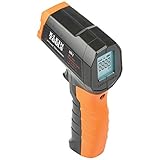
- PRECISE TEMPERATURE MEASUREMENT: Optical resolution (distance-to-spot) of 10:1 ensures accurate temperature readings from a distance
- WIDE MEASUREMENT RANGE: Measure temperatures from -4F to 752F (-20C to 400C), covering a broad range of applications
- ADVANCED FEATURES: Laser targeting, backlit display, auto power off and fixed emissivity
- FIXED EMISSIVITY: The thermometer has a fixed emissivity value of 0.95, providing consistent and accurate readings across different surfaces
- NON-MEDICAL DEVICE: Not intended for use on people or animals, complying with regulations and maintaining clear distinction from medical devices
NIST Technical Note 1958 presents a surface boundary condition that combines convection and radiation:
q″ = hc(Ts − Tg) + σεrΦ(Ts⁴ − Tg⁴)
q″is heat flux at the surface.hcis the convection coefficient.Tsis surface temperature andTgis the surrounding gas temperature.εris the radiative emissivity used in that formulation.Φis the view/configuration factor.- NIST uses
σ = 5.67 × 10⁻⁸ W/(m²·K⁴).
This equation is a particular modeling formulation, not a universal expression for every enclosure, spectral condition, or material. NIST TN 1958
Where radiant heat matters in construction
Building surfaces and occupants
A person exchanges radiation with walls, ceilings, floors, windows, and furnishings. A large, cold window can make occupants feel chilled even when room-air temperature is acceptable because the person’s radiative exchange with that surface is unfavorable. Conversely, warm interior surfaces can improve comfort without raising air temperature by the same amount.
Roof and sky exchange
At night, a roof can radiate energy toward the colder sky. The roof may cool below the surrounding air temperature, changing condensation risk and surface comfort. The net result depends on sky conditions, cloud cover, roof emissivity, wind-driven convection, roof color and coating, and the roof’s view of the sky and nearby obstructions.
Radiant barriers and low-emissivity surfaces
A low-emissivity foil or coating can reduce radiative exchange across an air space, but it does not replace insulation where conduction dominates. Its performance depends on facing an air gap; pressing it against another material removes much of the intended radiative resistance. Dust, oxidation, fasteners, and adjacent surfaces can also alter effective performance.
Best Value

- 🎁【High Accuracy】 DESOMIYE laser thermometer gun adopts the latest high-sensitivity temperature sensor, which can measure the temperature range of -50°C~600°C (-58°F~1112°F) in only 0.5 seconds. For best results, the reader should be 14 inches away from the object.
- 🎁【Wide Range of Applications】Infrared technology makes this temp gun convenient to measure the surface temperature of inanimate objects: cooking, baking, grilling, frozen food, fried food, car repair, completing HVAC projects, plantation, winemaking, water temperature measurement, appliances, etc.
- 🎁【Not Suitable for Humans】 This infrared thermometer gun is an industrial thermometer, it cannot be used to measure body temperature. The reading measured by the temperature measuring gun is the surface temperature of objects and liquids, and cannot measure the internal temperature, so the temperature of people or animals measured will be inaccurate.
- 🎁【Easy to Use】 Simply scan the surface of your object, hold down the trigger of the infrared thermometer gun, and release to get live temperature readings anywhere between -50°C~600°C (-58°F~1112°F).
- 🎁【User-friendly design】 With hold data function, unit switching (°C/°F), temperature calibration range between -3°C ~ 3°C. Each IR temperature gun has a large backlit LCD screen for easy temperature reading even in the dark, and 12 seconds auto-off to prolong battery life so you won't run out of power accidentally.
High-temperature equipment
In industrial equipment, radiation can become a major loss path as surface temperature rises. A historical National Bureau of Standards study reported that, for the processing equipment cases it examined, radiation losses exceeded natural-convection losses around 150–200°F (65–95°C). It reported that above 600°F (315°C), radiation loss was very high and convection could usually be neglected in those described cases. These are application-specific findings from NBS Technical Note 923, not universal design thresholds for every modern assembly.
The same 1976 note gave an example of an iron ingot at 1800°F (982°C) in which only about 65 millionths of the emitted energy was in the visible band. Most emission was outside visible light, which is why a surface can radiate substantial power before it visibly glows.
Independent reader supportYour contribution helps us test, update, and keep practical guides available for everyone.Can an infrared camera measure radiant heat transfer?
An infrared camera detects radiation in a selected wavelength band and converts detector signals into an image or an apparent-temperature estimate. It is useful for finding thermal patterns, locating missing insulation, identifying thermal bridges, comparing surfaces, and documenting inspection conditions. It does not, by itself, report the net heat-transfer rate through a wall or roof.
What’s actually slowing this PC down?
Pick the symptom - the matching free tool is one click away.
Interpretation can be affected by:
- surface emissivity and whether the entered camera value matches the actual finish;
- reflected/background radiation, especially from shiny or low-emissivity surfaces;
- the camera’s spectral response and calibration;
- viewing angle, distance, field of view, and obstructions;
- surface moisture, dirt, coatings, and semitransparency;
- air movement and convection occurring at the same time as radiation.
NBS TN 923 documents industrial thermography and its detectors, while NIST describes a specialized Thermal-infrared Transfer Radiometer for radiance-temperature measurements of extended blackbody sources. NIST Thermal-infrared Transfer Radiometer A radiometer or calibrated radiometric system can measure radiant power or radiance more directly than an ordinary camera, but even that measurement is not automatically a whole-assembly heat-flux measurement.
NIST’s blackbody-calibration work derives radiance temperature from measured radiant power while accounting for aperture geometry and diffraction. NIST Infrared cryogenic blackbody broadband calibration For construction diagnostics, use thermal images as evidence of surface-temperature patterns and combine them with weather data, air temperature, moisture information, material properties, and a heat-transfer model before assigning a heat-flow value.
A practical workflow for a radiant-transfer estimate
- Define the surfaces. Identify which surface emits, which receives, their areas, temperatures, coatings, and whether other surfaces or gases intervene.
- Convert temperatures to kelvins. Do this before any fourth-power calculation.
- Choose the model. Use
σAT⁴only for an ideal blackbody,εσAT⁴for a stated gray-body approximation, or a fuller enclosure model when multiple surfaces and view factors matter. - Set emissivity inputs. Document wavelength range, direction, surface finish, cleanliness, and temperature basis rather than copying an unqualified number.
- Determine geometry. Apply the appropriate view/configuration factors for facing, recessed, angled, or partially obstructed surfaces.
- Add other modes. Include conduction through solids and convection to air or gas where they occur; do not label the radiation term as the total heat flow.
- Check units and scale. Confirm watts, square metres, kelvins, and whether the result is total power or heat flux in watts per square metre.
- Validate measurements. For infrared images, control reflected radiation and camera calibration, and compare the pattern with a physical model or independent temperature measurement.
Common mistakes and how to avoid them
- Using Celsius in the fourth power: convert to kelvins first.
- Assuming the cooler surface emits nothing: subtract its outgoing term when finding net exchange.
- Treating emissivity as a permanent material constant: qualify it by wavelength, direction, finish, and contamination.
- Ignoring view factor: account for the fraction of emitted energy that can actually reach the target surface.
- Calling a thermal image a heat-flux map: an image is radiation-derived and may show apparent temperature, not net watts.
- Assuming radiation is the only mode: combine radiation with conduction and convection in assemblies and equipment.
- Generalizing historical thresholds: the NBS temperature ranges describe the industrial cases in that 1976 note, not every building or process.
What the physics means for design decisions
Radiant exchange grows rapidly with absolute temperature, is reduced by low emissivity, and is shaped by what each surface can see. For a construction detail, the right question is therefore not simply “What is the temperature?” It is “Which surfaces exchange radiation, over what area, with what emissivity, at what absolute temperatures, and with what view factor—and what conduction or convection occurs in parallel?” That framing prevents a low-emissivity product, a thermal image, or a blackbody equation from being applied outside the conditions where it is valid.
Quick Recap
Product prices and availability are accurate as of the date/time indicated and are subject to change. Any price and availability information displayed on Amazon at the time of purchase will apply.

