Free tools Windows power users keep installed
One-click scans. No signup required.
For most renovations, use both source control and the right filtration: isolate the work, exhaust dusty air outdoors when practical, and clean settled dust. Add a portable HEPA air cleaner when dust is concentrated in one room or the home has no forced-air HVAC. Use a MERV 13 (or the highest compatible) central filter when a ducted system can safely accept it and the fan can run for extended periods. Heavy demolition or sanding may require an industrial portable HEPA unit inside a negatively pressured work zone.
Portable or whole-house: the short answer
A portable purifier cleans the room where it sits. A central HVAC filter can clean air throughout the connected duct system, but only while the blower operates and only if the equipment can handle the filter’s airflow resistance. Neither option contains dust at its source. During construction, containment, local exhaust, ventilation and prompt cleaning remain the primary controls.
As an Amazon Associate I earn from qualifying purchases.
| Situation | Best starting point | Why |
|---|---|---|
| One bedroom, basement or other isolated room under renovation | Portable HEPA unit sized by clean-air delivery rate (CADR) | It concentrates filtration where emissions are highest without changing the whole HVAC system. |
| Several occupied rooms served by one forced-air system | MERV 13 central filter, or the highest rating the system will accommodate | The return-air system can treat air from multiple ducted rooms while the fan runs. |
| Renovation room is isolated but occupants need cleaner air elsewhere | Containment plus a portable unit in the work area and compatible HVAC filtration for the rest of the home | Each device covers a different airflow path. |
| Demolition, drywall sanding or other high-emission work | Enclosed negative-pressure zone, source exhaust and industrial portable HEPA filtration | Residential room units may not move enough air for a construction zone. |
| No forced-air HVAC | Portable units in occupied areas, with containment and outdoor exhaust where feasible | There is no central duct network to carry filtered air. |
Portable air cleaners are designed for a single room or area, according to the U.S. Environmental Protection Agency (EPA). Central filtration is a whole-home option only for rooms connected to the ducted system; a room with no supply or return path will not receive the same benefit.
What each type can—and cannot—do
Portable HEPA air cleaners
A portable unit draws room air through a filter and returns cleaner air to that same room. Its useful capacity is expressed as CADR, normally in cubic feet per minute (cfm). A higher CADR moves and cleans more air, but it does not automatically make a unit suitable for a larger or open-plan space. Doorways, high ceilings, leaks in containment and the location of the unit all reduce the effective cleaning rate.
#1 Best Overall

- WHY CHOOSE AHAM VERIFIDE AIR PURIFIERS: AHAM (Association of Home Appliance Manufacturers) is an ANSI-accredited organization that sets strict standards for appliance performance. Air purifiers with the AHAM VERIFIDE seal have been independently tested for air cleaning performance and energy efficiency. When you choose an AHAM certified air purifier, you're choosing a product trusted for reliable and effective indoor air quality improvement
- HIGH-PERFORMANCE AIR PURIFICATION: A powerful 56W high-torque motor and 143 CFM CADR delivers fast, effective cleaning. The Levoit Original Filter is HEPA-grade while operating in Sleep Mode (Based on IEST RP C001.7). Ideal for home, bedroom, or office
- AHAM VERIFIDE, PROVEN PERFORMANCE: AHAM VERIFIDE with a CADR (Clean Air Delivery Rate) rating of 143 CFM for smoke, 153 CFM for dust, and 167 CFM for pollen—refreshing air in a 222 ft² room 4.8 times per hour and a 1,073 ft² room once per hour
- GENUINE REPLACEMENT FILTERS: For the best performance and longest lifespan, use official Levoit filters designed specifically for Levoit air purifiers. Levoit replacement filters ensure the best fit and high-efficiency filtration, while off-brand filters may be unreliable and may damage your Levoit air purifier
- FIND COMFORT: Our filter has strong filtration performance of fine particles. 99.97% filtration efficiency for 0.1 to 0.3μm airborne particulates, including pollen, dust, and animal dander allergens. Tested by an independent lab
Use a portable unit when the work is confined to one room, when occupancy is localized, or when there is no forced-air system. Place it where it can draw from the dusty part of the room without blocking the intake or exhaust. If the room is under negative pressure, keep the purifier inside the enclosure so it recirculates and filters the zone rather than pulling contaminated air into the rest of the home.
Whole-house HVAC filtration
A central filter sits in the return-air path and treats air whenever the blower circulates it. EPA guidance says to select at least MERV 13, or as high a MERV rating as the system will accommodate. CDC/NIOSH likewise advises upgrading central HVAC filter efficiency to MERV 13 or better for improved air cleanliness.
The filter cannot clean air while the fan is off. It also does not capture dust before it enters the return, and it cannot protect a room that is not connected to the ductwork. A filter with greater efficiency can also create more pressure drop. That may affect equipment operation, energy use and humidity control, so confirm compatibility in the equipment documentation or with a qualified HVAC professional before installation.
Recommended Free Tools
Industrial portable HEPA units
Construction-zone air scrubbers are built for higher airflow and harsher loading than ordinary occupied-room purifiers. CDC construction guidance identifies portable industrial-grade HEPA units capable of approximately 300–800 cubic feet per minute and calls for selecting equipment that provides an equivalent of at least 12 air changes per hour (ACH) for specified construction-zone applications. Those figures are construction-control guidance, not a universal requirement for every household room.
Industrial units are appropriate when demolition or sanding produces dust faster than a small room purifier can remove it, when the work zone must remain under negative pressure, or when the unit will be connected to ducting for exhaust. They are not automatically suitable for an occupied room: follow the manufacturer’s instructions for exhaust, electrical load, noise, filter loading and safe placement.
Why filtration is only one layer of dust control
Construction dust is generated at the tool, settles on surfaces and can migrate through gaps, clothing and pressure differences. Filtration addresses airborne particles after they are in the air. It does not stop a saw, sander or demolition activity from generating dust, and it does not remove settled material from floors, ledges, registers or furniture.
Rank #2

- Effortless Operation: Simplified control panel with intuitive design makes it easy to operate. No complicated setup—just one tap, and you're on your way to cleaner air, saving time and letting you relax with ease
- Compact Yet Powerful: Covers up to 1,076 ft² while maintaining a compact size of just 6.69 x 6.69 x 9.84 inches. Its small frame makes placement a breeze—whether on your desk or in a corner, it's ready to work hard wherever you need it (Laboratory Tested: Our air purifier efficiently cleans 250 ft² every 15 minutes, covering up to 1,076 ft² per hour)
- 360° Airflow & High Efficiency Filtration: The elegantly engineered 360° surround air intake, coupled with the sophisticated a triple-layer filtration system, meticulously captures an astounding 99.97% of airborne pollutants, transforming your living space into a sanctuary of purity and vitality
- Quiet with Essential Oil Option: Operates as quietly as 22dB, perfect for undisturbed sleep. The built-in essential oil tray lets you add 3–5 drops to infuse your space with soothing scents while enjoying purified air
- Fully Certified: Backed by DOE, ETL, FCC, CARB, CE, and ROHS certifications, our air purifier meets the highest standards for performance, giving you peace of mind with every use
- Contain the source. Close the work area with a properly sealed barrier and control openings used by workers. Keep doors closed when practical.
- Maintain appropriate pressure. For dusty work, use a controlled negative-pressure enclosure so air flows into the work zone rather than out toward occupied rooms.
- Exhaust outdoors when feasible. Local exhaust at the tool or an industrial unit ducted outside can remove contaminants instead of recirculating them.
- Filter the remaining air. Use a correctly sized portable HEPA unit, compatible central filtration, or both.
- Clean deliberately. Remove settled dust with the cleaning method specified in the project’s safety plan before reopening the area. Do not rely on a purifier to pick up visible debris.
EPA and CDC guidance describe air cleaning as a supplement to source control and ventilation, not a replacement for containment, exhaust or cleaning.
Crashes, No Sound, or Screen Glitches?
Random freezes, missing sound and display glitches usually trace back to one bad driver. Find and replace yours safely.Free scan · under a minuteWindows Errors? Fix Them Before They Spread
Repair common Windows errors and clear accumulated junk for a smoother, more stable PC - no reinstall needed.Free scan · no reinstallHow to size a portable purifier by CADR
Start with the room’s floor area and ceiling height. EPA’s 2022 room-sizing table gives these CADR estimates for an 8-foot ceiling:
| Room area | EPA CADR estimate | Equivalent room volume at 8-foot ceiling |
|---|---|---|
| 100 square feet | 65 cfm | 800 cubic feet |
| 200 square feet | 130 cfm | 1,600 cubic feet |
| 300 square feet | 195 cfm | 2,400 cubic feet |
| 400 square feet | 260 cfm | 3,200 cubic feet |
| 500 square feet | 325 cfm | 4,000 cubic feet |
| 600 square feet | 390 cfm | 4,800 cubic feet |
These are sizing estimates, not a promise that every model will deliver the same airflow at every fan setting. A purifier’s advertised CADR may be measured under a particular test condition, while the unit in a dusty room may slow as its filter loads. For a renovation, use the manufacturer’s stated CADR for the unit’s intended particle test and choose a capacity that matches the actual enclosed volume.
A practical sizing method
- Measure the work room’s length and width, then multiply by the actual ceiling height to obtain cubic feet.
- Compare that volume with the EPA area estimates, adjusting upward when the ceiling is higher than 8 feet.
- For an open doorway or connected space, size for the full volume that can exchange air with the work room, or close and seal the opening instead.
- Prefer a unit with a published particle CADR and a genuine HEPA designation. If a listing gives only a marketing airflow figure, treat the capacity as unverified.
- Run the purifier continuously during dusty work and for the period specified in the project’s dust-control plan afterward. Use a lower setting only when noise or occupancy requires it and the resulting airflow remains adequate.
CADR is not the same as the fan’s raw airflow. It represents the rate of cleaned air delivered after accounting for particle removal. A unit with a large fan but no published particle CADR cannot be compared directly with one that reports CADR.
How to choose and run a whole-house HVAC filter
Select the highest compatible MERV rating
Choose MERV 13 when the furnace or air handler is designed for it; if the system cannot accommodate MERV 13, use the highest compatible rating rather than forcing a restrictive filter into the cabinet. Check the filter dimensions, airflow arrow and the cabinet’s maximum recommended pressure drop. A filter that does not fit tightly can allow dusty air to bypass the media.
Do these 3 things before closing this tab:
1Fix the driver behind crashes, sound loss and screen glitches2Clear out junk files and repair common Windows errors3Scan for outdated or missing drivers - takes under a minuteVerify the system before changing the filter
- Check the equipment manual or manufacturer data for approved filter ratings and pressure-drop limits.
- Confirm that the filter rack accepts the intended thickness; substituting a thicker filter can obstruct the cabinet or leave gaps.
- Ask an HVAC professional to evaluate an older or marginal blower, especially if the system already has weak airflow, icing or overheating symptoms.
Use the fan deliberately
The HVAC filter works only when the blower is moving air. A fan setting that runs continuously or for long circulation periods increases filtration time, but it also uses more electricity and can affect heating, cooling and humidity control. During construction, balance the need for circulation against the equipment maker’s operating limits and the comfort of occupants. A central filter is not a substitute for isolating the dusty room; it should not be used to pull large quantities of uncontained construction dust through the home’s return system.
Rank #3

- 𝐇𝐢𝐠𝐡𝐞𝐫 𝐀𝐢𝐫 𝐈𝐧𝐭𝐚𝐤𝐞 & 𝐋𝐚𝐫𝐠𝐞𝐫 𝐂𝐨𝐯𝐞𝐫𝐚𝐠𝐞 𝐟𝐨𝐫 𝐏𝐞𝐭 𝐋𝐨𝐯𝐞𝐫𝐬: This air purifier for home pets is designed with a larger front air inlet and wider dual-side air inlet, which can pull air from multiple sides and trap airborne pet hairs and odors more easily. Engineered to tackle the wildfire smoke, floating ash, and heavy smog, this high-performance air purifier creates a safe haven indoors, keeping your indoor air fresh during severe air quality alerts
- 𝐒𝐦𝐚𝐫𝐭 𝐏𝐌𝟐.𝟓 𝐀𝐐𝐈 𝐃𝐢𝐬𝐩𝐥𝐚𝐲 & 𝐀𝐮𝐭𝐨 𝐌𝐨𝐝𝐞: Built-in high-precision PM2.5 air quality sensor, real-time monitoring and digital display of indoor air quality. In Auto Mode, the purifier automatically ramps up to higher speed the moment it detects incoming wildfire smoke or household odors, ensuring no-hassle, round-the-clock purification.
- 𝐖𝐚𝐬𝐡𝐚𝐛𝐥𝐞 𝐏𝐫𝐞-𝐅𝐢𝐥𝐭𝐞𝐫 & 𝟑-𝐒𝐭𝐚𝐠𝐞 𝐃𝐞𝐬𝐢𝐠𝐧: Equipped with a high-efficiency 3-stage filtration system, the air cleaner can capture micro-sized airborne particles, including harmful PM2.5 particulates, dusty combustion ash, seasonal pollen, and pet dander. Cleaning the pre-filter helps save your daily replacement cost and extend the life of the HEPA filter. More activated carbon pellets help absorb unpleasant odors
- 𝟒 𝐒𝐩𝐞𝐞𝐝𝐬 𝐚𝐧𝐝 𝐓𝐢𝐦𝐞𝐫𝐬 & 𝐄𝐧𝐞𝐫𝐠𝐲-𝐒𝐚𝐯𝐢𝐧𝐠: The room air purifier has 4 adjustable fan speeds. You can choose the fan speed according to the air quality. The higher the wind speed, the faster the purification speed. When you are out or resting, you can set the air purifier to automatically shut off after 2/4/6/8 hours to reduce energy costs. Running at maximum wind speed for 24 hours only consumes 0.63 kW·h of electricity
- 𝐐𝐮𝐢𝐞𝐭 𝟐𝟎𝐝𝐁 𝐒𝐥𝐞𝐞𝐩 𝐌𝐨𝐝𝐞 𝐟𝐨𝐫 𝐋𝐢𝐠𝐡𝐭 𝐒𝐥𝐞𝐞𝐩𝐞𝐫𝐬: Choose our quiet air purifier for bedroom. Noise is as low as 20dB in sleep mode. Low noise, low speed and no lights make it perfect for a good night's sleep. Even light-sleeping babies or pets can enjoy fresh and clean air on quiet nights
Construction-zone requirements for heavy dust
When emissions are high, create a dedicated work zone rather than trying to clean the entire house after dust has escaped. Seal penetrations and maintain negative pressure with a properly selected exhaust or HEPA unit. Keep supply and return openings arranged so air moves from cleaner areas toward the work zone and then through the filter or exhaust path.
Using the CDC airflow figures
CDC guidance for specified construction-zone applications cites industrial portable HEPA equipment in the approximate 300–800 cfm range and an equivalent of at least 12 ACH. ACH is calculated from airflow and room volume:
ACH = (airflow in cfm × 60) ÷ room volume in cubic feet
Quick wins for a faster PC:
Scan for outdated or missing drivers - takes under a minuteDriver Scan →Repair Windows errors before they cause bigger problemsFix Now →Fix the driver behind crashes, sound loss and screen glitchesFind Drivers →To plan for a 12-ACH target, rearrange the relationship:
required cfm = (room volume × 12) ÷ 60
For example, a sealed 12-by-10-foot room with an 8-foot ceiling is 960 cubic feet; 12 ACH corresponds to 192 cfm mathematically. If the application calls for an industrial unit, select equipment according to the complete construction plan, including leakage, exhaust configuration and filter loading, rather than buying solely on the calculated number. The CDC’s 300–800 cfm range applies to the specified construction uses in its guidance.
Occupied-room versus active-zone equipment
An occupied-room purifier is designed for people living in the space and is normally recirculating. A construction air scrubber may be louder, draw more power, use a larger filter and be intended to exhaust outdoors or maintain pressure in an enclosure. Read the operating instructions before placing industrial equipment in a living area, and keep combustion appliances, extension cords and exhaust routes safe.
Rank #4
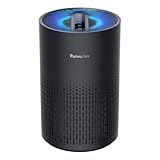
- Cleaner Air In Minutes: Purivortex is proven to filter common pollutants from your home’s air. This air purifier purifies rooms up to 880 ft² in one hour. It can purify a 215 ft² room in about 15 minutes, giving you noticeably fresher air in a short time. Breathe clean, crisp air and feel the difference in your space. (*Tested in an ISO 17025 certified laboratory under typical residential room ventilation conditions.)
- Breathe Easier with 99.97% Filtration: Purivortex HEPA air purifiers for home feature a powerful 3-layer filtration system — a pre-filter, HEPA filter, and activated carbon—that filter up to 99.97% of pollutants, including dust, smoke, pollen, pet dander, and VOCs. Purivortex air filters filter out particles as small as 0.1 microns, while the carbon filter helps reduce light household odors from smoke, pets, and cooking.**(**Independently tested in an ISO 17025 laboratory.)
- Bigger Filter, Better Purification: Purivortex goes beyond the standard—while most purifiers of this size use a 4 inch filter, Purivortex air filters stand tall at 6 inches. That’s nearly 1.5× larger, pulling in more air and delivering cleaner results, faster. Filter made of FSC-Certified paper, sourced from responsibly managed forests, ensuring both high performance and care for the environment.
- Backed by Science, Trusted by Standards: Purivortex air purifiers are rigorously tested to deliver powerful purification performance. Certified by ETL, FCC, and CARB for safety and energy efficiency, and verified through independent SGS laboratory testing to prove their effectiveness. With Purivortex, you get science-backed confidence in every breath.
- 2 Years of Guaranteed Confidence: Purivortex stands behind the quality and performance of every purifier, which is why Purivortex air purifiers come with a full 2-year warranty. More than 500,000 families have already chosen Purivortex for cleaner, fresher air. With added convenience features such as 3 timer settings (4H/8H/12H), 4 fan modes (Sleep/Low/Med/High), and 4 night light modes (Multicolor, Blue, Green, Purple), Purivortex delivers comfort tailored to your lifestyle.
When combining portable and central filtration makes sense
| Renovation pattern | Configuration | Key operating rule |
|---|---|---|
| One closed room, occupants elsewhere | Negative-pressure enclosure plus portable HEPA unit inside; MERV 13 HVAC filter if compatible | Keep the enclosure sealed and prevent the central return from becoming the dust pathway. |
| Several rooms open to one central system | Contain each active area as much as possible; use compatible central filtration and portable units where people spend time | Run the HVAC fan only within equipment limits and do not rely on it to replace barriers. |
| Home without ducts | Portable units in occupied rooms and an industrial unit for the work zone when needed | Control transfer through doors and temporary barriers because there is no central filter. |
| Demolition or prolonged drywall sanding | Industrial HEPA unit sized for the enclosed zone, local exhaust and supplemental portable units outside the zone | Use the industrial setup to control the source; outside units protect occupied areas. |
Combining systems is useful because the devices serve different air paths. The portable unit treats the room in which it is placed; the central filter treats air that enters the return duct; containment keeps either system from being overwhelmed.
Step-by-step setup for a renovation
- Map the airflow. Identify the work room, adjacent occupied rooms, HVAC supply and return grilles, doors, windows and likely leakage paths.
- Choose the control level. For light, localized work, a correctly sized portable HEPA unit may supplement barriers. For demolition or sustained sanding, plan an enclosed negative-pressure zone and industrial filtration.
- Seal and isolate. Install the barrier before dusty work starts. Keep the work-zone door closed and route worker traffic so dust is not carried into clean areas.
- Install central filtration safely. Fit the MERV 13 filter, or the highest compatible rating, with the airflow arrow pointing toward the equipment. Do not use a filter that exceeds the system’s approved pressure drop.
- Position portable equipment. Place the intake where it can draw contaminated room air and leave clearance around the intake and outlet. Keep cords and equipment out of walkways and away from wet processes.
- Start filtration before generating dust. Establish the intended pressure and airflow first, then begin cutting, sanding or demolition. Keep the system operating for the cleanup period specified by the project plan.
- Inspect during the work. Watch for loss of airflow, a loaded filter, barrier movement, unusual equipment noise or dust escaping the enclosure. Stop and correct the control rather than continuing with a compromised setup.
- Clean and reopen methodically. Remove visible dust using the project’s approved procedure, verify that adjacent areas are clean, and only then dismantle barriers.
Will a HEPA purifier remove drywall dust?
It can remove airborne drywall particles that pass through the purifier, provided the unit has adequate particle CADR, is placed in the dusty room and runs long enough. It will not collect dust that has already settled, stop particles released outside its intake zone, or compensate for an open doorway that lets contaminated air leave the room. Drywall sanding therefore calls for source capture and containment first, with HEPA filtration as the airborne-control layer.
As the filter loads, airflow can fall. Inspect the unit according to its instructions and replace the filter when the manufacturer’s indicator or the project’s maintenance procedure calls for it. There is no single replacement interval that applies to every construction job; dust generation, run time and filter size determine loading.
DIY MERV 13 filter-fan cleaners
EPA describes a MERV 13 filter-fan cleaner as a documented supplemental option. The basic concept is a box fan paired with a properly fitted MERV 13 filter so room air is pulled through the filter and cleaner air is discharged back into the room.
- Use a filter and fan combination that is mechanically stable and correctly oriented; the airflow arrow on the filter should point toward the fan.
- Seal obvious gaps between the fan and filter so air does not bypass the media.
- Keep the assembly upright, unobstructed and away from moisture, heat sources and trip hazards.
- Inspect the filter frequently during construction because loading can reduce airflow.
- Treat the assembly as supplemental filtration, not as a replacement for a sealed work zone, outdoor exhaust or industrial equipment when the application requires it.
A homemade cleaner does not have a standardized CADR unless it has been tested as an assembly. Do not assume that a fan’s advertised airflow equals clean-air delivery through a loaded MERV 13 filter.
What’s actually slowing this PC down?
Pick the symptom - the matching free tool is one click away.
Common failure modes and fixes
| Symptom | Likely cause | Corrective action |
|---|---|---|
| Dust appears in the hallway or adjacent rooms | Barrier leakage, open door or pressure moving air out of the work zone | Seal openings, keep the door closed, verify inward airflow and add appropriate exhaust or HEPA capacity. |
| Portable unit runs but visible dust remains airborne | CADR is too low for the room, the unit is poorly positioned or the filter is loaded | Re-size by room volume, improve placement, inspect the filter and use a higher-capacity unit when necessary. |
| Central HVAC airflow becomes weak after installing a higher-MERV filter | Filter pressure drop exceeds what the equipment can handle, or the filter is loaded | Check the approved rating and pressure-drop data, install the correct size, and obtain professional evaluation if airflow problems persist. |
| Dusty room is not improving even though the HVAC fan is on | The room is not connected to the duct path or the fan is not actually circulating air | Use a portable unit in that room and verify the blower operation; do not assume whole-house filtration reaches unducted spaces. |
| Noise causes occupants to turn the purifier off | High airflow setting is uncomfortable in an occupied room | Use a quieter setting only if its CADR remains suitable, add capacity with another unit, or schedule the loudest operation when the room is unoccupied. |
| Air has an ozone smell or the device advertises ionization | Non-filtration air-cleaning features may be operating | Prefer mechanical filtration and follow the manufacturer’s safety information; do not add ozone-generating features to a construction-control plan. |
Filter maintenance during construction
Construction loads filters much faster than ordinary household dust. Establish an inspection routine before work begins. Check portable and central filters for visible loading, confirm that airflow has not fallen, and keep replacement filters available. Follow each manufacturer’s replacement indicator or maintenance instructions rather than relying on a calendar interval.
When handling a loaded filter, prevent the captured dust from being shaken back into the room. Bag or dispose of it according to the project’s waste and safety requirements. If a filter becomes damaged, wet or loose in its frame, stop using it until it is replaced and the airflow path is sealed.
Quick Recap
Decision checklist
- Is the dust confined to one room? Start with containment and a portable HEPA unit sized by CADR.
- Does the home have a ducted system serving the occupied rooms? Use MERV 13 or the highest compatible rating, and operate the fan within equipment limits.
- Can the work zone be enclosed and kept under negative pressure? Do that before relying on any purifier.
- Does the task generate sustained heavy dust? Evaluate industrial portable HEPA equipment in the CDC-referenced 300–800 cfm class and the applicable ACH target.
- Are occupants sensitive to noise or airflow? Add capacity or schedule higher settings instead of turning the only unit off.
- Is there an ozone or ionization feature? Choose mechanical filtration unless a qualified safety review supports another technology.
- Are filters loading rapidly? Increase source control and airflow capacity, and follow a more frequent inspection and replacement routine.
Product prices and availability are accurate as of the date/time indicated and are subject to change. Any price and availability information displayed on Amazon at the time of purchase will apply.

