Do these 3 things before closing this tab:
1Clear out junk files and repair common Windows errors2Fix the driver behind crashes, sound loss and screen glitches3Repair Windows errors before they cause bigger problemsThe reliable way to check your property’s drainage is to compare the intended layout with what is physically installed, then confirm any suspected connection with a controlled dye, smoke or CCTV test. Stormwater from roofs, downspouts and foundation drains should follow the stormwater route, while toilets, sinks, showers and laundry should reach the sanitary wastewater system—unless your municipality specifically operates a combined sewer. A confirmed wrong-way connection should be reported to the local utility and corrected by a licensed professional.
What a correct connection looks like
In a separated drainage system, two networks perform different jobs. Stormwater is rain and snowmelt collected from roofs, downspouts, foundation drains, yard drains, driveway catch basins and similar surfaces. Sanitary wastewater is water from toilets, bathroom sinks, showers, kitchens, laundry and other indoor fixtures. Each flow should discharge to the corresponding public main or to an approved private drainage arrangement.
As an Amazon Associate I earn from qualifying purchases.
A cross-connection occurs when a stormwater source is tied to the sanitary sewer, when sanitary wastewater is routed to the storm system, or when a pipe defect allows either flow to escape or enter the wrong place. A storm-to-sanitary connection can overload the wastewater network during rain and contribute to backups. A sanitary-to-storm connection can send untreated wastewater toward a ditch, creek, lake or other receiving water. The exact remedy and deadline depend on local bylaws and the design of the public system.
Do not assume every street has separate mains. Some older districts have combined sewers, and some properties use private drainage fields, holding tanks or other arrangements. Ask the municipality or utility whether your street has separate storm and sanitary mains, a combined sewer, or a private system before interpreting a test result. Hamilton’s guidance, for example, distinguishes combined sewers from separated storm and sanitary systems; the same observation can mean something different under each design.
#1 Best Overall

- [4.3IN HD SCREEN&16GB DVR]The SYANSPAN Sewer Camera comes with a 4.3-inch HD screen,providing clear and accurate visuals for inspections.This inspection camera with light is equipped with a digital video recorder (16GB DVR) and includes a 16GB TF card,allowing easy storage of captured images and videos for later review.Perfect for reliable and efficient sewer inspections
- [HIGH LIGHT LED&DETECT 33FT UNDERWATER]The drain camera features 12 powerful,adjustable LED lights,providing excellent illumination for clear observation in any environment.This endoscope camera with light is IP68 waterproof and includes a durable cable with a cable pusher reel,allowing it to easily navigate tight spaces and bends in pipes.The high-flex metal spring ensures smooth passage through curved areas,making your inspection more convenient and efficient
- [8-10H COLD-RESISTANT BATTERY]This borescope camera is equipped with a powerful 10000mAh battery that lasts up to 8-10 hours on a full charge,perfect for extended use.The inspection camera supports power banks and performs reliably in cold winter conditions,making it ideal for outdoor inspections.[8-10H COLD-RESISTANT BATTERY]This borescope camera is equipped with a powerful 8500mAh battery that lasts up to 8-10 hours on a full charge,perfect for extended use.The inspection camera supports power banks and performs reliably in cold winter conditions,making it ideal for outdoor inspections
- [33FT-164FT FIBERGLASS CABLE]:The plumbing camera features a durable,waterproof,and corrosion-resistant fiberglass cable.With a built-in distance counter,this borescope camera with light allows you to easily track the cable length and pinpoint problem areas.The included cable reel ensures convenient storage and smooth deployment,making inspections more efficient and hassle-free
- [APPLICATION&AFTER SALES]Perfect for both home and industrial use,this borescope inspection camera meets the needs of plumbers,contractors,inspectors,engineers,municipal workers,and other professionals.It efficiently inspects hard-to-reach areas such as wastewater systems,stormwater systems,various pipelines,drains,and ducts.If you have any questions,feel free to contact us for one-on-one guidance from our engineers
Establish the intended layout before opening a pipe
Ask the utility or municipality
Request the information that is available for your address: the location of public storm and sanitary mains, known service laterals, cleanouts, inspection chambers and any private-lateral inspection requirements. Ask whether the municipality requires prior notice, permits, approved dye, public notification for smoke testing or a licensed contractor. A utility map may show the public connection but not every privately installed branch, so treat it as a starting point rather than proof of the internal layout.
Collect property records
Look for as-built drawings, plumbing permits, sewer-lateral reports, drainage plans, renovation invoices and inspection reports. Compare those records with the current building. Pay particular attention to older homes, finished basements, additions and basement-bathroom projects. Hamilton identifies partial cross-connections created during renovations or basement-bathroom additions as a recurring configuration to investigate. A permit drawing can show the intended route even when the buried pipe is no longer visible.
Locate every access point
Find the sanitary and storm cleanouts, outdoor inspection chambers, catch basins, manholes that you can legally access, downspout outlets, sump-pump discharge, foundation-drain cleanouts, yard drains and driveway drains. Photograph each location and mark it on a simple sketch. Record whether a cleanout cap is present and intact. Halifax Water warns that damaged or missing caps can admit stormwater and debris into a wastewater lateral even when no deliberate cross-connection exists.
Perform a dry-weather visual inspection
Walk the entire exterior while there is no recent rainfall. Follow every downspout from the gutter to its termination. Classify the outlet as a splash block, surface discharge, swale, buried line, storm connection or an unknown route toward the foundation. A downspout that disappears underground is not automatically wrong; it may feed an approved storm connection or infiltration system. The missing information is where that buried line ends.
Inspect foundation drains, window-well drains, patio drains, pool or hot-tub drains, yard inlets and driveway catch basins. Note any pipe that enters the foundation, a basement floor, a sanitary cleanout or an interior drain. Check for standing water, unusual odors, damp soil, erosion or staining around outlets, but do not treat those signs alone as proof of a cross-connection.
Rank #2

- 【2026 Upgraded Cable Reel Unlock System】:Unlock & lock in just 1s with a simple twist. No more stuck cables or sore hands—coil or release with ease! Unlike market designs sewer camera that leave you struggling with two tiny, hard-to-turn screws—difficult to adjust and tighten properly—one wrong move could lead to cable jams or even permanent damage. Ours comes with all-around upgrades (stability, compatibility, flexibility, security, durability), overcoming many common Weaknesses on the market.
- 【Faster Identify Issues – HD 1080P Camera with 7" IPS Screen】:The sewer camera has a true HD 1080P lens and a bright 7" IPS screen, helping you identify issues faster with a clear view inside pipes. The 16× zoom lets you see small details like cracks, clogs, and rust. Unlike older 1000TVL pipe camera with dark TFT/LCD screen, it shows clear, bright images that make spotting problems easy. Checking your pipes often helps you find leaks early and reduce costly damage to walls, floors, or ceilings.
- 【Record More Videos-DVR with 32GB Card】:This sewer pipe camera lets you view and record in real time with instant playback—no extra devices needed, it helps you quickly identify pipe issues.The 32GB memory card offers more storage than typical 8GB cards. so you can record more videos with your sewer inspection camera, allowing for thorough and accurate analysis.MORE,Easily transfer videos via SD card or USB-C. Save records, share findings, and review footage on your PC with ease.
- 【So Easy, Anyone Can Use It — 8H+ on a Single Charge】:This sewer camera is easy to use—Unlock and lock the cable reel in just 1 second with a simple twist, making it easy to coil or release the cable. Just plug& play the display, and you’re ready to go — no complex setup required.The cable is marked in feet, so you know exactly how deep the issue is—no guesswork. The built-in 5000mAh battery lasts over 8 hours. Need more time? Plug into a power bank (not included) via USB-C, even while in use.
- 【For Most Pipeline Environments—IP68 Waterproof HD Camera】:① The IP68-rated camera head works in wet, dirty, or flooded pipes.② Six adjustable LED lights (3 levels) let you see clearly in dark, deep pipes—so you can spot cracks or blockages fast.③ Comes with 25mm (0.98 in) and 84mm (3.31 in) sleeves to handle small or large pipes.④ A flexible stainless steel spring tip helps navigate bends and corners without getting stuck.
Check the sump pump discharge while the pump is running. It may send water outdoors, to a storm connection, to an approved infiltration area or into a laundry sink, floor drain or other sanitary fixture. A hose terminating in a sink is not by itself evidence of an illegal connection; the question is whether the permanent discharge arrangement complies with local rules and whether the receiving drain is sanitary or storm.
Inside the building, inventory basement bathrooms, floor drains, laundry sinks, utility sinks and plumbing installed during extensions. Trace visible piping where possible and look for abandoned lines, capped branches and recent penetrations through the foundation. A renovation can leave an old foundation drain connected to a sanitary branch while a newer drain follows the storm route, creating a partial cross-connection that is invisible from the street.
Repeat the inventory after a moderate rainfall if it is safe. Observe where water actually flows, but never enter a flooded chamber or open a manhole. Rain can reveal a blocked outlet or a pump discharge that is not obvious in dry weather; it can also make a dye or camera test harder to interpret, so use wet-weather observations to plan testing rather than as the sole confirmation.
Choose the confirmation method
| Method | Best use | What it can establish | Main limitation |
|---|---|---|---|
| Visual inventory and records | Finding likely sources before testing | Presence and apparent routing of downspouts, sump discharge, cleanouts and renovation plumbing | Buried or undocumented connections can remain hidden. |
| Dye test | Testing one suspected connection on an individual property | Whether dyed flow reaches an unexpected sewer, cleanout, manhole or outfall | Requires access, suitable observation points and coordination; colour can be difficult to see in fast, dark or submerged flow. |
| Smoke test | Finding roof- and foundation-drain inflow and some hidden connections | Where smoke exits and which openings communicate with the tested line | It does not detect every illicit discharge and can alarm occupants if notice is inadequate. |
| CCTV/video | Locating a lateral route, structural defect or visible junction | Breaks, roots, deterioration and accessible connection points | Requires equipment and access; non-flowing or submerged discharges may not be visible. |
How to perform a controlled dye test
Dye testing is a tracing exercise, not a one-step proof that every pipe on the property is correct. A tester adds a small amount of non-toxic, water-soluble coloured dye to one selected source and watches the expected storm and sanitary access points. If the colour appears in the other system, the result indicates a suspected cross-connection. Campbell River describes the same principle: dye follows water, and an unexpected appearance in a sanitary sewer, waterway or other location can indicate a cross-connection, leak or pipe defect.
- Plan the test with the utility. Tell the utility what source you intend to test, where the dye may emerge and when you will observe it. EPA illicit-discharge guidance recommends reviewing sewer maps, obtaining property access and coordinating with other agencies so dye released to a storm drain is not mistaken for a pollution incident.
- Select one source. Use a single downspout, catch basin, foundation-drain cleanout, sump discharge or interior fixture at a time. Do not add dye to several locations simultaneously; you will lose the ability to identify the route.
- Record conditions. Write down the source, dye colour, approximate amount, time, weather, pump status and all observation points. Photograph or video the access points before and during the test.
- Introduce the approved dye. Follow the utility’s product and quantity instructions. Use only a dye identified as non-toxic and water-soluble for the intended drainage system. Never pour chemicals, solvents or unknown products into a drain to make the route easier to see.
- Observe both systems. Watch the relevant storm inlet, sanitary cleanout, inspection chamber, manhole or approved outfall for the period specified by the tester. Keep people and pets away from open access points and do not enter a confined space.
- Record the outcome. Note where colour appears, when it appears and whether the observation is definite, faint or inconclusive. A storm-source dye appearing in a sanitary sewer is the classic cross-connection result identified by Surrey; sanitary-source dye appearing in a storm drain or waterway is the reverse-direction warning.
- Repeat only as a separate test. Flush or wait as directed, then test the next source independently. Mixing colours or sources makes the record difficult for a contractor or utility to use.
No visible colour does not automatically prove separation. Flow may be too high, the receiving pipe may be submerged, the dye may be diluted, an access point may be distant or the source may be blocked. Ask the tester whether a different observation point, a slower flow condition or CCTV is appropriate.
Rank #3
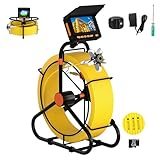
- [ Sewer Camera Snake Inspection Camera With Light ]: Waterproof 1080P HD,stainless steel plumbing camera can capture clear images. With flexible spring for inspecting a 90°or bigger bends. The built-in 12pcs bright LED lights will shine the dark pipe,drain,sewer,duct,wall to be clearly visible. You can adjust the drain camea light on the compact screen.
- [ 0.9‘’ Borescope For 1.5'',2'' or Bigger Pipe Inspection ]: With 110°wide viewing angle ,the 23mm plumbing sewer camera can go into a 25mm straight or bigger pipeline to scope and capture the inner images for plumber. A 1.5'' protective cover and a 3.5'' roller guide wheel come with the sewer inspection camera,and they will protect it from scratches. With the guide wheel, the sewer pipe camera can run into a 90mm or above pipe more easily.
- [ 32GB Video Recording Screen and 8500mA Battery]: The sewer camera screen with a 360° rotatable fix mount and flip sunvisor are for better inspection. A 32GB card comes with this 4.3'' HD screen for recording clear and more sewer drain inspection videos. A 8500mA rechargeable drain camera battery in this screen can provide energy for about 6 hours.
- [ Cable with Meter + Feet Marks,Newly Upgraded Spool with Brake and Buffering] :The plumbing sewer camera and the 5mm semi rigid cable are all snake.We print length marks 'M and FT'on the 200FT cable.So you can see how far the pipe drain camera went into the wall,duct,pipe or sewer.The special cable spool will rotate when the cable is moving.So easy to pull the cable out and push it back.Equipped a brake hook and Buffering clip for controling the yellow cable.
- [ User-friendly and Versatile ] : Everyone can use it,no complex operation.Plumber, homeowner, construction and municipal worker can use the pipe sewer camera to detect blockage/damage in water pipe,sewer or wall;Mechanics can use the sewer drain inspection camera with light to inspect the internal condition of air conditioning/vehicle.You can also use it to retrieve item that fallened into gap or narrow crevice.This sewer drain camera can reach many place that people cannot see or go to.
When smoke testing is useful
During a smoke test, a qualified crew blows smoke through a sewer line and its laterals. Smoke emerging from a roof downspout, foundation drain, cleanout, yard opening or other location can reveal an improper connection, an open joint or a broken pipe. King County describes smoke testing as a way to identify broken pipework and improperly connected roof and foundation drains.
Smoke testing needs advance communication. Smoke can enter buildings through dry traps, missing cleanout caps, floor drains or plumbing defects, and residents may mistake it for a fire. Ask the utility or contractor what notices, trap priming and ventilation steps are required. Keep vulnerable occupants, pets and anyone with respiratory concerns away from the work area unless the responsible authority gives specific safety instructions.
A negative smoke result has a narrow meaning: smoke did not emerge at the locations and under the conditions observed. EPA guidance lists incomplete detection as a limitation, so a clean smoke test does not establish that every discharge is correctly routed. Dye or CCTV may still be needed for a buried, submerged or intermittently used connection.
Use CCTV to locate the route or defect
A sewer camera can travel through an accessible lateral and show the pipe’s route, condition and visible junctions. It is especially useful after the visual inventory identifies a cleanout or after dye or smoke suggests a particular branch. King County lists breaks, root intrusion and deterioration among the findings a camera can reveal; Brantford and Vaughan use CCTV in lateral and sanitary-sewer investigations.
Ask the operator for a continuous recording, an annotated sketch or footage showing the camera’s distance from the access point, pipe diameter and observed junctions. A useful report identifies the direction of travel, clock-face position of defects, approximate depth where available and whether the camera reached the public main. Keep the access-point location with the video so another contractor can interpret the footage.
What’s actually slowing this PC down?
Pick the symptom - the matching free tool is one click away.
Rank #4

- 【Real 1080P High Definition Waterproof Lens】 Drain camera Equipped with a 1080P full HD camera and high brightness LED lighting, providing sharp and clear real-time images. IP68 waterproof and dustproof design, can penetrate deep into damp and greasy pipelines, without fear of water stains and dirt, allowing cracks and blockages to be visible
- 【100 FT Ultra Long Cable】The snake camera equipped with a 30 meter (approximately 100 feet) high toughness semi-rigid cable. It can easily penetrate into hard to reach areas such as long pipelines and large tanks, and detect blind spots at deep distances. Cable tape distance scale markings help you accurately locate problem points and improve detection efficiency
- 【5-inch Large Screen Real-time Display】 The 5-inch DVR high-definition display screen supports real-time viewing and synchronous recording.The plumbing camera equipped with a built-in 32GB storage card, it can take photos/videos with just one click, save detection evidence, facilitate subsequent analysis, generate reports, or share with customers
- 【Integrated Portable Tool Box】 The inspection camera system adopts that the host combine together with an orange sturdy tool box innovatively, make it easy to store and ready to use. All accessories (such as lenses, hooks and so on.) can be stored in an orderly manner in the box to avoid loss and facilitate easy carrying to any work site, achieving ready to use upon opening the box
- 【Widely Compatible】 Pipe camera made of sturdy shell design, durable and long-lasting. Widely used in various industrial and household scenarios such as pipeline dredging, house inspection, and automobile maintenance. KCapyn pipe snake is an efficient and economical choice for professionals and DIY enthusiasts
CCTV cannot see what is not in the camera’s field of view. A non-flowing discharge may leave no visual trace, a submerged section can obscure a junction and a blocked or collapsed pipe may stop the camera before the relevant connection. EPA guidance identifies those limitations. A camera inspection also does not authorize excavation or prove that an unseen branch does not exist; it establishes what the accessible run shows.
Interpret the evidence
| Observation | Most useful interpretation | Next action |
|---|---|---|
| Storm-source dye reaches the storm system and indoor-wastewater dye reaches the sanitary system | Routing is consistent with a separated system at the tested points. | Keep the test record; investigate any untested source separately if concerns remain. |
| Storm-source dye appears in a sanitary cleanout or manhole | Suspected storm-to-sanitary cross-connection. | Stop treating the result as a DIY diagnosis; send the record to the utility and a licensed plumber or sewer-lateral contractor. |
| Sanitary-source dye appears in a storm drain, ditch or waterway | Suspected sanitary-to-storm cross-connection or a leak. | Notify the utility promptly and prevent further discharge if the authority gives safe temporary instructions. |
| Smoke exits from a roof or foundation drain | The tested sewer line communicates with that opening; the cause may be an improper connection, open trap or broken pipe. | Confirm with records, dye or CCTV before selecting a repair. |
| Dye appears in soil, a waterway or another unexpected location | Possible leak, failed joint, broken lateral or cross-connection. | Have the line located and inspected; do not assume the public system is the only source. |
| CCTV shows a crack, roots or deterioration without a visible wrong-system junction | Structural failure may be allowing inflow or outflow even if routing is correct. | Obtain a professional repair recommendation and retest after work. |
Document the source, colour, time, weather, pump status, access points, observations and video file name. A precise record helps the utility distinguish a confirmed wrong-way connection from a pipe defect or an inconclusive test.
Independent reader supportYour contribution helps us test, update, and keep practical guides available for everyone.What to do after a suspected or confirmed cross-connection
Contact the right authorities
Give the local utility or municipality the test record and ask what reporting, inspection and repair rules apply. Surrey states that identified cross-connections must be corrected promptly under its bylaws. Hamilton operates a formal private-lateral inspection program. Those examples illustrate why the required process varies by jurisdiction; do not rely on another city’s deadline or permit rule.
Use a qualified professional
A licensed plumber, drainage contractor or sewer-lateral specialist can isolate branches, expose buried pipe safely, install an approved reroute, cap an abandoned connection, repair a failed joint or arrange a permitted connection to the correct main. The professional should verify the proposed repair against the utility’s standards before excavation. An inexpensive camera or dye kit may help you identify an accessible section, but it does not replace professional access, interpretation or repair when the line is buried, shared or near a public main.
Recommended Free Tools
Protect the system while waiting
Do not disconnect a pipe and leave wastewater or pumped water flowing onto the ground. Do not block a required sanitary drain, cover a cleanout permanently or discharge contaminated water into a storm inlet. Ask the utility for temporary measures that suit the property and the suspected direction of flow. If sewage is surfacing indoors or outdoors, keep people and pets away, avoid contact with contaminated water and follow local public-health instructions.
Best Value

- ◆5-inch HD display with DVR◆ The Sewer Cameras features a 5-inch HD 1080p display, delivering exquisite clarity inside pipes and effortlessly identifying issues within plumbing and drainage systems. The built-in DVR system supports instant video recording and high-definition photo capture, with a 32GB TF card included for viewing live footage and saving video clips and photos. You can document inspections and review footage through the pipe system.
- ◆17MM HD 1080P Camera◆ The Sewer Pipe Inspection Camera best to fit for pipes at 50 -200mm (2 - 8 inch), camera with super flexible spring can easily go through 90° bend pipes at 200mm (8-inches), in order to get a better viewing, we also provide 25mm protective cover to make the camera can easily enter the middle of bigger pipes.
- ◆IP68 Waterproof&Night Vision◆ This Drain Pipe Cameras has grade IP68 waterproofing and it can work in the 10 meters underwater. Equipped 6pcs high light adjustable white LEDs and 140°viewing angle,the inspection camera can easily view live video at any time and anywhere. This plumbing camera equipped with 5000mAh Rechargeable Li-ion Battery,it support 6-8 hours working time per fully charge.
- ◆Sewer Camera 100 ft◆ Pipe Inspection Camera with 100 feet (30 m) Semi-Rigid Fiberglass Cable, 5mm in diameter, featuring a digital length counter, this sewer inspection camera lets you easily track distances during inspection. Portable reels included make storage and handling of cables convenient.
- ◆Extensive Applications◆ The Industrial Endoscope is suitable to inspect the pipeline, sewer, air duct, tank, underwater and others dark environment, check the internal cracks, corrosion, weld, plugs and other unusual circumstance. Buy a Drain Sewer Industrial Endoscope today to avoid tomorrows plumbing problems.
Verify the correction
After repair, obtain photographs, an updated sketch, invoices and any permit or inspection sign-off. Repeat the appropriate dye, smoke or CCTV check as directed by the utility. Test each branch that was altered, not just the section that was easiest to access. Keep the final record with the property documents so a future renovation does not recreate the same uncertainty.
Common situations and how to troubleshoot them
“My downspout disappears underground.”
That description identifies a buried section, not its destination. Locate the downstream cleanout or outlet through records, professional tracing, dye or CCTV. Do not infer that the line is sanitary merely because it enters the foundation area, or storm merely because it began at a roof.
“The sump pump drains into a laundry sink.”
Determine whether the sink is connected to the sanitary system and whether local rules permit that arrangement. The pump may instead be required to discharge outdoors or to an approved storm or infiltration system. Ask the utility before rerouting it; an improvised hose can create flooding or a new prohibited connection.
Free tools Windows power users keep installed
One-click scans. No signup required.
“The dye did not show anywhere.”
Check that the selected source received water, the observation points were correct, the dye was visible under the lighting and flow conditions, and the test was not diluted by a submerged or high-flow pipe. Have the utility or tester choose a closer access point or use CCTV. Treat an unobserved result as inconclusive, not as confirmation of correct routing.
“Smoke came into the basement.”
Leave the area if anyone feels unwell, ventilate as directed and notify the crew. Smoke may have entered through a dry trap, missing cap or building defect rather than proving that a roof drain is connected to the wrong main. Record the exact entry point and have the plumbing professional inspect it.
“The camera stopped before the street.”
A blockage, collapse, root mass or submerged section may be preventing access. The footage still identifies a condition requiring attention, but it cannot establish the route beyond the stopping point. Ask about cleaning, a second access point, locating equipment or a controlled excavation.
“The street has a combined sewer.”
In a combined system, stormwater and sanitary flows may intentionally share a public main. That does not automatically make every private connection acceptable: private piping must still comply with local standards, prevent sewage discharge to the environment and avoid damage or surcharge. Obtain the municipality’s written interpretation before changing a connection that may be part of an approved arrangement.
The Tool Desk
Outbyte PC Repair FREERepair Windows errors before they cause bigger problemsFix Now →Outbyte Driver Updater FREEFix the driver behind crashes, sound loss and screen glitchesFind Drivers →Safety and environmental precautions
- Never enter a manhole, wet well, catch basin or other confined space without a trained confined-space team and the required atmospheric monitoring and rescue plan.
- Do not remove a manhole cover or open a public structure without permission.
- Keep children and pets away from dye, open cleanouts, sewage, storm outlets and testing equipment.
- Use only products approved by the utility for tracing. Never combine dyes with cleaners or disinfectants.
- Notify occupants before smoke testing, prime traps when instructed and follow the contractor’s ventilation directions.
- Photograph and label every observation, but do not handle suspected sewage without appropriate protective equipment and hygiene controls.
- If wastewater may be reaching a waterway, contact the utility promptly rather than attempting to flush or conceal the evidence.
A practical decision checklist
- Confirm whether the property is served by separate storm and sanitary mains, a combined sewer or a private system.
- Gather plans, permits, lateral reports and renovation records.
- Map downspouts, sump discharge, foundation and yard drains, cleanouts, inspection chambers and interior fixtures.
- Inspect visually in dry weather and photograph each outlet and cap.
- Choose one suspected source and coordinate a dye, smoke or CCTV test with the utility or a qualified professional.
- Record the test conditions and distinguish an expected result, a wrong-system result, a structural defect and an inconclusive result.
- Report a suspected cross-connection and follow the jurisdiction’s inspection, permit and repair requirements.
- Have the repair completed by a qualified professional and retain the drawings, footage, invoices and verification test.
The central rule is simple: identify where each source is intended to go, observe where it actually goes, and treat any unexpected destination as a matter for the utility and a licensed professional. Visual inspection narrows the possibilities; controlled testing establishes communication between pipes; CCTV explains the physical defect that must be repaired.
Quick Recap
Product prices and availability are accurate as of the date/time indicated and are subject to change. Any price and availability information displayed on Amazon at the time of purchase will apply.

